

John Sweeney and Will Benedict Win Three Bridge Fiasco
Was AI the winning ingredient for the winners of the Three Bridge Fiasco? Michael Moradzadeh wrote in our February issue “Will AI Win the Pacific Cup?” Before Saturday’s unusually breezy Three Bridge Fiasco, John Sweeney asked Grok for a suggested strategy for the race, and it served him well. He and Will Benedict followed the strategy and won the J/105 class aboard Advantage3 against 15 other J/105s on the course. Who else asked AI for a 3BF strategy? Grok’s Three Bridge strategy is at the end of this story.
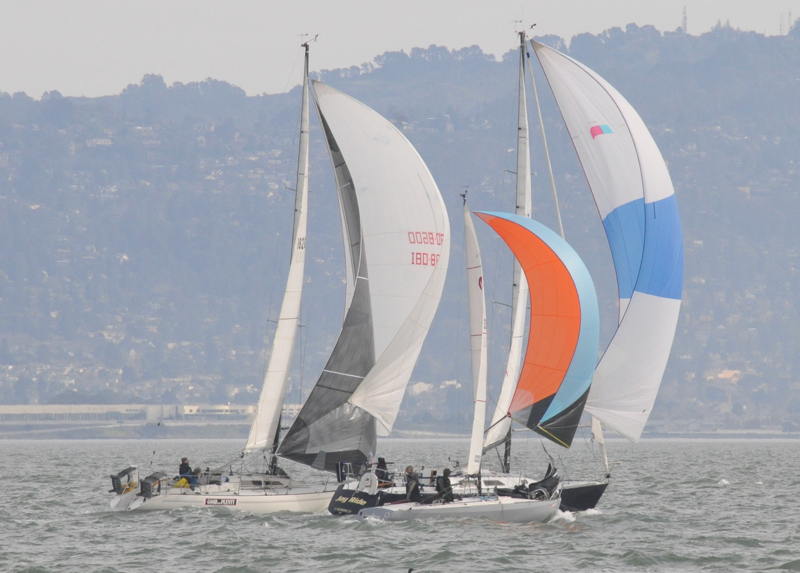
John Sweeney wrote, “I finally won the Three Bridge Fiasco! I sailed one maybe back in ’99 on Yucca; we won crewing for Hank in place of Rob Moore but first time skippering! We sailed Will Benedict’s J/105 Advantage3 in honor of Pat Benedict, a founder of the J/105 fleet, who passed away recently. Will also won it in 2019 with his son Jayden driving so he’s won it twice in [the] last decade as tactician/crew. Both on his J/105.”
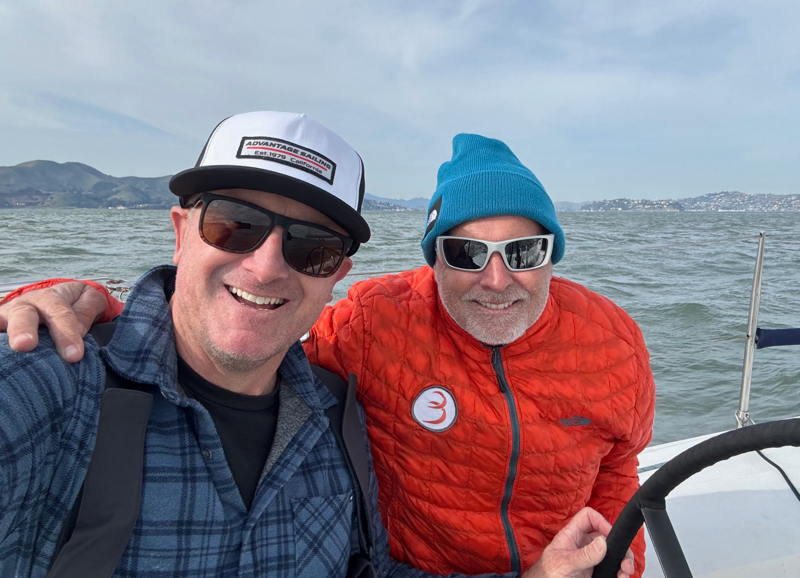
Zach Berkowitz, who won the J/99 and J/100 combined division with Chris Steinfeld, tells us, “There’s a reason the Three Bridge Fiasco brings out more boats than any other regatta in the Bay Area, let alone in the United States, because it‘s FUN. You can put endless hours of thought into preparing for the race, but [at] the end of the day, it’s all about how you react and modify your plan according to what Mother Nature serves up at start time.”
We were sorry to be sidelined this year with a recovering rotator cuff, as it looked like one of the better years in a while. There was enough breeze to overcome a very strong ebb, so almost all the boats finished by 3 p.m., with most finishing between 2 and 3 p.m. The frequent light-air events mean there are often many DNFs, but not this year. Most boats started and completed the event, so the 2–3 o’clock hour was a busy one on the Golden Gate race deck. At least they weren’t sitting waiting for the last boats to finish before the 7 p.m. deadline.
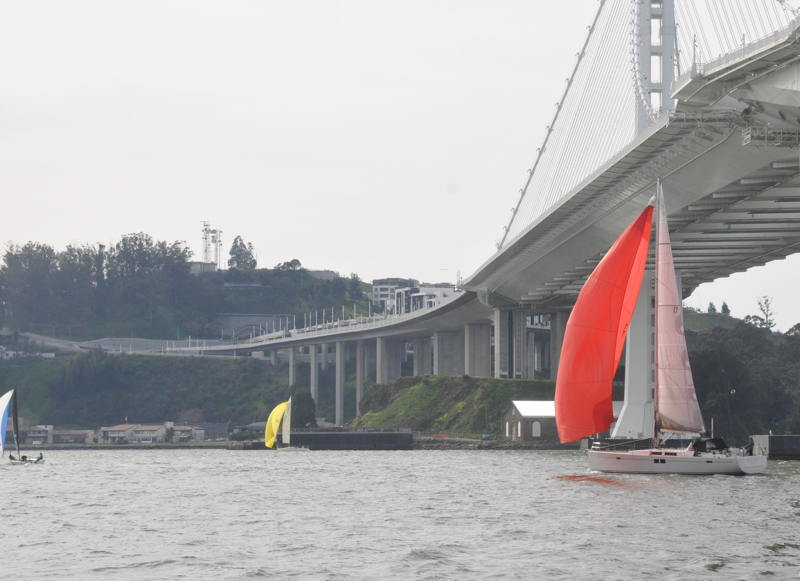
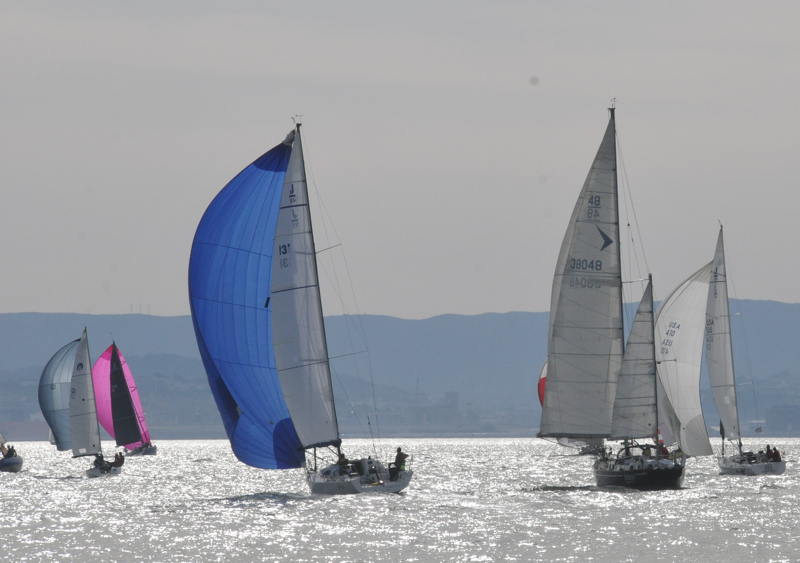
The forecast was for winds of 5–8 knots, but much of the race was sailed in 10 knots with reported top true wind speeds of 15–18 knots. The fleet split in two primary directions, with many heading west to go clockwise down Crissy Field to knock off Blackaller early and then headed to Red Rock, while the other big group headed through Raccoon Strait for Red Rock first, planning to save Blackaller for last. That meant most boats were rounding Yerba Buena to starboard, which, with a NE wind, was easier than in most years. (This is the opposite of “The Perfect Daysail.”)
Randy Gridley aboard his Sabre 38 MkII Aegea shared a perspective from his tour of the Bay. “We joined the fleet of boats heading to Red Rock first. This got us around the island before the ebb built. Most boats made it around Yerba Buena with little difficulty. The ebb from Yerba Buena added considerably to the speed to finish, or Blackaller for those who still needed to round that mark (we saw 9–10 kts SOG from YB to Blackaller and 20 kts apparent wind, so it was a sleigh ride!).”
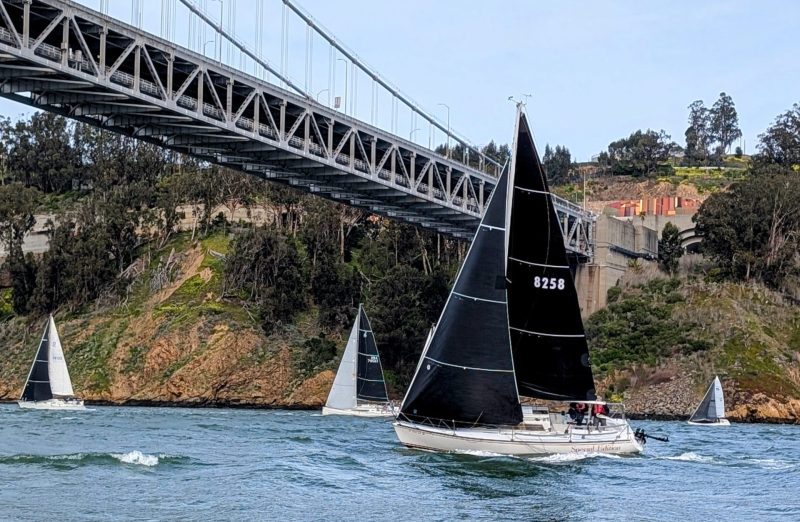
We asked Fred Paxton for his winning strategy for his Alerion 28 Zenaida, and he replied, “The winning strategy: staying between Chris and Denise Kramer on Sweet De and Mike Quinn on Resilience and the finish line. [Resilience finished just 9 seconds behind Zenaida!] We all went to Red Rock first and got around at slack water. I also want to thank the race committee, a cast of dozens, who did a great job of getting everyone on their way and results Sunday morning.”
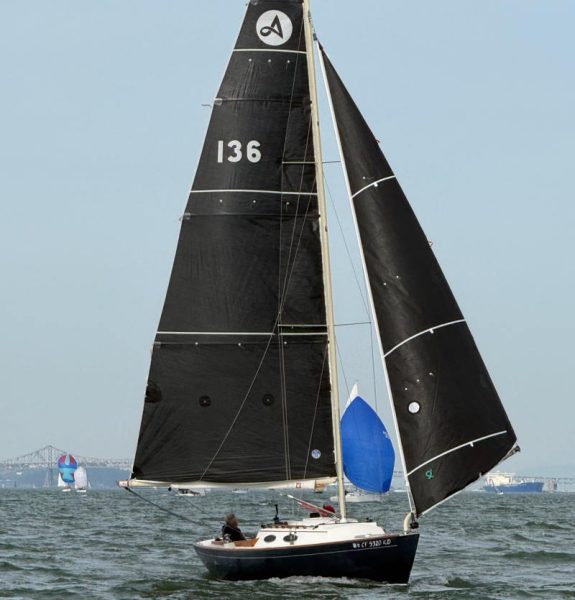
Most of the winning happens on the water, but boat preparation, a good strategy and a bit of luck are always in play. For the pre-race strategy, John Sweeney, asked his AI buddy, Grok, for some input. Grok responded to Sweeney’s prompt with a very thorough answer. “That’s a clever twist leveraging the tidal shear in light conditions, John — going west to Blackaller first along the Cityfront shore where the early ebb kicks in sooner post-high tide (around 9:30 a.m. at 6.8 ft, with slack ~11:23 a.m. before the ebb builds to 3.3 kt max mid-afternoon). In the light NE winds (5–8 kt early morning, easing to 3–5 kt by afternoon per NWS and other forecasts), that shore-hugging leg west could be a beam reach or close reach, with the slight ebb on the beach giving you a free push against any lingering channel flood — minimizing VMG loss in the zephyrs while the fleet slugs it east or north.
“Round Blackaller to port (counterclockwise for the buoy) to stay in the shore relief and avoid the accelerating channel flow initially. At ~11 a.m. rounding, you’re right at the tail end of the flood in the deep channel (still pushing east ~1–2 kt weakly before slack), so tacking out mid-Bay post-rounding sets you up for that assist.
“From there, I’d pivot to Red Rock next (northeast ~6–7 NM) over Yerba Buena — hug the Marin shore (Sausalito to Point Stuart) for early ebb relief in the shallows, where the current reverses sooner, turning what could be a slog against the building Bay-wide ebb into a manageable close-hauled leg in the NE breeze. Past races in similar light air/early ebb show this CCW route (Blackaller → Red Rock → Yerba Buena) pays off by knocking out the northbound against-current leg while the ebb is still weak (~1–2 kt opposition if you hit it by noon), rather than saving it for later when it’s ripping 3+ kt and parking boats. Round Red Rock counterclockwise (port) to minimize bridge eddy exposure and align for the down-current run south.
“Then south to Yerba Buena (~5 NM) with the strengthening ebb in your favor — NE wind makes this a broad reach or run, flying the kite if you’ve got one, and the current slingshot keeps you moving even if the breeze fades. Round Yerba Buena clockwise (starboard) to use the island’s wind shadow less and avoid north-side eddies in ebb. From there, the final westbound push to the finish rides the full ebb tailwind, on a reach in any persisting NE.
“This flips our earlier CW plan but fits your shore-channel play perfectly in these conditions — avoids the afternoon parking lot at Yerba Buena that doomed many in past light-air Fiascos. If the NE holds stronger than forecast or you see the fleet bunching north, swap to Yerba Buena second (east downwind with channel flood remnants), but that risks the Red Rock leg in peak ebb — watch the leaders for tells. Either way, prioritize current over wind in light air; safe racing!”
Grok did pick the winning direction, though it suggested rounding Blackaller counterclockwise and called the Blackaller, Red Rock, Yerba Buena direction the “CCW route,” which is bass-ackward. But you have to consider Grok is still a beginner at racing the Bay. Did anyone else ask AI? We wonder if there was any difference among Grok, Gemini, ChatGPT, Claude or racestrategist.ai. It is, of course, fine to consult AI before a race, but the racing rules would disallow that help as outside assistance if you consulted it during the race.
And just so you know, the race was sailed and run by humans. A note from the race committee said, “The race committee is very proud of all the racers that finished the notoriously difficult Three Bridge Fiasco this year. And also proud of those who did not finish, but came out and tried it. We all grow by trying and practicing hard things, and a 21 NM midwinter tour of San Francisco Bay is a fun way to grow — alongside 300 other boats.
“The race would not have happened without a large team of volunteers. We had 22 people scheduled across three 5.5-hour shifts, and almost half the team worked multiple shifts. Some worked all day. If you enjoyed the race and ever see someone wearing a Fiasco Volunteer shirt, please thank them.”
Congratulations to John Sweeney and Will Benedict in the J/105, Advantage 3. But the first two finishers in the 3BF were Bottle Rocket, a Seacart 30 sailed by David Schumann and Trevor Baylis, and the Corsair F-27 Papillion, sailed by Drew Scott and his son, Kenji. All three vessels sailed a great race, and all deserve credit.
Congrats, all three! In Rhapsody, second monohull to finish just behind Advantage3, we also bagged Blackaller first. Most boats who did that then headed for Raccoon Straits. But when we reached the river of late flood through the center of the Golden Gate Bridge, we tacked to port and sailed fat to Blunt, then rode the late flood up to Red Rock. Maybe Advantage3 made the Straits work, but for me and my brother Anthony, heading to Blunt put us ahead of most who head through the Straits.
There were 294 monohulls entered and 10 multis (Ross was on one). I congratulated my good friend and great sailor, Dave Schumann. I’m also the first to say we monohulls couldn’t keep up with Bottle Rocket’s 16-18 knots (into the ebb!) to round TI first, or her similar speed (per Race Replay) from Red Rock to Blackaller. It is notable, only two multis finished before the monos. Great sailing. Great race committee work. We’re in debt to the 3BF volunteers.
The 3BF is the best race. It sure has been a long time since I won the SH division in 84 on Svend Svendsen’s “Svendle” That was my first single-handed race! I won the 3BF again a few years later, but I can’t remember which year that was. You always remember the first time…;-)