

Is the America’s Cup Being Run Illegally?
Bay Area sailor and recent Three Bridge Fiasco winner John Sweeney recently posted his view on the current iteration of the America’s Cup on yacht designer Julian Everett’s Facebook page. Sweeney speaks his mind:
The America’s Cup is not merely a sport in decline. It is operating outside the Deed of Gift that governs its existence.
Since the demise of the International America’s Cup Class (IACC) at the 2007 Valencia regatta, the Cup has careened into a high-speed, foiling spectacle. Some celebrate it. Most sailors do not. But aesthetics and nostalgia are not the real problem.
The real problem is legal: The current holder of the America’s Cup is running the event in material violation of the Deed of Gift, and the New York courts — the only courts with jurisdiction — have a duty to intervene.
I intend to ask them to do exactly that.
THE DEED OF GIFT IS NOT OPTIONAL
The America’s Cup is not owned by a federation, a commercial rights holder, or a media company. It is governed by a trust instrument — the Deed of Gift — enforced for more than 170 years by the New York courts.
It has been modified before. But it has never been abandoned.
Among its core requirements are:
• Racing in yachts that comply with specified waterline limits
• Racing without stored power or engines
• Racing on a windward–leeward or triangular course
• Racing on an arm of the sea within a defined distance of the winning club’s location
• Yachts propelled solely by sailors
Today’s foiling craft fail these requirements on multiple levels.
I will not disclose every element of my legal action here. But one fact is undeniable: Foiling yachts do not comply with the minimum racing waterline requirements as clarified by New York courts, nor do they comply with the Deed’s prohibition on stored and assisted power.
Flying above the water is not “sailing” as contemplated by the trust.
WHO I AM – AND WHY THIS MATTERS
I am not a casual critic.
I trimmed the main on America True and Oracle BMW Racing. I later funded my own campaign — the Sausalito Challenge — for the 2007 cycle, which ultimately evolved into Shosholoza. From 1999 to 2007, my partner Tina and I purchased and restored four IACC yachts and ran a vintage challenge series out of the Sausalito Yacht Club.
That series attracted serious teams. Larry Ellison joined with USA-61 and USA-76. The momentum ended when Alinghi and Oracle shifted focus to the commercial Moët Cup concept.
I have spent my life inside the America’s Cup ecosystem — as a sailor, a syndicate founder, and a steward of its history.
This is not theory. It is lived experience.
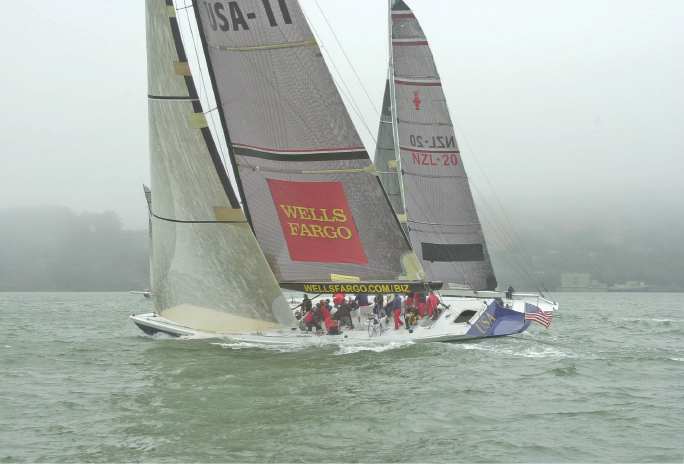
WHAT THE CUP WAS MEANT TO BE
The original America’s Cup envisioned large, demanding monohulls — closer in spirit to the J-Class than to aircraft. Yachts sailed by crews of 25–30. No engines. No batteries. No flight control systems.
Just sailors.
Racing was meant to be grueling. Tactical. Human. Conducted on recognizable courses that rewarded seamanship and endurance.
Today, the Cup is sailed by pilots managing systems — not crews sailing boats.
Speed alone is not the violation. Structure is.
THE LEGAL LINE THAT WAS CROSSED
The most direct violation — and the one that brings the event squarely back under New York jurisdiction — concerns racing waterline length.
Foiling yachts circumvent waterline limits by removing displacement from the equation entirely. The New York courts have already spoken on minimum waterline standards in prior Deed litigation.
Foiling did not amend those rulings. Marketing did not amend the trust. Commercial success does not supersede law.
Additionally:
• Races are not held on Deed-compliant courses
• Stored energy systems assist control and propulsion
• The competition is effectively sold and rewritten by the defender
That is not how trusts work.
THE SOLUTION: A MODERN, DEED-COMPLIANT CLASS
My petition will not merely challenge. It will propose.
I will ask the court to enforce a 90-ft maximum waterline monohull class, sailed by approximately 30 crew, with:
• No engines
• No stored power
• No assisted control systems
• Deed-compliant courses
• Racing held within a 50-mile radius of the winning club
Not retro. Not nostalgic. Modern — but lawful.
A class that blends the majesty of J-Class with the discipline of IACC. Aluminum or alloy behemoths. Brutal. Punishing. Spectacular in a way that sailing is meant to be.
“TEAM NEW ZEALAND DOESN’T WANT THAT”
That argument fails historically.
In 2007, I was the chosen Challenger of Record contingent upon Team New Zealand’s winning the Cup. My lawyer and I were present to execute the agreement. Together, we developed a 90-ft waterline concept — precisely the hybrid class now being ignored.
What changed wasn’t feasibility.
It was commercialization.
A FINAL WORD
The New York Yacht Club has a responsibility here. Silence is acquiescence.
The America’s Cup does not belong to flying machines, sponsors, or television formats. It belongs to sailors — and to the law that created it.
Someone has to enforce that law.
Absolutely correct. I am a long term sailor at 78 and have watched this “evolution ” with horror and then distain. What those boats do is not sailing…it’s foiling. They can’t sail in super light air, then can’t sail in wind above, I believe, 18 knots. They are not only not within the Deed but the violate the spirit of sailing which is sailing through the water, not skimming above it. I am sure I am not the only person who use to look forward to the Cup races, and be glue to the TV watching them , who now ignores the entire scene. Good luck with the suit.
Thank you for your thoughts ! Totally agree !
Hear, hear, John!! However, in this day and age, where it’s capital, and corrupt insiders, uber alles, getting the NYYC to prosecute your well-reasoned complaint is about as likely as getting Pam Bondi to go after oranjboi for violating the Emoluments Clause.
What a “bless your heart”
Comment.
I am fully in on this notion – Americas Cup sailing should be basic, monohull, no electronics sailing. Mostly up to the skill of the sailors. The multihull speed boats can exist, just not as “Americas Cup” boats. They can be their own group.
While the legalities mentioned may be correct, and I don’t dispute them, the old AC was boring. Slow.
The new foiling series is exciting, fast and above all entertaining.
And thus far appears also to be commercially viable, which the old version was not.
By all means pursue a legal challenge.
If you win, good luck with setting up a new version of the old style event.
It will no doubt go back to being a race between billionaires and even then not guaranteed any TV coverage or opportunity for revenue for the organiser.
If you win it may simply be a pyrrhic victory.
Nostalgic sailors will rejoice no doubt, but the rest of the world has already moved on.
Other classes of racing have adopted foils, and no doubt more will follow.
Bit the historic classic wooden J Class boats have a few races mainly in the Med, so nostalgia is also a potential attractor of eyeballs.
Good luck! You’re going to need it!
“Go back to being a race bewteen billionaires”? And what exactly is it now? Some kind of “everyman” equal playing field romp that anyone can join? Developing and racing a modern America’s Cup (AC75) foil boat typically costs well over $100 million USD for a competitive campaign. The America’s Cup has devolved into NSCAR on the water and the typical weekend club racer can’t even begin to identify with what the foil “boats” (and I use that term loosely) are doing. At least with the old “boring” America’s Cup–which indeed, unless you were a racing sailor could be akin to watching paint dry (except for the occassional sketchy mark rounding when it was more like watching the paint catch on fire and burn down the house) the weekend club racer–and weekend cruiser–could understand what was going on and even may be apply something he or she saw to their own sailing bag of tricks.The America’s Cup doesn’t need to be “must see T.V.” It doesn’t need to make prime time on ESPN. What it needs to do is honor its deed of gift.
I disagree with Mark. I found the monohull races far more interesting. I used to follow the multi-hull races but no longer do so. I was on a sailboat years ago when the Americas Cup was in San Francisco with the foiling multihulls. Watching the races from that standpoint was boring. I saw the foils for a minute or two and then they were gone. I haven’t seen a monohull Americas Cup race in person so I can’t compare. Watching on TV, the monohull boats are far more interesting. I don’t know about legalities but I fully agree with John.
It ends up being horses for courses. Or sailboat classes for race legs. While I acknowledge and accept there is a certain degree of nostalgia for the ‘old’ 12m AC monohulls, once the ‘hoodoo’ of the NYYC was broken and Australia II took the ‘Cup’ home to Perth, the ‘tradition’ was broken, and people other than the NYYC began to look at alternatives.
Remember the mismatch beteen the 120′ Kiwi boat and Dennis Connor’s speedy catamaran…???
Before casting aspersions, remember who started the whole ‘catamaran’ thing. Ahem.
If the case is won, and the allegations upheld, I can’t see the ‘modern’ foiling race series disappearing.
They may no longer be able to award The Auld Mug, but an alternative will soon be produced.
So while the current foilling teams require big dollars, it is at least a commercial proposition, with the race set up, spectator grandstands and commercial sponsorships the TV coverage now attracts.
Which will no doubt continue, perhaps under the banner of AC Cup, rather than ‘Americas Cup’ which not doubt they’d be forced to give up.
As I said in my previous, it may be a pyrrhic victory, as no-one has ever suggested that the former 12m-style AC was a ‘spectator sport’ and it certainly hasn’t had much atrraction from the TV stations and sponsorship more generally, so no doubt will go back to being nothing more than a plaything of the uber wealthy, as the J-Class series in the Med is now. Which is fine, if that’s your thing, and as high end yacht racing has always been. It has always needed deep pockets to run a big fast boat.
And perhaps it will find an audience, somehow, if the nostalgia expressed here is anything to go by.
But it certainly won’t have the ‘stadium spectacle’ of the foiling boats, which obviously are attracting a different audience.
Watching the old AC was like watching paint dry. Occasionally one of the painters would drop a brush. Or a ladder would fall over. Ho hum.
I get the attraction for weekend warrior sailors of other monohull classes but…seriously…the foiling cats are the new F1 of sailing and, as I also stated previously, several other classes are switching to foils also.
I guess because it’s faster.? Or more exciting.? Possibly even more fun..??
I’m not ‘dissing’ the old style AC, just pointing out that the gateposts have moved, and the horse has already bolted.
I certainly wouldn’t object if a ‘new/old’ 12m class of “Australias Cup” recommenced. The more the merrier!
But I suspect the big advertisers and sponsors will stay where the audience and the publicity is – with the foiling cats.
I’m also 78 and spent and lot of my youth racing YRA on the bay. I always looked forward to the America’s Cup but not so much anymore. I didn’t find the lesser speed of the original monohulls boring. Rather, I could better relate the tactics and effort of each contender due to my own experience. I find that much less so with the foiling multihulls. I’d like to see the America’s Cup return to monohulls and foiling multihulls have their own class. I will say that pushing the limits in competition often leads to advancements in technologies that can add to the value of commercial products available to the rest of us however I don’t think this is reason enough to have deviated from the Deed of Gift to the extent it has.
Barstool debates over AC foiling boats vs “the good old days” are endless and will remain regardless of any court filing. Unless the petitioner is sponsoring a team I don’t see how he or she has any skin in the game. The language from the deed amendment granted by the NY court in 1956 is most telling to me: “…and it appearing to the satisfaction of the Court from said petition and the papers annexed thereto that circumstances have so changed since the execution of said Deed of Gift, in a manner not known to the said donor and not anticipated by him, as to render impractical a literal compliance with the aforesaid terms of said Deed of Gift; and it further appearing that the grantor of said Deed of Gift has died and that the Attorney General of the Sate of New York is the only person interested in this proceeding; and said Attorney General having appeared and certified that he has no objections to the entry of an order as prayed for by petitioner…”
In other words, things have changed since 1857 and the court doesn’t really care.
I concur with the majority of the comments, Bring Back The Monohulls. With regards to the television popularity and ratings, I feel the lack of awareness is one of the big issues of yesteryear and futurity. Unless one was actively seeking out the America’s Cup many had no idea it was happening. It seems to me better awareness would bring in bigger interest, which equates to better advertising opportunities, as long as it doesn’t mean requiring a subscription again. Of course televising it at decent hours will help as well.
Thank you from writing.
My curiosity is the Deed of Trust rules of the America’s Cup; if they have been broken or misinterpreted?; how will/can they be enforced? What leeway is the Defender able to modify the Deed of Trust?
The Deed only contemplated their “modern” huge wooden ships with cloth sails. So is that the only formula allowed? Or is the “beloved” (by those over a certain age) 12 meters with carbon fibre and titanium allowed? Ask anyone actually sailing in the event in the last 12 years what they prefer? Should the Indianapolis 500 be raced with 75 hp engines for the nostalgia? Time and everything marches forward. Hopefully we can too.
Where can I contribute to this worthwhile cause?
By all means, let’s get back to the true roots of the America’s Cup: Lawsuits. Surely, that’s what the authors of the Deed of Gift wanted, for people to litigate the rules two centuries later.
By the way, I happen to agree with almost every critique of today’s America’s Cup. As a 40-something year old, I couldn’t care less about the foiling boats, though most of my friends — sailors and non-sailors alike — think it’s cool. I also tend to get pretty nostalgic about the good-old days, but I recognize that my wistfulness is mostly BS. Was I watching a full two-and-a-half hour race between Pact 95 and Stars & Stripes? Definitely not! But I was working in Shelter Island and was surrounded by the boats and the event for half the year, so you’d better believe the 1995 Cup will always have a special place in my heart. (By the way, did I watch every second of every race when Oracle came back against Team New Zealand in 2013? Absolutely. And it was edge-of-your-seat awesome.)
Maybe we should all admit that sailboat racing is actually kind of boring to watch, especially if you go out and do it yourself twice a week. I actually think it’s much more interesting to follow a round-the-world race — you can check in at your leisure, watch footage, read posts, check the tracker, etc. Buoy races just are kind of blah.
And maybe we should stop trying to harken back to those good-old-days and try to make sailboat racing great again. Sailing/foiling is thriving, even if it’s evolved beyond what we know, recognize or want it to be. We should stop trying to interpret what people, who couldn’t possibly imagine the ways in which sailing would advance, really meant and wanted when they wrote the Deed of Gift 200 years ago. I am incredibly skeptical any time someone gleefully wants to go backward in the name of tradition and old-timey rules. (I did not mean to draw political parallels when I wrote that, but there they are and please take them literally.)
Maybe instead of suing someone, we should put our efforts, and money, into reviving the old classes that we love so much. It was great to see the Js in Bermuda in 2017. Why hasn’t someone made a deal with the America’s Cup event authority to have a J or 12-Meter regatta go with the Cup? (The answer, I’m sure, is that it’s too damn expensive.) It seems like John Sweeney is the perfect person to organize something like that.
I will watch, or at least I’ll pretend to watch, but I’ll be sure to comment in a place like this how much better and authentic and tactical and relatable and majestic that kind of sailing is — because it is!