

International 110 Action at Inverness Yacht Club
Michael Sporer recaps the International 110 fleet’s participation in Inverness Yacht Club’s (InvYC) Bender Series #8.
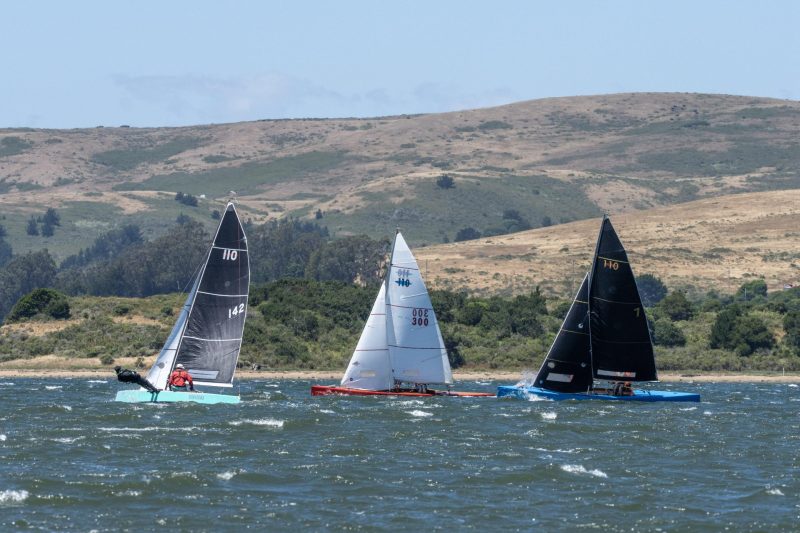
I write this report from the perspective of a participant. Keep in mind none of this could happen without our dedicated race committee and safety volunteers, to whom we racers are eternally grateful.
Just look at June 28 this year — the breeze was strong and forecast to increase. Two races were planned that day, and small-boat sailing as well. Around 3 p.m. the InvYC weather station on the end of the pier registered a sustained 19 knots of breeze with gusts to 25. Out on the bay it was certainly higher. How much? No one really knows.
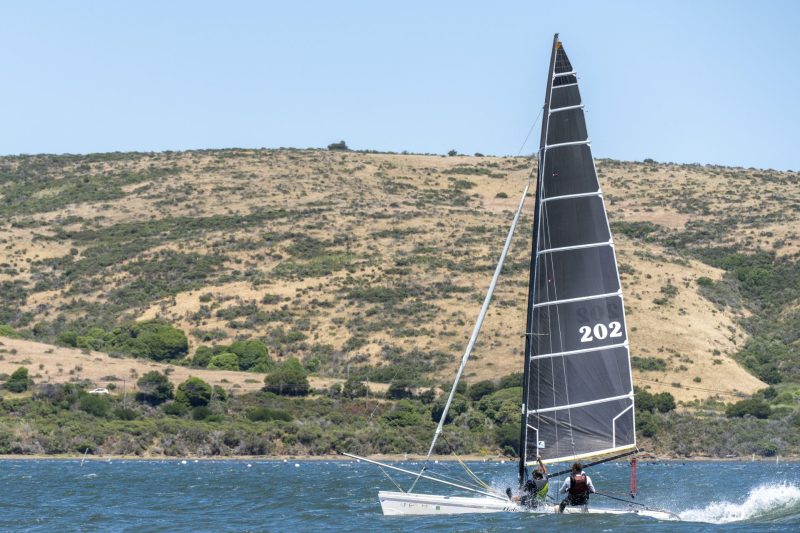
After the small boats were all tucked away in their beds, only four intrepid teams chose to go out again for the second race in light of the building breeze. Three teams racing 110s, and one really crazy guy on the Hobie 20 Jasmine, ventured out. This was not a race to win (unless you actually won), but rather a race for survival, one where finishing the race was the goal. Sort of like the Race to Alaska, but on an infinitesimally small scale. Finishing is enough, and winning is the foamy head on the beer.
So why, you might ask, does InvYC have a 110 fleet? One word: safety. A 110 will never stick the top of the mast in the mud and pin itself there. A 110 shouldn’t sink, although the author has come close. The 110 is a keelboat, but no ordinary keelboat. The 110 is “the world’s original sportboat™”, a lithe 900 pounds in a 24-ft coffin-like package. Capable of planing in a moderate breeze, but when the wind picks up, watch out, because you are either flying over the wave tops ahead of you (fast), or trying to plow through them (not fast at all). I leave it to my crew Daniel Maloney to describe.
“Alas, I didn’t have a video camera running, nor even turn on my phone GPS tracker. The fastest I’ve ever clocked my boat was 15 knots, and that was 10 years ago. But I swear this day we went even faster, and watching that old video of the younger version of myself, I’d say it was a lot faster.”
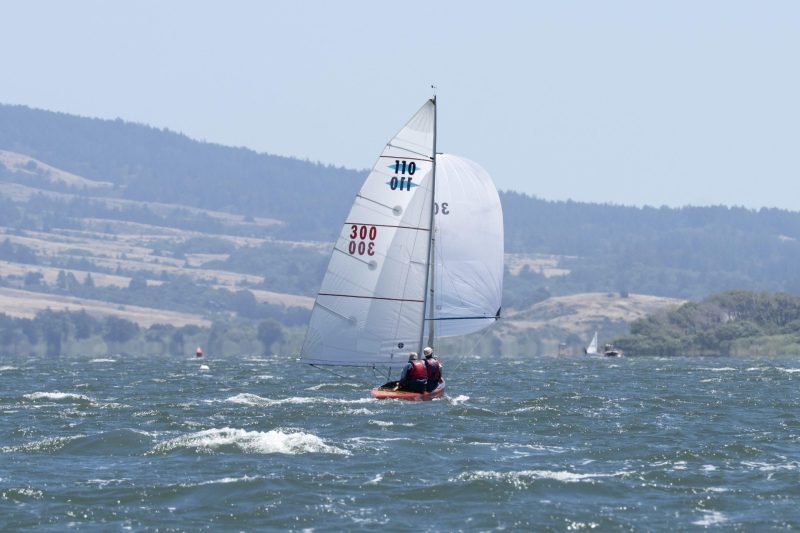
“That spot off Shell Beach where the bay necks down, it funnels and accelerates the wind for a turbo experience. After we stuffed the nose of the boat into the wave ahead up to the partners, it was time to reconsider our strategy, and for weight aft. Lifting the nose and steering around the peaks was like carving down a ski slope.
“Even then, every once in a while you missed avoiding a wave and plowed into it instead; you were slamming on the brakes, and you felt it. When the boat was planing it responded to the slightest movement of the tiller, but when the bow was under water it was unclear if it would ever respond, or by how much. Wipeout was a real possibility, and as long as you kept the crew on the wire you should be able to recover; if not, I have a story to tell you about my experience in Lake Michigan. So, if this sounds like your kind of fun, come join us.”
As a teen I crewed for a top 110 sailor back east on Hingham Bay once in 1970, I think. while planing, with me on the wire, we buried the bow. I swung forward around the headstay and was dangling, with the flogging chute, to leeward. Definitely the first ‘sport boat’.
Hey Eric! Hey Milly! Looking fun out there!!
Greetings from Seattle!