

Groundhog Day in the Oakland Estuary
If reading this story feels like Groundhog Day because you’ve read it before, you’re right. Boats keep sinking along the Oakland Estuary right under the nose of the USCG officers and staff on Coast Guard Island. The UCSG is responsible for patrolling federal waters, and are the folks who do vessel safety checks for registration and other vessel safety requirements to keep the Bay and estuaries clean and safe. Regardless of their proximity to the Estuary problem boats, they and the other responsible agencies (BCDC, Port of Oakland, City of Oakland, EPA) seem unable to work together to keep the Estuary clean and safe for the general public.
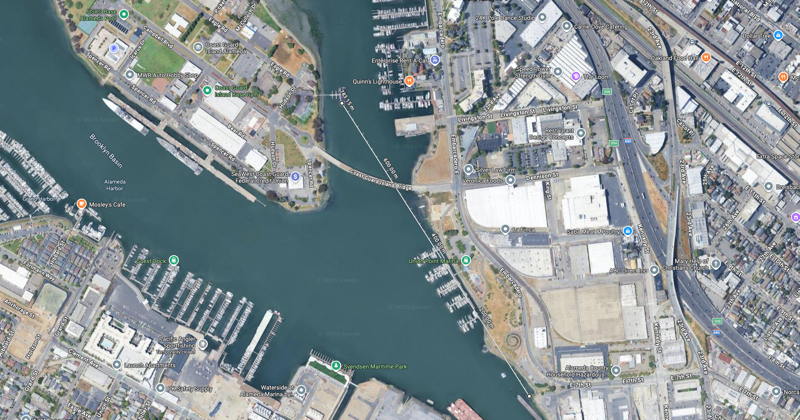
The growing number of illegal anchor-outs is actually relatively small. We texted tireless Estuary activist Brock de Lappe, asking him to guess their number. He responded from a BCDC meeting he was attending to say it’s probably under 30! It feels as if there are more agencies responsible for mismanaging the illegal anchor-out problem than actual anchor-outs. We know the agencies are often hamstrung by budgets and personnel issues, but when we look at the aerial photo from Google Maps above, we see a nicely watered, green baseball field on Coast Guard Island, two large Coast Guard cutters at the dock, and four spiffy, idle Coast Guard patrol boats at their small-boat docks. The Union Point Park across from Coast Guard Island apparently can’t afford the water to keep the grass green. The Coast Guard has a huge job doing Search and Rescue, drug and illegal immigrant interdiction, and other Homeland Security operations. When we spoke with their office a while ago, they explained that they have only 60,000 people in the USCG to manage their various responsibilities.
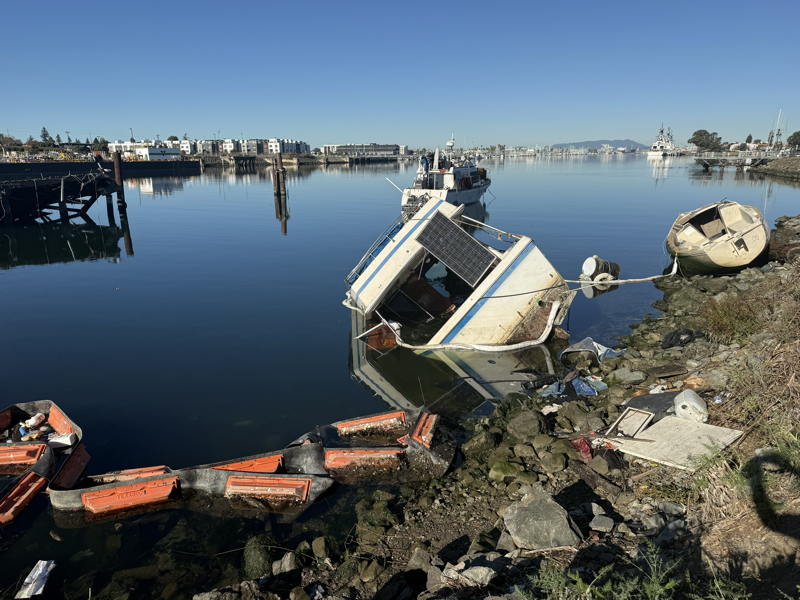
As a point of reference, we get almost weekly press releases from the USCG highlighting all the illegal immigrants they’re picking up offshore from San Diego and Southern California. You can imagine the time, people and budget required for all those USCG ships patrolling the open ocean to keep our shores safe. Therefore, it just doesn’t seem as if it should be that hard for the USCG and all the affiliated agencies to handle the problem in the calm, protected, nearby waters of Coast Guard Island. Compared to the work the USCG is doing off Southern California, it feels as if they could walk over and take care of the Estuary problem on their lunch break.
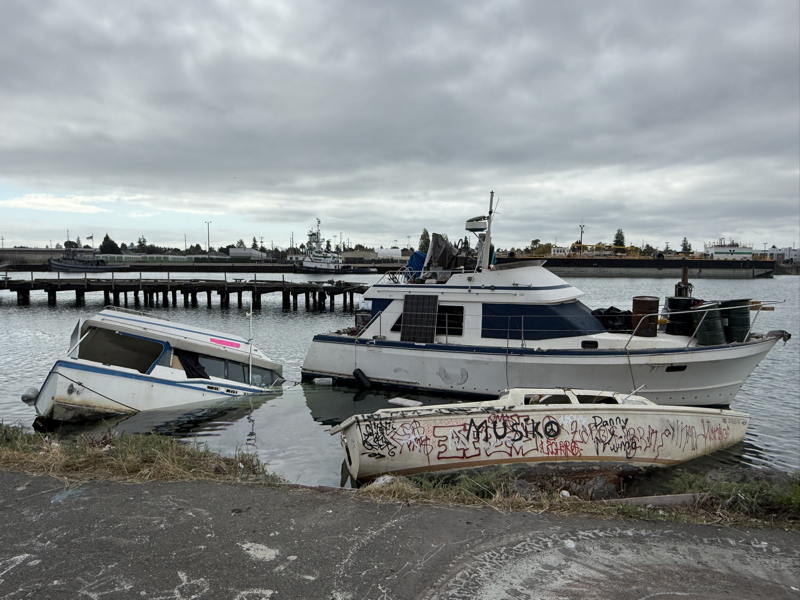
It wasn’t that long ago we wrote a hopeful note about the Coast Guard: “The Coast Guard says they will also be advising anchor-outs of federal anchorage regulations and how to contact harbormasters.” But that’s Groundhog Day again. We’ve written far more hopeful notes than reports of actual agency cleanup activities. We prefer and look forward to writing about progress sometime in the future. Soon? A cleanup costs millions; prevention costs thousands.
If people can swim in the Seine in the middle of Paris (population over two million) it feels as if you should be able to safely swim, row, sail or paddle in the Oakland Estuary (adjacent population 436,000). The anchor-outs are not the only reason it feels unsafe to swim in the Estuary, but they are very small and easy to visit, removing contributors to the problem. We love that people have found housing in boats, but if they’re not safe on the water and cause huge environmental damage to be cleaned up at public expense, they need to be on land. The same boat that’s a nuisance in the water could move 100 yards inland to a trailer park and perhaps be a perfectly good and safe home.
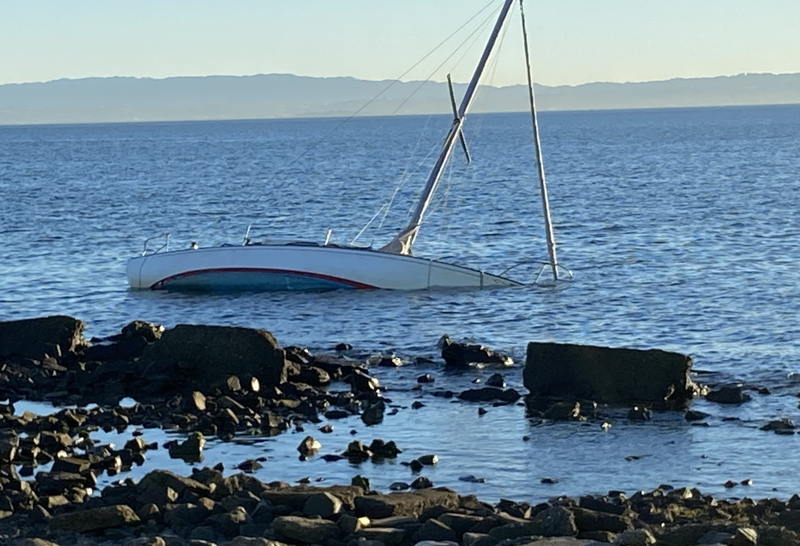
We certainly think these people need a housing solution. We’re not for “throwing people out on the streets” any more than we’re for throwing people currently living on the streets out onto the water aboard boats. The insane cost of housing, including the insane cost of what cities spend to build what they call “affordable housing,” needs a solution. We can tie a bowline, but we’re not sure we know how to solve the housing crisis. Though we’re sure repeatedly sinking, illegal anchor-outs will not be part of a good plan.
We know we and all our readers do continue to appreciate what the Coast Guard does to keep people safe. We just wrote about US Coast Guard Search and Rescue specialist (SAR) Douglas Samp, who will be in San Diego to help brief the 137 boats signed up for this year’s Baja Ha-Ha on safety protocols. That’s cool.
If you have some time to spare, you could watch this 15-minute video of the Oakland homeless problem, which includes a lot of coverage of the Estuary anchor-outs.
Interesting article. Is it safe to say that these anchored-out boats may be new to the estuary. Is anyone documenting these problem boats? A count is nice, but from what I have seen, a cleanup is done, and another crop of derelict boats appears. Just check boats for sale and see the number of ads showing up offering boats for free (or $1). I am seeing these types of adds increasing. Some may become the next derelict boat in the estuary. Garbage and derelict boats require on going cleanups. The USCG does a great job, but does not have a 24/7 derelict boat patrol and should not have one. Thanks for
putting “affordable housing,” in quotes. What is really needed is housing for people making less than
$50.000 per year.
Luckily the estuary has lots of advocates who are continuously documenting and lobbying for resolution of this on-going problem. We called it Groundhog day as we’ve run a lot of coverage on the fantastic documentation done by Brock deLappe and by Mary Spicer of I Heart Oakland Estuary. If you put his name in our Find field you’ll get a list of stories like this: https://www.google.com/search?ie=UTF-8&oe=UTF-8&q=delappe&domains=www.latitude38.com&sitesearch=www.latitude38.com There are many more. Some stories include statements from USCG leaders acknowledging their role and their intention to get involved to provide enforcement. They are certainly not the only agency responsible but they travel the Pacific to do similar patrol activities. 90% of this problem is with in a mile or less from their base. Sometimes literally aground on Coast Guard Island itself.
Oakland is especially bad, but everywhere we have urban dumping and storm drain pollution with everything floating into our lovely SF Bay. Given the boat dumping problem in the Delta, not to mention other smaller embayments, maybe it’s time that the state steps up? There was once a Department of Boating and Waterways but it mostly administered grants for docks and such. And it was eventually folded into the state parks and recreation department as a mere division. What we need is a state agency that can patrol and enforce dumping laws, remove vessels that the USCG and Army Corps won’t touch because they are not deemed “navigational hazards”. Maybe like a CHP for the water?
There is actually a program though the problem is larger than the program can handle. The California Division of Boating and Waterways has a program known as SAVE (Surrendered and Abandoned Vessel Exchange) that funds government agencies to support vessel turn in.
https://dbw.parks.ca.gov/?page_id=28816
Part of the problem is there are just a ton of boats that need to be cleaned up.
I’m curious why the owners of sunken boats can’t be held responsible for their removal and disposal? Presumably all these boats were once registered with the DMV and have title records. Finding the current owner should be easy, but what is the mechanism for holding them liable for the cleanup cost? Can someone shed some light on this question? Thanks
The most common situation is that the owners buy the boats for $500 or even $1 to use as cheap housing. The boats are not registered, not insured and the owners are buying them because they essentially have no money. Spending money to find these owners who have no money to hold them accountable for the problem is a further waste of money. It’s a sad situation. Investing in patrols and enforcement would prevent the problem in the first place and save millions as well as protect a beautiful public resource. Beyond that is to somehow find some housing and help people get back on track.
If you have time to watch the video you’ll get a better appreciation for the challenge.
I think the saying “you can’t squeeze blood out of a turnip” is the answer to your question Jeff. The people responsible for these boats don’t have money, that’s why they and their boats are sinking.
Regarding “Groundhog Day in the Oakland Estuary”.
This article on the Oakland Estuary’s derelict vessel problem paints a picture of Coast Guard inaction that simply doesn’t align with the reality of their mission, their manpower, or the complex legal structure governing these waters. Frustration with the situation is valid and pervasive, but focusing on one agency already stretched to its limits—while not doing so on obligations of the multitude of other agencies—does a disservice to the men and women of the United States Coast Guard.
The U.S. Coast Guard has approximately 60,000 total personnel—active, reserve, and civilian—tasked with safeguarding 95,000 miles of coastline, global responsibilities–performing Search and Rescue, counter-narcotics, migrant interdiction, polar operations, cybersecurity, aids to navigation, marine inspections, national defense roles, etc.
The Coast Guard must prioritize life-saving operations and national security missions—not municipal code enforcement. These operations require an enormous number of cutters, small boats, aircraft, and highly trained personnel.
The snide suggestion that Coast Guard crews could “walk over on their lunch break” is not only inaccurate, but dismissive of the operational tempo these personnel face. Small-boat stations and patrol boats sit idle only to the casual observer—they may be on standby for imminent search-and-rescue, conducting crew rest after overnight operations, or preparing for deployments.
Derelict and abandoned vessel enforcement is not solely—nor even primarily—a Coast Guard mission. State and local authorities, BCDC, city governments, environmental agencies, and harbor districts all have legally assigned responsibilities for this.
Many of those agencies lack staffing, and funding—that is a regional policy issue, not Coast Guard negligence.
The Coast Guard has repeatedly offered outreach, safety checks, and regulatory guidance on the Estuary, but cannot enforce local anchoring rules without a request for assistance or remove vessels without the required interagency process. They certainly cannot absorb the workload of multiple agencies simply because their island is nearby.
We all want sustained cleanup efforts and a solution to this complex problem. Scapegoating the one maritime agency that is already operating at maximum capacity adds nothing to the discussion other than division.
The women and men of the Coast Guard serve us all with great professionalism and often at personal risk. It is amazing they do all they do with their current staffing level. They deserve our respect and support. This article does in fact praise the Coast Guard multiple times do credit to you for doing that. Unfortunately that is undermined with trolling comments such as “…boats keep sinking along the Oakland Estuary right under the nose of the USCG officers and staff on Coast Guard Island”, “…we see a nicely watered, green baseball field on Coast Guard Island, two large cutters at the dock, and four spiffy, idle Coast Guard patrol boats at their small-boat dock” and of course, the aforementioned “walk over on their lunch break”. Seriously, what was your point.
Respectfully,
Steven Bustin
Steve – thanks for your comments. We completely agree with your sentiment that the USCG is not the primary agency responsible for the Oakland Estuary. We also agree they have a huge job as part of the Department of Homeland Security.
All sailors certainly respect the abilities, dedication and service provided to the nation and mariners by the Coast Guard, so they are not faulting them for their primary responsibilities. We know they’ve saved the lives of many friends and are grateful for their service.
Despite this, we can’t imagine there is a Federal, State or Municipal agency that feels they have the budgetary or people resources necessary to manage all that is asked of them. The USCG ‘only’ has 60,000 people to do their job the Oakland Police ‘only’ has one marine patrol officer to manage the estuary. Most private enterprises also feel severely understaffed.
It’s not a useful comparison. The question isn’t who’s responsible or who has the staff and budget available to do the job. It’s how can all these under-resourced, overworked agencies work together to solve the problem.
In 2023 we reported the following, “Our plan is to increase the level of Coast Guard law-enforcement presence in the Estuary at random times throughout the day,” Captain Taylor Lam of the USCG told ABC7 News this week. Lam said the Coast Guard will deploy different multi-mission small boats, as well as “some of our aviation resources to provide overt presence from the air.”
In 2024 we reported, “The good news is in an email Brock de Lappe received from USCG Commander Dave Herndon, Chief of Response Operations at USCG San Francisco. The email outlines an updated plan for Estuary cleanup to occur over the next couple of months.”
We just recently asked the current USCG base commander, Captain Jordan M. Baldueza to let us know what they’re doing about the problem. He responded, “The Coast Guard remains dedicated to working with our partners for a clean, safe, and thriving Oakland Estuary. In 2025, the Coast Guard has conducted 60 harbor patrols and responded to 30 reports of pollution within the Oakland Estuary, including leveraging the Oil Spill Liability Trust Fund for over $30,000 to mitigate and safely clean up the discharge of 340 gallons of oil and hazardous materials. Sixteen (16) Notice of Federal Interests and six (6) letters of warning were issued to vessels posing a pollution threat to the Oakland Estuary. The Coast Guard strongly encourages mariners who notice a discharge of oil or sheen into any navigable waterway to make a report to the National Response Center 24/7 at 1-800-424-8802. To report a discharge of sewage or solid waste, please make a report to the California Environmental Protection Agency here. While there are limitations on Coast Guard authority to salvage and remove abandoned and derelict vessels from the waterway, we look forward to supporting the City of Oakland, Oakland PD, Alameda PD and other stakeholders to support potential cleanup operations leveraging the state of California’s Surrendered and Abandoned Vessel (SAVE) and the National Oceanic and Atmospheric Administration’s (NOAA) Marine Debris removal grant programs, acting within the confines of our authority and jurisdiction under federal law. For further information regarding this project, please contact the lead agency, the City of Oakland.”
It is clear from the USCG communications that they feel they are a significant part of the solution. They’ve committed to being part of it many times. We understand that, like all agencies, the USCG is overstretched and under-resourced to solve this problem alone. Yet, there doesn’t seem to be a better geographically located agency with boats and skills to take a leadership role in solving this problem.
The USCG website gives a pretty good outline of the responsibilities and the resources. “Captain Baldueza assumed command of Sector San Francisco in May 2024. As Commander, Sector San Francisco, he leads nearly 600 Active, Reserve, and Civilian Coast Guard men and women operating three Cutters, seven Small Boat Stations, an Aids to Navigation Team, a Vessel Traffic Service, and a Marine Safety Detachment in addition to more than 1,000 Coast Guard Auxiliarists. His area of responsibility spans from the Oregon border to the San Luis Obispo County line and much of Nevada, Utah, and parts of Wyoming, and includes over 2,500 miles of shoreline within the San Francisco Bay and its tributaries.” It’s a big job. Should their budget, people and boats be doubled? We have no idea how to evaluate the resources and budget but it feels like they have a lot of the right resources to be a significant player in solving the problem.
The Coast Guard can’t and shouldn’t do it alone but having all the agencies explaining the little bits they do get done and the big reasons they can’t do is not confidence-building. Rather than explaining what they’ve done that clearly has not worked, they should let everyone know the next initiative they’re taking to meet with other appropriate agencies and the collaborative next steps they’re all taking together.