

Estuary Anchor-Outs, Raft-Ups, and Wrecks — The Problem Keeps Growing
We keep talking about it, and we keep sharing the photos, and we can’t help wondering what will happen — and when — regarding the numerous (and increasing) illegal anchor-outs and derelict and sunken vessels in Oakland/Alameda. We shared two posts recently, and now, we have another, with a bunch of photos suggesting that the situation is getting worse.
First up, last Friday we received the following photo from Latitude 38 delivery driver and sailor Bob Bodnar, who snapped a shot of the latest boat to join the growing fleet of wrecks along the Oakland shoreline. It doesn’t take being hit by a container ship for boats to meet their fate on the calm waters of the Estuary.

The blue sky and sunshine look inviting, but there are still troubles on the waters of the Estuary — and not just on the water. Last week, former harbormaster and Estuary activist Brock de Lappe shared photos of rafted-up anchor-outs, wrecked and abandoned boats littering the shore, and the mess in the Jack London Aquatic Center parking lot.
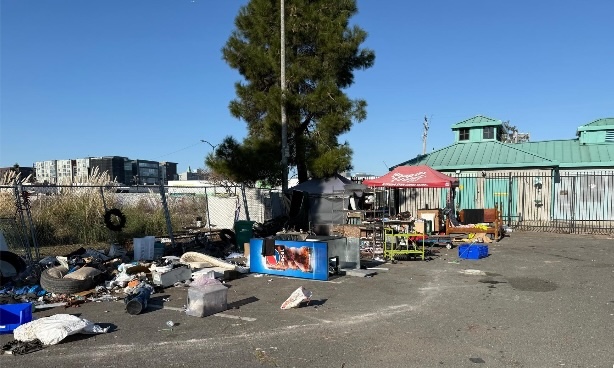
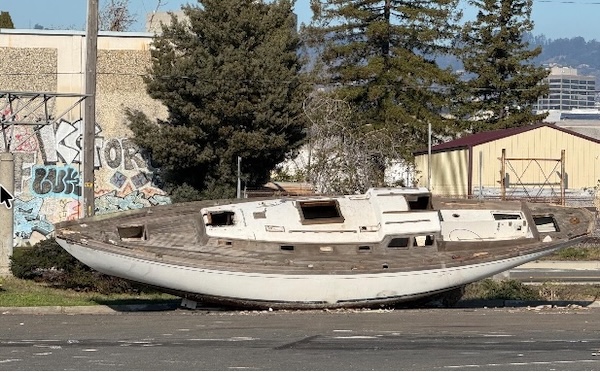
Brock sent the following email to the BCDC’s Enforcement and Compliance manager, Isabel Chamberlain, along with numerous people both within and outside of government.
“Today I completed an updated photo survey of the illegal anchor-outs on the Oakland Estuary.
“The number of boats has increased in the Brooklyn Basin, many are rafted up.
“This is an extreme hazard and quite likely many will break loose during our next winter storm.
“There are new anchor-outs adjacent to the Best Western Bayside Hotel on the Embarcadero and off the east parking lot of Union Point Park.
“Likely only a matter of time before these join the other sunken wrecks along the shore.
“It is incomprehensible that this is allowed to happen.”
The City of Oakland has posted a notice that it intends to clean up the parking lot, starting today, December 15.

As for the rafted anchor-outs, they appear to be multiplying. Brock writes, “The number of anchor-outs off JLAC has continued to increase over the past several months. These boats present a severe safety hazard to youth rowers and have resulted in both capsizes and unwanted harassment. There are now a minimum of 18 vessels anchored in the basin. It is entirely predictable that when a winter storm hits, with a 35-knot SE wind, several of these vessels will break loose and end up on the rocks. At that point the owner walks away and it becomes yet another expensive public cleanup.”

The following photo looks alarmingly similar to one we shared in October — only now there’s another derelict vessel in the mix.
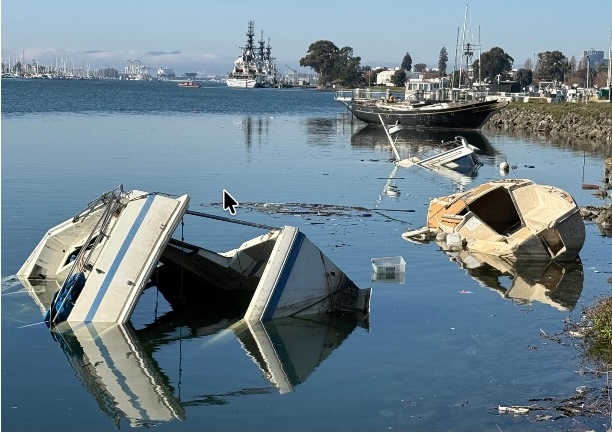
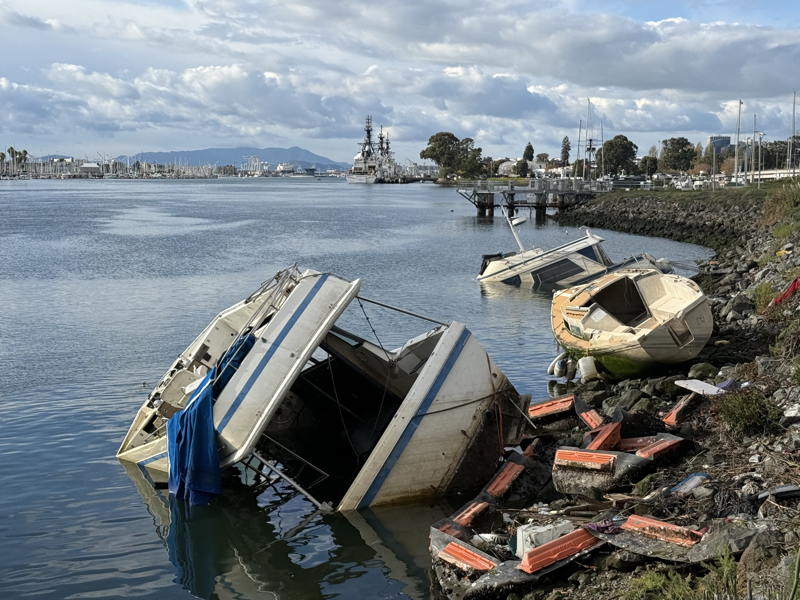
If the grounded boats aren’t removed, and they then multiply, so too do the problems. Add to that the seemingly increasing number of anchor-outs, raft-ups and derelict vessels, and it appears that things are going to get a whole lot worse before they get better.
When the marinas get bought out such as Safe Harbor did to Blackstone the insurance requirements are now you have to have full coverage to be in this marina. It puts a lot of people out. I totally understand why they are there.
The second to last picture , that black hulled boat at one time must have been something else . I wonder how bad it is ?
I have to imagine the economics don’t lie: It’s more expensive to enforce than it is to pull up the sunken boats, even if they cost $100k a pop to extract once sunken. We’ll get more grants. 🙂
The state needs to get involved. Need policies requiring boats have a bond in place, or insurance before being put in the water – and simplified enforcement as Washington put in place with its Derelict Vessels Act, which substantially lowers the threshold for removing a boat. Sucks but it’s the truth. WA does not require a bond, but the bond / insurance approach would really pre-empt the problem in the first place – if the vessel is not insurable, and it is understood that the authorities would swiftly impound it, we wouldn’t be putting impoverished people in the position to lose their (albeit modest) investment either to being seized or sinking.
The insurance companies will determine which boats are worthy of being underwritten, and which ones not. That should not meaningfully increase anyone’s premiums vs today – it would just guarantee that vessels that cannot be reasonably insured will stay off the water, or get scrapped on their way out.
Once a person without the means purchases one of these hulks, there’s no turning back. There’s a significant pool of boats in Alameda waiting for this fate.
The state of California is incompetent so don’t hold your breath waiting for them to do anything positive.
Enforcing the existing laws would solve the problem, however some attorney would file lawsuit after lawsuit to prevent that from happening.
This isn’t a homeless problem, it’s a drug problem and nobody wants to do anything about that either. Too many people are making billions off the “homeless” and have zero incentive to fix the problem as it will cut off the gravy train that is filling their pockets with taxpayer dollars.
I think if I anchored there I would be met by some form of enforcement officer. Why are they not enforcing the existing regulations. Seems like a simple solution to me.
I thought it was a 12 hour anchor zone. I guess the word ” strict ” means nothing if not enforced.
“The City of Oakland has a strict Nuisance Vessel Ordinance, limiting anchoring to 12 hours.
I ran the Lake Merritt sailing club located at the JLAC marina from late 2004 to October 2006…at that time it was a beautiful and vibrant youth center and sailing club. This maybe one of the saddest things I’ve ever seen a community allow to happen. I can’t say I will ever regret leaving JLAC to sail to Hawaii that year but I sure am sorry for the citizens of Oakland for losing an amazing community center and estuary.
Here’s something I’ve been wondering about, but haven’t seen much coverage on – where are these boats actually coming from? Are they stolen and it just isn’t being reported? Or is there some informal or hidden market where owners who no longer want their boats simply give them away?
I appreciate that you continue to cover this issue. I live across from Coast Guard Island in Marina Village and the situation gets worse each day.
It’s a good question. They could come from Craig’s List, our own Latitude 38 Classifieds or a lien sale from a boatyard or marina or any other personal sale. It’s good to remember it’s not just an Oakland or Bay Area problem. It’s truly nationwide and many states are trying to come up with ways to regulate and enforce responsible boat ownership and also to help dispose of abandoned and derelict vessels. We recently wrote about the Boat US National Database of Abandoned and Derelict Vessels, https://boatus.org/adv-database, the California DWB SAVE Program, https://dbw.parks.ca.gov/?page_id=28816, and the state of Washington program: https://dnr.wa.gov/aquatics/recovering-derelict-vessels. They’re important programs but are underresourced to solve the problem. There are tons of old fiberglass boats from the 60s and 70s and lots of people needing shelter who underestimate the challenges of managing a boat.
Ideally, buyers wouldn’t be able to buy a boat without being able to show they have the ability to insure it and a legal place to keep it. Too many owners are walking away from boats leaving marinas and boatyards with a responsibility that’s not in their budgets either. People thinking far ahead are imagining the ‘circular economy,’ where product designers and manufacturers build products for use today but have the disposal solution incorporated in the design/build stage so future generations aren’t left with the responsibility of cleaning up problems from decades ago. Female sailing hero and solo circumnavigation record-setter, Ellen MacArthur, left sailing to help heal the planet and promote the circular economy. She continues to be a force for good with the Ellen MacArthur Foundation: https://www.latitude38.com/lectronic/circumnavigator-ellen-macarthur-navigating-the-circular-economy/.
In the meantime, we’ve all got a mess on our hands.
In the middle of trying to dispose of a 16ft fiberglass run about, rather than post in Craigslist to end up as more trash in the estuary.. I’m trying to to dispose of it and not getting anywhere. Does anyone have info on where to tow a boat for proper disposal? Might help other boats out there too.
We are on a short “mini-cruise” from Ensenada to SD/Mission Bay/Dana Point/Alamitos Bay/Avalon then a straight shot back to Ensenada. I am writing this from the turning basin in Dana Point. We have seen the effects of the poorly-maintained-to-derelict, often incompetently operated boats at each stop. In general, though, SoCal harbor authorities seem to handle the problem far better than NorCal does. San Diego’s anchorages, for example, all require setting up an account with the Port, then reserving an anchoring slot in La Playa, Glorieta Bay, or the cruisers anchorage (A7). The allowable time and frequency is managed and ENFORCED.
A mess created by the minority the majority will have to deal with. These are the same people who throw their trash in the street and pollute the estuary dumping poop and pee overboard, yes they are polluting the estuary but who cares! The large sailing ship is still half sunk in Alameda by the Nob Hill shopping center, “if a non profit can do it then why can’t a poor person do it” seems to be the mantra. Brock has been outspoken about this for many years and has a good focus on the problem, but he seems to be a lone voice calling in the wilderness. Not the USCG’s problem, not Oaklands problem and not Alameda’s problem, just the tax payers problem and that’s the problem.
Oakland is a living and breathing shitshow, where anything goes and people can dump trash anywhere and everywhere with no consequences. There are homeless encampments everywhere, which occasionally are cleared, only to be reoccupied the next day.
The crux of the problem is too many boats. Stop all production of boats, unless easily recyclable…no more fiberglass. Soon those derelicts would look valuable. The boats here would then begin taking on the allure of old American cars in Cuba. We live in a throw-away society.
That’s funny. I was just talking to a guy in the UK about this problem yesterday. Truth: I only glanced at the article and didn’t do much reading. But I’ll come back. And offer suggestions and share observations. And we’ll see.
Another problem that just gets worse is theft at Marina Village from people that live on these boats. It will only get worse if something is not done to correct these problems. It’s not only a problem for the Oakland Police; the Alameda Police, and the management of Marina Village, also need to be involved. A went to a ABAG meeting a couple years ago where promises were made and some assistance did come, it just wasn’t enough. We all understand how hard it is for multiple government and private companies to work together without pointing fingers at each other but I’m a little disappointed by all of them. I’ve kept a boat at Marina Village for almost 20 years. It was always full with a waiting list to get a slip there. Now there are empty slips everywhere. This just isn’t good for anyone.
The camp-outs and derelict problem is a blight, nuisance and hazard that – for most of us – encroaches on the right to enjoyment of the public areas. A couple of years ago, the public launch ramp and parking lot at Vallejo was completely taken over by these same types. I found it depressing and never want to go back there. Part of the problem is lack of political will to confront the problem. A tough hand is needed to nip the problem in the bud, or the derelict communities will grow and become more aggressive and entitled. And to you homeless advocates: anchor-out encampments are not the answer!