

Reflections on Cruising the Coast of Venezuela
Outside of today’s headline news on Venezuela, it can be easy to forget that Venezuela has welcomed many cruising sailors to its coastline over many years. In fact, we were among that group. We were reminded of this when we received a letter from cruiser Nick Coghlan, who wrote to us about his and his wife’s Venezuelan cruising experiences in 1988 aboard their Albin Vega 27, Tarka the Otter. We had just reviewed his book, Under Wide and Starry Skies, in our December issue when his memory of cruising Venezuela arrived. We’ll share his full Venezuelan story in an upcoming Latitude 38, but meanwhile, we shouldn’t forget how many wonderful cruising areas have been temporarily off limits due to geopolitics.

Like Nick and Jenny, we have our own memories of cruising Venezuela a decade ahead of their cruise.
Going further back, we took a year off from college in 1976/77 and sailed from Maine to Venezuela and back. There were four of us aboard a Camper & Nicholsons 35 — my brother Peter, Max Fletcher and friend Astrid Deeth. In February 1977, we spent five days or so having the time of our lives dancing in the streets of the Port of Spain carnival celebrations in Trinidad. Afterward, we managed to get a visa at the Venezuelan consulate to cruise the coast. We sailed west from Port of Spain to Isla Margarita, then to the mainland in Cumaná, then out to Isla Tortuga and then Los Roques before, sadly, turning north to head to Puerto Rico, the Bahamas and back to New England.
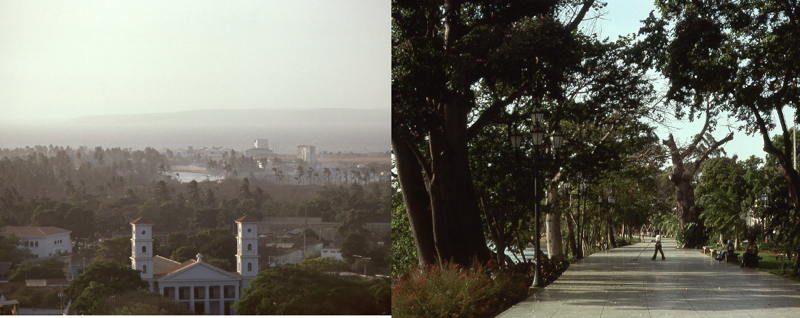
Digging out our old journal reminded us of the beauty of the place and the friendliness of the people. There was great sailing, with many anchorages, fabulous beaches and great diving. The city of Cumaná, about 160 miles east of Caracas, was a thriving city with clean, polished park plazas, and busy retail with many American cars on the street. Everyone, except us, was pretty fashionable.
There were a few signs of change. When visiting Cumaná we tied up in the industrial harbor astern of a Russian freighter. After returning from clearing in at customs we found ourselves talking with some of the Russian crew, who invited us aboard for drinks that night. That’s where we learned to drink the Russian way. We brought a little rum and they had wine and vodka. Don’t remember if there was food. All drinks were poured straight and polished off with each successive toast to whatever struck our fancy. We hadn’t had ice in weeks and we thought a huge freighter might have some. That’s not the Russian way. During long discussions on competing political beliefs, we toasted Brezhnev, Carter, world peace and every other toast-worthy cause of the moment.

Late that night, the four of us stumbled down the gangway and back to the boat to pass out until morning. We woke early to a large crowd of Venezuelans peering at us from shore. Having cleared out of customs the night before, we left early for a difficult 60-mile sail across to Isla Tortuga. The sailing was beautiful but the condition of the crew made it very challenging. On Isla Tortuga we again found a gorgeous tropical island on which to recover. More fabulous beaches, swimming and diving.
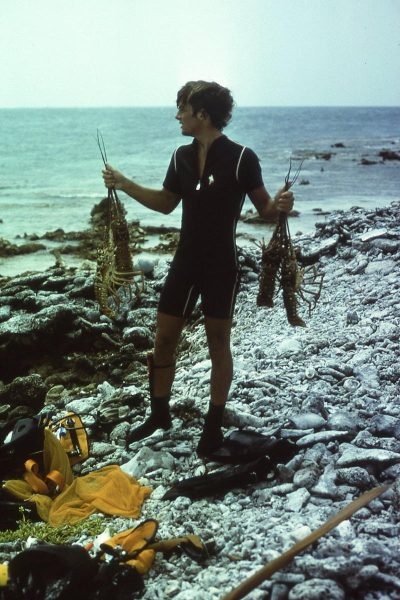
Even then, there were signs of change and indications of things to come. In 1976 Venezuela nationalized the oil industry, though it wasn’t until 2007 that Chavez seized the assets of the American oil companies operating there. And, as we cruised these offshore islands, we noted small runways with private planes and some brand-new speedboats despite the fact that there was no tourism on the islands. It’s interesting to also read a story Richard Spindler wrote about Venezuela in 2010.
We saw only one or two other cruising boats during our two-week jaunt along the coast and offshore islands. There was chatter among cruisers of possible pirates in the area, and we had one incident when a single flare was fired at night and we wondered if we were being lured into a trap. Our running lights were not working so we were completely dark and therefore reasoned they couldn’t see us and wouldn’t be firing a flare unless they’d seen us on radar, in which case we assumed they were not in need of help. That’s not a good reaction if there were actually a boat in distress.

After a couple of days on Isla Tortuga we headed farther west and slightly north to Los Roques. We were torn regarding which was our favorite place. Isla Tortuga had some gorgeous beaches and some signs of civilization to make it interesting. Los Roques was the same but completely deserted. Just sand, palm trees, reefs and us. Why compare? They were both great. After a couple of days exploring and diving in Los Roques, we regretfully had to turn north toward home. We sailed the 400-plus-mile passage to Ponce, Puerto Rico. It was the end of our Venezuelan sojourn and the beginning of our return to civilization, though luckily we still had the Bahamas ahead.

There are many beautiful cruising grounds in the world that have been temporarily removed from cruisers’ itineraries because of local conflict. We now feel lucky to have been able to experience Venezuela when we did. In that era, many would have avoided Vietnam and cruised Venezuela instead. Today, cruisers are enjoying Vietnam and Southeast Asia.
We spent three summers in the late 90s in Venezuela and travelled the entire country from the highest mountains to the deserts and Angels Falls. We spent a lot of time in the Aves and Roques, bought duty free booze in Margarita . The people were fabulous and super friendly. It is sad what has happened to the country and we only hope with the removal of Maduro life will get better. My prayers go out to the people of Venezuela.