

The Resourceful Sailor — A Portable All-Round and Anchor Light with Sensor
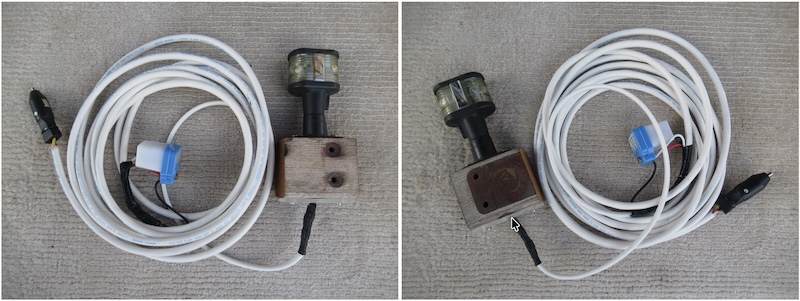
How would I leave Sampaguita, a Pacific Seacraft Flicka 20, unattended at anchor for an extended time? What if I were sailing in Mexico or the Marquesas and needed to travel to the United States for a few weeks? Or, what if a bird damaged my anchor light? While there were several concerns regarding these scenarios, such as ample ground tackle, security or accessibility, this installment focuses on creating a portable low-power anchor light using a cigarette lighter adapter, spare boat cable, an old fixture, and a light-sensor switch.
Regarding security, any accessories that could be easily removed would need to be locked below. Included in that were the flexible and temporary solar panels used to charge the boat‘s batteries. By design, the panels were easily removed and relocated (“Sampaguita’s Solar Solution,” ‘Lectronic Latitude, August 2024). This means that the anchor light would draw on the system without replenishment.
I had replaced the anchor light with a new tricolor/anchor/strobe light in 2021. This new light was superior to the old in every way, except that it drew 0.5 amps, compared to the 0.2 amps of the older one. For the mathematically challenged, the new light used 150% more energy!
I had installed the previous anchor light in 2014 and fitted it with LED bulbs. By the time I replaced the light in 2021, the weather and sun had degraded it sufficiently that it held no meaningful secondhand value. I kept it as a spare.
Once I had imagined a need for a low-power, set-it-and-forget-it anchor light, it came together quickly. I already had spare duplex wire on board, the old fixture, a well-stocked electrical kit, and my trusty scrap bin. From Amazon, I purchased some inexpensive male cigarette lighter plug adapters (I needed some of these on hand anyway) and light-sensor switches (three for $10).
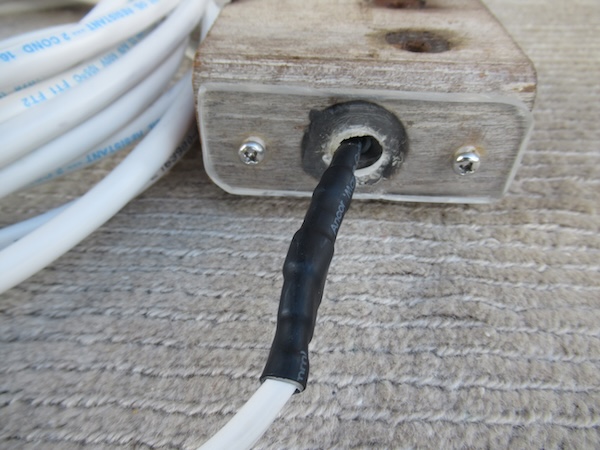
I attached the light fixture to a salvaged piece of Sampaguita’s old teak bow platform, providing a base. (I had replaced the platform two years before.) This wood already had holes drilled into it that would accommodate the electrical wiring and lashing the fixture to the backstay. Also from the scrap bin, plastic tubing served as a conduit through the teak, and foam bits filled any vacant space. I connected the fixture’s wire leads to an 18-foot length of duplex wire, adding adhesive heat shrink over the connections to keep moisture out, prevent chafing, and provide strength. A small piece of acrylic, already conveniently and appropriately drilled (“Keep the Stern Light in Sight,” ‘Lectronic Latitude, August 2021), stabilized the area.
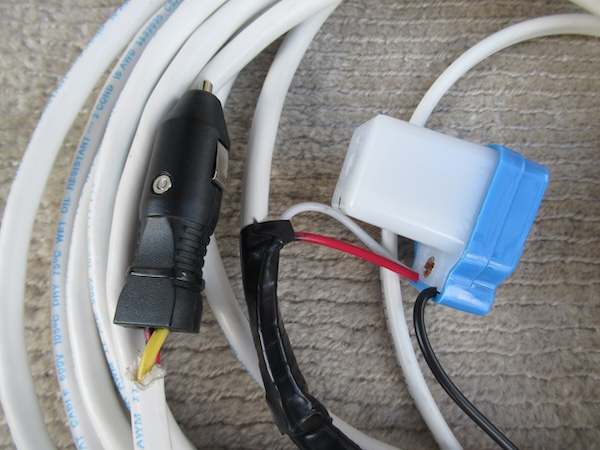
Two feet along the cable from the light, I wired in a light-sensor switch. When the sun set, this switch would complete the circuit, and the light would automatically switch on. These wire connections were challenging to cover fully with heat shrink, so I wrapped them well with the next-best thing: electrical tape.
Finally, I added a male cigarette plug adapter to the bitter end of the duplex cable. The adapter plugged into the cigarette lighter terminal in Sampaguita’s cabin. The cable would lead through the slight space between the drop boards and the companionway sliding hatch, through the cockpit to a backstay, where it would be lashed as high as I could reach with some clever marlinspike seamanship. The cable would also be lashed to the stay below the sensor switch, mitigating wire movement and relieving stress on the connections.
Have I used it? I have, but not for its original purpose. As stated in “Sampaguita’s Solar Solution,” I installed it when I had trouble with degrading solar panels in Baja, Mexico. It helped economize my electricity usage for a couple of weeks until I could replace them. During this time, I realized that I could also use it as my sole navigation light, if necessary. A Flicka 20 is under seven meters and can legally operate under power with a single, all-round, white light.
Some notes about the setup:
- There are simple dry-cell portable navigation lights. I had these on board, but they wouldn’t suit an extended absence.
- Sampaguita sported lithium batteries, which could better handle a semi-charged state without permanent damage.
- I used a cigarette lighter adapter because I had already outfitted Sampaguita with an outlet. USB was an option, but I am not sure about the compatibility of a USB plug and a 16 AWG duplex cable.
- 16 AWG was overkill for the job, but it was the size I kept aboard as a universal spare. If I had a more urgent need, I could cannibalize the portable anchor light for its wire. If I’m going to store extra wire on board, why not give it a secondary purpose?
- Nearly colliding with an unlit boat in an anchorage after dark has always given me a scare.
- If you have ever had an eagle roost on your masthead, or a pelican or booby strike at sea, bird damage is not far-fetched.
- The setup is also part of my small boat-delivery kit.
Remember, keep your solutions safe and prudent, and have a blast.
Check out this quick video of the light being tested:
https://www.youtube.com/watch?v=AMLNBnCvmA0