

Episode #251: Pacific Cup, Master Mariners Regatta, and Pacific Puddle Jump (Latitude 38 Verbatim), With Host John Arndt
This week’s host, John Arndt, reads four articles from the June and July 2026 issues of Latitude 38 sailing magazine. Hear “An Epic E27 Shakedown to Hawaii: Part 1” by Jonathan “Bird” Livingston from the June 2026 issue; “Who’s on First? Your Winning Pacific Cup Picks” by Andy Schwenk, “Master Mariners 2026 — Clash d’Elegance” by John Riise and John Skoriak, and “Believing in Magic” by Chris Fratini, all from the July 2026 issue.
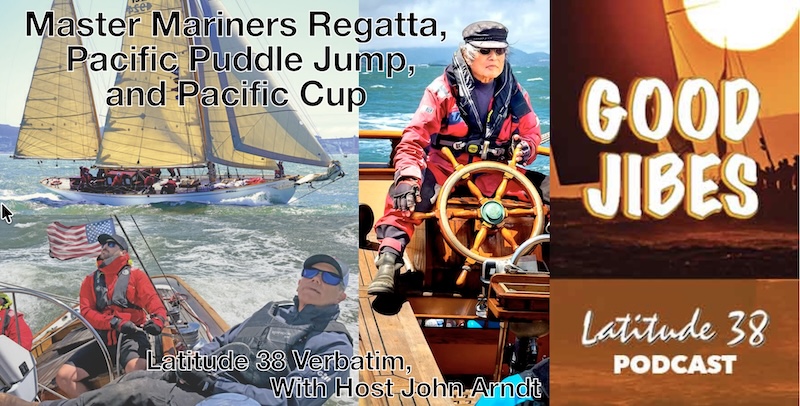
Here’s a small sample of what you will hear in this episode:
- Dousing the kite in 35 knots, and getting slimed by a whale
- Andy Schwenk’s 2026 Pacific Cup picks across every division
- The fun race ethos, Free Bowl of Soup as an overall contender, and
why you should saw the handle off your toothbrush - Brigadoon sets a new elapsed time record in ‘Gaff 1’ at 102 years old
- A crew member swept off Water Witch on the last jibe, recovered by a spectator powerboat
Follow along and read the articles here:
“An Epic E27 Shakedown to Hawaii: Part 1”
“Who’s on First? Your Winning Pacific Cup Picks”
“Master Mariners 2026 — Clash d’Elegance”
“Believing in Magic”
Listen to the episode on Apple Podcasts, Spotify, and your other favorite podcast spots — follow and leave a 5-star review if you’re feeling the Good Jibes!
Check out the episode and show notes below for much more detail.
Show Notes:
- Pacific Cup, Master Mariners Regatta, and Pacific Puddle Jump (Latitude 38 Verbatim), with Host John Arndt
- [0:14] Welcome to Good Jibes with Latitude 38
- “An Epic E27 Shakedown to Hawaii – Part 1” by Jonathan “Bird” Livingston
- Read it here: https://www.latitude38.com/issues/june-2026/#44
- [1:20] The Express 27 Lighten Up and the accidental birth of double-handed Pacific Cup racing
- [3:48] Hoisting the kite in 35 knots, crest-to-crest leaps, and getting slimed by a whale
- [6:44] Averaging 280 miles a day and running 50 miles behind Merlin at the halfway point in a 27-foot boat
- “Who’s on First? Your Winning Pacific Cup Picks…” by Andy Schwenk
- Read it here: https://www.latitude38.com/issues/july-2026/#60
- [8:19] Andy Schwenk’s picks across every division — Cal 40s, Hobie 33s, and the 80-foot Wiley Gem headed to Hawaii
- [15:32] The fun race ethos, Free Bowl of Soup as an overall contender, and why you should saw the handle off your toothbrush
- [20:30] Would you like to sponsor Latitude 38? Email us to learn more!
- “Master Mariners 2026 – Clash d’Elegance” by John Riise & John Skoriak
- Read it here: https://www.latitude38.com/issues/july-2026/#50
- [20:56] The 2026 Master Mariners Regatta on San Francisco Bay
- [24:43] Brigadoon sets a new elapsed time record in Gaff 1 at 102 years old
- [28:40] A crew member swept off Water Witch on the last jibe who was recovered by a spectator powerboat
- [30:31] Check out our classy classifieds at Latitude38.com
- “Believing in Magic” by Chris & Tami Fratini
- Read it here: https://www.latitude38.com/issues/july-2026/#78
- [31:56] Kingston, Washington to the Marquesas in 28 days. With 2,950 miles, crew attending class and launching a business underway
- [35:16] First squalls in the ITCZ, 400 miles of doldrums, and finally finding the southern trades
- [38:10] The damage list and a landfall in Nuku Hiva that brought the whole crew to the rail with quiet smiles and misty eyes
- Check out the July 2026 issue of Latitude 38 Sailing Magazine
- Make sure to follow Good Jibes with Latitude 38 on your favorite podcast spot and leave us a 5-star review on Apple Podcasts
- Theme Song: Pineapple Dream by SOLXIS
Transcript:
Please note, transcript not 100% accurate
00:03
Remember, you’re in the fun race to Hawaii. As they say on Molokai, smile, hit no broke your face.
00:14
Welcome aboard Latitude 38 listeners, listeners. We never had those before till we had a podcast and unbelievably we’re now up to 250 episodes. In fact, this will be episode number 251. It’s actually going to be a verbatim, a few stories from a recent issue, July, and also uh one from June. And this is a collection of uh stories from our recent issue, but also the 250 stories are West coast sailors who’ve sailed around the world.
00:44
currently sailing around the world. Amazing lineup of guests, including Paul Kayard, Lynn Pardee. Recently we’ve had Karen Heck, who is planning to sail around the world. We’ve got Josh Colley, who just finished sailing around the world. And then Scott Eason, who’s been racing all over the planet and racing on the Bay. And that’s just a smattering of our 250 episodes. So welcome aboard to this.
01:12
Episode number 251 of Latitude 38’s Good Jibes Podcast.
01:20
kicking off the first story of our 251st episode of Good Jibes. We have a story by Jonathan Bird Livingston, who normally is sailing his Wiley 39 Punk Dolphin on the Bay. But this first story comes from the Wayback Machine from the Pacific Cup way back in the 80s when he was sailing an Express 27 designed by Carl Shoemaker. And he sailed it with Gary Clifford in the Pacific Cup in 1984.
01:50
And this is the first part, the two-part story by Jonathan Livingston about his and Gary Clifford’s shakedown cruise of the newly built Express 27 lighten up in the 1984 Pacific Cup race. Jonathan writes, in 1984, when men were men, boats were light, and liability waivers were written on cocktail napkins, a brand new design slid quietly into the water, the Express 37. Carl Shoemaker drew it.
02:19
which is to say a naval architecture Jedi calmly merged the ghost of Nathaniel Herschhoff with the DNA of Sparkman and Stevens and then sprinkled in the modern ULDB witchcraft and walked away like it was no big deal. The Express 27 wasn’t just a boat. It was a haiku about speed. It was the nautical equivalent of a perfectly fitted leather jacket. Nothing extra, nothing missing.
02:48
Hull number three belonged to my goofy friend, Gary Clifford and me. We sailed her hard in the Gulf of the Farallons and coastal races, including the San Diego race from San Francisco, where the conditions range from sporty to why do we do this again? Somewhere almost certainly at a yucca bar lubricated by optimism and beer, we were Shanghai’d into helping organize a new ocean race to Hawaii. Few rules, big fun, questionable judgment.
03:18
Because Gary and I were on the organizing committee, which sounds more official than it was, we created our own division so we could race the Express 27. We called the boat Lighten Up, which in hindsight should have been a warning label. We also decided to sail double-handed, and accidentally the double-handed Pacific Cup was born. History is often made this way, not with intention, but because someone says, sure, what the hell? When we started, the Westerlies were cranking.
03:48
the kind of breeze that takes a ULDB and asks politely whether it would like to remain in the water. We were double reefed with a storm jib reefing offshore and the boat already twitchy and alive like a caffeinated ferret. Gary, a true Santa Cruz ULDB barfly philosopher, invoked the sacred words of Bill Lee, fast is fun. Then he added, Bird, what do you think about having more fun? After a beer,
04:18
of seamanship we hoisted the 1.5 ounce kite, bore off, lit the afterburners, friends, we had no idea this little boat could go that fast. The reef main kept her glued down just enough in the Express 27 simply accelerated and kept accelerating. 17 knots, 20, the wind building to 35, seas stacked up like apartment buildings, white water everywhere.
04:45
The bow wave shot past our ears and physically assaulted our faces. The rooster tail behind us looked illegal. At this point, surviving became the adhesive holding the program together. There was no turning back, no reducing sail, mostly because we couldn’t figure out how to get the kite down without someone being launched into a different time zone. So we did the only logical thing. We kept driving. Then came the surfing, real surfing.
05:15
The kind where you drop into the trough like a pro, carve up the face, feel like the whiplash of acceleration punch you, bear off again, and suddenly you realize the boat is not merely fast. It is offended by the laws of physics. Then it happened. We went so fast that we sailed up the backside of a swell, punched through the crest, and left the water entirely. You could tell. The noise stopped. No rushing water. Just silence.
05:45
For a second, maybe two, then boom, we landed. And did it again, crest to crest. Gary named it immediately, the Crest to Crest Leap, which is how sailors process trauma by branding it. That night, because the ocean enjoys plot twists, we hit a whale. Its tail smacked the rudder so hard it ripped the tiller out of our hands. Then we were slimed by whatever fishy goo came out of its blowhole.
06:15
Imagine being a mugged by a marine mammal and then baptized. Once our hearts restarted, we checked the rudder and tiller. Perfect. Which meant there was only one thing to do. We called Carl on the SSB, parentheses SSB, a radio that was invented and around before Starlink. But anyway, we called Carl on SSB through KMI radio at Point Reyes. Gary yelled something along the lines of, Carl.
06:44
We love you. Carl being Carl was reserved. Calm, you could hear the smile. The quiet, deeply satisfying approval of a man whose design had just been launched into the airborne mammal collision test phase and passed. We averaged 280 miles a day for four days. At the halfway point, we were only 50 miles behind Merlin, halfway to Hawaii in four days in a 27-foot boat. Double-handed.
07:13
slightly unhinged. Carl Schumacher’s design and the Allsburg Brothers’ construction proved what West Coast sailors were beginning to believe. These new ULDB machines weren’t fragile toys. They were tough as nails, seaworthy times 10, and unapologetic about going obscenely fast. Fast was fun, too much maybe, but gloriously just enough. So that’s Jonathan Livingston’s story from our June issue.
07:42
Part two is in our July issue, which just hit the streets last Thursday. And you’ll get that issue. And the last issue have pictures of some of Jonathan Livingston drawings from the time and also a Mr. August poster picture of Gary Clifford. Pretty impressive shot. Anyway, that’s it for that story for the part one of the Express 27 Epic Shakedown on the
08:10
Pacific Cup to Hawaii in 1984 by Jonathan Livingston and Gary Clifford. And on to our next story.
08:19
For the second story, we’re going to let you know who’s going to win the Pacific Cup. Or rather, we aren’t. Andy Schwank has got it dialed in. He’s raced and delivered boats back from Hawaii 60 and a half times. If you haven’t read about that half time, we’ll have to post that story in our show notes. Because that half time was one of the more exciting times when Andy delivered his own Express 37 back, but had a super challenging time.
08:47
really truly almost losing his life potentially, but made it back and came back to tell us who’s going to win the 2026 Pacific Cup in our July issue, which came out as I say, last week, he predicts who’s going to be the winners and the boats just started today. The first classes started as I’m recording now earlier today, they’re on their way to Hawaii in light air, headed up wind, looking for those trade winds to take them west, but they’ve got a bit of a battle.
09:16
in light airs till they find some breeze. So our story from the July issue starts out, who’s on first? You’re winning Pacific Cup picks by Andy Schwank. Did we win? Are we winning? These are comments almost guarantee this individual is competing in a sailboat regatta. The Pacific Cup was first sailed to Hawaii in 1980, envisioned as the fun race to Hawaii.
09:44
It is easily lived up to this founding motto. The Pacific Cup, Pac Cup as most of us call it, has been held in every even number of years since, except for COVID 2020. It has provided folks from around the world an alternative to the legendary TransPAC. The Pac Cup is about 175 miles longer than the TransPAC via the Great Circle route. Though I think actually someone contested that number on our website in comments, but…
10:13
We’ll leave that here in the story. Generally, it is more about precise navigation than straight line, hair on fire, boat speed. Circling back to the introductory sentence, how can one know if they are doing well or winning or losing? It is a race after all, isn’t it? The fleet is split between PHRF and ORR, two different styles of handicap designed to make racing fair for differently designed boats against one another. ORR boats are weighed and measured.
10:42
The results are fed into a secret formula, not kidding here, and a rating is assigned. PHRF boats are simply assigned a handicap by a board of supervisors and are subject to change through an arduous process. Further, the fleet is split again between double-handed and fully crewed. No single handing is allowed. A fully crewed 70-footer might carry 10 to 12 passengers. Most vessels have four to six passengers aboard.
11:11
These vessels are equipped with trackers of all kinds of Elon’s latest gadgetry. They are also required to report their position twice daily. The racers are allowed to use this information to assist in choosing their course along with a myriad weather and associated pixel slang technologies. Of course, you could go old school with a sextant barometer, but I don’t think anyone ever does that anymore. I’ve had the opportunity to cross this great Eastern Pacific whale pasture over 60 times.
11:41
I’ve had some success and on a few occasions. My best friend Steve from Milwaukee, Washington put it this way, Andy, I have no idea if you are a talented sailor or not, but you seem to have an uncanny ability to find your way onto a winning vessel before the regatta starts. Although I don’t know everything about each boat and at the risk of losing what few friends I have, the following are my predictions from the murkiest crystal ball west of the Mississippi.
12:08
If this bracket prediction holds up, I’m heading to Vegas with my newfound superpower or Reno Tahoe. I’ve heard it’s very pleasant there. All right, let’s do this thing. In the smallest division due to depart July 6th, that’s today, double-handed PHRF Division 1 with three entrants, everyone wins a prize. I can safely say that Greg Ashby, RYC by way of Arnold, California,
12:35
who single handed to Hawaii and back last summer, looked strong. Now with some help, I say he claims a narrow victory over father-daughter duo team Cheeseman aboard Bozinga. Surf claims third spot on the podium. I may regret betting against a Hobie 33, but they’re all RYC, so I can predict that the club built on fun will prevail.
13:01
PHRF2 is stacked with talent and terrific boats. I bet a Cal of 40 will win. They always do, but which one? Viva has just done fantastically since a recent refit. Commodore Quancy could play the bridesmaid, and my sleepy pal Chris on Kyaka could be the sleeper in this class for third. As July 7th dawns, the second double-handed class, this time ORR, will be on the line.
13:28
In this star-studded affair, it’s easy to pick another Cal 40. They nearly always beat me. They won the TransPak, single-handed TransPak, and the last Pac Cup. Shaman with fearless ferry captain, Bark Hackworth, the controls may shine again here. The Wolf Pack will be dueling with Turbo Camper in a coin flip. Looking at the lineup in this class is frightening. They are all capable of winning the whole enchilada.
13:58
PHRF-1 is what the Pacific Cup is all about. From a 51-foot cruising furniture factory to an ultralight 30-foot surfboard. From a veteran gentleman in his 90s Flash Girl competing in another of several Pacific Cups next to a young man in his first aboard Recidivist. That 90-year-old, of course, is Commodore Tompkins aboard his Wiley 39 Flash Girl. Captain Gary on Ventana.
14:26
has won before and very well may again. The Dark Horse for second, Olsen 30s, may be second only to the Cal 40s in their winning ways. And with some beginners locked, the Pirates aboard Recidivus could hold on for third. Also in the herd, starting on the seventh, are the folks who paid a little extra, read a lot here, to meet the criteria for being rated under the mysterious O.R.R. rule. In oh O.R.R. 4, another R.Y.C. badass,
14:56
Lightspeed, skippered by culinary wizard Gilles Conbressant, ably assisted by Bay Area navigator Mark Jordan, is not only the favorite, but also a contender for overall glory. I owned an Express 37 and have seen what they can do in the open ocean. Probably the only design specifically designed to win this regatta. Why not another coin flip between Dorado and Kodiak Express?
15:23
a North versus South challenge before Canada becomes our 51st state. Wait, is this still a thing?
15:32
It will be a busy day on the start line and as ORR3 comes thundering across, TC, a Hobie 33 out of Seattle has probably won every regatta I have seen her enter. These vessels were designed after the Santa Cruz 27. Hobie Alter actually purchased a SC27 and disassembled it to create building specs for the Hobie 33. Bill Lee thought that was cool and suggested that he purchase several more. In any case, as long as you can keep the bow up and
16:02
dirty side down. They are just deadly weapons on this part of the Pacific in the summertime. My father had a Santa Cruz 40 and I must have done at least a dozen Pacific crossings aboard. So Marissa or Quiver in second. Captain Buzz in his tiny EO for third. The race committee gets a rest before the final farewell party starts on the 10th. The competitors in this class are meat and potatoes of this regatta.
16:30
50 feet seems to fit the Pacific rollers, and these vessels in the right conditions are easily sailing over 20 knots, with rumors of 30 not uncommon. This start includes the college kids on Oaxaca, former sailing legends aboard adrenaline and the boys wearing the hats that come up with their swan 42 free bowl of soup. The story goes that back in the day, these same co-owners had a J24 and offered a sailing adventure via a radio promotion.
16:59
to support a local soup kitchen. Fast forward 30 years, hundreds of thousands of dollars have been raised for the charity by Free Bowl of Soup Team. She’s my pick for the class and also a strong contender for the overall. Say the college students slip in for second and Freya out of my favorite yacht club other than Richmond for third. Interestingly, the same Sloop Tavern Yacht Club was once home to Seattle Sea Scouts who won the prestigious
17:28
Swiftshire Regatta in Victoria, British Columbia, and their victorious homecoming was held in the parking lot as Washington liquor laws do not allow minors inside the premises.
17:40
Finally, here they come. The no expense baird, our foulies all match. We have seawater flowing through our veins, and all the vessels are capable of getting there in less than a week if the conditions are right. The newest, largest vessel in the fleet, the Wiley Design Gem, hailing from Portlandia, is sure to turn heads and turn in some impressive daily runs. Just to pause there, I did look at the Wiley Design Gem. It has a beam of
18:09
Well, its length is 80 feet, a beam of 13 feet and three quarters, which for my Sabre 38 is 12 and a half feet. So double the length, only a foot and a half or beam. That’s incredibly skinny missile headed off to Hawaii. The Disney Clan with Paiwhacket is the obvious favorite on paper and is my pick, but the race isn’t sailed on paper. And when the going gets weird, the weird turn pro.
18:37
Sava Tessa’s second, and Zeus, the only vessel with a fancy foil, is third. When I was a green weenie before crossing the equator to be welcomed by King Neptune in his court, a friend of mine chartered ragtime and brought her north from New Zealand. Only she wasn’t ragtime in those days. She was infidel, and her tiller was 14 feet long and took at least two burly sailors to handle her in a blow. The one thing that hasn’t changed is her rivalry with Merlin.
19:05
Probably the best side bet in the race. That’ll be fun to watch. We wish all these sailors fair winds and following seas. The Richmond Yacht Club that hosts the pre-race parties and the Kaneohe’s legendary luau’s at the finish make every sailor feel like a winner. And many will prove me wrong by becoming winners this summer. Double check the antibiotics. That’s personal advice from Andy Schwenk. He can tell you more.
19:32
Don’t take anything you don’t need and saw the handle off your toothbrush. If you get a chance to drive, keep the bow under the kite and wear sunscreen. Remember, you’re in the fun race to Hawaii. As they say on Molokai, smile, it no broke your face. Thank you, Andy. You know what? If you’re going to be betting on Polymarket, take those winning picks. Bet big, and you’ll be a winner from here on out. That is a great prelude to the
20:01
Pacific Cup, is taking off today and this week, July 6th through the 10th. And they’ll all be headed on to Hawaii and you can view them on the tracker on the Pacific Cup website. Hey, listen up. We hope everyone is enjoying listening to the stories of West Coast sailors on our Good Jives podcast. We’ve heard lots of great feedback from the 150,000 listeners who’ve tuned in over the last couple of years. And if you have a marine business, we’d like to give you an opportunity to connect with them.
20:30
during upcoming podcasts. If you’d like to be a sponsor of future podcasts, you can email Latitude38 to learn more about how your company can benefit from sponsoring good jibes. All right, our next story from the July issue is the Bay Area’s classic master mariners race, Master Mariners 2026, as it was titled Clash to Elegance.
20:56
If we had to pick just one event on one weekend to represent the fun, color, spectacle, and history of sailing on San Francisco Bay, not to mention some of the coolest people and the coolest boats, it would be a no-brainer. The annual Master Mariners Regatta sailed, as always, on Saturday, a Memorial Day weekend, May 23rd in 2026, and not just for the eclectic assemblage of classic schooners, gaffers, cutters, and catches, a few of them more than a century old.
21:24
But also for the weather, this event almost always seems to luck into bright sun, white caps, spray flying, and 20 to 25 knots of chilly westerly blasting through the Golden Gate and down the slot into the Berkeley Hills. These conditions often send small craft scurrying for calmer water. But for the 40 boats entered in the 2026 Master Mariners Regatta, this was nirvana. This fleet’s
21:50
ranged in size from the 23 foot bear class up to the 132 foot brigantine Matthew Turner. The Turner took the ceremonial first gun in the non-racing parade class at noon. Then the first official start gun fired for the Bears, fielding five boats this year at 1215 and the rest of the 10 divisions following suit in five minute intervals. Latitude had a correspondent embedded in the fray this year. Publisher John Art.
22:21
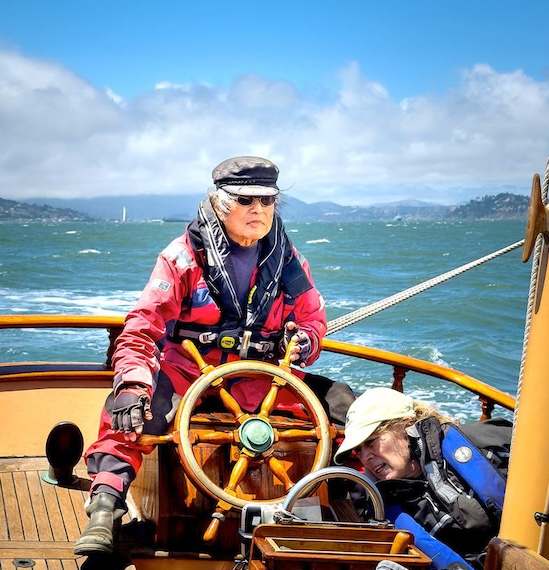
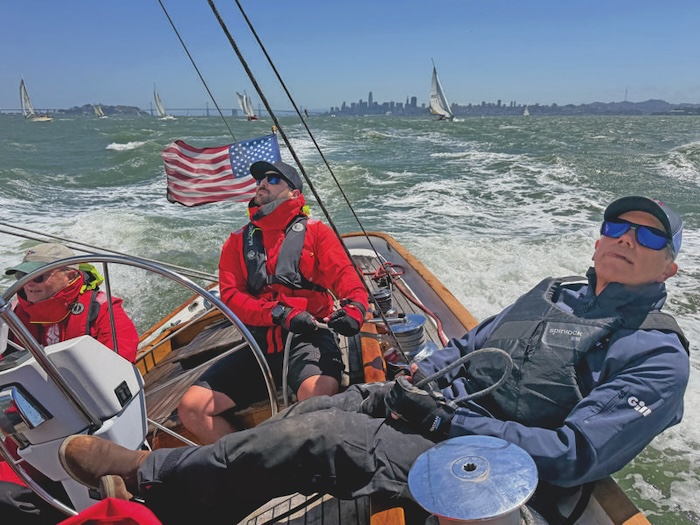
That’s the guy who’s reading this month’s story written by John Reese, our editor since early eighties. He’s written 10 billion words for latitude, every one of them excellent. But anyway, carrying on here, publisher John aren’t sailed aboard. John Eggleston’s spectacularly restored 56 foot P-class cutter, Waterwich, a local girl built in 1928 by the Stone Boatyard in Oakland. So she’ll be joining the 100 year club in two years.
22:51
Now John is no slouch when it comes to sailing. I guess he’s talking about me here, huh? In addition to helming latitude for more than a decade, he’s helmed several of his own boats to racing victories in various events. How is this level of skill and expertise utilized aboard Waterwich? My main role was rail meat, John says. That’s what I told him. The good news is that the rail turned out to be ringside seat for recording.
23:17
the events of the day, starting with water, which is own start with the rest of the Marconi one whose nine entries made it this year’s largest division. As the morning fog backed off and wing picked up, the Bay was choppy with soon to be fading ebbs says John. To keep it all interesting, the pre start included dodging boats heading out for the single handed Farallon’s race, 420 sprinting down the waterfront under Spinnaker and right of the middle of the whole dang show.
23:46
a Japanese Coast Guard ship passed right through the fleet. Other oldies but goodies this year included Hans Lis’s 32-foot Hana Ketch, sequester, built in 1940, Sandy Swanson’s 32-foot Winslow Sloop Black Witch, built in 1949, and the oldest yacht in the fleet and possibly the entire West Coast, Spalling Marine Center’s Freida, a 32-foot Cookson Gaff Sloop built in the beach in Belvedere,
24:13
by a saloon keeper in 1885. Matt Zaram from Spalding Marine Center was a Freeders helm this year. In addition to the Bears, other local talent, in parentheses, one designs on hand included a couple of 25 foot bird boats, San Francisco’s oldest indigenous one design fleet dating back to the 1920s, and several 38 foot ferrelon clippers, many of which were built upriver in Stockton in the late or in 1950s.
24:43
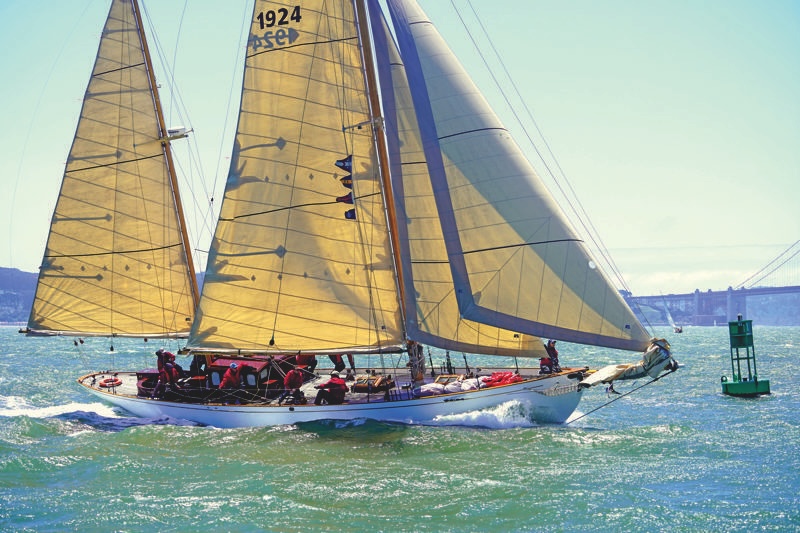
The queen of the ball, well, one of them, was also back. For the 49th year in a row, Terry and his daughter, Lindsay Klaus’s mighty 65-foot, Harrishoff schooner, Brigadoon, once again showed her heels to the Gaff 1 division. Not bad for 102-year-old. Brigadoon was built back in the East Coast in 1924, but she was so well-kept that you would be forgiven for thinking she was launched last week.
25:11
As icing on this year’s cake, and thanks to those small craft advisories, winds gusting, I’ve been to the 30s in the afternoon, Brigadoon set a new elapsed time record for Gaff’d One Division, beating her own time over the 17 mile course several years ago.
25:27
All boats mentioned so far easily meet the requirements to become members of the Master Mariners Benevolent Association, one of the largest and most active fleets of classic yachts in the country, built to traditional design and in traditional manner. So a newer boat, such as Ken Inouye’s lovely 53 foot, which is the wrong length, that was actually overall with bowsprit. The actual length is around 38 feet. uh Angleman Gaff Ketch.
25:55
Makani Kai launched in 1970, qualifies because she has a classic design built a plank on frame manner. Let’s see, Ken is also on the cover of this month’s issue and pick it up wherever you pick up your Latitude 38 or hopefully you subscribe, but you’ll see Ken on the cover on Makani Kai and of the July issue.
26:17
The Matthew Turner, launched in 2017, qualifies for the same reason. And speaking of history, no mention of this regatta is complete without a reminder of its origins. The first master mariner’s regatta was conceived back in 1867 as an in-the-bay race for commercial ships. The skippers flew the house flags of sponsors and all the money raised went to disabled sailors and the widows and orphans of sailors lost at sea.
26:45
which is where the benevolent part of the MMBA comes from. And speaking of which, house flags from sponsors are still flown on all of these ships. Anybody who wants to sponsor a boat in next year’s Master Mariners at Gata needs to get a flag and contact the Master Mariners Association and become a sponsor. It’s a great event. Latitude is sponsored for years. And we had our flag flying aboard the Eglston’s Boatwater, which this year, of which I was sailing.
27:15
Great fun. Local businesses donated awards to winning ships in the form of a ton of potatoes for the galley, a quart of wood for the galley stove, or a set of crystal goblets for the captain’s table. But the most coveted award for winning boats then as now was a silken gold fringe banner displaying a strutting gamecock and the word champion emblazoned in big letters. Second and third place boats got slightly less blingy versions.
27:43
And if you go to the master Mariners party after the race at the Anson O’Yacht Club, you’ll see winners, including Brigadoon with a long string of those strutting game cocks hanging from the top of the mass because they’ve won a lot of races over their 49 years of racing. Back then, the course crisscrossed, this is back then in 1867, back then the course crisscrossed the bay with the home stretch being a run down the city front from Fort Point.
28:12
present day Black Hollow Bowie, to the finish off Fisherman’s Wharf, where it was pre-live streaming days, half the city turned out to cheer on their favorites. These days, the fleet follows a similar bay tour, course, including a parade down the city front, but the stretch run is from Southampton Shoal to a finish line behind Treasure Island or to the east of Treasure Island. In the old days, captains and crews would spread out to saloons all over the waterfront.
28:40
These days, the fleet jams into docks at Enso Ya Club to celebrate their victories or drown their sorrows. Back on board Water Witch, the race was going well until the last jibe around the last mark. One of the features of the beautiful lines of Water Witch is that her elegant lines are undisturbed by lifelines and her low freeboard keeps her close to the water. On the jibe, near the Bob Klein buoy,
29:07
fellow rail rider, Elena Stevens was caught off guard by the deep water running down the new Lourdes rail and got swept off the boat. John says we were moving fast, so we got separated quickly. She waved a signal she was okay. And as we maneuvered to line up a challenging recovery effort, a spectator powerboat shadowing the race saw our signals and was able to follow our pointing to pick up Elena. They delivered to the Encelillac Club where we had an
29:37
extra reason to celebrate the day. Other than that drama was minimal this year. There were a few failed fittings, a broken block forced Frida to retire, but no broken stars, broken spars or broken bones, and no shredded sails, which considering the conditions is a testament to the designs, builders and the classy owners of these classic boats. Thanks.
30:01
To JR, John Reese, our editor for the writing and thanks to John Skoriak who gave a lot of input and photos to the story. uh Writer, photographer and everybody who competes in this race makes it a great event for the Bay and has got a history as I said going back to 1867. The end of June, many of these same boats that were racing were on display at the Corinthian Yacht Club, the Master Mariners Wooden Boat Show and that’s another great opportunity to get up and close and personal.
30:31
with wooden boats on the bay. Hey, good Jibes listeners and Latitude 38 readers. Have you looked in our classy classifieds lately? It would be impossible for us to know how many boats have sold to new owners over the last 45 plus years of publishing Latitude 38. But we’re sure they have helped countless people realize their sailing dreams. Every month there are new boats listed that will fill someone’s sailing adventures. If you have a boat you want to sail or are looking for that next boat in your life,
30:59
pages of Latitude 38 will surely have something to suit your fancy. Pick up a magazine at a local marine business or visit our classy classified pages at latitude38.com to find boats, gear, job opportunities and more. Then tell us your next sailing story. All right, one last story from our July issue for those of you who would like to listen rather than read. Hopefully you like to do both, but I’m going to…
31:27
Read your story from our Changes in Latitude section, which is filled with cruising adventures of West Coast sailors who’ve headed down the coast, often with the Baja Ha Ha, which people are signing up for the Ha Ha right now for 2026. We’d love to have you aboard and sailing with the 32nd annual Ha Ha this year. And we will bring you a story now from somebody who sailed down from Kingston, Washington, but now on their trip across the Pacific. So.
31:56
This story from Kehalani, a caliber 40, Chris and Tammy Frattini, they are from Belivian Magic and from Kingston, Washington. So their story from them. If pressed for a single word to sum up a month-long ocean crossing, relentless is the one I would choose, but magical would run a close second. This is the story of how my wife Tammy and I sailed Kehalani from Cabo San Lucas to the Marquesas Islands.
32:25
Tammy and I are not complicated people. Give us a solid boat, oh open water, a destination worth chasing, and we’re happy. Best friends for nearly 40 years and married for almost 10. We spent 30 of those years sailing in the Pacific Northwest. Having long dreamed of a big sailing adventure, we acquired Kea Hullami, a stout blue water cruiser and veteran of one circumnavigation in 2023 and spent a year preparing her to cruise offshore once again.
32:55
With new rigging and plenty of other upgrades, we sailed her out of Kingston, Washington in September 2024, headed for Mexico with San Francisco as our first stop. We continued down the Pacific coast to the Sea of Cortez where we spent a year. We loved the people, the places, the food, and the remarkable cruising community. It was an unforgettable experience and we were reluctant to leave, but we were ready for more.
33:22
In October 2025, we began planning our South Pacific Passage. As the storied gateway to the South Pacific and a place Kehlani’s former owners had loved deeply, the Marquesas were the obvious first stop. After the customary repairs and upgrades, by March 2026, we were as ready as we could be. We engaged a couple of sailors to crew with us. Peter, who crewed our Seattle to San Francisco Passage, and Jeff, a new face.
33:51
They met us in Cabo for an early April departure. Interestingly, Cabo is one of the shortest routes to the Marquesas, second only to San Diego. With the boat provisioned for 40 days and a weather window opening up, we set sail on April 3rd heading west into the blue Pacific. One aspect of our passage made it peculiar. It was a range of activities our crew was engaged in. Peter and Jeff
34:18
had been working on a web-based business venture for nearly two years. The testing and go live phases of their launch were due to happen at the same time as our scheduled passage. I guess this is the new world of cruising. Not wanting to miss the opportunity, they decided to proceed while at sea. Meanwhile, Tammy was nearing the completion of a lifelong goal, a degree in government. With her final semester coinciding with our passage,
34:45
She had to attend classes and complete finals while underway, which proved no easy feat. I handled the boat while the crew hammered away on keyboards, held meetings, attended class, and filmed videos for assignments. Once clear of the coast, the sailing was pleasant. Mild and sometimes elusive winds accompanied the customary and unpleasant North Pacific short and steep swells. As polywags, i.e. sailors who have yet to cross the equator,
35:16
We had learned about squalls from books, movies, and online videos is somewhere around the fifth parallel north latitude that we spotted the oddly well-defined cluster of ominous clouds rapidly approaching from the northeast. Not wanting to turn into George Clooney in his famous nautical film, we shortened sail and braced. Within minutes, a wall of wind hit us like an angry elephant in our quiet afternoon of lackluster sailing turned into an epic downpour in a moderate gale.
35:46
Thanks to the reef early, reef often mantra, we rode out the squall on a comfortable broad reach while taking the soaking of our lives as a warm horizontal river of rain tore through the cockpit from port to starboard. Half an hour later, as abruptly as it arrived, the squall passed and we settled back to light and variable winds. The cockpit remained animated for some time, childlike reenactments and everyone laughing hysterically.
36:15
Glad to have that first one behind us, inspecting it was the first of many. Beyond the coast, progress slowed considerably. When we finally reached the northern edge of the intertropical convergence zone, it had expanded to 400 miles with little to no wind in the foreseeable future. The dreaded doldrums. Having worked out our fuel consumption, we decided to motor sparingly and sail whenever winds offered any forward progress. Days later,
36:44
After sailing at two to three knots for almost a week, we reached the equator. Exhausted but happy, we toasted Neptune, celebrated our promotion from polywags to shellbacks, and went for a swim in the bluest water we have ever seen. Three more days of light winds and strong westerly counter currents followed before we finally found the southern trades. Once they arrived, we flew. Full sails and broad reaching at hull speed are better. Our best three-day run,
37:14
covered 458 nautical miles, spirits were high. Going from a warm bunk to a wet, windy cockpit is rarely appealing, but one morning on the 3M watch, I settled in and in short order felt like a contented outside dog hanging, keeping watch on the house and its people. There was something simple and pleasantly purposeful about it. Even the extreme constant rolling felt weirdly ordinary.
37:41
The bioluminescence along the windward side lit up the hull like neon lights as we slid down each swell. It was magical and mesmerizing. The passage reminded us that long journeys like these are uniquely mindful experiences. Cruising, we concluded, is simply moving your house with everyone and everything in it from one amazing place to another. There are fun moments and hard moments. During the latter, the journey becomes an inescapable chore.
38:10
and prerequisite for enjoying the spoils. Relentless indeed. By Journey’s end, the damage list included boom vang bracket ripped out of the mast base during a squall, electric bilge pump float and alarm switch dead, a mystery saltwater leak somewhere on midships, manual bilge pump diaphragm shot, engine hour meter dislodged and lost somewhere in the lazarette, steering chain broken during another squall. This one took some time.
38:40
to fix and a genuine leech strip shredded during a botched furling job. There is likely more we have yet to find. Landfall in Nukahiva was unforgettable. About an hour from the bay entrance, daylight settled in and as if on cue, the wind veered and kicked up. The skies opened up to a downpour of biblical proportions. We were all on deck and laughing like children as we took another soaking in stride. As we entered the beautiful
39:09
Tai-oi. Gosh, this is a tough one. Tai-hoi, Tai-hai-bay. The rain stopped and a beautiful morning greeted our triumphant arrival. The scenery was worthy of Jurassic Park, the fragrance of the sweet fertile soil overpowering. We were reminded of our arrival under the Golden Gate Bridge in 2024. The cast almost the same. A soft gaze, deep slow breaths, eye contact with mate crouching at the lifeline.
39:38
the same quiet smiles and misty eyes. 28 days, 2,950 miles, a different hemisphere, a different time zone, from spring to fall with no summer in between. We bloody made it. Thanks, Chris. Sounds like an incredible trip. I know many of this year’s Baja Ha Ha participants have their eye on the Pacific following the Ha Ha. Maybe they’ll take another year in Mexico.
40:06
because so many of the people who do the ha ha and plan to do the Pacific find out Mexico is an awesome destination and want to hang on longer. But your trip sounds amazing, both in Mexico and all the way across the Pacific. Of course, I don’t know where you’re headed to next, but we’ll look forward to hearing more from your sailing adventures. And to all you ha ha ha ha sailors, but also Latitude 38 readers and Good Jobs listeners,
40:32
Thank you for listening to this episode, number 251 of Verbatim, a version of Good Jibes, which brings you a story from current or recent issues of Latitude 38. And if you like this podcast or any of our podcasts, we hope you give us a five-star rating, share it with friends, let others know about Latitude 38 and our Good Jibes podcast. There’s an amazing collection of good episodes that you can find on Spotify or Apple podcasts or on our website.
41:02
And we’d love to have you subscribe to Latitude 38 or subscribe to our electronic latitude newsletter. We have some more great stories in every issue of the magazine going back to 1977. And if you’re keeping track, that means our 50th anniversary will be coming up in spring of 2027. So thanks for listening. Thanks for reading. Hope you’re enjoying your summer of sailing on the West Coast or wherever in the world you’re unfurling your sails.