

Episode #250: 2026 Scuba Show On Location With Host Ryan Foland, Part 2
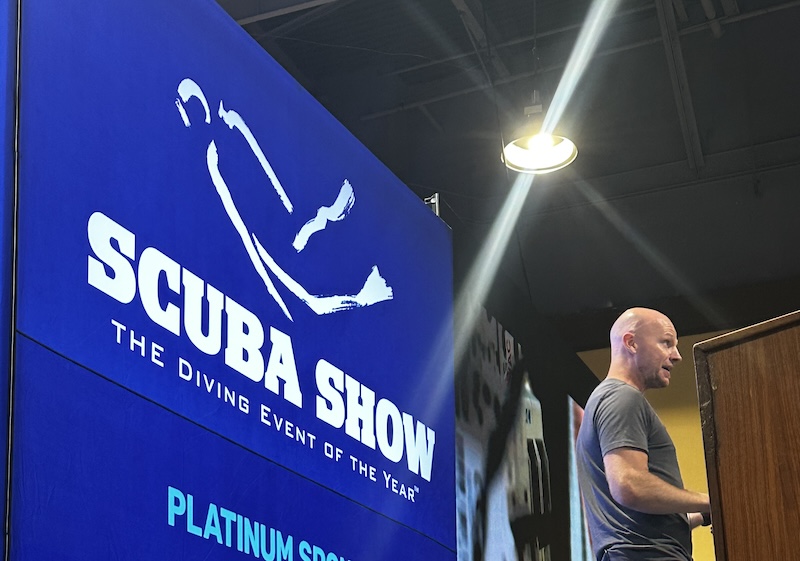
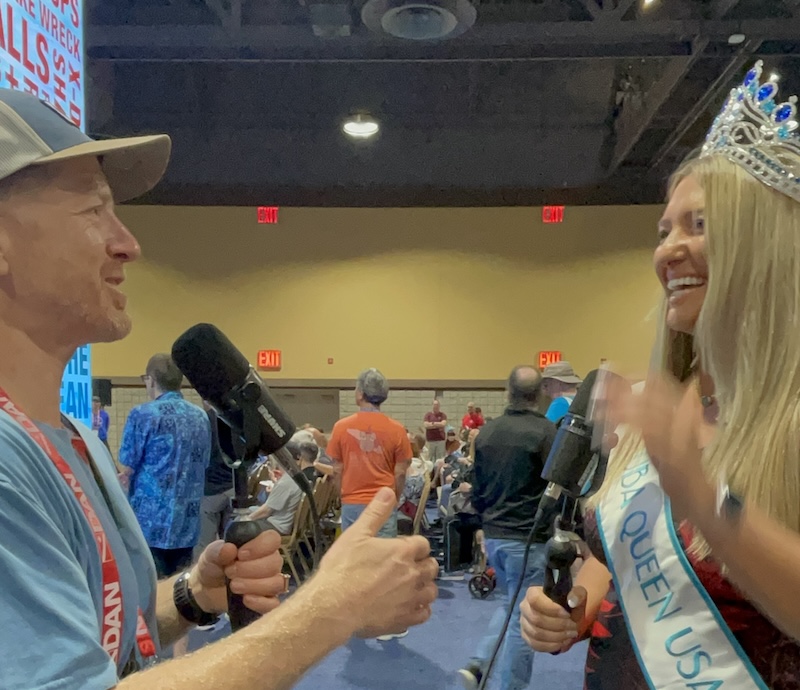
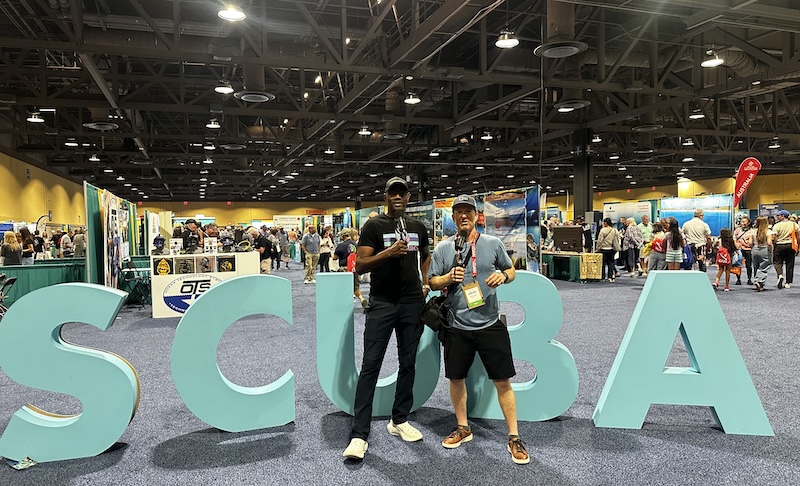
This week’s host Ryan Foland joins us on location from the Scuba Show in Long Beach on May 30-31, to go behind-the-scenes at the diving event of the year.
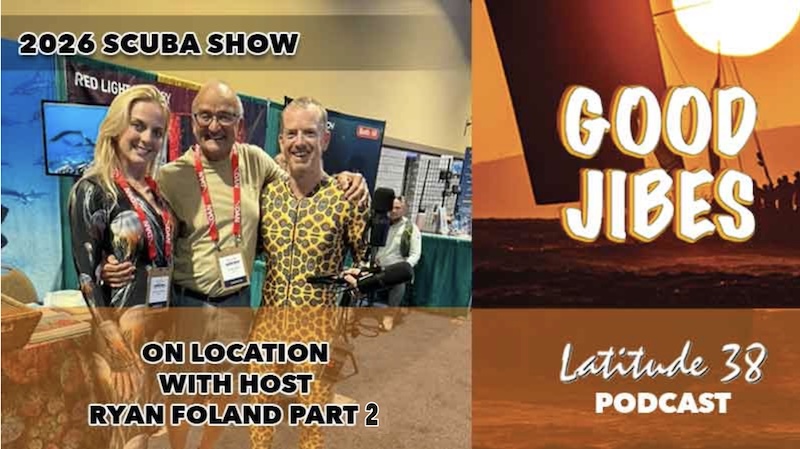
In this Part 2, you’ll hear the unbelievable survival story of saturation diver Chris Lemons, what was going through his mind in what he thought were his final moments, a tiki bar with tiger sharks, a scuba cat, and Ryan finally finding the perfect skin-tight outfit for life on the water.
Here’s a small sample of what you will hear in this episode:
- Why Chris thinks he survived his extreme diving incident
- The documentary Last Breath (2019) versus the 2025 Hollywood film, and how each portrays the story
- Meeting Mark Evans, new co-owner of the Scuba Show
- How local divers find shots no one else can
- Beqa Lagoon Resort talks tiger shark dives and marine conservation in Fiji
Listen to the episode on Apple Podcasts, Spotify, and your other favorite podcast spots – follow and leave a 5-star review if you’re feeling the Good Jibes!
Learn more at ScubaShow.com and connect with Ryan at Ryan.Online
Check out the episode and show notes below for much more detail.
Show Notes:
- Part 2: 2026 Scuba Show, On Location with Host Ryan Foland
- [0:14] Welcome to Good Jibes with Latitude 38
- [0:42] On location at the Scuba Show in Long Beach
- [3:24] Chris Lemons walks through the helmet-cam footage of the incident
- [6:11] The umbilical wraps over the structure, and the dive bell isn’t where it should be
- [9:26] Communications cut out, tension builds on the umbilical, and Chris becomes an anchor to a 10,000-ton vessel
- [12:27] The umbilical snaps and Chris falls 30 feet back to the seabed in total darkness
- [16:21] Climbing back to the top of the structure expecting to see the dive bell and finding nothing but silence
- [18:34] Running the numbers on remaining gas and coming to terms with the likelihood of dying on the seabed
- [20:16] What goes through your mind in those final minutes
- [24:08] The crew loses control of the vessel entirely, and an ROV with a tether finds Chris using a beacon ping
- [27:01] The “Swedish solution” finally lets the crew regain control of the boat
- [28:31] Dave reaches Chris 35 minutes after he ran out of gas and begins the rescue
- [30:44] Duncan pulls Chris into the bell 41 minutes after he ran out of breathing gas and resuscitates him with two breaths
- [34:08] Why Chris thinks he survived
- [36:53] The documentary Last Breath (2019) versus the 2025 Hollywood film, and how each portrays the story
- [38:23] Meeting Mark Evans, new co-owner of the Scuba Show, on bringing the event to four countries and trying to attract younger divers
- [44:18] Mark’s own favorite dive destinations (the Red Sea tops the list)
- [48:33] Audience Q&A with Chris Lemons
- [59:44] Chris on leadership and preparation
- [1:08:53] A stop at the Beqa Lagoon Resort tiki booth to talk tiger shark dives and marine conservation in Fiji
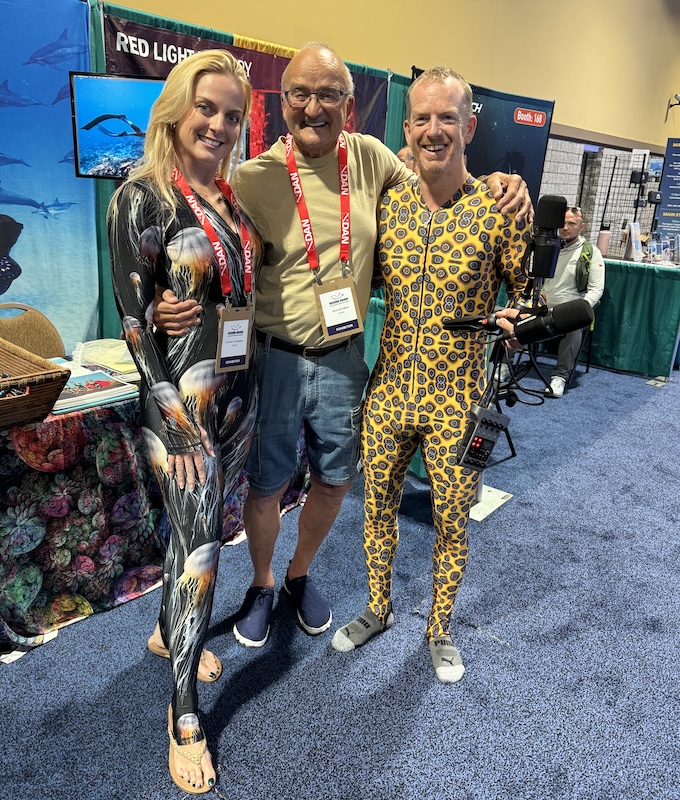
- [1:14:09] Getting talked into a Slip Ins blue-ring octopus dive skin for the road
- [1:22:29] Closing out at the GoPro booth – how local divers find shots no one else can
- Check out the June 2026 issue of Latitude 38 Sailing Magazine
- Make sure to follow Good Jibes with Latitude 38 on your favorite podcast spot and leave us a 5-star review on Apple Podcasts
- Theme Song: Pineapple Dream by SOLXIS
Transcript:
Please note, transcript not 100% accurate
00:03
But there was nothing. There was not a speck of light and not a sound in the sea above me.
00:14
And welcome to what likely will be the second edition of this year’s behind the scenes podcast with Good Jibes at the Scuba Show in Long Beach. We had so much content. I’m assuming this is the start of the second episode. Latitude 38 brings you Good Jibes, which is a podcast to talk about all things sailing. And today you’re going to hear the second episode of my experience talking with all kinds of fun and interesting people at the Scuba Show. So enjoy.
00:44
the scuba show.
00:48
This is taken from my helmet camera. But Dave and I were working right inside this structure that I told you about. So maybe about 30 feet inside on the bottom. And we were in the process of removing a section of pipe work, basically. em
01:03
We were doing some pressure testing, as I’m sure you know. One of the biggest dangers to divers subsea is differential pressure, particularly in a working environment. So if the internal pressure of the pipe work is significantly lower than the ambient pressure of the water, then you can get sucked in. So we’re always very conscious of that. We had a big hose, a two inch hose coming down from the vessel, plumbed into the structure to allow us to test the pressure on either side and isolate this pipe work before we took it out.
01:31
But this is the kind of thing we do every day, very routine. The conditions that night were actually quite good. As I mentioned, nine days out of ten, you can’t see your hand in front of your face, but that day the visibility was actually quite good. The diving bell, which we always make sure we keep above any subsea structures. We always hold it maybe 15 feet above anything below the water to make sure we don’t catch it on anything. We’re sitting above us clear. We can actually see it from where we were working, which is pretty unusual in itself. So there was really no indication, I suppose, of what were to come. It really wasn’t.
02:01
normal day at the office until we heard the alarms. For us on the bottom, hearing alarms is not an unusual set of circumstances. We have inside our helmet a microphone and an earpiece which gives us an open line of communication to a single point on the boat which is a dive supervisor which is the job that I do now. And what you can also see here though is everything going on in the background in dive control where he sits which is usually other divers saying how much better they were at it back in their day, you know it’s the same everywhere isn’t it?
02:30
But you can also hear the various alarms going off. There are oxygen alarms, carbon dioxide alarms, hot water alarms. We have two diving bells on that vessel. So when we launched the other bell, you can hear the alarms being tested for that as well. So I guess the point I’m making is it wasn’t particularly panic inducing, maybe a little bit louder than normal. It definitely got our ears to prick up a little bit. But quite quickly after that.
02:54
Our dive supervisor, Craig Frederick, that night, was a Canadian, told us in no uncertain terms really that we needed to put our tools down and we needed to get ourselves out of the structure and back to the diving bell. And it was just something in the tone of his voice, something that told us this wasn’t a drill, this wasn’t normal. He didn’t really explain what was going on. He perhaps didn’t need to. But we didn’t panic at that point. We basically just did what we were told. We put our tools down. And as it says there, we made a fairly orderly exit from the structure. So again, this is the real footage from
03:24
camera and you can see Dave making his way out in front of me and you can also see my umbilical that I talked about a minute ago running away there as well. We have a real mantra in diving because that is a giver of life that you know that is everything we need to sustain us in these obviously very inhospitable conditions that whenever we’re moving around or whenever we’re moving the boat around umbilical management is king is what we say and so whenever we’re moving we always carry it in our left hands because there’s a myriad of pipe work of valves
03:54
of bolts, all sorts of things you can catch that umbilical on so you’re always very conscious of where that is. Most structures we work in down there are not really well suited to divers, they haven’t considered designing that that sort of maintenance if you like, but this one was pretty new, it was actually quite open, I’ll show it to you in a minute, had good access, good egress, so in truth we were able to make our way out of the structure fairly quickly and fairly easily and I think maybe within
04:19
20 seconds or so, we had actually dropped down outside the structure onto the open seabed without any problems. But that really is, I think, where the confusion started because the diving bell, which we had left right in front of us with our umbilicals running straight back to it, wasn’t there. I don’t think at this point I processed what was going on above me.
04:42
You really just have a very singular mindset when you’re down there, particularly as a saturation diver. As you know, scuba divers, there is always the option of bolting to the surface. If you run out of gas, for example, it’s never a good idea, it? But we can potentially mend that. As a saturation diver, that’s just not an option. If you were to go straight to the surface from
05:00
300 feet, having been saturated with gas, you’re going to die pretty quickly from explosive decompression. not going to be a nice way to go. So you only think of one thing and one place, and that is the safe haven and the breathable environment of the diving belt. It’s pretty easy to find in all conditions, really, even with really poor visibility. I’m a dive supervisor now, as I mentioned.
05:23
I do occasionally have to tell divers where it is if they ask and I’ll say to you what I say to them, which is, you know, it’s at the end of your umbilical, you idiot. uh our umbilicals, instead of being in front of us, were actually wrapped back over the top of our heads and over the top of the structure we’d been working inside. So we turned to start climbing them. We’re weighted negatively, we’re negatively buoyant so that we can operate on the seabed. So that’s a job which takes two hands.
05:51
So as we start climbing, Duncan, Duncan Alcock who was the guy in the bell that night, is able to start coming up on the slack of the divers, the umbilical slack. He can only do one of us at a time. He chose to do Dave first, you’d have to ask him why. ah But that means that as I’m climbing, I’m leaving a loop of umbilical behind me.
06:11
It comes into a harness that we wear, it’s attached to our waist by a pretty strong carabiner, you know, for good reason. But that, yeah, as I said, as I’m climbing, that means I’ve left a loop. And when I get to the top of this structure, I turn to make sure it hasn’t caught on anything, because as I said, we’re always conscious of that. But ultimately, as you see, and as you perhaps know, I failed in that endeavour. Up on the bridge.
06:34
they have suffered a catastrophic failure of this dynamic positioning system that I talked about. as with all our life support systems on the boat, we have multiple backups. So the computer has a backup computer and there’s a backup to the backup.
06:46
That single point failure is just not supposed to be possible. But that’s exactly what happened. We lost all three due to a bus fault, an electronic fault. Just something we hadn’t considered. We hadn’t risk assessed. We hadn’t risk managed because we in our minds, naively as it turns out, completely assumed that we were always protected by that redundancy. So again, you know, a massive lesson for us that night. But that means that now this boat is suddenly at the mercy of that 35 knot wind and that six meters or that 18 feet of swell.
07:16
and has become a sailboat drifting away from us and it’s drifted over the top of our heads, over the top of the structure, dragging the bell and our umbilicals with it.
07:27
For me on the bottom, that footage belies it’s looped slightly for dramatic effects in the documentary, makes me look a bit silly really. That happened extraordinarily quickly. I turned to make sure, when you see the real thing, I turned to check it hasn’t caught on anything and I knew straight away, instantly really, that I was in very serious trouble. My sort of initial concern, I can show you the structure actually.
07:54
This is actually where it is. if you can see right of where it says West, there’s what’s called a transponder, basically. We shouldn’t have been there, but that’s another story. And I’d gone to the right of that, and my umbilical has gone to the left of that. So my umbilical is passing through a little.
08:09
two and a half, three inch gap through the bottom. My umbilical is about two inches thick. But my initial concern is not so much that it’s been caught, it’s that it’s still slipping. It’s still, as the boat is moving away and dragging us, our umbilicals are only about 150 feet long, so there’s only so much slack they can give us. It’s slipping around the bottom of that gap.
08:29
and it was pulling me down into the top bar of this structure. My legs were splaying. And I remember thinking, you know, my legs are going to break here. This is going to hurt. And then secondly, I thought, I’m glad you find that funny. Secondly, I thought if this continues to slip through this gap, I’m going to get pulled through there with it. And that’s going to be like being pulled through a cheese grater. And that’s not going to be a great way to go either. Thankfully, though, and I guess with some degree of irony, the umbilicals stopped slipping.
08:59
But that effectively means that I’ve become an anchor uh to a 10,000 ton vessel. And obviously there’s only ever going to be one winner in that situation. The boat continues to move away and that starts to put massive tension, massive strain on the umbilical. I am begging them, pleading with them far less politely than that to give me some slack. They’re telling me in no uncertain terms I need to get myself back to the diving bell. But very suddenly… um
09:26
a like a jack being pulled out the back of a speaker. um I think the communication or the power cord must have got severed and suddenly I couldn’t hear them and they couldn’t hear me. I remember even in the midst of that situation, which I won’t pretend anything other than the fact that I was panicking and was frightened. oh
09:45
uh I remember that distinctly being a very lonely feeling, know, that feeling suddenly of having somebody to talk to, somebody to help me, and suddenly not being able to hear anybody at all being a, you know, a scary thing. Massive tension continues to come onto that umbilical though, and nobody can sense that more than Duncan, who’s up in the diving bell.
10:03
So again, that’s real footage from the night and that’s a stainless steel rack being peeled off the wall by the tension on the umbilical. Exactly as Duncan describes, if you can understand his accent. ah If that had been ripped from the wall and hit him and pulled him down into the water with us, there’s just no way any of us would have made it home that night.
10:22
For me on the bottom though, think the next thing to go is the tension continue to come on. I think the gas hose must have become stretched and kinked to the point that suddenly and very abruptly I had nothing to breathe, which you can probably imagine is never a good thing, is it? But it is something we train for as divers. We might occasionally turn a diver’s gas off just to see how he reacts. We shouldn’t, but we do. ah And certainly as commercial divers, you train for that a lot, that situation. And despite what you might see in the movie,
10:52
where there’s a lot of explanation to that. It’s a very instinctive thing to do when you don’t have anything to breathe. We have a knob on the side of those Kirby Morgan’s just to open the emergency supply of gas that we have on our backs. So suddenly I could breathe again. But I’ve put zero minutes on the screen because that puts you in a very, different world. You’ve moved from a world where you have this essentially infinite supply of gas, as I described to Omnia, you have a very finite one.
11:19
If you’ve seen the documentary about this, they make big deal of about five minutes. If you do the maths based on where I work, it’s more like about nine. But we’ll never know. We don’t really have any frame of reference for this at all. But very little gas, in an emergency situation to get yourself back to the diving bell.
11:37
Dave, who’s in the water with me, as I described, our umbilicals are only about 150 feet long. I think we must have got to the point where the vessel, the boat, was already about 150 feet away from us. So he turns to try and get back and help me. But he can only get to within maybe two or three feet of me. But he explains it far more eloquently than I do.
11:57
I don’t have a distinct memory of the sound of the umbilical breaking. Dave describes it as a very violent event, like a shotgun being fired. I do have quite a distinct memory of that face-to-face he’s talking about. If you have seen the Hollywood version of this, think he says something to me like, I will come back for you. But we couldn’t speak to each other. That never happened. But I do have a memory of the of the eyeball-to-eyeball moment where I’m looking into his eyes and unable to speak to him, but basically pleading with him to help me.
12:27
and he’s essentially saying, I’m sorry, my friend, you’re on your own. And just like a movie, he was dragged away from me into the darkness, but I could still see the light on his helmet. And then as he’s pulled away by the boat, I lose sight of him as well and essentially never, never see him again. Dave is in no small amount of danger himself. He’s pulled from the top of that structure. The boat is moving away at about four knots. So pretty quickly, he has to pull himself along 150 feet of umbilical with other structures
12:57
things down there that he can catch himself on. He describes it as putting himself back through a river of treacle really. He’s a very, very fit guy, like a sort of rock climber live kind of physique. The vessel above him is moving around erratically. It’s actually rotated twice through 360 degrees. So when he does finally get himself back to the diving bell, his umbilical is wrapped and tangled all around it. So he’s got to undo all of that. He says by the time he gets onto the little stage that we have under the diving bell, he was exhausted.
13:27
point, know, he says that was far more difficult than having to come and rescue me later on, so difficult times for him. For me, when that umbilical snaps, it releases the tension on me, so I fall backwards from the top of the structure and fall the sort of 30 feet or so back down to the sea bend and land on my on my back like a bit of an upturned turtle really, and I remember pausing for a moment in disbelief really, I think. uh
13:53
I still have that thing, don’t think I processed what was happening above me. It just seems slightly surreal to be honest. I can also remember the darkness being like something I’ve never experienced before or since really, an absolute darkness in which I couldn’t see my hand in front of my face. It’s a…
14:09
There’s a lot of you know, I’m sure it’s a disorientating place to be, place to be at the best of times, isn’t it? Under the water. For me, even with a light and a compass and somebody telling me which way to go, I’m still easy to make a fool of yourself. But with none of that, it was hard to tell which way was up or down even at that point.
14:25
I didn’t think a lot. It’s very much, I think, or flight at that point. And my thoughts were simply about, I must get back to that diving bell. And for me, that seemed to mean finding the structure, climbing to the top of it, and seeing if I could find some way to swim back. But in that darkness, when I of stumbled to my feet in an ungainly fashion, it was so absolute that that enormous structure that you just saw, which could only have been six foot from me, I had no idea where it was.
14:51
So very much like you going to the restrooms in the middle of the night last night, you you put your hands out in front of you and hope for the best. I set off in, yeah, in hope more than expectation really and…
15:02
don’t like talking about luck too much, but you could consider that we had an enormous dose of bad luck and then definitely a huge amount of good luck after this that means I’m stood here today. And one of those was absolutely that I took just a couple of steps and bumped straight into what I assumed was a structure. I couldn’t even see it when I was touching it, but it felt metallic. I could very easily have turned and walked out in any of the other directions into effectively no man’s land, which would have rendered finding me and subsequently rescue me infinitely more difficult.
15:32
difficult. But I did find it and I sort of…
15:36
I remember being worried that I would lose it, so I kind of edged my way along it, looking for a way to climb up, but it was quite open, so it was quite difficult to find something obvious to get hold of. But eventually I bumped in on my forearm, bumped into what I later found out was the pressure testing hose I talked about. So a two inch rubber hose coming down from the ship. As the vessel had moved away in that uncontrolled fashion, it had been ripped off the back deck and fallen through the water column over the top of the structure I was working inside. And it just had enough weight
16:06
it enough purchase in it for me to be able to climb to the top which is what I did. But when I got to the top up to the level with the top of the structure that was a seminal moment really because for some reason I thought I just assumed I would see you know
16:21
Duncan, Dave, in front of me, the diving bail there lit up. We’d all go back, we’d have a cup of tea as we Brits do, have a laugh and joke about what had happened, somebody maybe give us a medal, I don’t know. ah And it would all be fine and we’d move on like we always did. um
16:36
But there was nothing. There was not a speck of light and not a sound in the sea above me. And that’s very much the moment where I realised that this was transition from this panicky, frightening situation into uh one which was potentially life-threatening.
16:52
So the beginning of some tough moments, I suppose, for me. But Duncan up in the diving bell, the communications to the bell have been uh severed or tripped out because of the umbilical breaking. So he doesn’t really know what’s going on, but he’s still got to pull in that umbilical.
17:11
don’t have too much time to talk about Duncan today. Unfortunately, a very wonderful man. I don’t know how much of that you can understand. He has a very thick accent, which even we people in England struggle to understand. Duncan was wonderfully portrayed by Woody Harrelson in the movie they played. It was great that he got played by someone so sensitive to it. So, yeah, a great man who has never let anybody down in his entire life, as I’m sure you can probably tell.
17:34
For me on the bottom though, I was on the edge of the structure. I remember being concerned that I would be blown off the top. There was a bit of a current and it was so dark I couldn’t tell where the edge was. So I kind of climbed or crawled, sorry, hand over hand across the grating of the structure, craning my neck up, looking for any kind of sign of life. But it dawned on me very, very quickly that I was powerless to do anything to save myself. My ability to be buoyant, so to inflate a jacket that we do wear, had been lost along with my umbilical that had been severed.
18:04
even if I could see the bell, there was no way I could swim up to it. My maths isn’t great at the best of times, to be honest. I remember thinking, you know, I’ve probably got eight or nine minutes of gas in the bottles on my back. I’ve probably used five or six minutes of this already, breathing hard, panicking, fighting my way back up to the top of the structure. I can remember thinking, even if Dave had been stood right in front of me, ready to pull me back up to that, that breathable environment of the diving bell, the margin between me getting in there and my hat off before I ran out of gas was
18:34
already very, very fine, very small. But with no sign of anybody, it dawned on me pretty quickly, I think, really, that in all likelihood, this was going to be the place and the time that I was going to die. But that had a strangely calming effect. I can almost remember when that, I won’t say hopelessness came over me, but that realization came over me, that panic I was feeling.
18:55
pretty much drained out of my body. remember almost it draining straight out of my feet. I was certainly trying to regulate my breathing, trying to calm myself down to extrapolate or, you know, lengthen out the gas that I had in my back for as long as I possibly could. But I think that almost happened automatically. The body almost calmed itself. I would have been hypothermically cold pretty quickly at that point. Once that hot water has gone, we can turn it off in a valve when we’re too hot. You know, it’s seconds before you feel utterly freezing. So I don’t really have a memory of
19:25
which is slightly strange. Maybe the body just shuts off unnecessary input, I don’t know, but I would have been very, very cold very quickly, which I suspect would have slowed my breathing rate to near nothing and then eventually my heart rate to nearly nothing as well. But yeah, the beginning of some difficult moments, I suppose, at that point for me on the bottom, but also for Duncan up in the bell. I don’t really like to…
19:48
labor those final minutes too much, suppose. I certainly feel I can appear a bit of a fraud, a of a charlatan in that obviously I’m stood in front of you today. I was going to say healthy and well, but we’ll say well anyway. People get notional death sentences every day, don’t they, through cancer diagnoses and things like that. But obviously it was an unusual and slightly unique set of circumstances to have that luxury almost, I suppose, of contemplating what I thought was going to be my impending death.
20:16
You know, I’m pretty selfish at heart, we all are really. So you do worry about yourself, but your thoughts turn pretty quickly, I would say, to the people you love and the people you’re lucky enough to have love you. The enormous damage that your death is going to cause logistically and emotionally to everybody at home. The unnatural order, I guess, of your parents being told, or my parents being told of their son dying before them.
20:42
What have I got on my internet browsing history? That’s not true, that’s the truth. I’m making that up. But I was in my early 30s, know, I had the hopes and dreams, I guess, of a life well lived in front of me, like I hope we all still do today. you know, for me, I in the process of building, physically building a house. And I remember thinking I won’t see the end of that. I was getting married the following year, although that didn’t work out, so I shouldn’t have worried actually.
21:10
But yeah, you know, the hopes that we all have of a life well lived, of travel, of coming to Long Beach to speak to you, of having children, you know, all the wonderful things that life can bring us. it felt that not just that these things were about to be ripped away from me, but they’re about to be ripped away from me in this ethereal, lonely, dark place. You know, I’ll never pretend to be anything other than a middle class boy who grew up in Cambridge in England, born in Scotland, though. But…
21:39
I remember thinking, how on earth have I ended up here? How has this happened? Why is this going to be the place that I die? why didn’t I work a little bit harder at school? Yeah, strange moments, moments I’ll never forget. As I say, I don’t like to label them too much. I don’t feel I’d given up hope. I was definitely hoping, but thankfully.
21:59
Those above me definitely hadn’t given up hope. I feel like I’ve got a fairly lucid memory of those final moments. As I said, I strangely don’t have a memory of being cold. So maybe I’m just making all this up or as I said, maybe the body shuts down unnecessary inputs. But I do remember it taking a lot longer than I thought it would. We do carry a gauge to tell us how much breathing gas we have left, but it was so dark I couldn’t make it out. you know, that was probably a good thing in retrospect. That would have been, you know, watching a countdown clock basically and panic inducing probably.
22:29
We don’t, as I said, we don’t know how long it lasted up at nine minutes up there. We only really have my memory of this, which I’ll explain in a minute. But yeah, what I do remember the pretty distinct, the sort of final moments, you know, don’t know, I’m sure there’ll be people in the audience who’ve had the misfortune of breathing down a scuba bottle, you know, not to you. But you know what it’s like, don’t you? When you get near the end, it gets a little bit harder to suck that last bit of gas down, doesn’t it? And that was very much like that. I can remember feeling that. And I remember thinking, you know, here we go. This is it.
22:59
I hope it doesn’t hurt. I hope my hat doesn’t fill with water. I didn’t want drowning to be the way that I died for some reason, you know? But that very final moment of passing effectively into unconsciousness, I think in truth what happened is probably just before I ran out of gas, the carbon dioxide would have started to build up in my hat as it wasn’t forced out and that probably put me under.
23:21
But yeah, I describe it as you going to sleep last night, tremendously excited about coming down here today to watch Liz principally, who’s after me obviously. But that sort of final moment of passing into unconsciousness effectively, you don’t remember. And it was very much like that. And again, I feel like a bit of a fraud. I get emailed all the time by people all over the world who’ve lost loved ones in wartime and things like that, asking me what it’s like to die. clearly and quite obvious self-evidently, I don’t have the right to tell them.
23:49
But the comfort I offer them sometimes, and I certainly offer to myself, is that if that’s what it’s like when my time does come, which it inevitably will, it was okay. It was a pretty calm passage into what I thought was going to be death. And if that’s what it’s like when it comes, I can just about live with that.
24:08
My part in the story, not that I do much as you might have noticed, is effectively over at this point. The vessel at this point is nearly 750 feet away from our position. ah The crew are desperately trying to regain control of it. They’ve had to go downstairs and wake the captain up. He was a 25 stone Norwegian covered in tattoos. The bravest thing anybody did that night was waking him up, dragging him up to the bridge. He and the chief officer are desperately trying to regain control of the vessel but ultimately unable
24:38
to do so because they kept tripping, not through any fault of their own. So there was no way for to get back to me. Dave can’t reach me because his umbilical is only 150 feet long. But what we did have in the water was an ROV, a remotely operated vehicle, that had a tether, a flying camera basically with a bit of a manipulator on, that had a tether that was about 300 feet long or so.
25:01
900 feet long beg your pardon and they got a ping off a beacon that I was wearing and they were able through range and bearing to swim that over to my position which gave you that slightly harrowing footage I guess that I showed you at the beginning and because it’s fun I’m going to show you some more so here we go. Yeah I’m showing this for a couple of reasons really.
25:20
Firstly is that you can see a water line in the helmet. When Dave finally gets back to me, he describes it as being half full. There is an oral nasal, as you may know, in that hat, but that doesn’t sit tight to your face. So how I didn’t drown, I don’t know. ah Maybe my esophagus was shut. We’re really not sure. You can also see me twitching in a slightly unnatural fashion.
25:41
Some people wonder if I’m waving at the camera, which is kind of thing I might do, but I promise you I’m not waving at the camera. We’ve hypothesized that that might be oxygen toxicity. You know, we talked about briefly at the beginning. I suspect not. I don’t think.
25:54
you do when you do the maths, it doesn’t really work out. I think more likely, and I’ve been informed by better educated people than me since, probably hypercapnic poisoning, so that buildup of carbon dioxide in my helmet at the end, you know, would have basically poisoned my bloodstream towards the end there, and that apparently is symptomatic of that, this unnatural twitching. But that also may have saved me, but I’ll come to that in a minute. But the most probably important thing about this really is I’m only showing you a minute or two of this footage.
26:22
The guys, and I’m not going to talk about trauma today, but I will tell you that the three of us in that water that night, we don’t really feel we suffered any trauma. We almost had the euphoria of coming through this. It’s been a positive experience in our life in a strange way. But many of the people that night on the vessel, 110 of them up watching this live on screens, for many of them watching a colleague, and hopefully for one or two at least, a friend effectively dying on the seabed.
26:49
because this footage goes on for nearly 40 minutes and after about four or five minutes I stop twitching and I lie there completely still for well over 35 minutes.
27:01
something that would have had profound professional and personal implications for everybody that night. And I only make the point really, you know, if you’re ever unfortunate enough to be involved in a traumatic incident of any kind, it’s often not just the people involved who are affected, it’s very much those who witnessed these things that suffer as much, if not more. So it’s just worth pointing out, I think. Up on the bridge, as I said, they’re trying to find a solution to this. I think in the movie they do a bit of rewiring, but they didn’t really do that.
27:31
The truth is they found a solution which we’re all familiar with.
27:34
They’re a Norwegian crew principally on board. They call this the Swedish solution. I don’t think it’s meant as a compliment. It’s like you call it the Canadian solution, you know, in that they turn the computer off and then they turn it back on again. So it’s always worth a try. You know what I mean? Why they didn’t do that earlier? Well, you can ask me about a bar later if you want, but there we go. But that does reset that computer system. And that means that they then have regained control of the boat and they can move it over to me in a controlled fashion. The captain has said since,
28:04
if they hadn’t been able to reset it, he wasn’t coming back to get me. He wasn’t going to risk the diving bell, the other divers, and ultimately the vessel just to come back and get me, which is fair enough. But thankfully, from my point of view, they do. And they’re able to move the bell back over the top of me. And Dave, who’s been chomping at the bit, now has enough umbilical to be able to reach me. But at that point, 35 minutes have passed since I’ve run out of breathing gas, so an incredibly long period of time.
28:31
Dave then can drop down and get me and again this is a real footage from the night. If you see the documentary you can see more of it but I’ll just mention a couple of things really. You can see him coming in from the left hand side into what is, you know, as you can see very much looks like a dead body. Big water line in the hat there again, you can see it. He comes in and he takes the hose which inflates his BCD basically, buoyancy jacket, off his, you can see him doing it there.
28:57
and he feeds it up my neck dam. So we wear a sort latex neck dam to keep the gas in and the water out and pushes it up there and gets the dive supervisor to turn it on, maybe just to flush the carbon dioxide out of my hat, just to give me a bit of a breathing supply for a while. He says it probably fell out as he was climbing back up, but you know, again, one of the many, many small things that may have saved me that night. He then checks the umbilical, there’s about…
29:20
10 foot of umbilical left, the ripped umbilical lying across the manifold, so he checks that to make sure it’s not going to catch on anything before he starts hauling me back. Just textbook stuff really because he takes his time, know, and God forbid you’re ever involved in some kind of dive or rescue, that’s the key. Don’t panic. What we didn’t need was a second body on the bottom that night. The coolest head you could possibly have in that situation, exactly the kind of human being you needed there, I needed there with me that night. Very, very measured in what he did.
29:49
He then clips himself onto me and gets Duncan to come up tight on his umbilical and then he can begin climbing up. And that diving bell is moving up and down, you know, 18 foot nearly in the water column. Massively difficult thing to do. As you can see, I’m about six foot five. I weighed quite a bit more. Back then you’re wearing a lot of heavy equipment. Monumental feet, which I can guarantee you 90 % of my colleagues probably wouldn’t have managed and a debt of gratitude, which I can’t sufficiently communicate either to you or indeed to him really.
30:19
really a monumental effort. He says getting me back over the lip of the stage that we have under the diving bell, he was at the point of having to drop me, he was utterly exhausted. Duncan lowers a little pulley out of the diving bell, a man lift basically, and he says if the current hadn’t blown the end of it towards him and if it had gone the other way, he was going have to drop me, let go, and start all over again, they’d have to find a way.
30:44
Thankfully though he does get a hold of it, he clips it onto me and Duncan can then take the strain and pull me up into the diving bell. I’m blocking the passage way into that. I’m hanging on the winch like this really with my head lolling down. Duncan was really struggling to keep my head up but I’m blocking the passage so Dave can’t get in and it’s really all over to Duncan in the bell now. But at that point when he does get my hat off, 41 minutes have passed since I’ve run out of breathing gas. know, beggars belief really.
31:14
This incidentally is not original footage, it’s a recreation Duncan and I made for the documentary and in truth this is the only trauma I suffered in this whole incident which is having to recreate this about 20 times for the documentary makers. and Duncan just gives me the kiss of life. It’s not true, it’s very lovely actually. But yeah, my head was bright blue apparently, whether that’s through sinosis or the cold or hypoxia, probably bit of all of that. But apparently just two breaths.
31:41
and I exhaled very violently. I don’t remember that, know, a few flashing lights perhaps, but you know, it suggests there was gas in my lungs and my esophagus was shut. And apparently I started to grunt, started to respond a little bit to his questions. And after two or three minutes, I’m actually able to, unlike the movie, I’m already, still in the water at this point. I’m actually able to climb back into the diving bell myself, sit down on my chair and apparently just start taking my equipment off like nothing has happened. I don’t really have any memory of that at all. But yeah, amazing. Dave is then able to get
32:11
back into the diving bell with me, with us sorry, we can then shut or they can shut the door to the bell and we can begin the process which takes about 35 minutes of hauling the diving bell back up to the surface and mating it to the diving chamber and during that time as it says there my survival seems more confusing to some than others.
32:29
Describe this to me since as, I don’t know how many of you have children, but if you’ve ever lost them in the supermarket, you’re just kind of pleased to find them again, but you’re also pretty pissed off they’ve done that to you in the first place, you know what I mean? There we go, fair enough. Yeah, very lucky boy.
32:46
As they’re bringing me back, they gently warm me with hot water. I was hypothermically cold. They wanted to do that quite gradually just to start to bring me up to temperature. So they used the hot water hose to bring me up. When we mate back onto the system, I’m able to climb down supported. The other nine divers are waiting. They rip all my clothes off. They use a shower to try and warm me up. None of that makes the documentary, thankfully. Nobody wants to see that. They wrap me in blankets. They very tenderly carry me through
33:16
to the bunks in the neighbouring chamber. We need to be slightly medically self-
33:22
sufficient in there. It’s very hard to get a doctor into us obviously. So we’re all sort of trained to a level that just about makes us dangerous really. ah They decided I might be showing signs of going into shock so they wanted to put an IV line into me. They had it go, they failed. They decided I probably didn’t need one after all. I had a bit of bruising around my legs. I was vomiting, a bit tired, but ultimately I was fine. I was talking, chatting, wanting to get up and move around. And they swear or they attest that not to the
33:52
tens of thousands of dollars of medical equipment we have in there to be self-sufficient, but rather to something very British really, which is the m tea cozy that they put on my head. So yeah, there you go. Straight off the parts apparently, nice and warm onto my very bald head as you can see, very effective. But that’s taken maybe an hour and a half after this all happened, looking pretty disheveled, which is how I normally look as you can see. uh
34:17
ultimately absolutely fine and you know just to finish all this off really why is that? Well I don’t know is the answer I don’t know we have people of faith in here but
34:27
This gets suggested to me a lot. I really don’t know. There are certainly elements of this that are very, very difficult to explain. I’ve spoken at hyperbaric conferences and medical conferences all over the world and never really to this date had a definitive answer. I’d always assumed the cold water played a massive part or was the biggest part of it really. I hear stories of kids falling through ice in Scandinavia or in North America, surviving for incredible periods of time.
34:54
I think that probably played a big part. It probably reduced my heart rate and my breathing to almost nothing. But I’ve also learned that had I gone, you know, been cold enough to going to stasis almost like you might be if you’re operating on somebody, you know, open heart surgery or something like that.
35:07
there’s no way I would have been resuscitated that quickly. It wouldn’t have been two breaths and back to consciousness. I think it played a part, but I don’t think that’s what saved me. Ultimately, I think that was probably, and it’s nice to talk to an audience who understand about these things, I think it was probably down to the gas that we were breathing. Six percent oxygen that night, 10 % oxygen.
35:25
in the tanks on my back which gave me a PPO2 of something like a thousand and ten. I think I’ve got the figures in a second. But I think that gave me just enough oxygen just to give the cells, the building blocks of life, maybe that last breath, know, of sorry, last breath that sounds, you know, of high PPO2 O2. Some have suggested this was, know, interesting talk to Kirk about it actually, almost like a breath hole dive in itself, you know, just gave the building blocks of life, you know, enough to survive. But I really don’t know. I suspect, as I mentioned briefly,
35:55
but apparently hypercapnia, so carbon dioxide poisoning, can be neurologically protective, so that might have protected my brain stem, because for me, surviving seems incredible, but more incredible, or at least no one’s been brave enough to say otherwise, is surviving without any brain damage. It just seems that would have been the first thing to go. I don’t understand that. So if you’ve got any suggestions, I’d be delighted to hear them. I think that’s it, really. Yeah, a few fun facts, really. So just for those of you interested, yeah, PPO2, the breathing gas, about 606 millibar.
36:25
My emergency gas about a thousand and ten, know, obviously we’re 210 about now for those who don’t know And it’s all in it’s all in liters and bar, which may mean nothing to you. So sorry full bottles basically, which we calculated probably gave me about nine minutes 44 minutes between losing the umbilical and running out of and getting back into the breather environment So maybe 35 minutes with you know, with no gas. We’ll never really know to be honest
36:53
And I think that is it. Yeah, if you’re interested in the movies, the documentary came out in 2019 on Netflix. It’s called Last Breath. I think it’s really good. It tells the story really fairly and accurately. And then they brought out the Hollywood version.
37:08
which has got to be one of the only ones you’re not involved with, Liz. don’t know what you’re doing. Must have been busy that day, which came out in 2025 and is a take on the story. It follows it pretty accurately, but was portrayed really sensitively by Woody and Simu Liu and Finn Cole, plays me, curly hair, young, good looking, obvious choice. So a really lovely experience to be involved with. So really to finish.
37:33
Thank you so much for listening. know you’ve got so much good stuff to do here. Really appreciate it. Thank you. And stay on that. All right.
37:45
Well, that was cool. Oh, they’re doing some Q &A. Hey, listen up. We hope everyone is enjoying listening to the stories of West Coast sailors on our Good Jives podcast. We’ve heard lots of great feedback from the hundred and fifty thousand listeners who’ve tuned in over the last couple of years. And if you have a marine business, we’d like to give you an opportunity to connect with them during upcoming podcasts. If you’d like to be a sponsor of future podcasts, you can email the attitude 38.
38:13
to learn more about how your company can benefit from sponsoring good jibes. All right. Well, I’m here with Mark Evans. hear you’re one of the owners of this.
38:23
awesome show, that correct? I am indeed. Yeah, this is our first year running the scuba show here in Long Beach. Okay, why was your last year? So is it the new management? Yep, that’s right. Yep. Mark and Ginny have kind of stepped into retirement a little bit, but they’re still there helping us in the background. Well, how exciting. It’s been great so far. We really enjoyed watching Chris here. uh What a crazy story. 40 plus minutes underwater and the ocean is my appotion, but it sounds like it became poison until it wasn’t. just now, how did you connect with him? Did you just bring him here to?
38:53
We had him at our UK show. oh We had him at the UK show at the end of February, beginning of March, and he was massive there. He had like 900 people. He was rammed the crowd. And he also is doing our Australia show in September, because we also run a show in Australia and the UK. So we have four shows. Tell us about where you are. So you’re Australia, you are… Yep. So we basically… Our company is called Rourke Media, and so we’re the largest independent…
39:17
diving media company. So we have five magazines. We’ve got North America, UK, Germany, in German, and Australia. And then we’ve also got shows in the UK and in Australia, and then two in the US, because we’re also doing Atlantic City next weekend. Wow. For the East Coast. You guys are on the move. And we have a website that gets three million hits. And we’ve got a YouTube channel with 50,000 subscribers. So we’re everywhere. So people are into diving these days. Yep, for sure. Now, in the sailing world, like it’s hard to find younger folks that are buying sailboats, and the industry is kind of
39:47
right now but is diving sort of seem to be independent from that? No it’s the same situation we’re seeing in diving particularly in particular countries probably more so in the States that it is an aging demographic. Yeah. So what we’re trying to do is we are having a big push to try and get more young people involved so all under 16s come to the show for free. Okay. You know we’re very family friendly. The UK show now we have a lot more families walking around with young kids with teenagers and this year in particular we saw we had a lot of like early 20-somethings walking around. Yeah.
40:17
our aim that we want to try and attract more younger crowds to like you know to bring them into diving. Yeah and we’ve we’re connected on the pulse with the sailors and so I think there’s a lot of great synergy because so many people on a boat are also in the water. Yep exactly it’s like on the water underwater but like said lots of energy a lot of links. Yeah now I assume you dive is it how did you get into it or are you the media guy that turned into the So I’ve been a newspaper journalist since I was 18 but I started diving when I was 10. Okay. I’m 52 now so I’ve been diving for 42 years so I basically combine my
40:46
hobby with my job when I was 25 and I’ve been in the industry ever since. That is amazing. Well, have you sailed? At one point, I’m assumed that you’re tapped into somewhat of the boating community in general. We don’t discriminate, but… So I have sailed nothing, not unlike massive sailing yacht or anything. I can sail, but just in sailing dinghies and stuff. But I can sail. I’ve got a five and a half meter rib at home in the UK. So I go tearing around in You make your own wind for sure on it.
41:15
When I came to the show last year, I had never been to something like this. And there’s the destination diving, there’s the specialty diving, there’s the cave diving. There’s just so many types of diving. Are you into a certain or are you dabbled around? If you were to be uh going to your own show, it’s hard because you organize it. But walking around, what draws you these days? Quick answer, what’s your favorite type of diving? My favorite diving is the Red Sea. Egyptian Red Sea, water, lots of fish and wrecks. Awesome.
41:41
We’re going to get introduced. Why don’t you introduce me to Chris over here? We’ll do a transition. We’re in line here. We’re waiting to talk with the man, the myth, the legend, the Hollywood movie. I haven’t seen the movie yet. So now you’ve seen him talk. I know you to watch the movie now. My buddy, Lawrence, watch. He’s like, oh, like, you he’d seen that perspective before and after. But now now the focus is back to Mark. And one of the things I was going to ask him is how he perceives the difference between sort of risk and hope and all of that.
42:08
You having seen him, have you gotten to spend a little bit of quality time with him at all? Yeah, yeah, well, quality, was probably when we did the UK show, I spent too much quality time with him on a Saturday night with a few beers in the bar. So, yeah, I got the inside track on the story then more over and above what he said here. So I feel like he his story is so elevated that everybody’s asked every question that you can even imagine. He’s talking about people emailing him about what it’s like to die and whatnot. So if you had a chance to ask him a question or two, what would you ask him?
42:38
Because you’ve got that inside. Yeah, I think the biggest thing I had with him was after something like that happened, how could you go back to commercial diving again? Right. Do you know what mean? It’s like you’ve had an incident like that. You know, think I don’t know if I’d maybe be thinking, you know what? Guardian angel, lucky cat.
42:52
whatever was watching out for me that day. And then I’d like go and become a window cleaner or something. he was back there doing the same job that, you he did that. he went back to actual diving. took commercial diving. He was back doing the same job that he had the incident on. I mean, that takes as I said to him, I said, you’ve got balls the size of church bells. At least the size of scuba tanks. Yeah. Yes. All right. Well, for those that were like me, literally, I’d never been to a scuba show before, but I’ve scuba dived my whole life.
43:19
Why would somebody come to a show like this? And granted, you have, it’s not just here in Long Beach, it’s all around the world. I had never like literally heard of it, never been here, because my diving is recreational, I go to Catalina, I do my thing, sail. But for our listeners, what do they get out of it? Other than, don’t, I think my initial impression too is like, I just don’t want to get sold.
43:40
Right. Yeah, I know. mean, big thing here is I say it’s all about finding it in for its information, education and entertainment is the way I look at it for the show. So come here to get inspired. You know, find new locations, see shiny new equipment, you know, new training, you know, just get inspired for what you’re to do next. Come and educate yourself and, you know, find out more information about what you might be able to do. We entertain like, you know, watch the speakers. We have some amazing speakers, not just on the main stage, but the smaller stages. Yeah. Not to catch up. But the first point, I had no idea.
44:10
that these like experiences even existed where you could just go travel and scuba dive. It was totally off my radar. And like diving with sharks and doing over here and all these exotic things. I am asking people randomly what are the three places that your favorite dives and one that you would not suggest. It’s a hard one really because the thing is
44:30
Even though I’ve done thousands and thousands of dives, I still get a thrill just out of being underwater because it’s the nearest you get to flying. So even when I like jumping a muddy puddle in the UK, when I’m testing equipment in a quarry and it’s three degrees in February, that might be hell for a lot of people, but I still enjoy it. know what I mean? So it’s a strange one. if there was one place on Earth, like I said, I was ever going to be diving, it’s the Red Sea. It’s just amazing. For us from the UK, it’s only a five hour flight, but it’s Indo-Pacific.
45:00
it’s warm water, you’ve got thousands of different fish species, coral species, world-class shipwrecks. I’ve been 92 times, so there’s definitely something there. Wow, okay, so your number one, number two, and number three is the Red Sea. We’ll give you that. Yeah, pretty much. So I would have said Sudan in the Red Sea was my number one, Egypt was number two, and then Aqaba in Jordan, number three. So now don’t let anybody hear, but what’s the place that you should not dive? Or would you avoid diving? Or you went and it was just…
45:30
more meh than excitement. I don’t know, mean the thing is, is a little bit like that. You’ve got stuff where you’ve got diving in the Mediterranean, it’s just, you there isn’t the amount of fish life that you get in the Red Sea and it’s only an hour further to fly. Right. But on the flip side, it’s very, very clear water, it’s nice and warm, lovely topography, and then you’ve got nice topside scenery. So there’s always a golden lining on any location you go to. Exactly, because when you’re diving, that’s only a certain amount of time underwater. You’re in the area, you’re immersed, you’re in the culture to travel to all that kind of stuff.
45:59
Awesome. So people come here to get information. They come here to get inspired. They come here to get entertained. They come here to probably even connect with other divers. Yep. One of my issues this year is that I lobster dive. That’s usually the primary diving that I do more into spearfishing and free diving. Just kind of during the summer, it’s lighter weight and you have to find somebody to dive with. So my lobster buddy, my dive buddy broke his wrist on the uh snowboarding this year. Right. So my lobster season was done and I just.
46:27
I just don’t have a network of people who I know that dive. Yeah, well that’s the other reason is you see behind the main stage there, we’ve got a big networking area where it’s a bar.
46:35
you can hang out. We know that from the UK show. It’s like that’s where everyone goes. They all come to you know, you might come up, you meet new friends. Yeah. come with them. sit down. have a beer. then you all split off. Somebody goes to watch a talk. Somebody goes to look at equipment or something and the rendezvous again. Have another beer. Next weekend they’re going diving together. So. Right. Awesome. All right. Well, it looks like there’s more emotion happening. I don’t know if Chris actually got away to the restroom. So I don’t want to bother him too bad. I guess, you know, he’s he’s he’s holding on to it. He’s holding on. He’s going to survive. I was going to say he did well.
47:05
He did well, but final message to all the sailors on the west coast I would assume this is the easiest show for them to get to but you’re all around but
47:15
What’s gonna get people off the docks off their boats and come hang out here? What’s your final words everybody? So I just say yeah I mean it’s the main thing is to say the speakers, you know, we have got world-class speakers here So they you know, that’s a fantastic job in its own right. That was so amazing, you know, but it’s like it’s just a great day out There’s lots to do. There’s lots of interactive elements. Like I you actually have a pool We have a pool where people can try diving for the first time Awesome. And we also have a virtual reality dive where you can do a 76 meter dive on a wreck in the Baltic without getting wet
47:43
You got it all here. All right. Well, I’m excited to sort of collaborate with the publication world to get people things in their hands that they can read, they can connect, they can get entertained and hopefully not be stuck 300 meters, 295 feet underwater and have their umbilical cord slip. Yeah, definitely avoid that one. All right. Thank you so much, Mark. It’s great to meet you and congratulations on your new show.
48:09
I’m excited to be back next year and continue to see growth. Awesome. Thank you very much for having me on. Thank you. Actually, actually this is actually more fun. Watch this instead of me taking your time. How about they want to talk with you and you guys so Chris this is a good jives podcast you guys have questions we just want to chat so I’ll give you a microphone. Okay and then lovely lady what’s your name? My name is Harriet. Harriet what do you want to ask?
48:33
the accident did you go back or how long was it between the two your two dives between the time you went next? That’s a good question yeah so we went back three weeks later. Holy cow. We got we got closed down by the health sort of health and safety executive in the UK to investigate the accident and then we ended up being the first three back in the water so Dave Duncan and I were the first team back and we went back to the same place and we removed the offending transponder bucket but we were fine it wasn’t through it wasn’t through any kind of bravery it was just purely
49:02
as I said on stage, we almost felt more confident about what we were doing. And that was your healing period and everything three weeks? Yeah, think was. Well, I think the real healing happened in that, you know, we have to decompress for four days at the end. Right. And we did nothing but talk about it for four days.
49:17
That was quite cathartic and I think by the time we came out it was over really. We were healed exactly. as I said, there’s lot of people who witnessed it who suffered far more than we did. Many of them decided never to work with divers and did have sleepless nights. But we were almost sort of felt stronger about what we did and I still have to pay the mortgage, you know? Of course. How many times can you do those 24 day dives in a year?
49:41
Well, mean, it’s we basically the advice generally is to have as much time off as you have in there. So if we spend 28 days in there, we try and have 28 days off. Just for the good of your health. But physiologically, it doesn’t really have much of an effect on you. You know, I think I would say the damage is psychological. It’s living in the confines of the chambers. You know, you can get a bit institutionalized. But Duncan in the story, he carried on diving right to 60 to retirement to 66, 67, I think, when he finished. You he just loved it.
50:08
kept going. thank you for sharing. So welcome. Ladies want to photograph with you. I’ll take the mic for a second. I don’t want to say no, it’s OK. All right, Lawrence, let’s check in with you. Yes, yes. What did you think about his talk, dude? I thought it was absolutely amazing. Now you saw the movie, right? Yeah, I saw the movie and no, that’s cool. Let’s let them say hi. Well, we’re we’re working with it. I’m getting Lawrence’s lowdown on it. So how was it seeing the real person and versus the movie?
50:37
Well, I mean, first off, was a surprise. Second off…
50:41
just his description of being able to fill around in the dark. And of course, in the movie, I mean, you don’t see any of that. It looks like dusk. It looks like it’s like the sun hasn’t come up yet, but you can still see outside. So like it’s lit somewhat. And so that was how the movie was. But for him to describe that it was just a black, like like a sort of blackness that you you’ve never experienced in life. Yeah. You can’t see. Yeah. That would make for a bad video right there. Oh, goodness. Blackness. Blackness is screaming, I guess. Right.
51:12
Chris, are you surviving? No, it’s okay. That’s good. Do you guys have any questions you’d want to ask him? All right, come in. We’re doing a podcast and we’d love to just have you ask your questions. All right, would you say hi? Hi, I’m Laura. Nice to meet you. Hi, I’m Laura. And Laura, proud ginger right here. Red hair, freckles. Are you proud ginger too? Yes, definitely. right, gingers get priority. I have a daughter. Okay, good. Very red-haired. Yes, all right. So what’s your question?
51:34
My question is, did you have any epiphanies in the last few moments and then did you come back with any? Okay, that’s a good question, yeah. I should have a better answer to this, but the reality is no, none at all. uh I definitely, I think people do feel you should have a new lease of life, you should sort of wish every day or treat every day like it’s your first. I think I kind of did that anyway and I think, most people do that, I like to think? So, no.
52:03
I definitely had a moment where thought I must not get worried about petty things in life and I must take advantage of everything. But then after a few days I started getting petty about stuff and I’m taking advantage of it. Life kind of takes over, that’s the reality I found. You still got to take the bins out and you still have to go and buy a pint of milk and things like that. I definitely have a more acute awareness of death, I would say. I think about death a little bit more and the finite nature of our life on earth and how fragile we are as humans and that kind of thing.
52:33
race life all the time but I like to think I was like that anyway but yeah no life kind of goes on so it’s not been a I would never pretend it was a sort of a life affirming or changing moment really yeah yeah
52:44
Thank you. What were you hoping that that he had like I’m curious. What do you hope to happen at that moment? Let’s say you’re down there and you could create that. What do you do you hope? I am actually very curious. My first thought when I saw the movie and heard about your experience was I wonder if he had one of those typical near death experiences where you like tunnel see things. Any any memories of anything? No, I’ve had people contact me who study that kind of thing. They’re very much into near death experiences and the sort of
53:14
the science behind that as much as the spiritual side if you like. But yeah, no, I don’t. I don’t remember that. I don’t know if it was maybe just because I gradually went over or I had so much time to think about it. It wasn’t like an instant, oh, I’m going to die in a flash of, my life flashes before me. had, I don’t know, maybe 10 minutes to sort of think about everything. And you think about a lot. You think about life and everything you’re going to miss and the future would have held. And I’m not going to have any children. I’m not going to see my parents again.
53:43
Never gonna sail again? Never gonna sail again, I’m never gonna finish the house I was building, know, all the amazing things life can bring. So I can maybe it was all out of my system by the time that sort of final few moments came. So I guess my life did flash before me, but in a more controlled fashion, I suppose. Yeah, I don’t know. yeah, still wanna explain. I think it’s a ginger light, by the way. They’ve said white light. It is a ginger light that we see at the end of the tunnel.
54:08
Oh, it’s a ginger thing? Yeah, it is. Well, it’s yeah, I’m a proud ginger. He’s got a ginger daughter. You’re ginger. And, know, at the end of the day, I’d love to see the ginger light come if that’s it in the darkness. Any other final questions for Chris? No, just thank you so much for sharing your time with us. You’re so welcome. Thanks. right. You got another question. Say hi. We’re a bunch of sailors doing a podcast. Hi, Chris. It’s wonderful to hear you speak. I’ve seen the movie and the documentary. Which do prefer?
54:33
The documentary actually. I’m both a neuroscience researcher and a diver. So I really enjoyed those aspects.
54:41
I guess what I’m interested in hearing from you was what is it like to relive your death every time you have to give a talk about your experience? Because many people don’t get to do that or it’s traumatic to them or they don’t want to see the pictures, but you get up there and you speak about it and I know you said that it wasn’t traumatic necessarily, it was more euphoric for those involved, but you’re looking at essentially yourself being hypoxic or dying as it were.
55:08
How it affect you? I think it’s twofold. think part of it is, it’s been exactly as you saw hinting at really, it’s been very cathartic to be able to talk about it. I mean even directly after the accident we had to, we still had to go through four days of decompression, you know, so we were locked in a chamber, everybody who was involved talking it to death, know, really going through every aspect of it really. And I think by the time we came out,
55:32
we’d almost processed it, I think, by that point. We were laughing and joking and we were ready to move on. But I think even since just talking about it has been cathartic, I think that’s part of you also has a need, I had a need to move on. mean, just in terms of that was my job. That’s the other thing people forget is that you can’t just sort of down tools. You still have to pay the mortgage. So I needed to find a way to get back to work.
55:54
maybe that’s part of it. I I know when I actually stopped diving, which was 11 years after that, there was definitely a sense of relief at that point, strangely, which maybe tells you more than you think. But yeah, the second part really is that you definitely feel disassociated from it. You know, I watched the footage. That’s what I was wondering.
56:09
There was sort of almost it’s a character and it’s on the screen and it’s not really you it takes on its own life. Very much so. Yeah. Yeah, it’s hard. I used to get quite emotionally invested doing these but now nowadays I’m a little bit more dispassionate about it because maybe because I’ve done it so many times. But also, yeah, I absolutely watch myself and I think, you know, is he he going to make it the same as everybody else really? So it’s a strange sensation. Yeah. Perhaps because I’m unconscious through most of it. That’s maybe part of it. Absolutely amazing. Thank Thanks for question. love you to meet you. Yeah, absolutely. All right. Well, hey, I’m not going to ask you a bunch of questions because you’ve been on stage and you just
56:39
You got attacked afterwards, but yeah, take a moment. I mean, you know, it’s good. It was a good talk. Take a breath, mean? Take a breath. Yes. It was a good idea. It was. Well, it is fun to think of how many people are just at such awe with the situation. Yeah. And I’m curious how you probably see these themes of what people are asking you. And so I’m curious to know about the themes and threads of what people ask.
57:09
as probably you see this over and over and over again, but that kind of gives me an insight to the consciousness of everyone who’s trying to like get into your head. What are the top questions? I mean, we obviously saw some right here, which is what happened at that moment of death. Are there other typical questions that people ask and that you just always, they always show up?
57:28
um Yeah, absolutely. People are sort fascinated by the human element of it really, more than the technical element of it definitely. So people always wonder, always get asked if I’ve had some kind of spiritual moment of some kind, know, whether I saw God or the light at end of the And the ginger here, she was trying to do that, but then it’s like, I was trying to see if she was disappointed. Yeah, well people usually are. They are, right? they’re usually coming at you from a certain angle. Or they’re thinking they want to verify or justify what they think or what not. And I admire your authenticity.
57:57
authenticity and vulnerability be like, no, no bro, it wasn’t like there’s nothing like. Yeah. Well, as I said, think I’d rather, wish I had a better answer. Yeah. Which is really the one they want to hear, which is absolutely, you know, and you know, it was life changing and life affirming and I’ve embraced every day. think it’s kind of exciting. It’s just not life. I think it’s kind of exciting because it’s, it’s almost like, um, I don’t want to say a thud, but yeah, people expect these situations and you’re the one that’s lived it and it
58:26
kind of makes, I don’t know, making me feel much more human, right? Yeah, I think that’s probably a good way of putting it, yeah, to feel more human. I mean, it does, and I do, I think I said to the lady there that you feel, definitely feel more aware of deaf and things like that, which does give you, you feel more human and more vulnerable, like you say, because we all are. Do people ask you about your thoughts on risk now, post? Yeah, lot of them. assume that’s a pretty big thread. Yeah, I mean, a lot of the time,
58:50
when I’m doing this, it’s not usually to dive in audiences, it’s normally to sort of more corporate audiences where we absolutely talk about risk and risk management and approaches to safety and to leadership and the decision making under pressure and things like that. there’s definitely a story that’s got whole lot 120 people on board, alarms going off, just so many people. Yeah, well, this is it. I mean, as I said at beginning, I’m very much often the one who’s doing the talking. But the really incredible people in the story are absolutely the people above me, the people on the ship, the calm way they approached everything.
59:19
What’s really noticeable when you listen to the audio from the bridge and from dive control is just how measured and calm everybody is and what must have been a really pressurized situation. you’re in the sea and you’re in the marine maritime environment, like there are protocols and rules and systems and strictness and things like that where like at the end of the day when you’re on land, maybe you don’t see as much of that structure, but how the, I’m curious, the leadership thread that you pull.
59:44
What are you sharing with corporations that you’ve learned about it? Is it just pointing back to the industry and the safeties and the redundancies and resetting the computer? What message are you sharing with corporations and leaders about? I mean, it varies. But yeah, I would say that the most salient one, would say, is we generally talk about preparation, which I think played a massive part in the reason I’m still here today, is that they had so many unprecedented decisions to face that night, stuff we’d never considered, never risk managed. But they were ready to
01:00:11
to tackle those mainly because so much of what they did have to do that night was automatic, was autonomous. We were so drilled, so proceduralized that a lot of the things people did, they did automatically. People knew their role. Leadership knew where to be. A lot of people, it’s as much about what people don’t do. People aren’t talking over each other. They’re not trying to step on each other’s toes. They knew their lane, what their part in the emergency situation was. So loads of things happened very seamlessly.
01:00:38
that then allowed them or gave them the headspace to be able to tackle the unprecedented stuff. So that’s often what we communicate to businesses and leaders is, nobody knows how people are going to react in the crisis. Very difficult to measure how someone is going to uh react, making really high pressure decisions in uh a high pressure situation. All you can do is be ready, as ready as possible and give people the chance at least to have the headspace to make calm decisions. And I think in a world that is short-fused, tick-tocky,
01:01:07
instant gratification, think that that appreciation for the preparation and putting in the dark work and doing the things that need to happen when no one’s looking, I think there’s a disconnect there. So it’s just a good reminder at how we leverage technology so much, we leverage AI so much, and there is this looming fear of like if we get too lenient on relying on these machines to make the decisions, you know, if the human behind it is not practiced and… uh
01:01:35
confident and courageous enough to make those decisions and like the whole shit falls apart. Absolutely. I mean we were very much the definition of that really in terms of yeah we were failed by a machine ultimately. We had become to rely on it. We become dependent, assumed these things would work you know. Beyond that a lot of technology saved us as well but it was absolutely the fact that the human beings were ready, processed, drilled and yeah. It’s just a good reminder we need to be hands-on however much these technologies allow us to be hands-off and there’s nothing like being
01:02:03
almost 300 feet underwater and actually a human life force in and relying on this technology. not as you touch upon, know, not being relying on people just being able to react in the moment, you know, that’s often not going to be good enough. You know, you need people who are ready to react in the moment, are well versed, drilled and prepared and therefore calm enough to be able to tackle stuff you just don’t know how you’re going to react to. And here at the scuba diving show, it doesn’t sort of pass by me that there’s a lot of things
01:02:32
to learn and to practice and that’s part of the fun of the process of learning to dive in general. It is risky, you’re down there, but it’s mitigating that risk. For me, it’s that adventure, it’s that excitement, especially when everything goes underwater, just the excitement and the risk increases. It’s just how you manage that and see it as the interpretation to those neurons. mean, people often see our line of work and assume it’s very, very dangerous, but I think the reality is scuba diving is probably more dangerous because we have hundreds of people looking after us every day. the dangers of diving are kind of taken out of your hands, you know, the ascent.
01:03:02
know, whatever else it is, the descent, the gas management. You’re right. Whereas here, people are often independent and they, yeah, it is, but you’re absolutely right. It’s inherently dangerous going under the water, but it’s also exciting and a wonderful thrill and we will do it for a reason, mainly because we love it. Is that why? And it can absolutely be managed. I did it for money in fairness, but yeah. Exactly. Lawrence, so we’re going to wrap this up. Do you have any final questions? He saw the movie. All right, this is my buddy Lawrence here. Take it away, Lawrence.
01:03:32
Hey, Lawrence. Hey, how’s it going? Lawrence Charles. I’m a big fan of the movie. We were talking about it on the way in. I have not seen a documentary. definitely have to watch that. So I have two good questions and one quick story. so quick story. I actually experienced death once before I handled it with comedy. was it was really odd. So my name is Lawrence Charles. While going to college, there was a Lawrence Charles in the city of Pittsburgh that was stabbed to death somewhere in
01:04:01
Pittsburgh and it was on the news. I was fashionably late to my telemarketing job. So as I’m walking in, it was almost like they saw ghosts and it was a room full of people and everyone was just cheering because the fact that I was still alive and the girl that sat next to… I’m glad to hear they were cheering for size. The girl I sat next to, she was in tears and she was like, I thought you died. And I said, what? I’m here.
01:04:30
And so I’m always, always have a sense of humor, but that was my experience of death. Yeah. Well, having a sense of humor is definitely the way to deal with these things. think absolutely. You can only but laugh at yourself in a situation. I we all, always think we all of us have near death experiences at some point. We walk too close to a car, whatever, you know, mine just happened to be in a bit of an unusual, unusual context. know what mean? But the point, another point you’re making is that, it’s like, you know, it’s funny for you, but look how it affected people.
01:04:56
cared about you and that’s the thing. It’s often much harder for other people than it is for you. What was so crazy, the gentleman, his middle name was Jay, mine’s is A, and the only difference was he was like about 5’8″. And of course, I’m 6’4″. And so that was, even my family back home was like, wait, what? And they were trying to figure it out. Meanwhile, I’m like, I’m fine. So two quick questions. First question is,
01:05:26
LA, we spent a lot of time on the freeways, 405 especially, 405 hour parking lot, essentially. And so I want to know what’s the longest that you’ve held having to go to the bathroom? Yeah, today might have been up there actually. And did you make it to the bell? I did make it just, yeah. I have had to leave the stage in the past to go to the bathroom, which is a very, very embarrassing situation, you know, but.
01:05:55
Yeah, no, the truth is there was a big soccer match on this morning. I’m not really a big soccer fan, but I am British. so I made a horrible mistake of going to watch it before I, and having a beer before I did this, you know, that was, I won’t be making that mistake again. Yeah. Cause with beer, you’re not an owner. You only a renter. So you gotta go pay it a rent. Exactly. Well, I paid the price. Yeah. So, um, second quick, quick question. You spend so much time underwater doing these really heralding dives. How much money do you make that lures you so deep?
01:06:24
in these depths in the North Sea. Yeah. One of the craziest oceans ever. Yeah. I it is. I would never pretend otherwise as we touched upon earlier. Don’t do it for the love of it. It’s definitely the best place in the world to work in terms of the rewards. So yeah, it’s pretty well paid. Well, you want to figure it out. Yeah. It’s a very American. It’s a very American. No, don’t bother me. I think right now they’re on about £2,000 a day because they basically get a bonus for being in the chamber. So what’s that? Like three.
01:06:52
$3,000 a day, something like that when you’re in the chamber. But it’s a kind of a job in existence sometimes. I was very lucky, I worked pretty consistently my whole sort of working life. But for a lot of people, they might get very well paid for a month and then you don’t get paid when you’re at home and they might not get another job. So yeah, it’s kind of good when the sun’s out and you’ve got to work, it’s great, but it can also be, it’s not always brilliant. Some good reading and a lot of money. That is exactly it. It’s a good chance to read and sleep if you’ve got kids.
01:07:21
Yeah, it’s brilliant. Yeah. Excellent. Well, speaking of reading, have you heard of Latitude 38, the magazine? I have not. I’m sorry. So I’ll give this to you as a parting gift. Thank you. It’s a sailing magazine that’s been around since 1977. OK. Up and down the West Coast. Massive for sailing around here, isn’t it? We were up in sort of Newport Beach and Laguna Beach yesterday. Yeah, just the West Coast. We love some This is the place to sail. Yeah, It’s amazing. All the way from San Francisco back and forth. Wow. But this is our podcast with it, so.
01:07:47
This is the, I can’t give you much. I’m not gonna ask you to be an influencer and don’t have a shirt for you as you’re attacked, but this has been- This is from Chino Prison. I was there yesterday. Oh yeah? That’s awesome. They have a diving program there, That is so rad. Yeah, it’s cool, yeah. Oh my god. So anyways, maybe something for you to read. Thank you. But it’s been a pleasure and-
01:08:03
Thanks for just letting us kind of integrate into your backstage experience You’re so welcome. Well, I love sailing, it’s something I very much like to get into as I get bit older and finally have a little bit more money. So yeah, amazing. I’ll read it with pleasure. Thank you. Sounds good. All right. Well, thanks so much, buddy. No worries. Nice to be here. All right.
01:08:19
Hey good Jibes listeners and Latitude 38 readers. Have you looked in our classy classifieds lately? It would be impossible for us to know how many boats have sold to new owners over the last 45 plus years of publishing Latitude 38. But we’re sure they have helped countless people realize their sailing dreams. Every month there are new boats listed that will fill someone’s sailing adventures. If you have a boat you want to sell or are looking for that next boat in your life, the pages of Latitude 38 will surely have something to suit your fancy.
01:08:49
Pick up a magazine at a local marine business or visit our classy classified pages at latitude38.com to find boats, gear, job opportunities and more. Then tell us your next sailing story. All right. I found my way to a tiki booth and let me see. Maybe we can introduce yourselves. I’m looking at two wonderful people that look like you’re basically like in a tropical country right now. What is your name and what booth are we at?
01:09:18
My name is Deborah. I’m with Banga Lagoon Resort and we love bringing the Bula spirit to our friends here in Long Beach. That’s why we got our tiki hut, tiki torches. You got flames going on. flames. got, we got, we got who’s this gentleman in bright green shirt next to you?
01:09:39
My name is Michael Brown and I also work for Banga Lagoon Resort and the Spirit of Maldives and we’re here representing both products. All right, well we are a bunch of sailors. This is a sailing podcast and we love to be under the water. So what’s the crazy stories that happen when we come travel and hang out and dive with you guys?
01:09:56
Well, one of the most amazing things, if we want to start with Banga, is we’re world renowned for our tiger shark dive. Tell me more. Tiger sharks, they’re going to eat me? No, we hope not. We haven’t lost anybody to that yet. Any limbs? No, no, no, no, not yet. All right. So tiger sharks, I see that behind you. that that them behind you? They look like big sharks. Well, they can range anywhere from about six feet up to 15 feet. We have a variety of sharks show up. We have nurse, silver tip, black tip, white
01:10:27
bull sharks and 95 % of the time give or take we have anywhere from three to six tigers show up and they can be up to 15 feet. Debra do you dive with the sharks? Well I’ll tell you what. Answer the question Debra. Good question. What I do want to mention though, not so much about me, but what we’re doing is our cathedral shark dive is about feeding them. I thought you were gonna say about fear.
01:10:56
It’s about feeding. Okay, let’s move on. We’re feeding them because Fiji’s been overfished and their food source has been depleted. we started… are stepping in for one time, helping out instead of hurting. Well, we’re feeding them now. This is a preserve, a marine preserve. So…
01:11:18
We’re protecting them and helping them survive, but we have a new shark dive too. It’s also a marine preserve and it’s called Apex Arena and it’s not a shark feed. This is more about diving with the sharks. These are more of the smaller sharks who have plenty of food in the ocean right now.
01:11:42
It’s a beautiful, fun, swim, natural, just swimming with the sharks. Debra gets people to swim with the sharks, but she doesn’t swim with the sharks. Michael, do you swim with the sharks? I have swam with the sharks multiple times, yes. OK. I believe that’s a bucket list for a lot of people, and especially the tiger shark. That sounds nice and dangerous. And it should be. Yes. Have you seen the full body suits? I just saw somebody come by with the swimwear.
01:12:06
I’ve seen a couple people cruising around. they have a Tiger Shark onesie for us dudes and for them. Like dressing like a shark with a onesie. Yeah, that’s cool. I’m sure you’d look good in it. I don’t know how good I’d look in it. I’m trying to get them to give me one for free and telling them that I’ll do that. But have you had anybody?
01:12:26
dress up as a tiger shark swimming with the tiger sharks? No. We do have some of our staff put on some blow up shark suits when we do celebrations at the resort. And when you say some of that, Deborah, is she in the shark suit? Oh, no, we’ve got our big Fijian guys. OK. They play tigers. Yes. Very cool. Well, if you want to learn more about this amazing opportunity to swim with sharks, new locations and things like that, where do they find you?
01:12:55
I guess we go to our website beqalagoonresort.com. Sweet. And it’s a reserve and you’re helping to support by feeding the sharks and getting people a good time. And I see you have shark gummies here too. Yes, we do. Very on brand. Well, I’m going to take a shark gummy and then Anne will deliver us to our next people. has the beer that she bought me with a new koozie that says, what does it say there, Michael? It says Banga Lagoon Resort.
01:13:18
Fiji Islands with a tiger shark on it. only problem is for a 12 ounce can and Ann got us at 22, but that’s all right. It’s okay. She got it in there. Deborah, it’s been great to talk with you. Good talking to you. the one thing that you’re going to tell people who haven’t swam with sharks, you need to convince them why they should.
01:13:41
There’s so many reasons I was trying to think of the most know, that was an amazing dramatic pause. We’re with you. Michael, you want to help? It’s just an amazing experience. It’s something to do. They’re majestic. They’re majestic and just so beautiful, graceful, and we need to protect them. Yes, protect the sharks. They’re our friends. They’re our friends. Thank you, Deborah. Thank you, Michael. All thank you. All right, we’re going to talk with Sushi.
01:14:09
Sushi, you’re on the Good Jibes podcast. What do you have to say for yourself? Meow. Sushi. Sushi. or a Savannah? Bangle. It’s a bangle? It’s a bangle. This is the mom. What’s her name again? Maya. Maya? Okay. Yes. Does she scuba dive? Yes, of course. Wow, that’s amazing. Thank you. Well, Savannah. He’s a scuba.
01:14:29
He’s a scuba cat. Is that a real thing? I was like, I We’re still waiting for a mechanism to take him underwater. Alright, let’s do it. If there’s a will, there’s a way. Alright. agree. Have fun, Thank you.
01:14:43
I’m back, I asked for the least ridiculous one. The least ridiculous one. And we’re the skin suit, what is it called? It’s a dive skin. A dive skin. We are the slip-ins dive skin. Slip-ins, right, slip-in.com. Yes, slip-ins.com to help you slip into your wetsuit. And we do love color. We love color and pattern. But I’m a man. But you’re a man, and even though there are a lot of men that love color and being flashy equally as much as ladies do. I’m a ginger. I can do a little flash. And I see some orange stuff, but I don’t know.
01:15:10
I mean, what do think here? Well, if you want to like, so like the least flashy one that we have is kind of Batman inspired. This one, think it’s called carbon fiber. I think it’s called like chain mail, but other. Yeah, this is carbon fiber. So carbon fiber is the most Batman inspired. Where’s the shark one? Oh, well, that’s this is Tiger shark. We have Tiger shark here. We also have leopard shark. I’m sorry. Whale shark. OK, so we got whale shark here. This one’s really nice because all of our prints are like symmetrical. And so they’re printed exactly the
01:15:40
same on each side, which is really, really cool. ginger whale shark. OK, it does look a little… That’s actually our number one print. Like, most people like that. And I have definitely heard from those who have snorkeled with whale sharks that the whale sharks get pretty interested in the people that look like whale sharks. Well, I don’t…
01:15:57
die with whale sharks again. So but also another good one is this Jam and Jelly’s it’s the one that I’m wearing right now I can tell you for sure turtles love this one turtles are very curious if you’re gonna start like moving on them and they’re gonna come over and take a chomp out of you not really but like I will tell you that they of everybody in the group they come to me when I’m wearing this. Or there’s just the Merman one? Yeah this is Merman one. Sir we’re figuring out the one that you’re gonna give me as an influencer I need your opinion.
01:16:27
ridiculous so we’re between what are we between she thinks a jellyfish I think that’s a little bit loud the as a man which one would you prefer to give me I think Tiger Shark would be good ah I’ll tell you if you go underwater with electric blue wave electric blue wave becomes iridescent oh that’s kind of I feel like I need a guitar in an Elvis wig with that
01:16:58
Kind of. You guys are going to give it to me for free. So which one is the is the one that you’re comfortable with departing? Which one you want to get out there that doesn’t make me look? mean, I’d rather have even something that is a little flashier. OK, OK, OK. Something about red, right? Something ginger. What is this one? Light. OK, that’s kind of crazy. Yeah, it’s kind of cool. OK, so so if I don’t we have a blue ring octopus.
01:17:26
That also kind of looks like it. That’s very cool. Okay, so if you’re going to make me, if you want me to stand out for your brand, what would you like? The lionfish or the polka dot leopard? The blue-ring octopus. Blue-ring octopus. All right, I’m going to go put that on. And it’s going to look pretty good on you. Oh gosh. All right, I’m going go put this on. Lawrence, what do you think? Oh man, this is your color. It’s a jellyfish though, right? Blue-ring octopus.
01:17:56
Blue Ring octopus. can, I’m an octopus. Most venomous animal on the planet. That sounds just like me. All right. I’m to put this on and uh, oh my gosh, this is kind of exciting. But you’re not going to change colors. No. Does the Blue Ring octopus change colors? Some of them are lighter blue, some of them are white, some of are yellow. They don’t change their environment. They just, they just like, they’re just straight alpha, huh? They just like, Hey, we’re just going to take you out because we can.
01:18:25
Alright, I’m gonna go change. Unless they’re molested. Oh my god! then you’re dead. Jesus! Yeah, take it. Alright, Lawrence? Yeah? Prepare, I’m gonna put this on. This is like heat. Alright, I’m in the jellyfish outfit. What do you think, Lawrence? I mean… Yeah, wait, let’s see. Alright, I don’t know who you are, but you’re from GoPro. My name’s Cohen. Alright, Cohen. I work at GoPro. Yeah.
01:18:53
So she picked it out for me. What do you think? I think it’s popping. This is what’s up with the feet. Oh, is that? my gosh. There’s a foot syrup. I think you needed this in your life a long time ago. Yeah. You have it today. Oh my God. Thumb hole. Now you guys got to take a picture together. Like jellyfish, jellyfish. Where’s my man over here? Let’s go talk to him. All right. To the owner who’s laughing now. What do you think? First impression?
01:19:23
No. What do you think? This is you, buddy. She said no. This is you. She said no, though. Is she messing with me? she’s messing with you. Go put a black one on. Go put a black one on? No, he’s going to… I kind of believe her. He’s promote our stuff, so he’s got to have something with some color. How about a wheelchair? No. How about I get… You give me one of each color and I can see which one resonates. No. I’m getting serious eyeballs over here.
01:19:55
No, no, I’m asking for support she says no and he says yes Her eyes are saying it all. Okay. Should I try in a whale shark? They have too much whale shark out there now If we’re gonna give you something you’re gonna promote it. I want you to wear something that’s gonna attract attention I just got on it Lawrence Lawrence. What do you think about what do you think? Are you embarrassed to hang out with me? Can I get a can I get a
01:20:23
I’m not gonna do it! She’s the one that doesn’t like it. You don’t like it? Rick likes it. The heel things are pretty funny. I’ve never had heel things on before. it keeps them I can think of is, you’re poisonous, dude. I am poisonous. Alright, Rick. Next year you’re gonna have a story. I love it. Alright, well, let’s get a picture with me and Rick here. Do we have a…
01:20:54
My phone’s in the thing. I’m gonna go change and I’ll get that airdrop. Tell us how comfortable it is. It is, it’s a little tight. can see, but I’m in the water all the time. I also foil board, like Doc Stop foil board, is gonna be the stupidest, craziest thing. I wear this one when I surf. Yeah? Yeah. Man, you get serious attention. I might get the wrong attention though. You’re gonna laugh about it and then you’re get out.
01:21:23
and be like, this is actually the best thing ever. Like, this is actually the best. Every time I’ve ever had anybody wear them, they’re like, oh, I think I look silly, or oh, like, this is kind of funny. And then they get out and they’re like, I’m not wearing anything else when I go diving or I’m in the water. Like, this is so cozy. And the great thing is, when I surf and I wear that suit, it’s a camera magnet.
01:21:47
Seriously. So you better be shredding. So you better be on your money. All right. So next year I’ll come back and we’ll upgrade to some other colors. this will be my… because I’m in the sun all the time. And if this means I don’t have to wear sunscreen. Literally. You don’t have to wear sunscreen ever. on your face. OK. Or wear a hat. Yeah. It’s pretty amazing how functional this piece of dive equipment is. All right. Well, you’re going to love it. All right. Well, thank you. You’re going to love it. Hey, hold on.
01:22:16
I think she has a question. No, I gotta go change. Alright, watch out I’m poisonous. Excuse me, I’m poisonous.
01:22:29
What’s going on here at the GoPro booth? You’ve been talking to these guys? Yeah, I’ve been talking to these guys. They’ve been telling me about their new camera that just launched and also about, you know, they do things like this is GoPro, right? So you guys are connected to the cartel. You guys doing stuff in Mexico? No, no. Far from that. from that. Tell us the story. No, no, no, no, no. So they were telling me that they were doing a shoot in Mexico and they were about to…
01:22:58
do like some important shots, but the whole cartel situation broke out, so they had to break out. Yeah, due to like safety situations, safety reasons, right? We had to pivot and we got this beautiful shot behind us ah in Florida. Very cool. very cool. And to be able to find this area in Florida where the depths are where they are um and like the mountainous like.
01:23:24
The terrain and the sea is so interesting, right? It is, it is. It’s just flipped upside down. It’s like another world. So just to be able to find this location and shoot this is pretty incredible. incredible, yeah. Yeah. And the way the light hit, like that’s incredible. Yeah, that’s where you have the beauty of a…
01:23:43
having a lot of what we call GoPro extended family connections. So family, GoPro family. Yeah. And being locals in this area where they can be like, I can show you the real beautiful things you will never see unless you’re from here. So. Oh man. That’s absolutely incredible. Yeah. I mean, to be here at the Scuba show, what have you experienced? What are the things uh that you’re excited about? Have you met any interesting people?
01:24:10
Yeah, I think at any show we’re at, we always meet the most interesting folks. The beauty about this show is that you’re getting people that in a way live in a different world because we’re above sea.
01:24:22
They’re below sea. Yeah, right. So there’s folks here that can tell you some crazy stories of like the wildlife down there and things they see the colors they see because as you get down, you know lower there’s less visibility of reds or so forth colors. So that’s really interesting uh and a lot of these folks that are coming to us have been followers of GoPro for like ages. We always have people that come over. We just had a gentleman come over tell us he’s had a hero camera since hero one.
01:24:52
Really started using it for diving once he got to Hero 3. Just bought himself one of the new Mission One Pros. And he’s just a lifelong GoPro fan. Things like that is really nice and touching where you get to have… We’ve had like the 30 minute, almost hour conversation with these guys.
01:25:08
of all the fun stories and everything they’ve been able to capture with their cameras. So that’s to us reassuring that we’re at least doing the right thing there. Very cool. And are there ways in which customers can attain a GoPro, say, you know, something that is top of the line GoPro wise, like for instance, that incredible shot?
01:25:31
How do you guys make it attainable where a customer has the opportunity to be able to purchase it maybe in like…
01:25:39
like payments or like or is it hey you guys know who we are it’s just one big purchase yeah and you’re gonna enjoy it yeah i mean there is a lot of new platforms right that people use for for purchasing on payments basically our new age layaway systems that we’ve seen with like um what’s one of them like uh can’t think of the top of my head like paypal pay later situations but i think for us the beauty of us right now is that
01:26:09
We are in over, at least here in North America, over 500 smaller mom and pop shops through our retail partners. And obviously they can offer different buying solutions, right? Something that like to your point earlier, how you said, you know, maybe it might be the one big lump sum payment. Well, if you go to like, for example, Catalina Dive Supply, which is one of our partners that we love working with, you can go there and they might be having different options for you to be able to purchase. And on top of that, you get someone who’s specialized in that vertical.
01:26:39
vertical so if they’re diving you know if they’re into diving and they go to Catalina Dive Supply well you’re getting someone that knows how to dive that knows how to use a GoPro and give you the best tips and tricks for it you know. Beautiful. Hopefully that answered your question. Yeah no that’s absolutely incredible I really appreciate your time and in this incredible afternoon turning into evening of oh just being able to roam around this incredible space and just look at
01:27:09
some really cool and meet some really cool people. Yeah. So I appreciate your time. Yeah, no, thank you. Likewise. And thanks for stopping by. What’s your name again? I’m George. George. Yeah. With GoPro. With GoPro. Yep. Thank you, George. And there you have it. I’m finishing back in a shark tank. Not a shark tank, in a cage with pretend sharks around. And if you got this far, you probably made it to the second episode.
01:27:36
from my behind the scenes on location at the scuba show here in Long Beach. Whew, it’s exciting stuff. You should come check it out. If you’re not following Latitude 38 on social media, you should. If you’re not following me, you should. If you haven’t gotten your copy of Speakership, my latest book, you should. If you want to reach out to me and be a guest on the podcast or suggest somebody, you should. You can get me at Ryan at latitude38.com. And if you want to learn about me,
01:28:05
on all my crazy adventures, you can find me at Ryan.Online. With that, we’re signing off again for another podcast brought to you by Lad238. We’ll see you underwater sometime. Adios.