

Episode #228: Barry & Samantha Spanier on Fulfilling a Lifelong Passion Through Sailmaking, with Host Monica Grant, Pt. 1
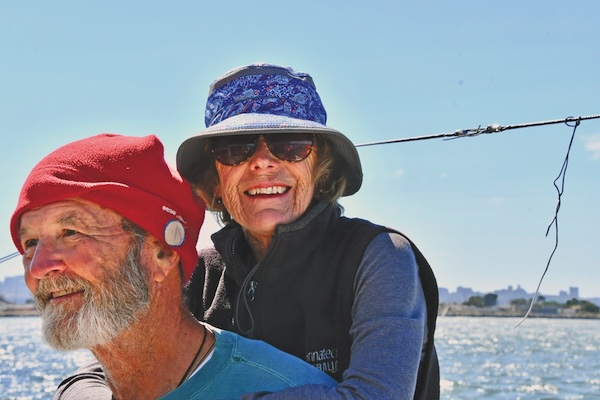
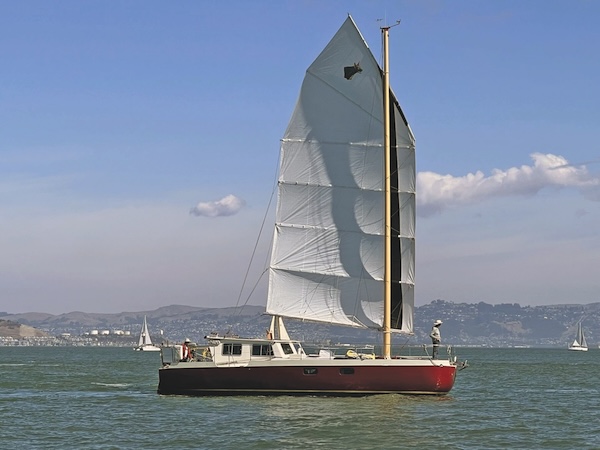
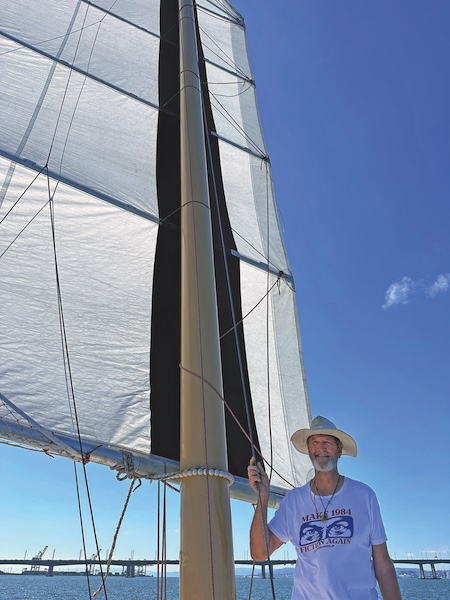
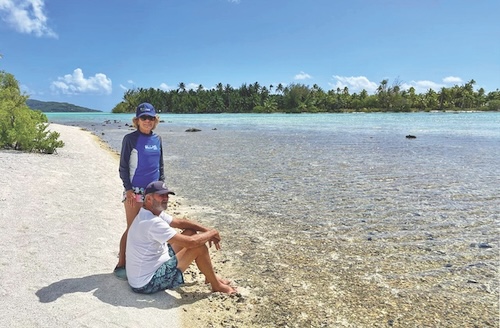
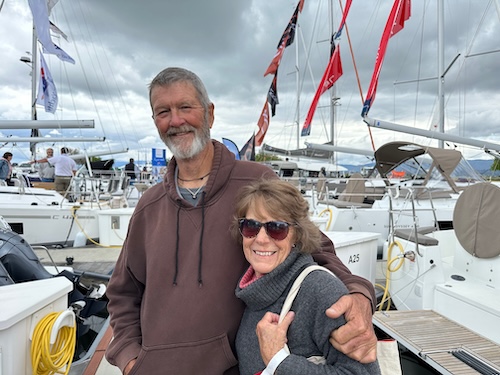
Welcome back to Good Jibes. In this week’s episode we travel down under where we catch up with Bay Area sailors Barry and Samantha Spanier to chat about their lifelong passions of sailing and sailmaking. After impressive careers in sailmaking and advertising, Barry and Samantha are now living their dream on their custom-built scow bow junk rig boat, SV Rosie G.
Tune in to Part 1 with host Monica Grant to hear how Barry started sailmaking, the design concept for Rosie G, his survival story on the water, what he would do differently if building Rosie G from scratch today, and some nostalgia for his scrounging days.
Here’s a sample of what you’ll hear in this episode:
- Barry’s windsurfer sailmaking career
- Learning sailmaking under Henry ‘Hank’ Jotz in San Francisco
- Building sails for a 54-foot yawl in the Tahitian jungle
- The 1978 shipwreck in New Zealand
- Designing Rosie G with Jim Antrim
Check out the episode and show notes below for much more detail.
Listen to the episode on Apple Podcasts, Spotify, and your other favorite podcast spots — follow and leave a 5-star review if you’re feeling the Good Jibes!
Show Notes:
- Part 1: Barry & Samantha Spanier on Fulfilling a Lifelong Passion Through Sailmaking, with Host Monica Grant
- [00:14] Welcome to Good Jibes with Latitude 38
- [01:31] How a chance encounter led to 25 years in windsurfing sail design
- [02:56] The Origins of Rosie G
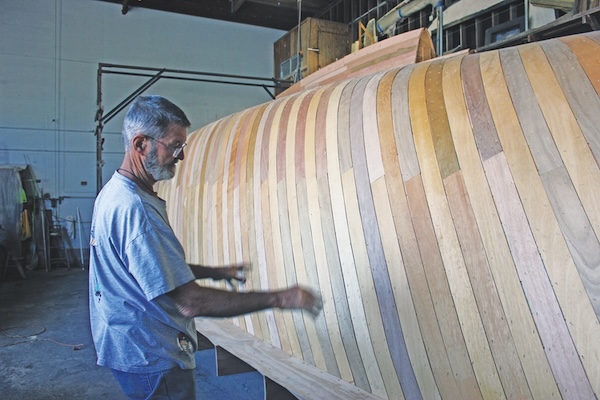
- [05:39] Building a 38-foot ferrocement boat in the 1970s
- [08:39] The Journey to Hawaii and Tahiti
- [13:24] The 1978 Shipwreck in New Zealand
- [18:19] Join our crew list at Latitude38.com
- Starting the Hawaii Sail Loft
- [21:42] The West Sail 42 Cornelia
- [22:41] Inside ballast, asymmetric leeboards, two rudders, and junk rig
- [26:04] David Razon’s mini-transat boat that changed everything
- [31:24] Why Scow Bows Are Superior
- [33:50] Are you thinking of sailing to Mexico or across the Pacific? Latitude 38 has a resource page called “Heading South” & the “First Timer’s Guide” to help you prepare
- The Design Process with Jim Antrim
- [34:12] Two and a half years of back-and-forth
- [36:06] The Electric Motor Mistake
- [39:49] The Doghouse Design Flaw
- [42:42] Building Seminole in a Shipping Container
- [44:48] The Bay Area Boat Building Community
- [47:05] Dumpster Diving Behind North Sails
- [48:50] How the shipwreck shaped Barry’s frugal mindset
- Make sure to follow Good Jibes with Latitude 38 on your favorite podcast spot and leave us a 5-star review on Apple Podcasts
- Check out the January 2026 issue of Latitude 38 Sailing Magazine
- Theme Song: “Pineapple Dream” by Solxis
Transcript:
Please note: this transcript is not 100% accurate.
00:02
You know, it was a community. was really exciting to be young and scrounging around in the Navy junkyard. Welcome aboard for this week’s episode of Good Jibes, in which we head back down under to catch up with Bay Area sailors Barry and Samantha Spanier. This intrepid couple headed out the gate aboard the 42 foot scow bowed Rosie G. Their plan?
00:29
to sail Rosie G the 8,000 or so miles from San Francisco Bay to Australia. Well, they made it and we are here to find out a little bit more about Rosie G and to learn what inspired Barry to design and build this boat. We also dive into how his lifelong sailing journey developed from its beginning when he was 10 years old to a lifetime of sailmaking and cruising. So hop aboard, sit back, relax, and we hope you enjoy this week’s podcast.
01:02
about oh
01:31
Basically from 1980 until 2005, I was pretty much, you know, that was my career. you know, it began with somebody coming in our sail loft in Hawaii and wanting to get a windsurfing sail made. And me and my partner saying, Oh God, throw that old stuff away. We’ll make you something better.
01:59
And that worked really good and that just exploded and took us into this whole world we didn’t know about. And so, you know, that led to years of this constant improvement and development. you know, the entire focus of windsurfing speed and racing is all about weight. mean, we were fighting to get grams out of a rig or a mast or…
02:28
booms, grams, you know, if you got 25 grams out of something, you were really winning, you know, take an ounce off, boy, that’s big. It would go in the magazine and say, you had the lightest this and whatever. So, and plus, you know, it’s good for sail area to displacement, makes you go faster. So when we got involved in building this boat,
02:56
It started with a design concept that I had drawn. You’re talking now about the Scow? Our boat now, Rosie G. Rosie G. Right. So we’ve had other boats before. I built another boat when I was younger. I built a ferrocement at Canangred and sailed it until I wrecked it in New Zealand in 1978. We’re going to come back to that. OK. And then, you know, so Rosie G started with these drawings that I did while I was in Tahiti.
03:26
And then again, some others. And then Samantha discovered these drawings and she came and said, what’d you say, dear? I said, do you wanna do this? Wait, did you know each other at that time? We’ve known each other for over 30 years. But at the time that I discovered the drawings, we were together as a couple. We actually could have been married too by then, I think. Yeah, possible.
03:52
was going through the paperwork and cleaning stuff out and I saw the drawing and I said, is this something that you want to do? And he said, I would love to. It was his dream boat. And I said, okay, if you’re do it, he thinks outside the box. Everything in his life, he just, he’s very creative. He has an amazing mind that doesn’t stop. And I said, if you’re gonna do this, I want you to do exactly what you want.
04:21
I don’t care how outside the box it is. don’t care what anybody says, but if you don’t do it, if you compromise, then let’s not spend the money and time. Right. We’re going all in or not doing it. So he said, let’s do it. So what do you think the timeframe was from starting to jumping aboard and we’ve done this, let’s go. I think that we found the drawing.
04:48
about two to three years before Jim Antrim said yes, we’re on. Well, 2019 is when we started the mold. two years before that we were in contact with Jim. And we found the drawings maybe.
05:11
maybe a year before that, something like that. So, you know, it took, it was a big, long process. Plus it involved, we already owned a West Sale 42 that we were rebuilding in Mahina Harbor. And uh that was a big project and we invested a lot of time and money and we were sailing the boat all the time and even imagining cruising on it. as we got older, the boat got younger.
05:39
I’ve not heard that expression before, but it makes a lot of sense. How did you end up in Hawaii? How did I end up in Hawaii? Well, mean, you had your sailmaking business in Hawaii? Well, I was a sailmaker and I built this 38 foot boat, finished it, not didn’t finish it, but put it in the water in 1974. is the first boat named Seminole.
06:07
Yeah, Seminole. So when that was done, you know, the whole time I was building it, I was also an apprentice at Jotts Sails in San Francisco. And he was very open and giving and helpful. And he encouraged everything about learning and taught me everything that he could. And so I became a sailmaker under his
06:37
Mentorship or whatever you want to call it. And so when the boat was done, me and my current wife at the time, who helped me build the boat and was a full partner in the whole thing, you know, we were like 22 and 20 years old when we started this. So, yeah, we had some money saved and just went for it. And when the boat was ready, not finished, but
07:07
It sailed. Me and Henry Jotson, Claudette, my wife at the time, and guy named Mark Heckman, sailed the boat to San Diego and put it in there in San Diego and… uh
07:25
had to make my way. So I had this other friend who had a smaller boat and I met him while he passed through San Francisco and he had been in Mexico and ended up in San Diego and I said, oh, Paul, know, what’s going on? He said, oh, you know, I’m broke and this and that. I said, you know, I…
07:47
I could use a hand, I wanna start a sale making business down here. And so we started, we started a sale making business in San Diego and it got successful pretty quick. Because there was kind of a vacuum for traditional sales down there. And our loft was right across the street from North sales, Motherloft and Henderson Brothers and.
08:11
And our loft was right at the where the icon law boatyard was and all this. And so it was big, quick. And and we expanded it and hired people and built lots of sails. And meanwhile, I was building my wind vane and my Dodger and and whatever else awnings to finish the boat. So we could go. And after a little more than a year.
08:39
I said to my partner, hey, it’s all yours, I’m leaving. And you went to Hawaii. No, I to Mexico, bummed our way through Mexico, know, made money by doing sail-making jobs along the way. And sometimes I would be hand sewing, sometimes I would be able to set up my sewing machine and, you know, just itinerant guy.
09:08
And then in Mexico, uh we had a crew on board and we wanted to go to Hawaii because my wife thought she was pregnant. We didn’t want to have the baby out of the country. And our crew left and continued on, went to Costa Rica and then she and I sailed the 3,300 miles from Acapulco to Hawaii by ourselves. And uh that was good, you know.
09:37
And then in Hawaii, I did the same thing. I just pulled the boat into the harbor and set up my sewing machine on the deck and just made stuff and fixed things for people and built a little sailmaking thing there, but never had a loft. during that time, I made friends with… uh
10:06
the Coon brothers from Trilogy Excursions. They only had one boat at the time, but I would fix their stuff. And then a guy came, a friend of mine from the loft in San Diego, Harlow Dowardy was his name, and he had a big Alden yaw named Jada. Yeah, it was like 54 feet. And he said, oh, my boat’s down in Tahiti and I need a whole new set of sails.
10:34
what do you think, you know? And I didn’t have anything. My wife abandoned me. She wanted to go have a picket fence and pets and stuff, you know? She said, I can’t go sailing anymore, okay. So um Harlow gave me money and I ordered materials and loaded them on the boat and sailed to Tahiti and.
10:57
And he said, oh yeah, well, by the way, know, my boat’s out in the jungle. Yeah. Seriously. Yeah. Like 10 kilometers from the end of the road. you know, there’s a nice little house and you can have that place and, and, know, just go anchor down there. And so I did. And a crew who sailed with me from Honolulu to Tahiti.
11:26
French guy, but American French guy. You know, he had two passports. He went along and then he stuck with me and we cleared out this little house and built a whole set of sails for a 54 foot yaw out in the middle of the jungle with no power. And, know, we had a generator that we ran while we sewed and the rest of the time it was all hand work. You know, we it all by hand. So it was kind of fun, you know. And then when that was over,
11:54
My visa ran out and it was time to get out of French Polynesia, so I went on to Cook Islands and then Tonga for a while and then went from Tonga to New Zealand. And in New Zealand, I was up in the Bay of Islands and there was a big schooner up there, the Constellation, and the woman that owned it.
12:17
knew me and Jeffrey from Tahiti and she said, hey, you guys wanna help rebuild my boat and fix it all up? And sure, Roberta, no problem. So that turned into months of work. Tauranga was where we were. And we…
12:35
We rebuilt that boat, 76 foot John Alden schooner. Including sails, presumably. Well, no, I put a row of reefs in the main or something and did some repairs, but it was all about rebuilding the boat. We tore it apart and put new everything together. Took the windlass off the deck and went in.
12:57
to a machine shop and had the main engine rebuilt and the generator rebuilt on board. the mast out. Took the mast out. It was 85 feet, weighed 4,600 pounds. Rebuilt the whole mast and re-rigged the whole boat and put it all back together. And then by that time, my own boat was also re-rigged and repainted and refinished.
13:24
had knew this and knew that and everything and then, oh, my visa’s expired and time to go. Time to go again. And so we left New Zealand and two days later we were sunk on the bottom. How did that happen? Oh, well, bad.
13:43
It was 1978, there was no GPS. You hit a reef or there was a big wave? No, was a 200 acre island. Oh, very nice. Kind of hard to miss. Well, middle of the night, blowing a gale, raining, no moon. It was just black, dark, horrible conditions. And we didn’t know where we were because we hadn’t had a sun for a day and a half. We were just, you know.
14:11
draw a line on a piece of paper and okay, that’s where we think we are. Well, we were on the wrong side of this little island and we blew up on the backside of it in the middle of the night. It was presumably there were people on the island and you were able to get help. An old couple. Caretakers. That was it. Wow. Yeah, was a, you know, we almost, one of the women on board went down with the boat and had to swim from underwater to get out and…
14:40
You know, we ended up on a sharp rock, half naked, all night long in this winter’s conditions, freezing cold. So you lost everything at that point? Everything was gone. I had my wristwatch and that was it. Was that everything you owned was always with your boat? Everything. Had nothing. So then you had to start again. Start all over. Where did you go to start again?
15:06
ah Well, I was stuck in New Zealand. I didn’t even have my own clothes. I had no passport. I had no money. um Nothing. So, you know.
15:17
My girlfriend was a Kiwi and her brother-in-law was a wealthy attorney and he was a diver and he belonged to a diving club. And so he helped me organize an expedition to go and try and save the boat. So we tried that first. And then it turned out that another storm in that trying to save it period had just torn it apart down on the bottom. so.
15:43
Then we switched to, well, let’s try and salvage. So we salvaged a lot of stuff, stuff I could sell. And we managed to get that back to Auckland and I cleaned it all up. And then, you know, that was it. Okay. I sold all this, the winches and the hardware and the whatever and made it okay.
16:07
Then I had to figure out what life was gonna do. And I had another friend, Michael Moorhart, he had some land up around Opua and he wanted some teepees made. So he said, well take my land cruiser and go shopping and buy what you need and I hear’s the plans. And so we went up to Opua and made a bunch of teepees for this guy.
16:36
was fun, but that earned enough money so that me and my girlfriend could fly back to Tahiti. So we flew back to Tahiti and lived on the beach in another friend’s shack out in the middle of nowhere. And it was good times. My French friend who…
16:59
wasn’t with me when I wrecked the boat. He lived in Tahiti and he says, oh, there’s this guy needs a crew to go back to Hawaii. And you know, he needs some sales repaired. I got this old sewing machine. If you can get it running, you know, we can do that. And so I fixed his sails and uh in exchange for a ride back to Hawaii. And then he stayed for a time. Yeah, that way.
17:23
got back to Hawaii. When I got back to Hawaii, I contacted the guy that was crewing for me when the boat sank and said, Hey, how’d you like to partner up and start a sail loft in Hawaii? Because we had talked about it literally while we were sitting on the rocks half naked. And I said, Well, that could be a good next move, you know, and he was American, a little younger than me, but he had saved all his money from crewing for somebody and
17:51
was a professional crew on Silvio Berlusconi’s 165. So, you know, had room and board and a wage and he just put all the money away and, oh, I got some money, you I can help out. So we found a place to work and opened up a little sail loft and started making sales for people. Hey, good jives listeners. Are you looking to sail more?
18:19
It’s the biggest mismatch on the California coast. There are thousands of boats not sailing because they need crew and thousands more sailors or soon to be sailors who want to sail but can’t find a boat. For over 45 years, Latitude 38 has been connecting boat owners with sailors to sail, or race the bay, or travel far over the horizon. Some connections have turned into thousands of blue water cruising miles, or race winning crews, or long term relationships, or just happy days of sailing. If you have a boat,
18:47
or want to crew, add your name to the Latitude 38 crew list at latitude38.com. You don’t know where such a simple act will take you. Is that where you met in Hawaii? no, no, she didn’t know me then. She would have never ever have been with me then. No If this is all still happening under the age of 30, I imagine. No, I was 32. 32, ah, close enough. Yeah, so was 32 when it all came down and…
19:15
got involved in this little sail off thing and we were going really strong for about a year and then had all these clients in La Jolla which was on the other side of the island from where our sail off was and a huge storm happened in January of 1980 and lasted a couple of days and just wrecked boats like 33 boats were on the beach.
19:40
And that was a lot, mostly our customers. Charger boats, big catamarans that we were working on and a couple of other really big monohulls that, you know, they would be, they were on moorings and they would come ashore and pick people up and go out and take them sailing. So we lost all that. And China were there, holy cow. And then like.
20:03
God sent them, these three windsurfing guys, young guys, know, in their early 20s came in, oh man, our stuff’s all wrecked, can you fix it? And that was it. Got involved in windsurfing and that turned into a…
20:19
30 year career. months later, six months later, they were in Europe. Yeah, famous. Famous as windsurfing sailmakers. you ever compete in windsurfing yourself? Me personally, no. But I was responsible for other guys having the equipment to go out and set world speed records.
20:44
I made, personally made the sails for the world champion 12 years in a row. I mean, I literally assembled them and sewed them and got them the way I wanted them and gave them to the guy. And then he went out and won 12 world championships. So, you know, I was kind of like the image of Neil pride in the world, everywhere. I traveled a lot. I never thought. oh
21:13
I’m gonna travel again, I don’t have a boat. God, I’ve been in so many countries and so many places. All because of sailing. All because of So literally, sailing has been your life, wind surfing, sailing. Well, we had the sail loft in Maui, owned sailboats. Right. So we could go sailing. Yeah. And then, I don’t know what year it was, we bought the Cornelia, but would have been around 2000 or something.
21:42
What is the Cornelia? It’s a West Sale 42. Oh, that’s the one you talking about that you were rebuilding. And it was a wreck. But, you know, we turned it from a wreck and got it to looking like a really beautiful boat. then when we got started building the Rosie G, we had some legacy money from my mother. So we said, OK, well, we can do this. You know, we can do this.
22:12
She’s the one who said we could do it. Somebody has to be the driving force, right Samantha? Well, like I said, if we weren’t, you know, if he wasn’t going to do what he wanted to do, then there’s really no point. So did Jim and Cree jump at the opportunity or did you have to convince them? Well, it took a couple of years to get Jim interested. He had to think about it because it was breaking a paradigm for him. And you know, I had been, I had known Jim.
22:41
for quite a while and been to him a couple of times about designing catamarans. And he had some really cool cat designs that I liked. I’d be in San Francisco and I’d go over to El Sabrante where he lives and visit him in his office and talk. And, oh, what about this and all this? You know how it would be with a naval architect. And so then finally, when we got this…
23:09
design thing together. I had actually drawn lines and outline and I had an interior plan and kind of a rough idea of what I wanted from the rig and some of the ideas were pretty far out there. I wanted to have inside ballast and a keelson and uh two rudders and asymmetric lee boards.
23:35
I wanted the inside bow so you could, if you ever got on a reef, you could just toss the bow and float over into the Because I had a lot of experience sailing around in the South Pacific and I knew what I was after. Jim just kind of went, no, no, no, no. What was his biggest issue? The bow or just the whole configuration? No, like the asymmetric leeboards and then, then.
24:05
no outside ballast and you he just said, I can’t make it stiff enough. can’t, you know, it was, was being really conservative and cautious and he knew nothing about the junk rig and I did too. I knew nothing about the junk rig other than that I’d read and studied a lot.
24:26
some experience building a junk sale in my loft in the early 80s and watching the guy sail and seeing how his boat performed. But I never knew anything more than that. And you can look at a lot of pictures and I’d seen some videos on YouTube that were intriguing. so, you know.
24:50
The original idea to have a junk rig started in 1976 or seven. That was when the first drawings came. And so, is something you just carry around with you. Meanwhile, I’m building sails that are going 50 knots and uh built a whole set of rigs for Russell Long’s Longshot.
25:14
world record boat with wing mass and you know, full bound sails and all that kind of sophisticated stuff, but I’d never conceived of the junk thing. what was it that was the biggest thing that you were interested in with Rosie G? Was it the shape of the boat, the bow?
25:34
Was it the rig or was it just, here’s five, six, seven, eight different things that I can do that are unusual? Yeah, that’s more like it. Right. I think I have some sort of thing wrong with my brain. Makes me think like that. This is how new ideas come about, is by trying things, right? What really pushed it was just seeing some, it was a seahorse magazine.
26:04
And you know, you can look online and see that. Okay. So Seahorse magazine had this article about this radical new mini transat boat that was designed by David Rezon. And, you know, he showed up at the measurement and the stability tests and all the other people, you know, at the time the rule for the minis is 21 feet long, 10 feet wide. That’s it.
26:33
You can have the sail area you want. can have rudders. You can have keels any way you want, but it’s 21 feet long and 10 feet wide. And well, that’s a pretty open rule. So here he shows up with this, all these other boats look like flying wedges and half for years and years. you know, then got swing keels and a few other things and, you know, pretty radical rigs.
27:03
And he shows up with this thing that’s 21 feet long and 10 feet wide, but it’s 10 feet wide almost all the way to the bow. It’s round and they’re going, oh, that’ll never work. it’ll go so slow up wind and it’ll be this and it’ll be that and da da da. And you’re so stupid. And you know, a complete round of insults. And then he just beat him to death. He beat him so bad.
27:34
The yacht club waiting for him to wait. With his second drink in hand. he was making 30 miles a day on a whole fleet. Right. So it was and they’re alone and they’re sailing these boats that are surfing under spinnakers with an autopilot driving doing 18 knots. So this is extreme single handed sailing. Right. And he said at the end, said, the reason I won is because I was dry.
28:03
and more comfortable. And I never feared broaching when I was under my spinnaker because the boat tracks so beautifully. And even I got knocked down. didn’t round up and do crazy stuff, you know? So I was rested more and that made me sail the boat better all the time. And it really maybe wasn’t so much about the boat in general, but it was more about being able to drive it.
28:33
be fit. So that made an impression on me. I thought, well. And the rest of them made the most logical decision. They banned him. They banned the shape. Exactly. That’s how you deal with people. You can’t be in our races anymore. You toss out what you don’t understand. That’s what we do. So now you have two classes in the minis. You have the old ones, the flying wedges, and then the new ones, which are mostly scow bows. Well, not only did the minis ban the scow bows,
29:02
but the class 40s and the America’s Cup and TP 52 and what’s the offshore class that 60 footers you know they all said no you can’t do this well why did they say that well partly ignorance and partly because they didn’t want to be beaten no money right because if all of a sudden this strange-shaped boat comes in and beats the other ones the other one has to rebuild a boat what’s more worthless than a racing boat that can’t win
29:30
Yeah, true. So this was a financial control thing. And in the class 40s now, they allowed this shape, but you still have to have a little angle at the front. teeny tiny bit. It’s all just a poof law. Like having a figure head on the front. Did you see the photograph in that? Today? In the email? Palindar, yeah. Is it Palinat? P-A-L-A-N-A-D? Yeah.
29:59
Yeah, Palinard 4 and in the Royal Ocean Racing Club. So did you see the first photograph that was in that article where the bow wave was blown away? That could have been Rosie G. Right. That’s what happens on our boat. Okay. It isn’t that extreme because we’re not doing 24 knots. Right. But what happens is the bow just, it’s like it forms this big foaming bubbling thing and then
30:28
If you’re going upwind, just splatters it away from the boat. It’s dry. mean, we were going to weather in 20 plus knots of wind and a full open ocean seaway and the deck was dry. Well, yeah, that’s definitely a big plus. I’ve been on a uh 82 foot schooner out in big weather and we’re in the cockpit way down.
30:54
and it’s like somebody’s just dumped a bucket of water on us. That’s crazy. If it rained, we got wet on deck. Well, in response to that email this morning, you said, scows will rule and never look back. That’s right. Yeah. that’s He’s predicted in 10 years. 10 years ago, I said that. Yeah, but also that in 10 years from now, scows are gonna be all over the place and the pointy ends are not.
31:24
Well, I’m not a racer and my experience with sailing is very limited compared to yours. Not not. His, Barry’s. And probably yours as well Samantha. But honestly I had not heard of a Scow Bow until I saw our story in Latitude 38 about the boat that you built about Rosie G. And I looked at it and went, well, that’s different. Well if you look around at cruising boats.
31:51
David Razan got involved with the company and they built a range of Scow-Bowd cruising boats. They’re aluminum, they’re the revolution 27 and 29 and 32. And these are, you know, there’s a 32 foot boat when you look down below, it’s like a 40 footer. As all the room. Well, I get, that’s a good point. You would have all that extra space because you’re not carving out half the bow for A third of a normal.
32:22
bowed boat is pretty useless. One third normally. And more modern ones that have these long, lean bows could be more than a third. And it’s just, this space just goes away. How do you even get up there to check the bolts on your headstay fittings? That kind of thing. So I guess based on what you’re saying, unless it’s something like an icebreaker where you want to be cutting through the ice, a a scowl is just…
32:52
perfect for every situation. mean, from my experience now with 8,000 nautical miles and through all kinds of different, now we haven’t been in some kind of horrendous gale yet, like 40, 50 knots. We have been in the marina. Right. But even that’s a good thing with a junk rig because you don’t have any windage, know, so your boat’s pretty quiet while all the other boats are like this and 50 knots of wind, you’re just sitting there. Yeah. Which is, that’s cool.
33:23
Latitude 38 here. Are you thinking of sailing to Mexico or all the way across the Pacific or maybe even further? We just heard from Joanna and Cliff saying my husband and I subscribe to latitude 38 and enjoy the good jibes podcast regularly. They went on to say they’re headed to Mexico in the fall and will continue across the Pacific to Australia. However, they’re looking to simplify all the choices they need to make to prepare. Of course, there’s tons of resources out there, but
33:50
Latitude does have a page on our website called Heading South and we also have Latitude 38’s First Timers Guide to Mexico available to read online on the Heading South page or a printed copy that is available to purchase in our online store. There’s a lot to know, but Latitude38.com is a good place to start.
34:12
The process, so I went to Jim, here, will you do this? And he said, well, I’ll think about it. And then a few days later, he came back and said, okay, I’ll go for this. Well, what’s that gonna cost? Oh, probably about this much. Oh, okay, well, so we sent him some money and it got it started. two and a half years. To get it finished. To get the design.
34:39
That’s what I mean to get the design finished because was there a lot of back and forth between you tweaking? Back and forth, back and forth. Well, I don’t know. I’ve done the calculations and I’m having a hard time getting my computer software to work on this because it’s so weird and I won’t calculate anything because of the way the rig is. And I have to study this junk thing so I can figure out what’s going on.
35:06
I said, all I want to do is get the balance of the rig right. know, well, what do you, okay. Well, I want to go for this much draft and balance. I said, well, I I want it to be three and a half feet. And finally, after a while, we compromised on four feet. Draft. Draft. That’s very shallow. Yeah. So we got four feet of draft, 7,500 pounds of lead balanced. And then in order to get some better,
35:36
upwind performance we thought, let’s put a dagger board in. So we put a dagger board that gives you almost eight feet of draft when it’s down. And it was really good we did that. But I did know somewhere that you said that now that you have been out on the boat and been cruising, I would do so much more than this first experiment. What would you actually do differently? ah First of all, I would never put an electric motor.
36:06
Ah, I heard that too. You don’t like electric, do tell. Unless somebody had some kind of magic batteries, you know, maybe the battery technology is growing so good, so fast that you could have sufficient battery power to be able to run your motor for.
36:26
Eight hours. To me to run eight hours, I would need four times as many batteries as we have. But if you’re sailing, when would you actually need to run eight hours? Oh, well, imagine you’re at the equator and you’re looking at your predict wind and you’re in the big blue blob and right over here about 50 miles away, it’s blowing really nice. Well, it would be great if you could just get over and go 50 miles.
36:55
But if we went like that, we could go 12 miles in two hours and we’re done. Did you have solar panels? Yeah, but they can’t. You charge as fast as you burn the power. When you’re running your motor to get six knots, you’re burning 18 kilowatts. And you have to guarantee some. Then you have to have some. okay, people say, why don’t you get a diesel generator? Well, why do I want to have a diesel in my boat?
37:23
diesel, I’m have a diesel. So for the cost of the batteries and the cost of the motor, we could have had two diesel motors and everything that goes with them. You know, it’s all sounds, oh, the motor’s only this much. Yeah. And then the batteries are this much. And the wiring and the whatever, that’s this and that’s solar panels and the charge controllers and you know, it starts to add up and
37:53
Pretty soon you’ve spent a lot of money for something that won’t deliver when you need it. Imagine if you’re uh in Fiji where the wind is shit most of the time and you’re behind some island and there’s a current that’s several knots and it’s actually dangerous because of where you are and you would really like to be able to get out into that wind that’s just beyond the lee of that island or…
38:21
you’re trying to get through a pass in the Turumotus and you know you only have enough power to run at full speed for an hour and a half. Or you’re inside the lagoon and you wanna move over somewhere else and the wind’s contrary, but you’d really like to get over there because there’s some impending weather coming and you’re not gonna sail through all the balmy fleet, but you could just put your hammer down and go for two hours and be where you need to go.
38:50
Everything about having an electric motor when you’re cruising. mean, San Francisco Bay, shit was never a problem. I mean, you know, you leave the dock in 15 minutes or less, you’re out in the bay and you’re sailing and you sail all day and then you could even recharge with the recombinant thing that the motor has. But then you go back in the slip and you run your motor for a half hour total maybe. great.
39:19
That’s really good. You’re an eco-warrior. But as soon as you get out, I don’t care whether it’s coastal sailing, whatever. You’re on electric motor, you better have a lot of batteries. Or some way to run them, like having a diesel. Well, you might as well have some kind of hybrid system from the very beginning. And so that was the biggest mistake, number one. And the second biggest mistake was
39:49
having the doghouse forward of the cockpit so that you had to look through the doghouse to see anything. Like close quarter maneuvering, putting the boat in the slip. can’t see anything. can’t see. The doghouse is in the way. And then there’s these huge windows on the back of the doghouse. And when the light’s right, they turn into mirrors. And it looks like you’re looking at where you’ve come from.
40:17
Right, that would be really confusing. Really bad. The first time it just freaked me out. couldn’t, what’s going on? So you get used to it. You figure out, I can stand up on the seat and look, or I can look over the top. It’s not the most comfortable though. But it’s not good. When you’re at sea, it’s meaningless. You pay no attention to it. It’s a comfy cockpit, it’s got cover over, can rain like crazy and you’re protected. But I would put the steering.
40:47
forward of the doghouse. I would build a forward cockpit with all the sail management and everything up there. So you could look up, see the sail, you could look forward, see the bow. It would be no doubt. And the boat’s so dry, would never even, it wouldn’t, you know, you could have a windshield and a cover, but you wouldn’t be like under spray all the time. Do you think you’ll build a Rosie G V2?
41:16
If someone came to me and said, let’s go for it. And it could be done in a year and a half. That could be fun. took three years from the time that they started building the mold. Right. 2019, 2021. And then February, the end of February 22 is when we launched her. He put in over 3000 hours once.
41:45
They flipped it over and they got us out of the tent and it was ready to start building the inside. In 12 months, he spent over 13 months. He did 3,000 hours of work in the boat. That’s a lot. And we lived in, you know, it was complicated. Anyway, we lived in Hawaii the whole time. We’re not doing that again. It was really difficult to make That’s not happening again.
42:15
to understand. that’s not even necessary as part I mean, it sounds like your situation was a little bit more comfortable than when you built Seminole because my understanding is that you lived in a shipping container in a boatyard whilst you were building that boat. We lived at uh Third and China Basin Street and, you know, we were hippie kids, right? um
42:42
Well, what are we gonna do? And we had a little house we lived in out in the Sunset District, which was a pretty good hike from the boat yard. And so, well, let’s uh see what we can do. And so some longshoreman said, oh, well, there’s an eight by eight shipping container down here. You guys can have that. I’ll move it down with my forklift, you know? And so he put that down there and.
43:06
We uh found an old porthole somewhere and cut a big hole and made a window we could open and put a little peek.
43:16
shake roof on the top to keep the water from leaking and cooling. And then we put in a wood stove and we had two pipe cots and a tool chest full of tools that you could sit on. And then a counter that had a Coleman stove and uh a Coleman lantern and a few jars with like rice and beans, but no refrigeration.
43:46
You could do that in those days. Well you could do it when you’re 20. Well you could do it when you’re 20, but I mean in regards to regulation and things I can’t see that being a thing these days. You’d have to be somewhere very remote to get away with that. But in those days… Oh we were right in the dead center of…
44:05
biggest. But there were a lot of people building boats, building their own boats. Oh there was probably 20 ferrocement boats under construction. so who do you think, can you remember the people you rubbed shoulders with at that time? Bill and LaVon Hines for sure. They built an Ingrid also, ferrocement Ingrid. There was another guy in Sausalito, he sailed his boat all over the world.
44:30
His boat’s name I think was Nunkey. Nunkey. Nunkey. Interesting. I am pretty sure. I can’t remember his name, but I helped plaster his boat. And so it was kind of a community. There was a lot of people in Redwood City. There was a whole rack of them.
44:48
Many of them never got finished. There were people down in El Viso. Yeah, in Sausalito there were a few. And I knew other builders. I knew a guy building in Ingrid up in Corvallis, Oregon, and Allwood. And then there was a steelboat guy over in San Rafael that was building this big steelboat in his backyard. He taught me how to weld. He was a Kiwi guy. I don’t remember his name.
45:19
but there was a lot, it was a community. I would go over and work on Wanderbird and hang out with Harold Summer and it was just a community. Billy, all of those guys in Sausalito. Billy Martinelli? Yeah. I had extra wood, I would always just swing over and drop it off on Wanderbird. I could get some really cool piece of black locust or something here for Harold, you can have that.
45:48
You it was a community. was really exciting to be young and scrounging around in the Navy junkyard. I don’t remember exactly where that was, but we would go over there and I got all the tubing from my lifeline stanchions there. I got my fuel tanks. were some kind of…
46:08
bronze water heaters off of some ship, you know, beautiful, silicon bronze 30 gallon tanks, you know, would have cost thousands and you get them for 10 bucks, that kind of thing. Cause it was Navy surplus.
46:27
And that was the whole deal, scrounge, just scrounge. We would uh go down to the city front and walk around St. Francis Yacht Club and just dig through the dumpsters because the dumpsters were full of stuff that the…
46:43
boat maintenance guys would just dump in there. I read a few, or have read a few of Faddy Goodlander’s books. And he talks about dumpster diving a lot. Oh That’s why we It’s stunning. mean, that’s how we got our sail loft in San Diego going. We lived across, you know, we were in this loft across the street from North Sails.
47:05
And we went over there one evening and God, look at all this material and this dumpster. Things that they were throwing out. You know, this big, we’d roll up a big roll of cloth and take it away. And then we watched. And on Wednesday afternoon, after the place closed, all of sudden this door opened up.
47:26
And the cleaners came with big brooms and just shoved everything out right into the dumpsters. Well, it was like a gold mine. So Wednesday was shopping day. Unbelievable. And we went over there and that was when they were switching from hanged on head sails to tape luffs and roll furling or just foils for racing. And they would just take a scissors and cut the entire luff off of a big head sail.
47:54
and just roll it up and throw it in the dumpster. So you’d get 15 number three bronze piston hanks and a big length of wire and thimbles and all just free. know, just haul it across the street. Then we would sell it to our customers. You know, here’s the special deal, you know. And so I even met Lowell North later on in my windsurfing life and said, hey Lowell, you know.
48:23
you don’t know this, but you’ve indirectly financed my business in San Diego. What’d you say to that? Well, he laughed, you know. We were talking about North Sales hiring us to be their design group. But we had already committed to be with Neil Pride. And then we stayed with Neil Pride for 20 years. it was…
48:50
But you know, just this whole life all started because I smashed my boat on the rocks. Because I guarantee you I never would have stopped if I hadn’t done that. You would have just kept sailing. Absolutely. Well at some point you would have had to earn money again. So you would have kept sail making presumably. money all the way along. That’s what I mean. Money was never an issue. isn’t how much you earn, it’s how much you spend that counts.
49:18
So I just never spent any money. It’s dogged me all my life where I just always felt like I couldn’t spend money. Even when I made money, I delegated that to my wife. And if I had 10 cents in my pocket, I was perfectly happy.
49:41
I could walk by any store. She hates to go shopping with me because I just won’t buy anything. It’s like ingrained. It’s how you live when you’re cruising with no money. do recall that feeling. When you’re cruising and you have no money, you just don’t spend money. You figure out another way. It’s not like you can just whip out the credit card.
50:08
I was doing this before there was credit cards. If you didn’t have a lot of cash, were nowhere. Yeah. Yeah. We hope you enjoyed today’s episode and thank you for listening. Without you, there would be no Good Jibes podcast. If you enjoyed this conversation, please subscribe to the podcast to be notified of each new episode. Oh, and tell all your friends so they too can feel the Good Jibes!