

Episode #239: Vivian Matuk and Delores Chan on the Dockwalker Program, With Host Ryan Foland
This week we chat with Vivian Matuk and Delores Chan about the Dockwalker program. Vivian is the Environmental Boating Program Manager for California State Parks and the California Coastal Commission, and Delores is the Environmental Engagement Program Project Manager for The Bay Foundation.
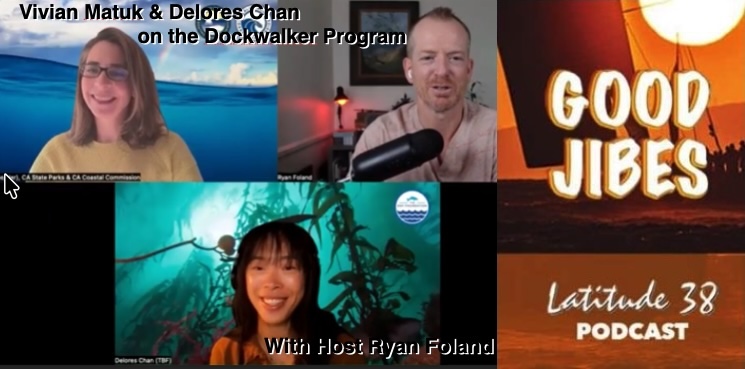
Tune in as Vivian and Delores chat with Good Jibes host Ryan Foland about how and why the Dockwalker program was started, the power of word of mouth in the sailing community, how to practice clean boating, how they get sailors who are strangers to have a rewarding conversation, and a story about a sloth.
Here’s a small sample of what you will hear in this episode:
- How do you make dock conversations not awkward?
- The California Boater Kit: oil absorbent sheets, fuel bibs, binder cards, and more
- Vivian’s origin story: from the Andes to California as a biologist drawn to water
- Delores’s origin story: a seven-year-old on a Bay Area boat who knew what a vertebrate was
- From sloth walker to dock walker the human touch that no AI can fully replace
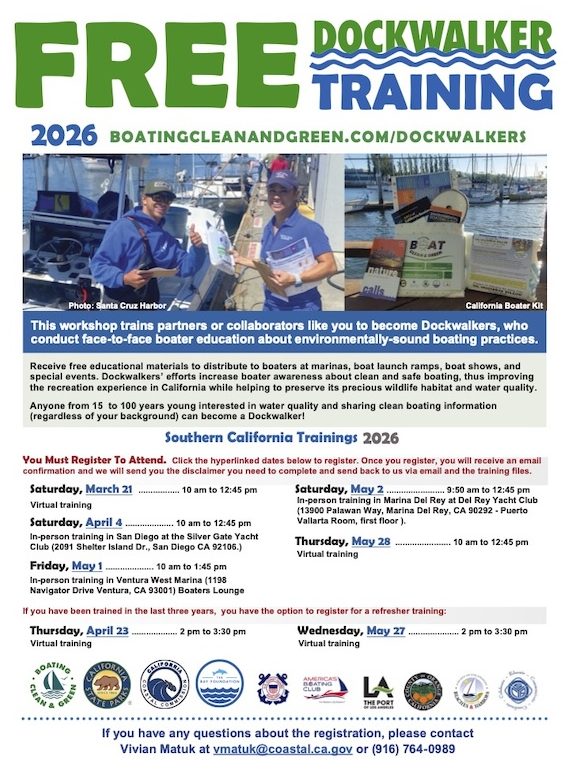
Learn more about the Dockwalker Program at BoatingCleanAndGreen.com/Dockwalkers and Ryan at Ryan.Online
Listen to the episode on Apple Podcasts, Spotify, and your other favorite podcast spots — follow and leave a 5-star review if you’re feeling the Good Jibes!
Check out the episode and show notes below for much more detail.
Show Notes:
- Vivian Matuk & Delores Chan on the Dockwalker Program, with Host Ryan Foland
- [0:14] Welcome to Good Jibes with Latitude 38
- [0:44] Learn more about the Dockwalker Program at BoatingCleanAndGreen.com/Dockwalkers and Ryan at Ryan.Online
- [2:09] Vivian’s origin story: from the Andes to California as a biologist drawn to water
- [7:21] The sloth rescue: buying Liberty’s freedom by a creek in Colombia
- [11:13] Delores’s origin story: a seven-year-old on a Bay Area boat who knew what a vertebrate was
- [17:45] Check out our Classy Classifieds at Latitude38.com
- The Dock Walker Program
- [18:16] What is the Dockwalker Program? California’s first peer-to-peer clean boating education program
- [21:38] 25 years old and the only program of its kind and other states are copying it
- [25:09] Oil, fuel, hazardous waste, trash, and marine debris
- [32:39] The California Boater Kit: oil absorbent sheets, fuel bibs, binder cards, and more
- [38:03] The Pumpout Nav App: find your nearest pump out station, free on Android and iPhone
- [39:57] How do you make dock conversations not awkward? The free banner, the questionnaire, and leading with curiosity
- [44:37] Dockwalker tactics in the wild: yacht club barbecues, boat shows, and the magic of face-to-face
- [50:15] The boater who used his binder card to help his neighbor report a spill
- [52:49] Want to sponsor Good Jibes? Email [email protected]
- Icebreakers and Sloths
- [53:18] From sloth walker to dockwalker: the human touch that no AI can fully replace
- [55:12] Ryan’s big idea: Latitude 38 as the ultimate dockwalker icebreaker
- [1:02:33] Who is the Dockwalker Program really for? Vivian and Delores answer
- [1:04:27] Learn more about the Dockwalker Program at BoatingCleanAndGreen.com/Dockwalkers and Ryan at Ryan.Online
- [1:10:41] We all don’t know what we don’t know and that’s okay
- Check out the April 2026 issue of Latitude 38 Sailing Magazine
- Make sure to follow Good Jibes with Latitude 38 on your favorite podcast spot and leave us a 5-star review on Apple Podcasts
- Theme Song: Pineapple Dream by SOLXIS
Transcript:
Please note: this transcript is not 100% accurate.
00:03
Once you have those conversations with people, they do care.
00:14
Ahoy everyone and welcome to another episode of Good Jibes, a podcast where we talk about sailing and things on the water. And I happen to be looking at two guests who are underwater right now. We’ll learn more about that later. But I’m very excited because today we’re going to be talking about the things that all, no, not all, but a lot of boats need, which are docks. And we all walk on docks. But after this podcast episode, I want you to think every time you walk on a dock from now on, I want you to think of this conversation.
00:44
So my name is Ryan Folland and our guests today are Vivian Matuk. Perfect. I want you to say it though so I can make sure. Matuk? Matuk. Perfect. Matuk. Yes. Yes. And then I’ve got Delores Chan. Delores, how are you doing today? I’m good. How are you, Ryan? Awesome. Well, this whole conversation actually started with an email and I don’t even know where you guys got my email, but somehow it showed up in my inbox and it had something to do with a doc. And so I…
01:14
clicked it open, did a half read it. I was like, wow, this looks cool. We should talk about it on the Good Jibes podcast. And so now we’re here. So before we get into the email and the contents and all that is, it’s always fun to get to know the people behind all of this. So Vivian and Dolores, the question we ask our guests is, what’s a story that shaped you? Now, I don’t even know. I don’t know if you sail. It doesn’t have to be a sailing story, but
01:40
seeing that Dolores has a background with a beautiful kelp forest that looks like I’m 40 feet underwater off of the coast of Catalina and Big Geiger Cove, waiting for a big uh bass to swim by there. And then Vivian, she’s got basically a half background with water that is so clear. It looks like a whale’s about to sneak up behind you and tap you on the shoulder. Two logos up in the corner that I can’t really read. A rainbow in the back with what looks like
02:09
Definitely some cumulonimbus clouds. So I don’t know who wants to go first. How about Vivian, since you’ve got a rainbow going on, what’s the story that shaped you? Thank you, Ryan. It’s great to be here. ah So I’m currently the manager, the Boating Clean and Green Program Manager for both the California State Parks and the California Coastal Commission. Did you say Boating Clean and Green? Yes, that’s the name of our program.
02:36
And the program is managed by both the California State Parks and the California Coastal Commission. And uh one story that shaped me is, as you can tell by my accent, I’m not from this beautiful country. I’m originally from Colombia, South America. So I was born and raised over 8,000 feet in the beautiful Andes. Yes, in Bogota. we do, of course, we have rivers, we have two beautiful
03:05
uh coast. I personally am not a voter. I’m a biologist. So um I finished my biology degree in Colombia and I did my uh practice or my thesis, undergrad thesis with the coffee research center in one of the most important, actually the only research center about coffee in the world, which is in Colombia, of course. Wait a minute. So the only coffee research facility?
03:34
Yeah, it’s the only research center um about coffee in the world that it started, oh my gosh, like in the sixties or seventies. So I did my thesis there because of course we have the best coffee, right? Well, sailors love coffee, so they might have to come back to that. exactly. And I had the opportunity to work with coffee growers um in the coffee region of Columbia, which are near a lot of creeks. So that’s my first.
04:02
um Attraction to water. Once I was done, I came to this beautiful state of California and I did my Masters in Environmental Management and I always have been attracted by water, its protection, water quality overall. So I did my Masters in Environmental Management and then I started working for the state uh in this amazing program, which is about
04:30
protecting our waterways, working with a fantastic group of people, boaters, and boating facilities across California. So my story is from the Andes, working in rivers, attracted always by water, not being boater, but I used to be a diver, always wanted to be working in the protection of our waterways. So that’s how I started in this beautiful program.
04:59
That is an amazing journey from coffee to biology and back. Now you talked about the creek. Was that your first exposure to water? Well, when I was a child, we used to travel a lot uh in Colombia and also to different parts of the world and always felt attracted to water because of course I in the Andes, I mean, you are. It’s got to be freezing there though. You’re not going to.
05:26
Let’s remember that we are in the tropic area. So Bogota, even though it’s at over 80,000 feet, it used to be cold. Unfortunately, nowadays due to the climate change, the temperature has increased. At that time was cold, but I had the opportunity to visit different rivers. Actually, when I was studying biology, we had a bunch of field trips to the Amazon, our coast, tons of different rivers in the savannas of Columbia. So I had.
05:55
since I was a child, a lot of experience with the water. Did you ever take leaves or build little boats and race them down the creek or down the river? Well, you know, I was more into exploring what, for example, was under the rocks and seeing them. Tell me one of your most memorable adventures like this. Like, I want to know a story of what happened. You’re talking about these adventures. We did this in the Andes and the river and these, but like…
06:24
Pull a moment from there and share me. Yeah. So there’s what there was when you pulled under a rock, was there what was the what was the craziest thing you found under a rock in a river in the Andes? Yeah, a lot of uh micro crustaceans. So I was doing a study about water quality and there are some organisms that are indicators of good or bad water quality. So because of presence of oxygen, among other pollutants. So.
06:53
or other pollutants. I was, um you know, fascinated by every time that I would grab a stone or a rock and just seeing what was underneath. So a lot of my co-acoustic was pretty fun, but I had a story which was fascinating near a river, not specifically related to a river. So we, in one field trip with my family, we encounter unfortunately a person who was
07:21
selling a sloth and we were able to… selling a sloth? Yeah, which you know, if you put yourself into a situation, some people have hard time and they try just to live their lives by doing stuff that probably is not legal because you know selling sloths which is a endangered species is not the case. So my husband and I, he’s also a biologist, we were studying
07:51
were able to release this, to get a hold of the slod. And it was a full adventure to then keep the slod and then find the proper way to release this slod, but not being detained by authorities because they kind of stop you and say, excuse me, what are you doing with the slod? This is illegal. So we were recovering the slod from the peasant and then trying to release this slod, protecting ourselves, protecting the slod. And they are sometimes- They’re very slow.
08:20
Where I was this is a process in my mind. I’m like thinking of this as like everyone is rushing but you’re like moving slow. Slow but you know, I don’t know if you have seen photos but they’re the one that we got. I’ve not taken an almost illegally traded or sold you know live animal in that capacity. No I haven’t. Tell me about it. So what was he like? So they are of course slow but at the same time they can be very aggressive. They have these two
08:50
they can have two or three nails like these one, like two, and they can really grab you people. can see people like totally scratch back because they can’t touch you. I just thought they were always slow. Like, oh, that’s a menacing claw, but. So it was hard to, hey, how are we handling the animal so we don’t stress it out? Yeah, it’s impossible. And also we’re protecting ourselves and also trying to find the best area to release the animal. had a couple of
09:20
biology friends who were biologists in that region. So we were asking them, okay, what is the best quote unquote? Yeah. What tree do I put it on? No, in which forest away from again, access to humans, we could release the animal. it was a whole adventure near a creek. No, is awesome. And it doesn’t have to do with the water. I like in that little story that you just shared about saving a sloth.
09:50
Like I learned more about you in that moment as a person. And I’ve learned you, you mentioned sort of the trajectory of stuff to where you are, but I want to hang out with people who are saving sloths and whether they’re by the creek or the river or the ocean or whatever. And I can tell you’re carrying intent and your, your, your love for the living environment around you. And it makes sense that you, you’re studying all that craziness. So thank you for the sloth story. I appreciate that. Delores.
10:19
Liberty, was that? Oh, I was going to ask you. We were to release it. So you did name it Liberty? Yes. Honestly, I was going to ask you if you named it, but then I thought maybe that wouldn’t be good to ask because you were so pure with it being like untouched by humans. I was afraid that you wouldn’t. I thought you might not have named it because you don’t want to call it Bob and then let Bob go. No, you know what’s so amazing is when the moment we released it, the animal knew.
10:47
I’m free. So we put it like gently and immediately climb the tree. And I started crying because I was like, oh my gosh, 24 hours of stress. It’s liberty. You know, like it’s like the materialization of these feelings of. You name the situation, not the sloth. And literally you’re saying that as there’s a rainbow going on behind you with the clouds. It’s very, very moment there.
11:13
All right, that’s awesome. Dolores, how about you? What’s the story that shaped you? Now it doesn’t have to, I’m not trying to trick you into a water situation. It could be any story that shaped you. We’ll get to know you a little bit. No, it’s totally. Yeah, I’m Dolores. And by the way, did you know the sloth story? How long have you been working with Vivian? I actually did not know the sloth story. I’ve been working with Vivian for a year and a half now. little over a year a half now. And you didn’t know the sloth story. Vivian, that sloth story is one of the most amazing, like,
11:43
I don’t know many people who have interacted with sloths, let alone save them, let alone name the situation anyways. So I just was curious if you knew about the sloths. So Dolores, what’s the story that shaped you that Vivian doesn’t know? Yeah. Such a good question. yeah, right now I’m…
12:05
I guess I serve as the environmental engagement program manager with the Bay Foundation here in LA. Say that title again real quick. You guys say your title so fast. Don’t forget that. I say it quickly because it’s a long… Okay, well… Environmental engagement program project manager with the Bay Foundation. So here’s something real quick. I do a lot of speaking. My most recent book is Speakership and I love the art of communicating. That’s why we’re here talking, right?
12:35
One of the, there’s four basic levers we can all use while we speak. The rate of speech is one that is pretty clear, but we don’t always use it. See, I’m slowing down right now. The thing is that if things are contextual, you can speed it up. But if you think about slowing down for the important stuff, then when you say things slower, sort of put some weight on it, as opposed to just kind of rushing through things. So when you’re the…
13:02
Project Manager, this is that, I’m like, whoa, it’s super fast, also just from a mechanism, slowing down, that means that it’s important. And so I’m just curious for you to try to introduce yourself, but slow down, like every word is almost so meaningful that it may feel like deathly slow to you, but it might actually help me as a listener be like, holy moly, that’s a dynamic, interesting, super important role versus what she’s just saying.
13:33
So I just want to hear it, because if I had to repeat it now, I couldn’t repeat it, but I want to hear it because I think it’s really important. Yeah, I appreciate that, Ryan. Yeah, I am the environmental engagement program project manager with Faith Shen here in the light. OK, this is awesome. So I will dig into that in second. What is the story? No, No, a story that has shaped me. Honestly, this is one that I think.
13:59
I’ve kind of forgotten about until relatively like recently my I was talking with my mom and we’re kind of just talking about just where I am in life like the work that I do and she reminded me when I was younger, we actually went on this kind of random like boating wildlife excursion. I’m originally from the Bay Area in San Francisco. It was in the Bay somewhere. I it’s very like fuzzy to me, but it was definitely back up.
14:29
home in the Bay Area. And it was definitely geared towards like kids, I would say there were a lot of like, environmental educators who were there, like, kind of showing off uh different species that you could spot in the Bay and just like teaching kids about them. And there was one of them had asked a question about like the difference between animals with spines and without spines and
14:55
I, my mom, it’s like coming from my mom, I’m not going to be like, oh, this is how I remember it. this is awesome. We’re all, Vivian, are you there with us in this boat? Are you on board? Of course, I’m fully here, captivated by the story. The educator asks, you know, like, who knows the difference between, like, animals with spines or without spines? Like, what are they called? And I guess I, as like,
15:23
I was probably like seven years old, like, she’s like, oh, that’s like a vertebrate or that’s an invertebrate. And my mom had like looked to one of the other parents and was like, I have no idea how she knows that. But it’s kind of it’s it is funny to me. And it’s like, it’s a story that sticks with me, even though I had kind of forgotten about it until recently, because I it kind of cemented to me that I’ve always had this love for
15:52
the ocean and for water and for wildlife. I wouldn’t say I lost my way, but there were definitely other interests that I explored. And then I wound up back in environmental conservation by one way, form or another. I think uh it’s fun to call back to think that seven-year-old me was randomly on a boat and knew this information.
16:21
It’s definitely something that continues to drive me and like the passion that I have for conservation and for the work that I continue to do. Yeah, that is awesome. That is awesome. I got the goosebumps when I was listening to that. Vivian, you didn’t know that obviously, but what do you think about that story? That’s, mean, that’s you. Yeah, that’s like that’s such a pivotal moment. I think we all can relate to those types of moments. And then we get out there with our boat and sailing, winding, whatever it is, and we just end up
16:50
all over the place, but to some extent, if you end up back to that same course or at the final destination or towards it, know, sailing is always the wrong direction until you get to the right direction. So it’s a constant reminder. I like how you said, Dolores, that like you just kept floating back to this. Yeah, it’s almost like your life’s current or your life’s like theme that’s going through. Yeah, exactly. Well, we are all the same, my friends. This is like I think we all have uh literally just.
17:18
I like to say the ocean is my potion and whether your passion is boating or not, if you’re a boater, you’re passionate about the water. And so I’m excited to hear about what you’re doing. Hey, good jobs listeners and Latitude 38 readers. If you looked in our classy classifieds lately, it would be impossible for us to know how many boats have sold to new owners over the last 45 plus years of publishing Latitude 38.
17:45
But we’re sure they have helped countless people realize their sailing dreams. Every month there are new boats listed that will fill someone’s sailing adventures. If you have a boat you want to sail or are looking for that next boat in your life, the pages of Latitude 38 will surely have something to suit your fancy. Pick up a magazine at a local marine business or visit our classy classified pages at latitude38.com to find boats, gear, job opportunities and more. Then tell us your next sailing story.
18:16
Now tell me about the doc, basically the email, the email that you sent out to me. I want to hear what that email is so everybody can get the email right now. Bing. And what is this Doc Walk program? What is this email about? Yeah, I can give a little bit about what the Doc Walker program is, how this email might have come across your inbox, But yeah, the Doc Walker program is this really, really amazing and also just
18:45
integral and first of its kind program here in California and even across the country. And what we’re really focused on is environmental education, as well as just promoting clean and safe voting to voters all across California. And we’re we can talk more, of course, about like how that’s done. But really where this came out from, I it was back in like 1994.
19:14
there was this organization called Save Our Shores. They’re based out of Santa Cruz County. um And they basically just saw that there was a knowledge gap um amongst voters in that area when it came to things like pollution prevention and disposal and even like remediation of pollution. And so what they did was they actually started to engage and just talk to voters in Santa Cruz and Monterey County, or sorry, Santa Cruz and Monterey Bay.
19:43
And it was like this one-on-one education. It’s just like a conversation. It’s kind of like how we’re doing right now. Like, let’s talk about boating. Let’s talk more of a doc-versation. Yeah, I love that. It’s a doc-versation. Should we make that up right now? Let’s play with it for a second. So we’re going to coin that. A convert. Wait, but we got to find the right combo of the words. there’s conversation. Could be doc-versation. Like, do we keep the F in there or?
20:12
Docversation. Or docversation. Because the F kind of… Docversation? don’t know, for some reason I dropped the F in there. Just say it back and let’s hear it. I kind of like docversation. Docversation. Docversation. I don’t know. You really have to hit the doc because you can’t be too much of a dog because it’s too close. Say You’re going to have to hit the D, the docversations. Let me hear you say it.
20:41
Okay, Dolores, say it. docversation. So are we going with the F, the forcations? Because this is a… listening, we want your opinion too. If you could be in on this, you’re good. But we’re not getting distracted here. We’re being innovative because we’re… There are… I pulled up the email, by the way, and the title is Southern California Yacht Clubs for you, the 2026 SoCal Doc Walk trainings and our partnership. So now I know how you got my email because I’m a…
21:11
proud member of the Blue Water Cruising Club. And as going through the board of directors and doing my time, at one point I was in, I was responsible or a point of contact as like, you know, one of those via emails. So yes, and I think this is a great thing. Back to these doc persuasions. We’ll figure this out as we go along, but. Absolutely. I can jump into giving you a little bit, Ryan, about…
21:38
the of the program. What is it actually? like, yeah, exactly. let me, let me tell you that the first of all, let’s, let’s be proud of what I’m going to say, because we’re proud of this. the dog walker program is the first of its kind peer to peer education in outreach program that basically helps train individuals from many backgrounds. Cause
22:02
Everybody from 15 to 100 years young is invited to be part of the community of dock walkers. We work with members from the public, boaters, marina, yacht club operators. That’s why I emailed you. We work with the conservation corps, Coast Guard Auxiliary Power Squadron. Anybody can be part of our program. These individuals are trained by our programs, the two agencies that I represent and the Bay Foundation.
22:30
to empower local voters to adopt clean voting practices by providing tips and tools and resources directly in a one-on-one manner to voters, individuals feel confident in their ability to properly implement the core messages of the program. So let me tell you why. Okay, so I’m way, way, I’m we’re here on a dock. I see it. Hey, Vivian’s walking by. I’ll be like,
22:53
I don’t recognize her. She’s not normally on my dock. So she’s walking by. Do you have like a suitcase or a baggage or is there like a… Excellent point. we, a couple of things is once you’re trained as part of our program, which is a free training that we can talk about. So would train me essentially and then I would walk to the docks of my own dock or are you having people down from your organization, like swarming the docks when people are starting to race or something like that. So.
23:20
The program is very versatile and flexible, so it goes two ways. The term dock walker is a little bit deceiving because you don’t necessarily have to implement the program, meaning meeting boaters, talking to them about clean boating practices. So you don’t have to walk the docks? Not necessarily, because, right. That name is deceiving. I’m just going to say it. Yeah, but that’s why when we started,
23:44
Actually, last year we celebrated the 25th year of the program. Okay, hold on a minute. Hold on. Let’s celebrate. Let’s celebrate the 25 years. You wanted us to be proud that this is the first and then we’re just like, down the line. So this is the first and it’s 25 years old? Yes, 25 years old. Okay. Which is and is the only program in the state and in the nation of this kind.
24:14
Where we in California and nationwide to the point that let’s be proud of California once again, you know, leading the efforts here. Let’s give it up for California. Yeah. Woohoo. Because the program has been so successful that other states like uh Washington, Oregon, Florida, Texas have been contacting us because they want to implement our program in the region.
24:40
But what is very interesting and going back to your question is once you are part of the program and you become a partner, dog walker, also call them environmental educators or clean voting ambassadors, you can implement the program anywhere where voters are. So for example, our partner dog walkers who are members of the community. So you’re empowering members of the community to influence voters in their local community can go to
25:09
marinas, yacht clubs, boating events, fishing therapies. You’re sending me out there, but then what is the message? What is the conversation? So that’s still I’m curious as well. Because I’m a potential a potential I walk dogs. I’m passionate about this. I’m potential partner. So just to sort of play back, it’s the first and 25 year old organization that at its core
25:38
has conversations about pollution management. What else? Give me two more. Exactly. let me tell you exactly why we have the program. And then I’ll respond to you. What are the core messages? is the information? So first of all, based on research,
26:01
developed by my two agencies and Dolores organization, the Bay Foundation, we identified that the most common sources of information for voters in California include marinas, boat shows and voting events, online resources and word of mouth. You missed podcasts. You missed GoodJobs podcast on that level. know, online is that’s under the category of online resources as well. Podcast is its own thing. I mean, there could be a
26:29
Yeah, but it’s new. This is a new category. So that’s on our online resources, which is good. We also have a podcast as you can hear later on. in Word of Mouth, specifically from peer and community members. So the Doc Walker program focuses on Word of Mouth as the main education and outreach strategy and also uses peer pressure
26:57
to motivate behavior change or influence social norms. Furthermore, a study from the proceedings of the National Academy of Sciences found that peer pressure is the most effective intervention for changing environmental behaviors because people tend to conform to social norms. So that’s why we have the Dog Walker program. Now, what do we No, wait, wait, wait. Let’s just chill there for a second. That was a lot. I’m just trying to process all that for a second.
27:27
Okay. It was a lot of information, a lot of good information, but like I also just need to need to process it a little bit. And the talk of peer pressure, I’d be interested why we’re why we’re I understand the reason for citing it, but do you is that like part of the sales when you’re recruiting people? Because it’s feel it be it be it feel weird for me to be an ambassador to to hear I want to peer pressure my peers. Like, is there a different phrase that
27:56
that I mean, I understand from the cycle and I love these types of studies and things like that. But are you finding people resonating with peer pressuring their peers? that like unique? Okay. I think the word like peer pressure often has like a negative kind of connotation. Like we think back to like when we were teenagers and it’s like, oh, like watch out, you’re going to be.
28:22
peer pressured into doing things you shouldn’t be doing, but then peer pressure also can have very positive like reinforcements, like in the sense of social norms and, and positive behaviors, right? Like, we can think about so many other behaviors beyond environmental change and benefit, like positive environmental change and benefits, where, you know, you see your friend doing something, and you’re more likely to do it purely because your friend is doing it.
28:50
Right. I think it’s one of those things where like, but the way you just described it, we’re rebranding peer pressure. here, there’s also right. But understand that maybe when you talk about peer pressure, talk about the rebrand as part of it. Yeah. Because if I didn’t stop and be like, because that was just kind of like that, just I just wanted to talk about that peer pressure moment. If we hadn’t stopped, I would have not if I would have listened, I would not seen that. And then I might have just jumped to that that normal like equation from it. And when I think
29:19
Dolores, what I really like what you said there was about, you gave me the example, you see somebody doing it, so you’ll sort of do it. But that’s a positive servant leadership enforcement example where you’re like, I’m not going to throw my oil away. I’m going to go dispose of it properly. Hey, look at me. I’m doing this. I’m setting by example. But then the peer pressure is more like, it’s more of a push versus a pull. And I’m just curious from, because I would love to help recruit and
29:48
help find people in this. But again, that just to me, I thought caught my ear. So if this is a rebrand of peer pressure and it’s more like you’re getting people to, I don’t know, how else would you describe it in words of like getting… So the peer pressure we’re giving is the definition, the science behind the program, because again, these are research And I agree with that. just read… uh
30:18
Everybody should read a book called Influence. It’s amazing. It’s very long, but it’s all about these six things of influence that are backed by studies. There’s so much around all of the studies and stuff. So yes, so the idea at the core, the peer pressure, it’s that random people coming down the dock and talking with people, having conversations is not what it’s about. It’s about people. It’s about activating the community with people that are already in the community, or are you trying to find people that, you know,
30:47
None. Yeah. Let me finish like the concept. we started first about defining who the partner dock walkers are. They are environmental educators. And they don’t all have to walk on docks. They can do it online. No, exactly. We also learn the fact that the science behind and now what do they want? The goal is to increase and improve clean boating practices across the state.
31:15
by empowering members of the community to share clean boating practices with the boater about management of oil, fuel, hazardous waste, trash and marine debris, both cleaning and maintenance. So that’s the list of the initial when I started to list, right? was like, pollution, can you go through those again? And what I’m hearing is that these are like the major topics that.
31:40
We all need to be having conversations about exactly. you know, our podcast peer pressure, peer podcast pressure. Maybe there’s a triple P in there. Yeah. And the good thing here is for our agencies and Dolores organization, what we feel is voters are good stewards of the environment. They just need information or they don’t know what they can convenient services. Yeah, they don’t know what they don’t know. Right. Or they’ve been doing things the same way.
32:10
to facilitate in a friendly, fun conversation with the voter. Hey, they know, but sometimes they’re like, oh my gosh, I didn’t even know that I have in my area a sewage pump out or that I can properly dispose of my used oil at a certified used oil collection center. So our partner, Doc Walkers, are trained by our organizations and agencies to refresh their memory about
32:39
what the potential sources of boat pollution can be, what the environmental, federal and state laws mention about those, and then about clean boating, best management practices we can share with the boaters. But most importantly, Ryan, we have developed the main outreach tool for the program that is called the California Boater Kit, which is a comprehensive clean and safe boating uh hands-on tool.
33:07
that will invite the voters to take immediate clean voting action after talking to uh the voter. So for example… so what is this toolkit? Exactly. Is it a digital format? Is it download? it… Yes. It’s an actual… Physical. Okay, I just wanted in my head just what it was. I didn’t know if it was an app or this or what. So a physical kit. Okay, now Dolores, share it.
33:36
Visually, got this physical kit, and it has a ton of resources in there and tools as well. So it’s got things like there’s an oil absorbent sheet and pillow in there. Those are great for absorbing oil and on your boat, preventing those accidental oil leaks. There’s also like a fuel bed to help catch any like stray drops when you’re fueling up. And then there’s just like a host of resources in there from
34:05
like pamphlets that talk about the different voting laws in California. There’s also like this really nice uh kind of like binder card and it just has a great breakdown of just like things to know who to call, like things to remember before you leave the arena, like lots of really great information for voters to keep in mind when they’re out on the water. then we do have the whole kit or the box.
34:32
I have one, if you want, I can just quickly grab it. So hold on for a sec. Okay, go get it. Go get the box. This is great. I just have this box in my mind and creating all the stuff and I’m like, anyways, curious little It’s kind of like a pouch I would describe. A pouch? I’ll show you, yeah. Okay. And there are actually like two versions of it technically. I think there’s… Oh, I see it. I put it, it looks like that you can see the like oil wrapper. It looks like a big, like the size of a big manila folder that is big and like, you know, filled out to the side like a…
35:02
Okay. Yeah. it’s white. It’s white with some printout. No, it’s a light mint color. But I think it’s kind of blending in with the wrapper. Yeah, it’s competing with the rainbow. Okay, cool. So… And let me mention, just to add to the fantastic information that Dolores just mentioned, the…
35:27
The voter kid was developed based on research and input provided by our technical advisory group comprised of members with the Marina and voting associations. In other words, the expert. And one more thing that is very important, Ryan, is on an annual basis, we conduct research about the voter kid. So we ask directly to the voter, hey, did you learn something from the voter kid? And what we have learned, fortunately, is the fact that uh
35:55
voters who have received the voter kit and the face-to-face conversation and education from uh partner dog walkers are much more inclined to implement some of the core messages of the program. For example, probably you know this being a voter. Being better. Exactly. you’re getting feedback on the kits. The kits are working because they’re saying they’re being more conscious and technically
36:21
They likely didn’t have a fuel bib before and now they do and you multiply that by a few thousand and then there’s a few gallons that are not in the ocean and a few less dolphins get bronchitis.
36:35
Yes, but you know, and the good thing is we’re giving them these hands on a tool for voters to immediately start implementing some of the messages that the dog walker is sharing with them because imagine it would be super weird Ryan that you are in your marina. Let’s say in Vivian dog walker and Dolores dog walker come to you and say hi Ryan. Are you a border? Oh fantastic. Can we just talk to you in your leg?
37:03
talk about what and then you start telling them and then you’re like, what? And, and, good. Like the cheapest way to control oil pollution from the bilge is to use an oil absorbent and what is an oil absorbent? And you don’t even have a way to tell them, Hey, I’m giving you the oil absorbent. Please use it as part of your daily operation. That would have been weird. the actual toolkit transformed these friendly conversation into an action. So
37:32
The boaters leave the conversation with a fantastic clean and safe boating tool that they can start implementing and using. the good thing is we give them all these tools like the oil absorbance and the fuel bibs among others. And we teach them, hey, this is why you use it, how to use it. And most importantly, at your local level, this is where you properly dispose of it. um We also have resources such as a uh pump out nav app.
38:03
California was the first state in the nation to create this fantastic app. is it called? It’s a pump out app. Is that what it’s called? Is that pump out nav app? You can download it for free in both your Android and iPhones. And once you download it based on your geolocation, it will tell you where the nearest pump out dump station floating restrooms are.
38:31
You can even report if the pump out is working or not. It has video, it has tons of things and it receives a national don’t know if I want video of the the Dumpout app. Well, you know, it’s good because believe it or not, a lot of voters sometimes don’t even know how to operate a pump out. So are lot of educational resources there. And the app receive a national award and actually
38:58
Other states, including uh Florida, Vermont, Dolores held me, Oregon, Washington. Yeah, Oregon. started with California? Is all California started? Give it up for California. Yeah, again, Dolores and another grantee, because some of our program is funded by uh other resources, were able to develop this app. And of course, again, California, you know, not being selfish, we’re saying, hey, join the effort. Join the way.
39:28
The lead in the middle of the flying V with a pelican just making that happen. Okay, thanks for… I’ve got a good idea of the what, of the why, of somewhat of the how, but I’m curious just to kind of sidestep into you gave the example of an awkward situation, which was awkward, the one that you… I was imagining standing on my 1977 Cal 34 sailboat that, you know, hearing people walking on the dock and whatnot. I’m curious…
39:57
just to get a little sneak into either the training or the logic behind, how do you not make these awkward conversations? mean, literally, maybe there’s two different scenarios. There’s like somebody who is literally just like walking down the docks, like, know, somebody who knows no one on the dock to the other extreme. I’m part of a yacht club and I could talk with my friends and whatnot. So maybe we could do one example of on one extreme.
40:25
somebody that has no connection with the boater or the dock, knowing that not just an N of one, but in general, like it could be awkward. Hey, watch out, this person’s coming. Or the other person who’s like, hey, somebody I know, like trust, love, have known for years, we’re sailors to the core, like that kind of a conversation. I’m curious some examples because that seems to be the point of friction that either things happen or not. And it’s amazing to see California putting the resources to train the trainers.
40:55
because the reality is there are too many docks for both of you and I to walk. So having something that, you know, can not only sustain, but grow and scale and go exponential, like help people understand what that conversation looks like, because I can see how people are passionate enough about the ocean to overcome their fear of talking with new people. And like, that’s the type of grassroots activism that is the type of people that want to save animals with big claws in the forest that are being sold.
41:25
and to identify correctly vertebrates or not on the water land. So I’m curious to know just kind of the examples or I can play the person on the boat or one of you can play the person on the boat or how do you train people to make that meaningful moment happen? Because it’s all great and it all sounds good on paper and you can have as you can distribute, no, you can manufacture 100,000 of those cases and get the state to pay.
41:51
hundreds of thousands to do it and invest and have people put the things in all of them. But this, like so many important programs comes down to this human connection, this human touch. And in a world that’s constantly distracted, in a world where even some people on the boat are on their phone, it’s to an extreme that like, how does what has worked for 25 years in a day and age where if I want to know, this is not me, this is like a, if I want to know about oil protection, I’ll just chat to you.
42:21
I’m going to ask Claude, you know what? I’ll build, I’ll vibe code my own app right now to find out where the bathroom is. Maybe that’s not all boaters, but we’re in this weird crazy time. So I’m sold on the dream. Yeah. But how do you, maybe an example or whatnot, those two different extremes? I don’t know who wants to take it or run with it. It was like the longest question rant in the history of the world. I’ll come up for Dolores, do you want to go first? Yeah, I’m happy to have you to touch on this, but I think on the kind of like awkward
42:51
And uh one of the things that we tell our dockwalkers and even provide kind of like as a supportive resource for them is that we have this banner. It’s a nice big banner and it has a really big word on it that says free. And I feel like we all love free things, especially in this. Exactly. So that’s one kind of tactic that we use that is like super helpful. And dockwalkers have said, like I
43:19
just got a request for a banner the other week, but it is one of those things where it’s like, how big is the banner? You say big, how many feet? I’m curious. It’s not like feet, but it’s big enough to catch someone’s attention. If we go big, if we go like really big. I know we got to go even bigger. You know, it might be interesting to run a study and have three options on the signs. You’re scientist, right?
43:40
And you basically put, would you like a 12 by 12 stand? Would you like a four by four foot? Would you like an eight did that already and that’s why the banner is the size. It’s manageable. Okay, okay. Obviously your research is you’ve already tested out the optimal size for everything. Pardon me. catching enough, yeah. And manageable. We’re everything about data, Ryan. But just enough and not enough to be annoying, but you got to get a few annoying ones out there to get the feedback to know that you got to bring it back. Yeah.
44:09
Yes, I think that’s just like one resource that we provide the Doc Walkers as a way to kind of break the ice. So bring people, they’re going to come towards you. Yeah, like come over here. Like I have a free thing for you. You just have to fill out this little questionnaire. It’s like a quiz. No stakes. There’s zero stakes in this quiz. Unless you want to bring stakes. do you know? If you have a free sign and stakes on a doc, on a grill.
44:37
Have you offered barbecues? We have had dock walkers actually, we don’t do the barbecues, but we have dock walkers that are part of yacht clubs and they do the yacht club barbecues. And sometimes dock walkers will set up a table at the barbecue. So yeah, we got steaks and free kits. Yeah. And you know, to go back to the awkward situation, we, oh in the component of our training, which is about how to implement the program, because
45:05
We have a variety of people like from Coast Guard Auxiliary to Actual Members of the community. When you listen off every, you know, all of that. Yeah. So we tell them like, hey, these are like uh the how to and we usually tell people, let’s say I will approach a voter respectfully and say, hi, I’m a partner, Doc Walker, uh and I would like to share with you this free voter kit that comes and I will explain really fast like what is included.
45:35
Do you have a of minutes to chat with me? Couple of things as you clearly described people are like, no, don’t bother me. don’t, I mean, who are you? And we try to push it a little bit more. Hey, like we have these free pollution prevention tools. I’m not selling anything. Actually, this is a free resource for you. Basically, it’s not a door to door. It’s dock to dock and you’re doing this. And remember not dock to dock. could be anywhere. We’re not online to line, bot to bot. uh
46:04
people, the person to person, we’re not selling anything, we’re not going to. a, maybe I can, do you have any, uh do you have any AI bots on your team? Cause you know, I’m practicing vibe coding and things like that. What if I created, you told me what information I would need and you got me through the training. I could train an AI model on that specific information. And then I could create, there’s something where you can.
46:31
You can scrape websites for data or you can integrate with things like LinkedIn. I could find or target boaters, people that have boats at a base or even go more filters and then reach out via a LinkedIn direct message through the premium version and then, you know, offer either the free or a digital version of the free or do some beta testing to see. And you can interact and have conversations with people online with a trained bot that could be scalable that
46:59
would all be opt-in and with the right type of free information or material, you hit a thousand voters, you get, you know, half to less than half to open up. You get a few few. It’s like the new modern mailer, but with a chat bot or have you ever had a chat bot partner? It’s like a chat bot. We do have like the, questionnaire that uh we were mentioning earlier, there is a, like a virtual version of it. So if someone, which we also do promote like emails, social media.
47:29
What have it the more traditional methods at this time? I guess, um, but yeah, if you take it, you fill it out, you, you know, pledge to clean and safe voting in California. We’ll send you the kit for free. Okay, do you have a version of the kit? a it’s a self educational system. So, uh, when you ask the question, um, the system will tell you, oh, great. No, this is not the response. The response is this, but Ryan.
47:55
I think this world is lacking the human touch and the face to face education, which is the mission of this program is having these conversations, listening to your experience. Let me, let me give you an example, which is fantastic. Last weekend, we participated at the Sacramento Boat Show. We exercise our role as dog walkers. have there the banner that Dolores is mentioning.
48:23
boat owners come or boaters, because sometimes you don’t even have to own a boat. can rent a boat. Yeah, you’re shooting fish in a barrel at a boat show. got everybody there. Exactly. Boaters come and get your free boater kit today. So people will say, you see like the word free. We’re using your marketing tools as well. look at it. It looks fat. see one of those. see a oil and port. Hey, so what is this a boater kit? And you start pulling stuff and then you start the conversation with the boat and you cannot imagine.
48:52
how magical that moment becomes because people are like, oh wait, I didn’t have any clue that oil absorbance even exists. And you’re telling me that these one absorbs up to a quart of oil. This amazing. what, you know, like you start building up into these interaction of education where you’re having the opportunity to have this conversation and people, know, you are a voter, know, voters are so sociable. So you ended up.
49:20
talking to the guy or the lady and they’re showing you their grandchildren, the last sailing adventure they did. And it becomes such a unique interaction where people start exchanging information. And as dock walkers we can, hey, building into these, hey, do you have an inboard outboard? Do you have an installed toilet on board? Do you know how to report a spill? And that’s the beauty of
49:49
In my opinion, what is missing with so much technology, we humans are moving away from our biology of being social, to tell you the truth. And it’s fascinating. You cannot imagine how you can turn a conversation into this great educational experience that these partner dog walkers are having. You know, every time Dolores and I
50:15
are working with our community of partner dock walkers and you hear them coming back and saying, wow, we have so many stories, Ryan, of how the program has generated a change, like a memorable interaction we had happen, for example, last year with a voter here in the Bay Area. The voter mentioned that the previous year he had the conversation with the dock walker, received the voter kit, and
50:45
The voter law, for example, the binder card that Dolores mentioned where you have all these important phone numbers for voters to report sewage spills, et cetera. And his fellow voter, the guy next to his boat sleep had an accidental spill. The guy immediately was able to give him- Knew where to call. The pillow and this is where you call and started this conversation. And these are the kind of stories that if you do everything
51:15
in artificial intelligence is like, change are we making? But yes, yes, yes. But also part of so yes, I agree on the human touch. And that’s why my real question for the heart of the show was, how do you not make how do you get those humans to talk with each other? Because if you can’t do that, then then the whole nothing works. Exactly. So that’s why we go over this during the training. We go over these strategies like, hey, use the word free.
51:43
I tried to offer the border kid then use the questionnaire that the question or that Dolores was describing, which is it prompts the conversation. So Ryan, it has like nine questions. We call it questionnaire, not quiz because you and I and Dolores know that when we are tested, people are like, I fail, what is going to happen? It’s just like sharing. And then if the person continued to be uh not wanting to talk to us.
52:11
Just, you know, there are millions of voters out there who can talk to us in a friendly way, say, hey, well, hopefully we can talk in the future. So we talk about these strategies, but overall, most of the times people really want to have access to the voter kit to talk to the dog walker because they see it’s a friendly conversation and we anticipate, we’re not sending anything. We’re not going to ask for any donation. We’re just here to share this. And people are appreciate like,
52:40
Nowadays, how weird it that people come to you and give you something. Education and resources is just like, hmm, interesting.
52:49
Hey, listen up. We hope everyone is enjoying listening to the stories of West Coast sailors on our Good Jives podcast. We’ve heard lots of great feedback from the 150,000 listeners who’ve tuned in over the last couple of years. And if you have a marine business, we’d like to give you an opportunity to connect with them during upcoming podcasts. If you’d like to be a sponsor of future podcasts, you can email Latitude38 to learn more about how your company can benefit from sponsoring Good Jives.
53:18
No, awesome. So a couple of things to touch on my crazy app idea, AI project, part of where the technology especially is to help get people interested into those conversations, right? So I don’t think that you would have the replication of that, the magical moment, which by the way, when you were talking about the magical moment of the person who had that realization at the moment when he needed what he needed most reminded me of
53:46
this thought that like we’re all kind of sloths trapped in our own minds of like limited or or being sold by the information that we do or don’t have. And the dock walker, which you were a sloth walker at the time, you sloth walked over and you found a sloth and you said, look, let me give you better information. This is illegal. Here’s this not my information, but like, let’s do the right thing here. Let’s let’s get the water clean. Let’s get the water out. Let’s get the sloth back.
54:15
And when you were describing the testimonial of the person, the look in their eyes, I couldn’t help but think back to Liberty as she or he was climbing up, seeing the contact where you knew that that changed. And literally, you started by saving sloths and now you’re saving sailors. And it’s all a little slow. You got to be careful. Sometimes there’s aggression. But for the most part, like if it’s slow and steady and you know where you want to go, the sloth can be free.
54:45
we can figure out how to take better care of our ocean and keeping things in the boat or if things get out of the boat to help secure. So it was a fun final moment as I was thinking back to the sloth, the sloth walker to the dock walker. And it is important to have those conversations and it is important to keep AI front of mind to see how we can make sure that we’re not losing on one front for the other. And the fact that you guys have been doing this for 25 years is great. I do also.
55:12
have what I think might be the most revolutionary idea of the whole show. Now we have come up with a new word which is pretty revolutionary, our doc for stations. But you talk about free and I’m curious your familiarity with Latitude 38 and the popularity of Latitude 38. It is a free magazine that seems to be pretty popular. Vivian, your experience with Latitude 38?
55:39
If you grab one, do you know about it? Then Delores, same question. And then I’m going to go to my big idea. I actually have not picked up the copy of Latitude 38. I’m not at like docs and marinas very often. No, that’s cool. No, this is totally cool. This is an honest engineer. OK, Vivian, how about you? When was the last time you grabbed a Latitude 38 or have you or do you know about them? Well, I have been working on this on this program for decades and you guys are very well known.
56:06
Not only California, in the entire West Coast and I think nationwide. So I think last time was back in December. uh But I usually check also your uh electronic uh version. whenever we have any education and outreach opportunities for our voters or marinas, I usually reach out to your editors and ask them, hey, can you just forward these to your uh audience? Because you guys have a great, you know,
56:35
relationship with the voting community and voting facilities across the state. Yeah, we love our latitude, Lat 38 nation. And here’s the this month’s magazine. It’s a nice, you know, hands on grubby color magazine with tons of photos and sailing stories and everything. And guess how much it costs.
56:55
It’s free. It is free. Do you know what probably is more appealing than a free sign is a Latitude 38 end hand. This is actually the peace stick that I think your organizations are missing. And this is my big idea. OK, like if I have a Latitude 38, like I always have some with me. I carry them with me wherever. when my events, I’ll just like, hey, did you want one? And people like, oh, my gosh, you look at this and this looks like a legit could be 499 on the
57:25
you know, on the rack. And if somebody knows about Latitude 38, like if I know somebody reads Latitude 38, I am their brethren. I am their connected. I understand that they read the same funny stories that I do, that they hear some of the same adventures across the sea and looking at the same races and looking at the same boats. So what’s crazy is that like you could think about maybe we can talk later offline about a more more of a partnership.
57:53
because we have distribution up and down all the way from here down to Baja, Mexico, and they’re in the places where boaters are going. They’re in the places where the oil absorbance are sold. They’re in the places for other safety things that would help with pollution and with all kinds of stuff. And it’s just pages and pages each month that come out. So imagine, I’m just curious your thoughts, because the free and the booth and the selling, you’re not going to get everybody, right? If you’re tapping into different communities,
58:22
to have a free sign, but also a stack of these either delivered to your home or nowhere to get them or some sort of collaboration, you can have 12 latitude 38s and have 12 very meaningful conversations, which as a bonus, you’re like, oh, dude, do you also want this free kit with all this cool gear in it? Oh my God. Yeah. Well, anyways, right. So you could disguise the initial awkward conversation by getting people a magazine that sometimes they didn’t know is free. They didn’t even know where it was. Similarly, just like people don’t know what to do.
58:52
or who to call when they see an oil spill. So there’s this like huge market of people that are not connected, but are connected in different spheres. And that’s my big idea after talking with you, even though now I feel like I’ve known you for years. So your thoughts on my thoughts. Thank you for the opportunity. we can. It’s important, you know, to reach out to.
59:16
different uh audiences across the state. And that’s why we have these like multifaceted outreach uh approach, uh working with like the different publications, as you’re saying across the state, because you know, this is the other issue, right? California is so big that, you know, people, we need to make sure that we are very uh inclusive. So, and real quick, just, you know, what, like, we talked about the digital and the physical, right? We talked about those different things.
59:46
And when you’re dealing with something that is, that you can touch, that you can feel, that you can have versus an email that’s forwarded to you, right? Look at the difference between the email that I didn’t fully read and this conversation of how much we’ve learned and grown and I’m sure we’ll be like friends for life. We’ll tell stories about sloths to the next generation. But the idea is like getting a forwarded email.
01:00:14
through something about an event that you have no connection for could easily come across as spam versus something that is physically included in something that’s handheld that thousands and thousands of people are hearing and reading and stuff like that. I think there’s this interesting blend between the different offerings and the different communities. And the final thing I want to say, and I don’t want to make this feel like uh it’s uh not coming from like a
01:00:40
feedback of love, but when you say that you’re for everyone or anyone, which you said a couple of times, and I deal with lot of startups and entrepreneurs, and I tell people all the time, if you’re for anyone or everyone, you’re for no one. And there’s a lot of research behind people not uh sort of jumping on board with something because they don’t think like it’s a certain way, right? So this idea of this isn’t for anyone or everyone, uh it’s for people who
01:01:08
are concerned with the future of our planet or positioned in a way that like, and it’s for sailors because of a certain reason and it’s for people because of a certain reason. So I feel like when you say you’re for everyone and anyone, it’s discrediting how important it is because it’s for those people who fill in the blank, uh really don’t have the information they need or could uh act more responsibly when they would if they had the information or the product or the number to call.
01:01:37
as we wrap to an end here, I want to your opinion and just thinking like, it’s not really for anyone or everyone. It’s for it’s for everybody who specifically. And I’d love to know that to define that person. It’s you, Vivian, it’s me, it’s Dolores, it’s us. But I’d love for you to help sort of secure the end of the show with like it is for the person who blank because for the people that have made it this long, I think they’re going to resonate with that. And
01:02:04
they might give you guys a call or they might want to learn more about it or they might want to tell a friend about it or they might look for somebody walking down a dock with a Latitude 38 and be like, oh my gosh, maybe they also have a kit that they could give me. What would you describe that person to as we come to a full circle, which has just been such a fun conversation with both of you about this important topic and an honest conversation about its implementation and the open conversation about how to make that effective because it only works.
01:02:33
if people know the information that they don’t know. Delores, I’ll you go first. This is not for anyone or everyone. It’s for the type of person who what? I think the Dog Walker program definitely is for those who are super interested and passionate about clean waterways and just getting the word out about how we can keep our waterways clean. I think also to the point, like in those conversations,
01:03:02
I know people who are like, oh, like, I don’t care about water quality. Well, the city already discharges sewage into like this area. Like, it doesn’t matter. But then what’s interesting is that once you have those conversations with people, they do care. They do care about their actions. They care about the actions of other voters. And that’s the thing. So it’s like, you can like say you’re not an environmentalist. You can say you don’t care.
01:03:32
your actions show that you actually do. And I think that that’s why sometimes we like that label of like, it’s not for everyone or sorry, it is for everybody because sometimes people just don’t even realize it. but I do think like with the dock worker program, like signing up for those trainings, like, yeah, like it’s, if you are interested in clean water and water quality, like good boating practices and clean boating management.
01:04:00
Come join us for a training. have a fun coming up this year. How do people find information? By the way, I’m applause. Yeah, it was very. That was great. Thank you. But real quick, tell people where they would go. Where’s an entry point? A website or something. So we have that. Vivian, hold on. Or you’re up just just with Dolores finish and then we’re going to we’re going to have you jump into that last question. Yeah, that. um
01:04:27
All the trainings are listed on uh California State uh Division of Voting and Waterways. California State Division of Voting and Waterways. And the website, so can help you, Dolores. Yeah, I’m trying to find the website. No worries, no worries. So the website is boatingcleanandgreen.com. Boatingcleanandgreen.com, that’s the base.
01:04:54
Let me get it. So it’s boatingcleanandgreen.com forward slash doc walker. Or you can use your favorite browser and just type in California doc walker and it will pop the first entry. And you can go from there, but the URL is boatingcleanandgreen.com forward slash doc walkers. And if you Google
01:05:19
Docversations, hopefully we do it before you and lock up the trademark and start the website and have a bunch of docversations. Docversations. Well, thank you, Dolores. That was a uh great finish to fill in the blank. And what resonated with me was this idea that uh we say it’s for anyone and everyone because we know at the end of the day, it really, really is at the end of the day, but so many people don’t see this as somebody for them or they just discredit and they’re just like, uh but you really, after talking with people,
01:05:47
uh at the core. Whether you’re a Doc Walker or not, I think I want to believe that everybody that spends time on the water is one or two conversations away from recognizing how passionate they really are and having a large enough excuse and friends to support them to continue to make decisions to help to change their beliefs, their actions, so that their actions share who they really are at the end of the day. Okay, Vivian.
01:06:14
This stock market program is not for everyone or anyone. It is for the people who fill in the blank. Want to I would say inspire and educate the voting community to implement those practices of people who care uh about the environment, about supporting community members, about generating a change uh in behavior. And when we said that is for everybody’s because we don’t want people to think.
01:06:43
Oh, I’m not a voter, so I cannot be a dog walker. Anyone can be a dog walker. That’s why we have so many partners, even people with municipalities, conservation corps, right? So that’s where we said that is for anybody who wants to be. But of course you have to be a person who is inspired to help to share those practices with the voter who’s motivated by making a change.
01:07:09
by supporting our environment for current and future generations. Because again, voters are good stewards of the environment. They just need information and easy and convenient services. And that’s where we want to generate that change. I love it. That’s awesome. I totally agree. All right. So here’s my answer. I thought of a fun answer because you covered all the basics there. So here’s another one. And I’m projecting this as maybe a reality out there of this big plan.
01:07:35
Doc walkers are not for anyone or everyone. They are for people who want to also become a Latitude 38 ambassador and get as many Latitude 38s as you want to give to as many friends as you want to have conversations, spread people around the good stuff inside of Latitude 38. Because in Latitude 38, you’re also hearing stories about responsible voting, hearing stories about how to do with pollution, hearing from different vendors that are helping people to do this. So.
01:08:03
Yeah, if you’re a fan of Latitude 38, that could be an indication that you could be a good dock walker because all you need, all you are is one good excuse away from hanging out on docks and talking with more sailors. And I can resonate with that because I love talking with people. So what a fun conversation. How do we get in touch with both of you? Do you want people to reach out to you LinkedIn or you push into the main website? Where do you want our listeners go from here for you? Great. So, yeah, people can.
01:08:32
You know, you can always email me or call me because you know, I’m a public servant. So and I love to talk to people as you can tell Dolores and I love to talk to people. That’s, know, what we do. So you can uh visit first of all, our website again, votingking.com. Real quick, what is what can you spell your name and just what would the email be if you want to give that out or to have them search it somewhere? Perfect. No, my email is my first name, Vivian.matuk.
01:09:01
matuk at coastal coas.coas.gov again vivianmatuk at coastal.coastal.coastal.gov our website is www.boatingcleanandgreen.com forward slash dockwalker the first portion if anybody’s interested we have a
01:09:28
Fascinating website with tons of information for voters and marinas and Dolores, I’ll let you include your information or mention your information. Yeah, absolutely. uh Yeah, I can my email is he. At Santa Monica. uh And then I am not a, I’m not part of an agency.
01:09:50
I’m part of the Bay Foundation, we’re a great nonprofit here down in LA working to protect and restore Santa Monica Bay. So you can find out more about our work at sansamonicabay.org. And we do also have all the dockwalker, at least all the Southern California dockwalker trainings listed on our website at sansamonicabay.org. If you want, if you’re listening from Northern California, go ahead and visit Vivian’s website that she mentioned. Yeah.
01:10:17
Ryan, hopefully you can make our Marina Del Rey lunch. Yeah. And thank you, Ryan. I wanted just to refresh your memory of your audience. This is a beautiful program between two state agencies, the Bay Foundation, and many partners across the state. So it’s a good way to show how we can work together in a fun way just to support good goals and missions. Yeah.
01:10:41
So next year around this time when we have a follow-up podcast, we’ll see the Latitude 38 logo up in the back of your backgrounds as we do that. so much fun, literally from sloths and seven-year-old smarty pants calling out information she didn’t know would float her down to a Zoom recording on a podcast about sailing while underwater with kelp behind her. And I think that I learned a lot today and it just helped to
01:11:11
remind me that so many people don’t know what they don’t know and there’s nothing wrong with that. You just don’t know. I don’t know so many things. But when the things that we can learn can help to support the things that we love, why not find a way to support? And it’s not that you have to be a dock walker or not. You could use AI and do your own research about protection and how to manage your boat in a more ecological way. You can be curious and find blogs and influencers that are
01:11:40
they’re doing things. So it’s uh not just a one-doc stop. But the one-doc stop at the Doc Walker program with all these amazing state agencies, Go California, is that it gives you an entry point, gives you training, gives you swag, gives you a free sign, gives you the support to set up, and then make it what your own is, your own vibe is. Your own yacht club has its own vibe. Some are in ties, some are in board shorts, and everybody loves a good story. So share stories that…
01:12:09
make a difference and people who realize and learn things because we all learn and maybe those stories end up in latitude 38. Maybe they end up out here on the internet. But at the end of the day, we’re all going to find that moment where there’s a story that shapes us to make the ocean something that becomes a priority to keep healthy, just like we prioritize our own health. There’s my dramatic close to this very fun conversation.
01:12:38
Yeah, thank you for the opportunity and for letting us share information about these fantastic community driven program that is not only in front of the ocean, but all of our uh waterways and with fun resources and data backed by science that will help our community out there. Because at the end we’re one, right? One planet and we need to work in front of that planet.
01:13:08
Yep. And I can tell you with 100 % research back that Latitude 38 readers love the ocean to the deepest extent. again, they’re just a couple of conversations away from being a better steward of the thing that they already love. So let’s continue to build our relationship with ourselves and the ocean and all of our fellow Doc mates, whether it’s a free sign or a Latitude 38 in hand. My name is Ryan Foll and this is going to shut down because I don’t have any more brain power to be.
01:13:35
so deep into a subject that is so meaningful because this conversation can continue to create ripples on a beautiful clean ocean bed that I will go foiling on soon this weekend. All right, if you want to get in touch with me, you can find everything about me at Ryan.Online. I have some cool services for people and a new book out that’s called Speakership. Command your stage and steer your impact. It is available on Amazon, spelled like it sounds, Speakership. And if you ever want to
01:14:05
Learn about me, can go to Ryan.Online or get me at [email protected] And if you’re in the SoCal region, you want to be a dock walker, but you’re intimidated, give me a call. We can create a little group or a little band or a WhatsApp group and we can figure out how to get something out there, get it going. Because it just, it can start and can keep going. So let’s protect what we have and make it better than we left it off. Ladies and gentlemen, that’s a show.
01:14:31
Vivian and Delores, it’s been super fun and I’m excited to stay in touch. Thank you so much for the opportunity. uh