

‘Pi’ to the 50th — A Remembrance To Remember
A story of ingenuity and adventure, loss and survival, and one deeply tied to the beginnings of ULDBs and the history of ocean racing on the California Coast.
Steve Fennell grew up the eldest of five siblings in Alameda, California. Sailing was the center of the Fennell family, and with their going out every weekend, it seemed that everything revolved around sailing. After graduating from SDSU, Steve found his way to Capitola in the late ’60s and purchased the historical Van Sickle house on Cherry Avenue. He lived there with his wife and daughter, Serena, and offered cheap rents to friends in one of the many rooms and apartments on the property. Steve became a middle school math teacher and was a free thinker way ahead of his time. He invented a honeycomb aluminum building material, the Fennell Module. He held ecology classes for students and “was a safe harbor” for young people in his community. Students could be themselves around Steve and “never have to worry.”
Steve had become involved in the Santa Cruz sailing community as one of the originators of the SCYC SCORE series, and he was keen to build a boat out of composites, just as he had seen his neighbor Bill Lee do with Magic. The empty lot across the street became his boatyard. According to interviews, Steve and a friend first attempted to build a boat off the mold from George Olson’s Grendel.
Apparently, they got far enough along in the build to have laid fiberglass on one side of the mold before Steve realized he should work on his own design and they abandoned the project. “When Ron Moore rescued Grendel’s mold from certain destruction, a new partnership was born between Ron and John Moore, and George Olson. The next chapter of the story was the creation of the ultimate Wednesday-night boat for Monterey Bay — Summertime. The first thing the trio decided was that the new boat needed a little more beam than Grendel’s five feet and change. No problem. They just jammed a few 2x4s in the mold and pried it apart until it looked about right. A foot more beam looked pretty good, and the glass and resin started flowing.”
Some speculate that the fiberglass Steve had laid up created additional rigidity in the mold, causing uneven spreading when they widened the hull, with the result being the famed and endearing asymmetry of the Moore 24.
Steve began designing the hull for Pi, a 24-ft fiberglass ULDB, in 1971.
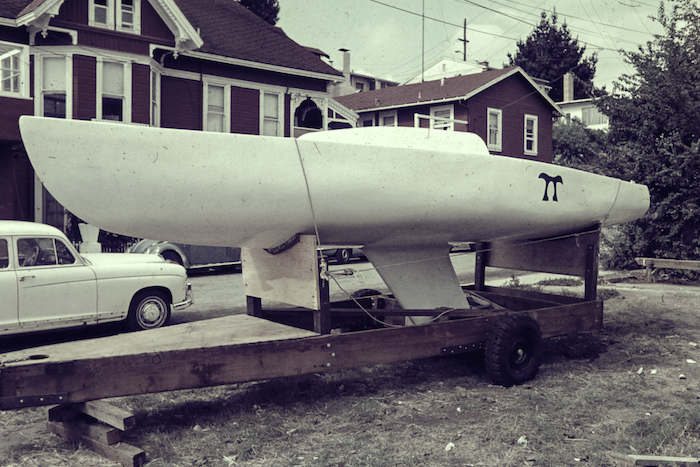
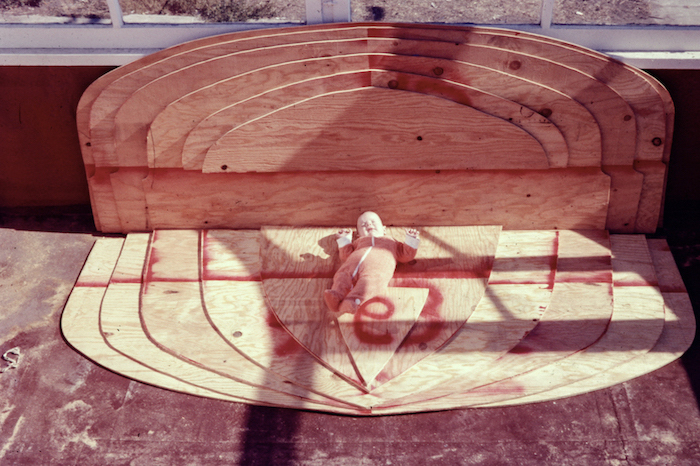
He documented the process in photos, often using his growing baby, Serena, as a marker of time passing as the boat materialized. In the family collection of slides, there is baby Serena with the stations cut out in sequence, Serena learning to walk around the lot when the fiberglass was being laid, and toddler Serena at the launch of Pi.
Steve included others in his build and would often let some of his young neighbors and students from the middle school, including Niels Kisling, help with sanding and painting.