

Max Ebb: Lunacy (The Art of Celestial Navigation)
I am not very big on major-league sports, but when there’s a big game on at the yacht club, it’s a major-league social event. People who are genuinely interested in the game usually stay home, where they can watch it uninterrupted. But down at the club, even though we roll out the giant high-definition screen, it’s more about food, friends and sea stories.
I was surprised to see the TV in the bar instead of the usual dining venue for a recent game. I took a peek into the dining room to see what event might have caused the sports fans to relocate, and I didn’t have to look far. A big sign at the door read “Football Widows Celestial Navigation.” This was a free, weekend crash course in celestial, given by one of the club’s old salts who had actually used a sextant in anger. The room was cluttered with empty sextant boxes, half-filled-out work forms and plotting tools, but not students. They were all out on the back deck, each with a sextant to practice with. And the old salt was nowhere to be seen. Instead, Lee Helm was giving sextant-handling advice, apparently subbing for the usual instructor.
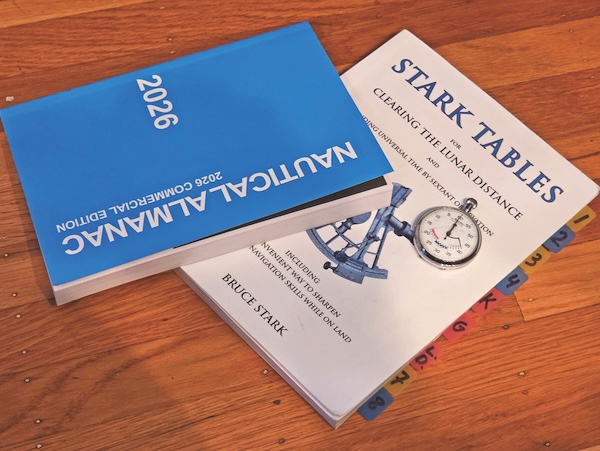
“I like to switch them between left and right hemispheres,” she explained after confirming that she was indeed the instructor that day. I was about to respond to the effect that the Eastern Hemisphere is harder for beginners, because you have to subtract east longitude from 360 to get Greenwich Hour Angle. Just in time, I realized she meant brain hemispheres.
“We do an hour of theory first,” she said. “I start them off with the navigational triangle and ways to get the calculated altitude, and the reasons for using an ‘assumed position.’ That’s the hardest concept, so it goes first while they’re still fresh. Then we get some welcome relief by switching to sextant practice, where they try to pick up the muscle memory of swinging the instrument to get an accurate measurement.”
It was nice to hear the students vocalize their “aha!” moments when they finally figured out, usually after some help, how to see the sun and the horizon at the same time.
“Interest in celestial has been, like, way up in the last few years,” Lee observed. “The prices for usable instruments on eBay have almost doubled since before COVID. Plus, people seem to think that GPS is more likely to be hacked.”
“The Airbus software recall is what made me take this up,” said one of the students as he handed off his instrument to another navigator-in-training. “If we have another coronal mass ejection like the Carrington event in 1859, it’s not just the satellites that get fried. Every electronic gadget could be damaged. Even my digital watch. So I’ve been shopping for a good used mechanical chronometer.”