

The Resourceful Sailor: Stepping a Small Boat Mast With a Tripod
We recently shared the story of The Resourceful Sailor unstepping the mast of a 19-ft modified Augie Nielsen Spitzgatter-design sloop using the foremast of a 65-ft wood-hulled, gaff-rigged schooner. In this second part of the sequence, he assists with the stepping of the newly varnished mast back into its rightful place.
Naturally, The Resourceful Sailor said yes when asked about helping step the mast of Murrelet (a 2019, home-built, 19-ft Spitzgatter), using her purpose-built tripod (also called a gyn). Murrelet would be on a trailer at Port Townsend’s Boat Haven Marina and ready for launch at the next high tide. Bertram Levy, Murrelet’s builder, had hauled her out just five days earlier for yearly topsides and antifouling work. It’s best not to keep wooden boats out of the water for very long.
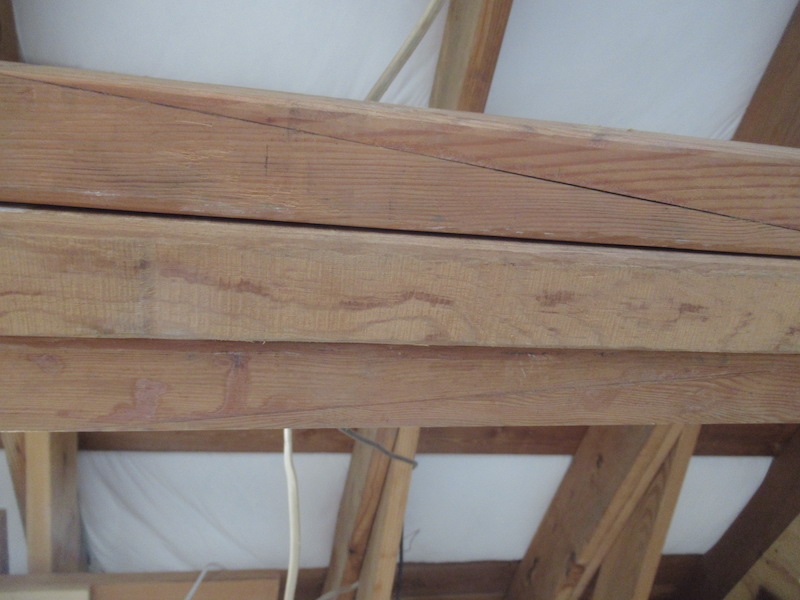
If you built a 19-ft, deep-keeled, wooden sailboat (and it’s not your first or biggest), it’s nothing to make a proper-sized tripod for stepping and unstepping its mast. It’s easy to store in the boat shop’s rafters and easy to use. The tripod consisted of three legs, made of two-by-three-inch lumber about 18 feet long, bolted together at one end through stainless steel straps riveted in place. The bolt included a U-shaped bracket that the fixed block of a two-part tackle (also called a gun tackle) would hang from. A tuft of carpet was added to the peak to protect the mast’s varnish. The tripod feet were tapered, each sandwiched by stainless straps, and brought close together for pinning to Murrelet’s stay chainplates and headstay fitting.

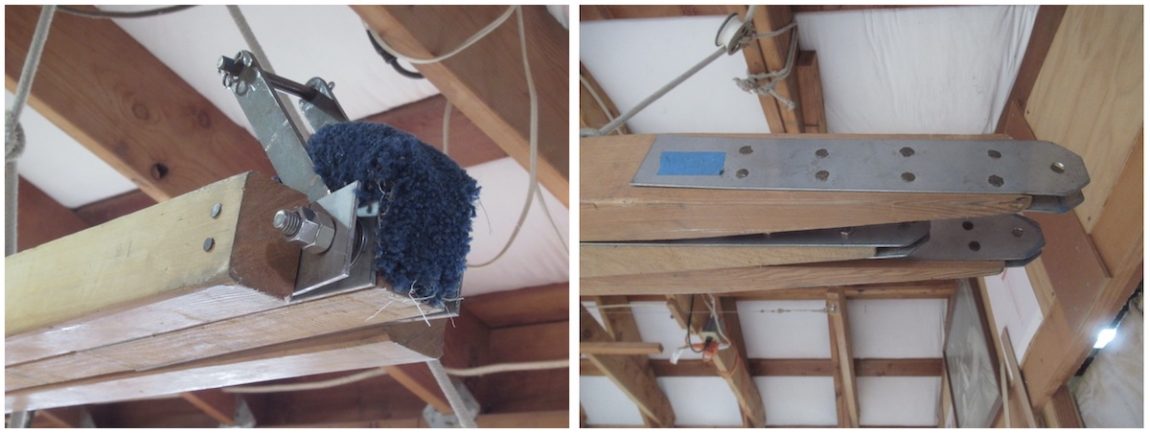
“The trick is knowing the balance point of the mast,” Bertram says about determining the perfect height of the tripod, explaining that there may be some trial and error. “The legs were made a bit too short at first, and extensions had to be scarfed in.”
Murrelet’s deck, when on the trailer, was well over my head. The towing vehicle, with the mast on the rack, was unhitched to allow room to set up the tripod, which was opened into a large “Y” configuration directly in front of and in alignment with the boat, the top of the “Y” to the bow. The “Y” was lifted and moved onto the deck, the two legs then being pinned to the shroud chainplates on each side of the boat, aft of the mast. The peak of the tripod was lifted by walking the third leg toward the bow, then pinning it to the forestay fitting.
The tripod was ready, and the mast was moved on board from the aft quarter of Murrelet, the base of the mast forward. There was a small sawhorse and cushion on deck for setting down the mast. The gun tackle’s movable block was shackled to an endless strap doubled around the mast. This strap was not girth-hitched; the shackle was clipped to both ends of the loop. We added a choker/retrieval line around the strap on the mast side of the shackle, with a loose round turn and a bowline. Led lower on the mast and tied off, this would cinch the loop down tight in the correct balance spot (we already knew where this was), opposing the upward pull of the hauling line. Later, after the mast was stepped, this choker line became a retrieval line. The cinch was loosened, and the strap and tackle were pulled down. The shackle worked well because it wasn’t a bulky knot that might have taken the critical extra inch in the haul height. The strap worked because it bound when cinched down and ran smoothly on the newly varnished mast on retrieval.
With the mast connected to the tackle, I hauled on the lifting line. I thought the gun tackle was perfect for this. The mast felt half its weight, and went up quickly without oodles of line stacking up on deck. Less hang time, less time for trouble. As I lifted, someone else held the mast base, causing the mast to stand up. By the time I reached the top, the mast could be guided to the mast partner, with just a few inches to spare over the deck. Once at the partner, I gently eased the line, lowering the mast through it. Bertram was below to guide the base to the step. It went in easily. We would have added the stays, but with Murrelet, we just added the mast wedges because the stays needed to wait until the tripod was removed. This was sufficient for her. The tripod was disassembled in the opposite order of assembly, and the stays were secured. Murrelet was ready to launch at the next high tide and return to her slip.
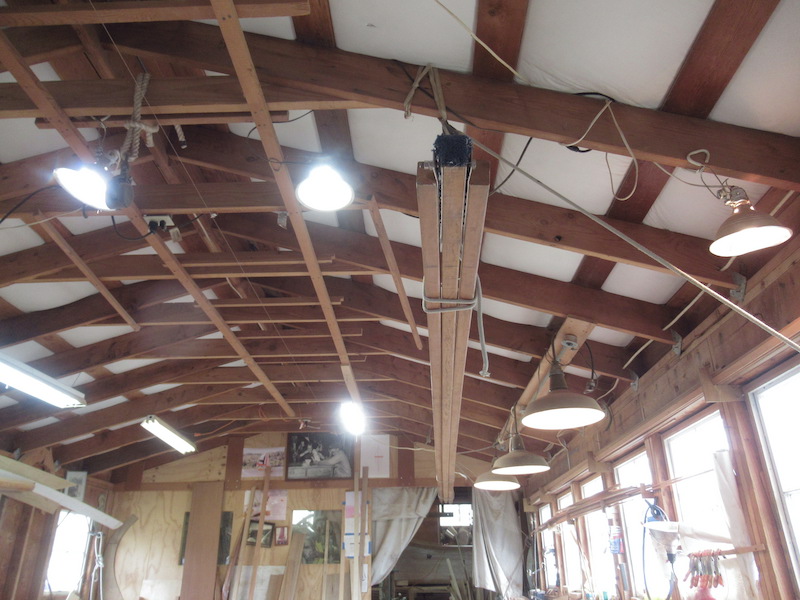
It turns out that the options for stepping and unstepping a small sailboat’s mast are aplenty. The Resourceful Sailor keeps learning new ways himself: gin poles, pole hoists, booms, yards, tripods (and cranes). What’s next? These are real-world physics at work (and play), and they are not exclusive to sailors. Do you need to stand a windmill, pull a well pump, or raise a barn? These might help. Remember, keep your solutions safe and prudent, and have a blast.
Here’s a video demonstrating the sequence [You’ll want to see this – Ed.]
The video is delightful and the percussion is a rare treat. Always good to see other options used by others.
Thank you for the kind words.
I use a gin pole on the Catalina 22. It is attached perpendicular on the mast. Then strap stays are attached to the mast and chainplates. Then hoist or lower the mast using a pulley attached to the mast and the forestay attachment on the bow.