

Episode #261: Max Ebb, Collapsed Lung, Fleet Family, Slocum (L38 Verbatim), W/ Host Monica Grant
In this week’s episode of Good Jibes, host Monica Grant reads four articles from the October 2026 issue of Latitude 38 sailing magazine.
Hear “Max Ebb–Dragging the @$$” by Max Ebb, “Rib-Shattering Pac Cup Return” by John Temoyan, “How a One-Design Fleet Became a Family” by Brandon Mercer, and “Sailing into Port Alone” from Sailing Alone Around the World by Captain Joshua Slocum.
Here’s a small sample of what you will hear in this episode:
- Doug and Rose pose as novices for a free university sailing club lesson
- Diagnosed with bruised ribs and a collapsed lung
- The kind of pain that gets worse every hour and won’t let you lie down
- Welcoming is our default setting
- J24 Fleet 17 crews show up to help each other move
Listen to the episode on Apple Podcasts, Spotify, and your other favorite podcast spots — follow and leave a 5-star review if you’re feeling the Good Jibes!
Follow along and read the articles at Max Ebb–Dragging the @$$; Rib-Shattering Pac Cup Return; How a One-Design Fleet Became a Family; Sailing into Port Alone.
Check out the episode and show notes below for much more detail.
Show Notes:
- Max Ebb, Collapsed Lung, Fleet Family, Slocum (Latitude 38 Verbatim), with Host Monica Grant
- [0:14] Welcome to Good Jibes with Latitude 38
- “Max Ebb — Dragging the @$$” by Max Ebb
- Read it here: https://www.latitude38.com/issues/october-2026/#64
- [1:15] Lee Helm and Flo Field argue over whether to leave the fenders dragging as a poor person’s knot meter
- [2:42] Out-of-town guests Doug and Rose pose as novices for a free university sailing club lesson
- [4:37] Lee estimates boat speed by listening to the Doppler shift in the bow and stern waves
- [6:25] A deep dive into transom drag, separated flow, and why a dry transom is faster
- [12:57] Doug sums it up: back east we have to wait for a storm
- [13:28] Check out the Latitude 38 Crew List to find a boat or crew
- “Rib-Shattering Pac Cup Return” by John Temoyan
- Read it here: https://www.latitude38.com/issues/october-2026/#39
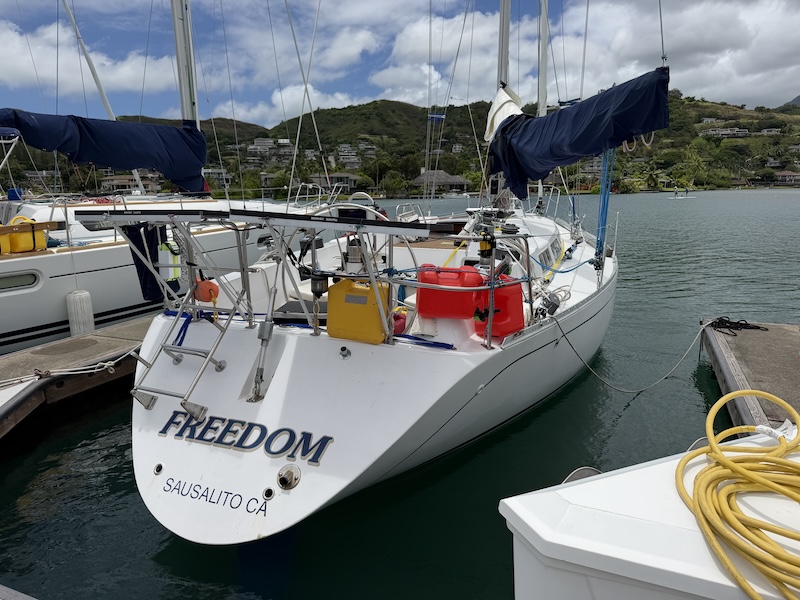
- [14:12] Departing Kaneohe a day early to outrun Hurricane Fausto
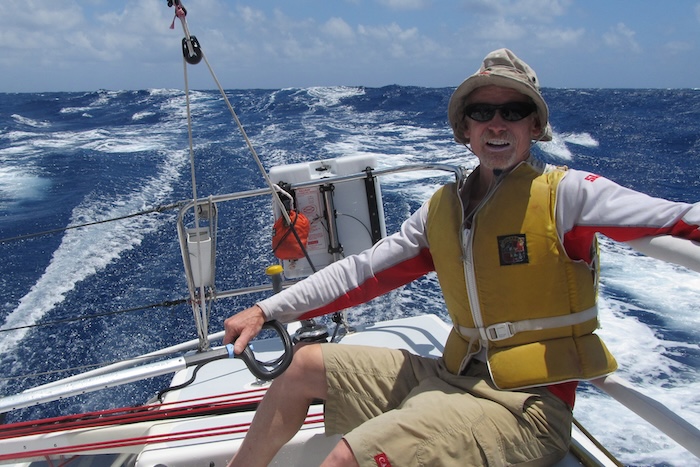
- [14:39] Thrown across the cabin below, ribs into a bulkhead
- [15:38] Turning back, Coast Guard checks in multiple times, and Kaneohe Yacht Club sends a launch at midnight to guide them in
- [16:30] Diagnosed with bruised ribs and a collapsed lung; grounded on Oahu for ten days while Freedom departs without him
- [17:28] Mahalo to the USCG, Kaneohe YC, Castle Hospital, and above all to shipmates Jim Martins and Chris Dorsey
- “How a One-Design Fleet Became a Family” by Brandon Mercer
- Read it here: https://www.latitude38.com/issues/october-2026/#54
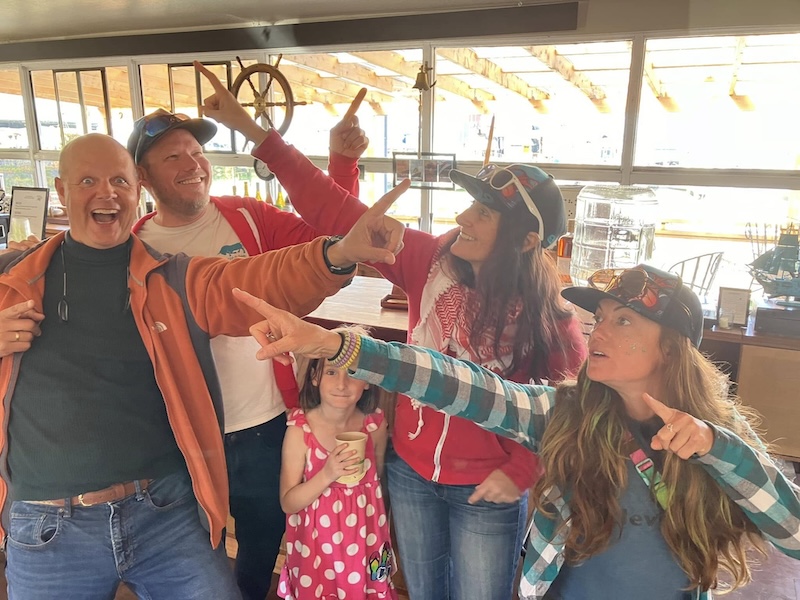
- [17:43] J24 Fleet 17 crews show up to help each other move
- [18:45] What makes a one-design fleet different
- [20:58] Pandemic Zoom game nights that became weekly in-person dinners, and why meeting each other’s families changed everything
- [21:55] Welcoming is our default setting
- [22:26] Kids tutored in Spanish, daughters becoming co-skippers, sons landing America’s Cup jobs
- [23:52]Want to sponsor Good Jibes? Email [email protected] to learn more
- “Sailing into Port Alone” from Sailing Alone Around the World by Captain Joshua Slocum
- Read it here: https://www.latitude38.com/issues/october-2026/#41
- [24:20] Spray rounds Dear Island Light at seven knots, spray throwing necklaces of light across Massachusetts Bay
- [25:47] Coming into Gloucester alone for the first time
- [27:12] The crowd cheers, an old skipper calls it perfect, and Slocum says nothing
- Check out the October 2026 issue of Latitude 38 Sailing Magazine
- Make sure to follow Good Jibes with Latitude 38 on your favorite podcast spot and leave us a 5-star review on Apple Podcasts
- Theme Song: Pineapple Dream by SOLXIS
Transcript:
Please note, transcript not 100% accurate.
00:03
Had I uttered a word, it surely would have betrayed me, for I was still quite nervous and short of breath.
00:14
Welcome to Latitude 38’s sailing podcast, Good Jibes. Here we share the world of sailing through the eyes of the West Coast sailor, with stories and tips about cruising, racing, adventure, exploration, or just plain sailing. This week we bring you stories from Latitude 38’s October issue. We start with Max Ebb’s Dragging the Arse. Max and Lee Helm get into a deep discussion about the complexities of boat speed.
00:41
all inspired by Max’s natural instinct to bring in the fenders when the boat gets underway. We then sail into the Pacific where John Tamoyan sustained a collapsed lung and bruised ribs soon after taking off on a delivery from Hawaii to San Francisco. Back in the bay, Brandon Mercer shares the story of how the J24 Fleet 17 became a family. And finally, we leave you with an excerpt from Joshua Slocum’s Sailing Around the World Alone. Sit back.
01:11
and enjoy!
01:15
the fenders where they are please?” the instructor ordered. I had already started to untie one of them so the command was surprising. I just thought we should look ship-shaped when we passed the club I replied. For years every time one of the boats from the University Sailing Club passed in view of the yacht club windows I couldn’t help thinking how leaving the fenders hanging and dragging gave the wrong impression of that student-run organization.
01:44
but it seemed to be the sailing club’s MO. It’s our poor person’s knot meter, the instructor explained. The sound tells the new students how fast we’re going, and we do a lot of docking practice under sail, so it makes sense to leave them set. When there are two volunteer instructors on a sailboat, there will be at least three different versions of how to teach. Instructor number one was Flo Field, a colleague of Lee Helm in the Naval Architecture Department.
02:14
and an expert in computational hydrodynamics. Lee Helm, also a grad student in the department, was instructor number two. No, let’s pull the fenders in, Lee argued. I don’t want to mask the sound of the Doppler shift. How did I get myself in the middle of this argument on a university sailing club boat? My two boat builder friends from back east, Doug Furr and Rose Wood, were visiting the Bay Area.
02:42
Sailing on the bay is a required part of my usual hospitality for out of town guests. But as fate would have it, my boat was on the hard that week. Lee, however, had an answer for that. Have them sign up for a free lesson at the sailing club, she recommended. It’s like our club’s latest promotion. Only available to visitors from like far away places and new arrivals to the city. Get a free personal keelboat lesson. But if it’s to promote membership, I questioned.
03:12
Why only for out of town visitors? If they’re only here for a visit, they won’t be a good membership prospect. Because though it’s labor intensive, word of mouth is a great way to promote the club, Lee emphasized. And the visitors are always here because they need to interact with locals. So if we show the visitors a good time on the water, the word spreads fast to the locals. Every little bit helps. We tacked a few times in light air to clear the breakwater.
03:39
with both instructors emphasizing the importance of keeping boat speed up during close maneuvers. Doug and Rose stayed under cover, not letting on that they had been sailors all their lives. Meanwhile, Flo had deferred to Lee on the fender issue, mainly because our guests were more connected to Lee than to Flo. So I got back to bringing the fenders aboard, taking a few seconds to note to our students that the last person to set the fenders had done it properly.
04:08
tying to the lifeline stanchions at deck level instead of to the lifeline wires. Is this your first time at a tiller? Flo asked. You’re doing really well for a novice. Not wanting to blow her cover, Rose deliberately steered a little too deep, letting the jib telltale stall. Can you really tell by the Doppler shift how fast we’re going? I quizzed Lee after we had settled down on Port Tack in the open bay. How fast are we going now? I asked.
04:37
as I took out my phone to check speed with my GPS app. I’ll estimate, like, four and a half knots, she said, after a short hesitation. It’s the bubbles. The bubbles in the bow wave are moving toward my ears. The foam in the stern wave is moving away. So the frequency is a little higher in front and a little lower stern. How can you tell the difference, I asked, we’re not moving fast enough for the difference to be very big. Not consciously, she admitted, but I think it’s internalized.
05:07
as a quality of the mix of sounds. Also remember that power is proportional to speed cubed, so a small speed difference makes a much bigger difference in the rate of energy dissipation in the water. Once you know your boat and calibrate your eyes and ears, it’s natural to be able to guess the speed with, like, surprising accuracy. Just then, as if to make the point, a small airplane flew over us at a moderately low altitude
05:36
And Lee did not need to offer any more explanations to our geeky ship’s company about the Doppler shift.
05:44
4.4 knots I announced when my phone’s GPS app had stabilized.
05:52
The point one is probably adverse current, Lee added.
05:58
But the sound I like best, noted Flo, is the sound of the bubbles behind the fully aerated transom with a rooster tail, when the boat is finally going fast enough to break the suction on the stern from the turbulent water. You know, that’s something I’ve always wondered about, said Doug. When the transom is dry, there’s just air pressure pushing on it. When the transom is wet, usually because the stern wave has raised the water level back there,
06:25
The pressure has to be at least a little more than atmospheric. So why does everybody say that the boat goes faster when the transom is dry? Isn’t it really just the opposite? For attached flow, I think you’re right, said the hydrodynamicist. The flow at the back of the boat is turbulent, but not necessarily separated. You mean like a canoe stern with a long run, suggested the boat builder.
06:53
or a stern overhang with a very flat aft rocker? For sure, said Lee. But with a flat or fully round stern on a heavy boat, the flow separates early and there can be, like, a lot of suction.
07:08
Separated flow can definitely reduce the pressure on the transom, Flo added. The separated water is accelerated forward with a lot of it now moving with the boat and momentum conservation pulls the boat back. Also pulls the boat down if the water is bubbling up behind, say a wide shallow transom that’s not going fast enough to aerate. And don’t forget the sides and bottom of the hull near the stern, Lee added. The low pressure on those surfaces can also pull after down.
07:38
Even though, like as the speed increases, the turbulence in the boundary layer might help keep the flow on the boat’s hindquarters attached and reduce the suction drag a little. Our guests looked a little confused. Don’t mistake turbulence in the boundary layer for detached flow, Lee tried to clarify. Boundary layer turbulence is on a small scale like inches or fractions of inches, depending on Reynolds number. Detached flow
08:07
is on a large scale on the order of feet and width of the stern. So what’s the takeaway from all this? Rose. Is it slow when the transom is partly underwater? I raced to Hawaii one year on a double ender with an apple cheek round stern and it was noisy. When we pushed the boat with the big spinnaker, it was enough to keep us awake like trying to sleep next to a waterfall. She stopped suddenly when she remembered that she was pretending to be a novice sailor.
08:37
to qualify for the free day sale courtesy of the university club. I thought you were steering too well to be a beginner, Flo teased. But I think the answer is fairly simple. If you’re going fast enough and if the flow is separated, then a dry transom is better than a wet transom or a wet stern. If you are in the attached flow speed regime, the transom should be out of the water. Lee had been searching for something on her phone during this last exchange and finally found it.
09:06
Here’s a graph of the pressure field around a submerged sphere moving through the water, she said, as she passed her phone around the cockpit. It’s not a boat hole, but the back half of a submerged sphere is not a bad stand-in for those apple-sheet ground sterns. The graph shows pressure as a function of distance from bow to stern of the moving sphere. The pressure is like pretty low after midships.
09:36
You’re ignoring the wave effects Flo protested. And also, if the pressure gets low near the surface, the transom will dry out and we’re back up to ambient air pressure. Right, we need more data to get a better picture. But the point is, if the transom can dry out, you want it dry. If you’re not going fast enough for that, you want to keep the transom clear of the water. Is there a formula for that critical speed, ask Doug? It’s based on the depth
10:04
Froud number, said Lee. V over square root of Hg, where V is boat speed, H is transom depth, and g is gravitational acceleration. Froud number, Rose asked. The froud number is a way of comparing boat speed to the speed of the waves the boat makes. Is that part of the hull speed formula, Doug asked? If you use knots and feet,
10:34
and the waterline length instead of transom depth, then like, yes, you get so-called hull speed at a Froude number of 1.34. It’s the speed of a deep water wave having a wavelength equal to the LWL of the boat. But that’s only quasi-non-dimensional. If you use feet per second, feet and seconds, or any consistent units to make it truly non-dimensional,
11:03
then hull speed is when the frowd number equals 0.4. What’s the required frowd number to keep the transom dry, I asked. Opinions vary, admittedly. Saunders in Hydrodynamics of Ship Design says when the depth frowd number is four or above, example, if the transom bottom corner is half a foot underwater with the boat at rest, the transom could dry out
11:31
when V divided by the ratio of speed over the square root of the quantity 0.5 times 32.2 equals four. That works out to 16 feet per second or 9.5 knots. Sounds high to me, said Flo. I’ve seen data that puts it at more like 2.5. Maybe because Saunders was writing in 1957, Lee speculated.
11:59
Small craft were heavier back then, so the stern waves were higher, adding more extra depth compared to the at-rest condition. More modern sources put it at like 2.5, which is the rule of thumb that I use. That makes it only 5.9 knots. We should talk one of our undergraduates, she said to Flo, into making this a senior research project. The thing to remember about the Froude number, Lee continued, is that it’s not linear.
12:29
with the square root in the formula. A boat and a scale model moving at the same Froude number, based on length, will make similar wave patterns. But if the model is one quarter full scale, it has to go as fast as full scale. You have to increase size by like a factor of four in order to double hull speed. With my guests outed as experienced sailors, the instructors had no one to teach.
12:57
We played Guess the Speed for a while and set the big spinnaker when the sea breeze came up. We all had the pleasure of hearing the hiss of the foam behind a dry transom and watching our rooster tail where the wake cavity collapsed well astern. You mean it blows like this every day? Doug noted with envy. I nodded. Back east, we have to wait for a storm, he said. I can send you some good membership prospects, which made the sale a success.
13:28
Hey good Jibes listeners and Latitude 38 readers. Have you looked in our classy classifieds lately? It would be impossible for us to know how many boats have sold to new owners over the last 45 plus years of publishing Latitude 38. But we’re sure they have helped countless people realize their sailing dreams. Every month there are new boats listed that will fill someone’s sailing adventures. If you have a boat you want to sail or are looking for that next boat in your life, the pages of Latitude 38 will surely have something to suit your fancy.
13:58
Pick up a magazine at a local marine business or visit our classy classified pages at latitude38.com to find boats, gear, job opportunities and more. Then tell us your next sailing story.
14:12
a rib shattering pack cup return by John Timoyen. Aloha. As part of this shorthanded delivery crew to return freedom from Kaneohe, Oahu, back to SF after the Pacific Cup, I was looking forward to a couple of weeks at sea to recharge my batteries that our workday world seems to draw down so quickly, but it was not to be.
14:39
We departed Kaneohe a day early to get some distance from the approaching hurricane Fausto. Reefed and beating our way north with confused seas, we were already soaking wet within a few hours, necessitating installation of valleys a bit earlier than we had hoped for. I had only been below for a few minutes when I was thrown across the cabin, my ribs impacting the bulkhead handhold. Initial pain lessened after a few moments, but I knew I would have to pay some attention to it.
15:10
Back on deck, the pain increased substantially over time and later still, when trying to lay down to rest, I could not get comfortable and had to sit up. The pain spasms were also starting to inhibit my breathing. After another hour of this, we made the decision to turn back. We alerted the Coast Guard of our status and Kaneohe Yacht Club to confirm a slip. As I was stable, we continued our way back.
15:38
four to five hours it took us to return to Kaneohe, they contacted us multiple times to check on my status. It was close to midnight when we arrived back at the yacht club, yet there were several folks who assisted us at docking and at getting me off the boat and into the ambulance that had arrived a few minutes later.
15:59
Castle Hospital in Kailua diagnosed me with severely bruised ribs and pneumothorax collapsed lung from the blow, which both inhibited my breathing and precluded me from flying for at least seven days. Freedom re-departed Kaneohe for the slog home early that next morning without me. As the doctors at Castle determined if my pneumo was stable or getting worse, it was stable.
16:30
There are worse places in the world to recuperate than Oahu, but nevertheless, pain medicine and moving slow became the order of the day. Ten days after the event, I was back home on the mainland and off the pain meds, but still sore and moving a bit slow. My deepest thanks go to everyone who pitched in and helped in one way or another. I’m sure that there are more of you than I realise, but here we go. The USCG, who, as always,
16:59
handled everything in a professional and confident manner. The Kaneohe Yacht Club, who even at midnight sent out a launch to help guide us on the long motor into Kaneohe Bay, as well as assisting upon arrival. Everyone at Castle Hospital in Kailua, who were beyond caring and professional. And finally, most importantly, my shipmates on freedom, Jim Martins and Chris Dorsey, who took great care of me on board and without complaint.
17:28
doubled back to get me onto the dock and into the hospital and set off again once they knew I was in good hands. Finest shipmates don’t exist anywhere. Massive mahalos to all of you.
17:43
How a One Design Fleet Came a Family by Brandon Mercer Whenever Randall Rassicott called out a manoeuvre, I would jump. Vang! Starboard twing to lifeline. Even now, hearing the skipper who taught me how to race, I automatically leap into action. An inch to the right! Watch the door jam! Today, we aren’t sailing. The crew from J24 Flight is moving a giant wooden sculpture. Eight feet across,
18:12
and weighing as much as a piano, through the threshold of Rascott’s new house. It is one of three times this summer that the J24 fleet has helped each other move.
18:26
With the J24s it’s kind of insane. We’ve all become family. We go to each other’s birthdays, each other’s weddings. Everybody’s helping each other move, says Jasper Van Villeet, skipper of evil octopus. That has little to do with saving sometimes.
18:45
Emmy Duckworth raced thistles for years, but here in the Bay Area? I started sailing with J24s and within a day it was like I’d been here the entire time, she says.
18:58
For me, it’s always been about the fleet, Ellie Tubman adds. Sailing is more about being with people and chatting on the boat and figuring out something together. It’s teamwork at the end of the day.
19:12
Carrying a heavy dresser up a flight of stairs and playing real-life Tetris around a tight corner with your tactician may not be how most crews practice for a regatta. This land-based teamwork with San Francisco Bay J24 Fleet 17 sets it apart as something far beyond just a one design class. It’s just an extension of what crew means. When Tenacious Cuddlefish Helm, Will Pertureba and Evil Octopus’ Bow
19:41
Brie Biller planned their move to a new house this summer, one group text to the fleet brought instant results. A sentence and the mention of pizza and beer was enough. Crews from six boats, including Russcott, who doesn’t even own a J24 anymore, appeared at 9am, ready to lift heavy objects. Everyone pitches in when work is needed, whether it’s fixing an outboard the night before a regatta, helping prep boats for travel regattas, or just scrubbing someone else’s hull.
20:12
There was a boat that came back an hour after ours and we were all just putting everybody else’s boat away because that’s what we do, just for ads. We just took care of everybody.
20:24
Being part of a one design fleet has a lot to do with it. On J-24s, every single piece of equipment, from the weight of the motor to the length of the lifeline lashings, is specified in the fleet rules, so boats are essentially identical. That means everyone knows everyone else’s boat, and crew swapping is standard. As Jasper recalls, I was docking and Roseanne was stepping off another boat, and she started de-rigging my boat.
20:53
She hadn’t been on my boat, but she’s like, yeah, that’s just what we do.
20:58
The fleet’s closeness grew during the pandemic. We were all confined to our homes and began doing game nights on Zoom. It’s amazing how you can actually play Clue remotely. Post lockdown, that evolved into Tuesday game nights, hosted at various homes with the host providing the main course and the rest of the boats and crews bringing salads, wine, beer, desserts and sides. Going to one another’s homes
21:26
and meeting partners and spouses meant extending relationships beyond just where you sit on the rail during a race. Anyone all different ages, all different backgrounds, everyone finds their little spot within the group and you can just be yourself, Tubman says. Robin Van Vliet, it concurs. We really don’t care if you’re male or female or non-gendered or non-binary or trans or queer. It doesn’t matter. It’s like, can you say it?
21:55
Are you a cool person? Awesome, welcome. Robin, then saving a skipper of Little Wing, got my son James through Spanish class. When he crewed for her, they would only speak Spanish to James, forcing him to practice before his finals. He earned his California State Seal of Biliteracy and is now finishing his master’s degree with a job waiting as a junior engineer for ARC Team USA in the America’s Cup.
22:26
As one of three female skippers, Roseanne Scholl of Flight was a strong role model for my daughter Addison. Addison eventually became co-skipper with me and Will, helping lead us to be 2025 season champions and driving for our Three Bridges fiasco second place fleet finish in January. She’s now at Cal Poly Maritime pursuing a career on the water. Yeah, I’m proud of my kids, but I’m also proud of my fleet.
22:57
We will take you out on a Wednesday night to show you the ropes, help you buy a boat and teach you how to race it. But we’ll also show up with chicken soup if you’re sick, the on-call tutors for your kids calculus classes and show up with a bottle of scotch for your retirement party. The J24 isn’t the only fleet with this type of community, but it’s been doing it consistently for a very long time.
23:25
Latitude 38 has called it a fun and approachable fleet. The boat design may be from the 70s and the balsa core hulls may have some soft spots, but the community around it is vibrant. Robin put it best, welcoming is our default setting. Hey, listen up. We hope everyone is enjoying listening to the stories of West Coast sailors on our Good Jives podcast.
23:52
We’ve heard lots of great feedback from the 150,000 listeners who’ve tuned in over the last couple of years. And if you have a marine business, we’d like to give you an opportunity to connect with them during upcoming podcasts. If you’d like to be a sponsor of future podcasts, you can email Latitude38 to learn more about how your company can benefit from sponsoring good gybes. Now for something a little different, we’re going to share an excerpt from Captain Joshua Slocum’s book.
24:20
sailing alone around the world. The wind freshened and the spray rounded dear island light at the rate of seven knots. Passing it, she squared away direct for Gloucester to procure there some fishermen’s stores. Waves dancing joyously across Massachusetts Bay met her coming out of the harbor to dash them into myriads of sparkling gems that hung about her at every surge. The day was perfect, the sunlight clear and strong.
24:48
Every particle of water thrown into the air became a gem, and the spray, bounding ahead, snatched necklace after necklace from the sea, and as often threw them away. We have all seen miniature rainbows about a ship’s prowl, but the spray flung out a bow of her own that day, such as I had never seen before. Her good angel had embarked on the voyage, so I read it in the sea. Boldner hunt was soon a beam, then marblehead was put astern.
25:19
Other vessels were outward bound, but none of them passed the spray flying along on her course. I heard the clanking of the dismal bell on Norman’s woe as we went by, and the reef where the schooner Hesperus struck I passed close aboard. The bones of a wreck tossed up lay bleaching on the shore abreast. The wind still freshening, I settled the throat of the mainsail to ease the sloop’s helm, but I could hardly hold her before it with the whole mainsail set.
25:47
A schooner ahead of me lowered all sail and ran into port under bare poles, the wind being fair. As the spray brushed by the stranger, I saw that some of his sails were gone and much-broken canvas hung in his ringing from the effects of the squall. I made for the cove a lovely branch of Gloucester’s fine harbour, again to look the spray over and again to weigh the voyage and my feelings and all that. The bay was feather white as my little vessel tore in, smothered in foam.
26:17
It was my first experience of coming into port alone with a craft of any size and in among shipping. Old fisherman ran down to the wharf for which the spray was heading, apparently intent on draining herself there. I hardly know how calamity was averted, but with my heart and my mouth, almost, I let go the wheel, stepping quickly forward and down the jib. The sloop naturally rounded in the wind.
26:43
and just ranging ahead, laid her cheek quietly against a mooring pile at the windward corner of the wharf, so quietly, after all that, that she would not have broken an egg. Very leisurely, I passed a rope around the post and she was moored. Then a cheer went up from the little crowd on the wharf. You couldn’t have done it better, cried an old skipper. If you weighed a ton, now my weight was rather less than the fifteenth part of a ton. But I said nothing, only putting on a look of careless indifference to say for me, ah!
27:12
That’s nothing, for some of the ablest sailors in the world were looking at me, and my wish was not to appear green, for I had a mind to stay in Gloucester several days. Had I uttered a word, it surely would have betrayed me, for I was still quite nervous and short of breath. Thanks for joining us. We hope you enjoyed the stories and look forward to our next episode of Good Jibes. Until then, fair winds and stay salty.