

Episode #214: Stephen and Kristen Van Dyck on Cruising the Pacific As a Family
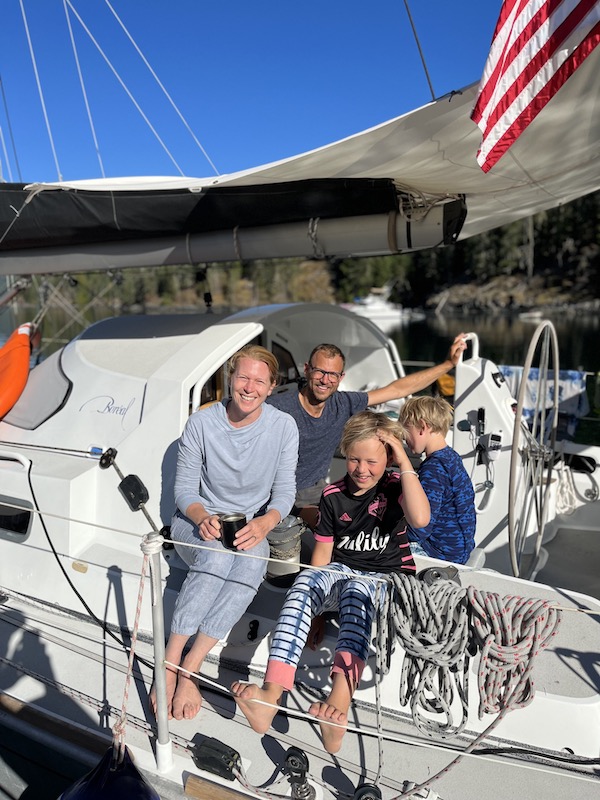
Welcome to Good Jibes! In this week’s episode we chat with Stephen and Kristen van Dyck and one of their sons, Paul, to chat about their year-long sailing sabbatical as a family. They’re living a sailing story that blends history, adventure, and family togetherness aboard their 2019 Boréal 44 Flyer.
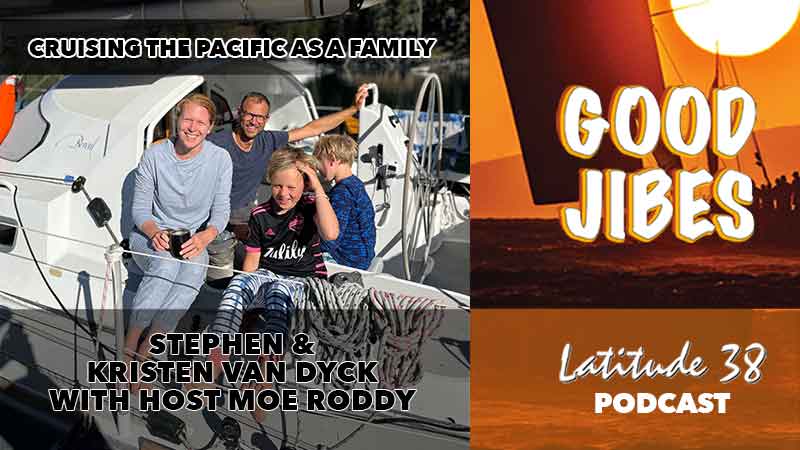
Tune in as the van Dycks share with Good Jibes host Moe Roddy their experiences of how to take the family sailing trip of your dreams, how to plan and structure a long sailing sabbatical, how an extended cruising trip changes your perspective on life and sailing, why it’s such a valuable experience for all involved, and how to make sure the kids keep learning while on the water.
Here’s a sample of what you’ll hear in this episode:
- Living with low expectations and embracing uncertainty
- Taking a year sabbatical with kids aged 11 and 13
- Online school aboard: navigating education with Starlink
- Kristen’s architecture career and the decision to pause
- How COVID changed their priorities and sparked the trip
Follow the Van Dyck family’s adventures at SVFlyer.com
Listen to the episode on Apple Podcasts, Spotify, and your other favorite podcast spots — follow and leave a 5-star review if you’re feeling the Good Jibes!
Check out the episode and show notes below for much more detail.
Show Notes
- Stephen & Kristen Van Dyck on Cruising the Pacific as a Family, with Host Moe Roddy
- [0:12] Welcome to Good Jibes with Latitude 38
- [0:44] This episode is brought to you by OceanPlanet Energy
- [0:58] Meet the Van Dyck family – Stephen, Kristen, James, Paul, and Pelle the cat
- [1:53] Stephen’s sailing childhood in the Chesapeake Bay
- [3:45] Kristen’s path to sailing – from canoes to cruising
- [5:33] Stephen’s defining memory: freedom on the water at age 8
- [6:59] Kristen’s leap into liveaboard life without fear
- [9:08] The unexpected engine trouble between Friday Harbor and San Francisco
- [11:33] Why now? Taking a year sabbatical with kids ages 11 and 13
- [12:55] The power of announcing your plans out loud
- [14:54] Online school aboard: navigating education with Starlink
- [17:36] Safety systems and watch schedules with kids
- [18:55] What Kristen looks forward to most: getting further afield
- [20:41] This episode is brought to you by OceanPlanet Energy
- Living in Uncertainty
- [22:06] Kristen’s architecture career and the decision to pause
- [24:47] How COVID changed their priorities and sparked the trip
- [26:09] The story behind the name Flyer
- [27:36] The boat: Boreal 44 aluminum cruiser specifications
- [30:26] Stephen’s time with Skip Novak and Pelagic expeditions
- [33:39] The life-changing experience in Tierra del Fuego
- [36:01] Multiple Newport-Bermuda races and learning offshore
- [39:49] Living with low expectations and embracing uncertainty
- [42:37] The Pacific Northwest vs. far-flung destinations
- [38:44] This episode is brought to you by OceanPlanet Energy
- Short Tacks
- [44:13] Paul’s perspective: surfing as the best part of boat life
- [46:07] Paul’s favorite book: Swallows and Amazons by Arthur Ransome
- [48:05] Kristen’s recent read: Foster by Claire Keegan
- [49:01] Stephen’s favorite: Walden by Henry David Thoreau
- [50:00] Self-reliance vs. community: the unexpected joy of help along the way
- [50:56] Favorite anchorage: Cuyler Harbor, San Miguel Island
- [52:48] Stephen’s favorite race course: Argentario, Italy
- [54:15] Stephen’s greatest inspiration: his father
- [55:39] How cruising compares to offshore racing
- [56:33] Kristen’s advice: just go do it, build up slowly
- [58:30] Magic moments: dolphins in bioluminescence
- [59:25] Fair winds to Flyer – follow along at SVFlyer.com
- Make sure to follow Good Jibes with Latitude 38 on your favorite podcast spot and leave us a 5-star review on Apple Podcasts
- Check out the October 2025 issue of Latitude 38 Sailing Magazine
- Theme Song: “Pineapple Dream” by Solxis.
Transcript:
Please note: this transcript is not 100% accurate.
00:02
If you’re doing it right, you do need to be able to like leave at three in the morning if things get crazy.
00:14
Welcome to Latitude 38’s Good Jibes with this latest episode brought to you by our friends at Ocean Planet Energy. Welcome everyone to the Good Jibes podcast brought to you by Latitude 38, the sailing magazine for West Coast sailors since 1977. I’m your host today, Moe Roddy, and I’m so glad you’re here. Each week, we bring you the stories and the adventures and voices of the people who make sailing on the West Coast so special.
00:44
whether it be about racing or cruising or exploring and everything in between. So settle in, drop your anchor and join me for another great conversation.
00:58
I’m so excited about my guests today. They are doing what I had always dreamed of doing and what I’m sure many of you have dreamed about doing. Today, we’re joined by Stephen and Kristen Van Dyck and maybe their two boys, James and Paul, but I think James is in school on board somewhere on the boat. But from offshore racing and classic yachts to a family sabbatical, cruising the Pacific aboard their Boreal 4040 named Flyer.
01:26
The Van Dycks are living a sailing story that blends history, adventure, and family togetherness. We’ll hear about Stephen’s offshore career, Kristen’s leap into sailing life, and of course, Pellie, the family cat, may just be the real star of the show. Welcome to the Good Jibes podcast. Thank you. It’s great to see you again. I always like to start at the beginning. So we’ll go back to the way back. um
01:53
You grew up sailing in the Chesapeake, Stephen, right? So tell us about that. Yeah. Well, so I was born and raised in Philadelphia and lived there actually all the way until I went to college. And my father and my mother are both from sailing backgrounds. And so the nearest place that we could sail as a family was the Chesapeake. So we had a Pearson 37 when I was a kid for many years. And we sailed and cruised that in the Chesapeake out of Oxford, Oxford, Maryland.
02:19
And it was just a great place as a kid, me and my two younger brothers just would be able to, you know, be kids and explore and go out on the dinghy and get a sense of what it was like to, you know, be a little bit loose in the world with a bit of a loose leash. And so that was sort of the beginning of our time learning about sailing and cruising. And of course that sort of led to a lot of other things, but it was a nice way to live as a kid in the summer months particularly.
02:49
The challenge was that it was still three hours away from Philadelphia. So was quite a drive and quite an effort. But in hindsight now really demonstrates my parents commitment to wanting to do it. Had your father already ended his sailing career at this point? Well, he was still racing quite a bit. um think, the early 80s was still helping out with some of the America’s Cup campaigns with the New York Yacht Club syndicates. And I think he was doing occasional Bermuda races. But I think his
03:19
intense part of his career had faded a bit at that point and he was focusing more on his family and his professional career. But it was always still very front and center and my mom also was born into a Samling family and so it was just sort of natural that my parents would spend their time and money to focus spending time together that way. And what about you, Kristen? You came to this later, right?
03:45
Much, much later. Yeah. So my family had a canoe growing up. That’s about as close as I got. So I grew up outside of Boston um in the suburbs. And so we, I spent a bunch of time near the water, but not really on the water. I mean, I went to summer camp and learned to sail sunfish and windsurfed and stuff, but nothing really until I met Steve. So we met in grad school for architecture around that time or shortly after Steve had a sonar out of Neroton Yacht Club in Connecticut.
04:14
And so I’d go occasionally racing with him doing that. That was not necessarily my favorite type of sailing. It was really close quarters. I was always worried we were going to hit someone, one of his dad’s friends, you know? But it wasn’t really until we moved out to Seattle, Steve got a little sailboat out here and then really got into kiteboarding and wing foiling and our kids did some windsurfing.
04:43
down in Hood River, Oregon, but then we got a powerboat. So that was the first time really we spent a lot of time on a boat and then this sailboat and cruising on the sailboat was really when I started to learn about sailing. So I did take some classes through the Seattle Sailing Club, which was, you know, sometimes it’s helpful to learn from someone who’s not your m family member. And those were great, actually, I loved those. Yeah, yeah.
05:08
I actually teach a course called Safety for Cruising Couples. Oh yeah. And there’s a lot that the other person doesn’t know. They don’t teach you. They haven’t let you know these things. Well, there’s so much you know by instinct that you might not think to teach necessarily. exactly. Steven, do you have a defining childhood memory that sparked your love of the water that that was it? weren’t going to.
05:33
It was always going to be a part of what you You know, I don’t think there was a very specific moment for me as much as there was a feeling, a feeling of freedom that came with being on the water. I’ll never forget we were cruising around the Chesapeake, probably over in the Choptank River or something like that one weekend. And we wrapped it up with some friends who had a little home built, like 12 foot dinghy with a jib and a mane, really simple little boat. And I think I was probably like eight or something. And I remember my parents just saying, yeah, go give it a go.
06:03
and my brothers and I piled in, neither my other two brothers who were two and then five years younger than me. But nonetheless, the three of us just kind of made it work. And I’ll just I’ll never forget the feeling of the, you know, the sails and the tiller in my hand and the ability to kind of point that bow wherever I wanted. And yeah, I think that that’s still the sort of driving sense of why why we why we go out on boats. There’s a real sense of freedom, isn’t there? Yeah, yeah.
06:33
Yeah, and empowerment. Yeah. then, um, Kristen, you, this is really a big thing for you because you are now living on a boat and you’re not going around the buoys. You’re going offshore with your two children aboard. Um, and the cat, so the cat falls overboard. It’s no big deal.
06:59
But, or maybe it is, I don’t know. anybody else hear that. the kids may disagree with that. They’d be perfectly fine with one or both of us falling over by the cat. That would be the end all. Well, this is a big, huge shift for you. You’re an architect. You’ve given up your career. So, I mean, there’s a process to this. Can you explain what that’s been like? You know, I don’t know if it’s just that my personality is, don’t.
07:26
worry a lot. I haven’t. And also just that Steve is really methodical and careful. There’s nothing about this to me really, maybe it should, but it does not feel frightening in any way. We feel very, I feel very, very prepared. And we’ve sort of slowly built up for the past. So we left in August on this trip, but for the past few years, we spent about a month on the boat, em sailing, motoring, mainly around
07:55
Desolation Sound, British Columbia. So we’ve seen like some big weather, we’ve been offshore a bit. So we sort of gradually built up. um I also think, I kind of like to joke. I mean, one of the things early on when we were doing the racing, not having done it before, it’s so much like you take the same things out and put them away again. You take them out and put them away again. It can be repetitive. And if you don’t necessarily,
08:23
have the joy, know enough to have the joy in what you’re doing yet. It can feel sometimes like a bear. So I sometimes joke that having kids is like the best preparation I could have had for living on a boat because I’m just used to, you know, I’m always cleaning up after something and things are always seem to be in chaos and then we put stuff away and put it back together. It just feels fun. We’ve had so many great experiences as a family on a boat, on boats.
08:49
and in little anchorages around Puget Sound and em in the San Juans. That’s just, we’ve had such good times. I think that’s kind of what I have in mind. It hasn’t felt like such a huge jump. Have you had any experiences yet that make you pause?
09:08
No. Well, I mean, we’ve had a yeah, we had an exciting time between uh Friday Harbor and uh San Francisco, where we made an unexpected stop in Newport, Oregon, because of engine seawater and our engine oil. But even that never felt I mean, we were never in danger. Yeah, it was just not what we were expecting. But that’s sort of what I’m expecting for this year. It’s a lot of not what we’re expecting. But I’m glad you said that because you know, a lot of people have children and and and they
09:38
you know, they may be fearful of going offshore with their children and you’re, you know, what you’re saying is just the opposite. Like it’s all good. Yeah. I think if you’re prepared, um we have a lot, so much safety gear that hopefully we’ll never see again once we put it away, but I feel pretty prepared for any condition. So let me ask you, go ahead. was even going say, think like, you know, the basics, obviously just time.
10:05
as much time as we can spend in the boat we do. And so that’s not just summers and stuff, but that’s on weekends and stuff. We’ll go out. I think we went out at both last couple of years for Thanksgiving and we had Thanksgiving on the boat. Just, you know, simple, like a couple of few nights kind of things, but like just being used to living life and doing things on the boat, because everything’s different. Absolutely everything is different living on a boat, as you know. And I think that that’s even more a challenge when kids are around. And so…
10:34
just the more repetitive, the more you can kind of get used to it. I think the easier that becomes. And you know, as, then you continue to sort of stretch your bubble and our bubble isn’t even that big right now, but like, it feels that everything we’re doing now is just another kind of expansion of where we can go and the things we’ve seen and the experiences that we’ve had. And you just keep adding those to your hopper of experiences. And you remember those when things get a little weird or different that, you know, every other time you’ve adapted, you’ve figured it out. You’ve solved the problem or whatever. And, um and I think that just,
11:04
builds confidence in you and yourself. It shows the kids that you can be resilient, you can learn, that they can do challenging and different things in life. They don’t have to do things the way that everybody else around them is doing them. um And that learning on your own and learning by experience is super important. It’s not just gonna be, hopefully they’re not gonna live lives where em AI chat bots just tell them how it all works and how the world works, but they’re.
11:33
really learning from real experience. And so this is a good time to try that and to live it and to let them see and experience that together with us. So how old are the boys? So James is 13 and Paul just turned 11. The intent was to take a year. So we’re taking a year away from our life in Seattle to do this trip. And the intent was to really try to do it at a time when the boys could be old enough to contribute and to observe and to remember.
12:02
and to participate as much as possible, but young enough that we’re not completely unmooring them from the social and educational needs that they have back at home. And so it was really felt like a good time. And I think about three years ago was a time that we used to say, hey, it’s three years away. Can we do this? And we kind of just made it happen. And I think one of the things that I’ve learned is that if you set a goal like this, or you can
12:31
find it and set a date and you know it has to happen at a certain time. I think one of the things that’s been really helpful for us and I haven’t really talked explicitly like to Kristen about this lately, but I think talking about what you’re gonna do out loud to your friends and to your family and to even people you don’t know is a super important thing. I think at least for us, because it’s helped kind of hold our feet to the fire.
12:55
We’re actually gonna do this? And I think to me, it’s one thing that sort of felt like, okay, there’s no going back. If we’re gonna be the people that we wanna be, if we’re gonna be, you know, trying the things that we’ve been saying we wanna try, and then we’re telling people that we’re gonna do this, we can’t not do it. So when it gets really hard. so profound, yeah. Yeah, when it gets really hard, you just have to remember that, like, you can do it, get through it, it’s okay. Like, the other people have done this before. We’re not breaking any new.
13:24
major ground here. yeah, and the further we go, the more we realize that other people have done much. We just met a family that they’ve been their son was born and they immediately moved onto a boat that was a project and they’ve been living on the boat ever since and they did a passage where you know, their child was in diapers. Yeah, I think it puts in perspective what we’re trying to do is it’s you know, it’s a big deal, but it’s plenty of people have done it before and talking to those people is really helpful as well.
13:54
Yeah. Well, I think there’s something about when you say it out loud, you go from being fearful to having courage. There’s something about a transition when you say, I’m going to do this. And I think that’s right. And it’s pretty profound. And by the way, I have em friends that I know of that here. There’s Tanya and Laurie Crooks. They live in Australia. He’s Australian. She’s from Germany. And I met them in the Caribbean and she was pregnant with their third child.
14:24
and they were living on their boat and they were cruising and they would strap the kids down in car seats in the boat when the weather got Genius. Yeah. I mean, it’s just like being in a car sometimes. We use iPads and they put no problem. iPads in a scopalamine patch, no problem. I know that’s so great. Well, I was going to ask you, what’s their routine like? What’s for the boys?
14:54
Oh, we’re I think we’re just beginning to figure it out. But um yeah, and I guess for people’s knowledge, what is today, the third of October? Yeah, so the third of October. So we’re only about six weeks or so into this adventure of ours. But the boys started school. They’re enrolled in a an online school, which is pretty incredible. And it’s amazing if you take some time away from normal life and you need to pull your kids out of school. um The amount of resources out there to support.
15:20
remote education are really amazing. yeah, since COVID, I think the options have increased dramatically. And there’s no, I think there’s really nothing to replace in-person school, but for a year, it’s interesting to have, there are many, many different ways of doing it. Do you have Starlink? We do. Yeah, yeah, we have that, which is, think, you know, most people that you meet cruising agree it is the vein of our existence and it’s also
15:47
the thing that allows many of us to actually even do this in the first place. So it’s a very interesting kind of balance that um that system plays in our lives. ah But it’s allowing us to do this because the kids are attending remote school more or less um with a school that does entirely online schooling. And so that’s really helpful and that’s gonna allow them to come back to school without missing a year. And so the days are pretty straightforward. The weekdays.
16:14
uh Currently we have a schedule where those classes are from about noon until three uh on weekdays. And so we have the mornings and the afternoons pretty open depending on the homework that’s going on. And we’re just beginning to dabble in doing that weekday routine on passage. And we’ll see how that continues to go. We’re going to have to get used to that. And so that’s something that’s um just a reality. But I think it will get easier with time the more we get used to it.
16:44
I should let our audience know that you are, are you on an anchor or are you in a slip right now? We’re tied up right next to a pump out station at the Santa Barbara Marina. There’s it’s blowing a gale out there right now. We decided to come in to see some, some friends for a few days during the gale and then we’re going to head back out to the Channel Islands. We’re more or less in town. Okay. And you, and so I should let our audience know, cause I’m seeing here, you’re sitting in the cockpit and Kristen’s down.
17:12
below, Yes, right. Jameson is in his cabin during school and Paul is in our cabin doing who knows what with the cat. Yeah. That’s right. So what do do for safety for the kids? So in other words, like, have you done nighttime passages yet? you had any? yeah, yeah, yeah, quite a bit. Yeah. How’s your watch system work with the kids and stuff? It all depends. Well,
17:36
It more or less the kids are welcome on deck. We love we would love them on deck at night. We don’t we’re not making them stand to watch at night. We’re beginning to dabble in having them stand to daytime watch, but currently there’s not a kind of a mission critical assignment. We’re we’re pretty coastal right now, like we’re within 7080 miles of the coast as we’re making our way down. m So you know, attention is pretty essential right now. um As we get further offshore.
18:05
And some of the longer passages, I think our intent is to give family proper walk-ins. But we also brought a friend aboard for the trip from Seattle down to San Francisco, which was incredibly fun. And he was a very brave soul to join us. uh And that was really fun, too. And I think having another party in the family is, for us, if it’s the right person, is a really great thing. That person can help change the family dynamic in a way that’s more fun and different. And um people just.
18:34
are surprisingly more respectful and easygoing when there’s someone else aboard and it’s not just the four of us. We’ve been playing with having a few people aboard here and there as we go on this trip, depending on what our passages look like. Kristen, what are you most looking forward to?
18:55
I’m really just looking forward to getting a little further afield. mean, we’ve been some of our last summer we took the boat up to Haida Gwaii from Seattle and we had days where we just didn’t see anyone. It was so beautiful. You don’t see any people, but you see, you know, 20 whales. That part was just incredible. And so I think, um you know, we’ve actually so far on this trip, it’s been pretty.
19:22
urban. We’ve had lot of urban experiences. had a lot of, we have a lot of friends and family in San Francisco, Monterey, here in Santa Barbara. So we’ve been stopping places and it’s been great. I mean, particularly as architects, it’s so fun to travel to cities by boat. I mean, to arrive in San Francisco under the Golden Gate Bridge. And that was the first time the kids had ever been there. And they arrived on a sailboat under the bridge. Pretty special.
19:46
But so that has been wonderful. But we just had a few nights in the Channel Islands before the wind really came up. And I think to have some more of that time, I’m really excited about. go back out there be a quieter, peaceful, yeah. Yes. Yeah. Just today here at the marina, I was just standing, you know, it’s right next to the harbor master. And there was an octopus just chasing crab down on the rocks just right near, you know, amongst all the boats. And it’s so incredible to see that kind of
20:15
stuff to have the time to just stand around and watch that for a while. um Out on the Channel Islands, you know, we’re like swimming with sea lions and seals and there’s terns trying to land on the mast and that kind of stuff is just, that’s what I’m looking forward to. Yeah. Yeah. It’s going to be incredible. This is the Good Jobs podcast brought to you by Latitude 38. We will be right back.
20:41
Hey listeners, this episode of Good Jibes is brought to you by our friends at Ocean Planet Energy. Founded by two-time Solo circumnavigator Bruce Schwab and later joined by Nigel Calder, Ocean Planet Energy delivers optimized power systems designed for serious offshore cruisers and racers. Their custom engineered solutions combine American power systems, high output alternators with solar panels, lithium ion battery systems, and smart power management.
21:09
keep you reliably running quietly and efficiently at sea with minimal fuel use and recharging time. Proven in the Vendee Globe and over hundreds of thousands of blue water miles, Ocean Planet Energy Systems give you the confidence to explore the most remote corners of the planet. Learn more at OceanPlanetEnergy.com. They’re good guys and would love to know you heard this on the Latitude 38 Good Jives podcast.
21:38
Welcome back to the Good Jobs podcast. My name again is Mo Roddy. Let’s get back to our story with the Van Dykes. What a great family story this one is. So I want to talk a little bit about your careers as architects and then about you, Steven, in your, because you had quite a accomplished sailing resume that’s, you know, it wasn’t your career, but you’ve done quite a few amazing things. But, um, Kristen, so,
22:06
What kind of, first of all, what kind of architect were you and are you, and are you going to go back to it? And can you do any of this while you’re offshore? And yeah, what’s going to happen? Well, I just happened, it’s funny how you don’t tend to specialize in architecture school. When I graduated, when we graduated and moved to New York City, I happened to work for an office that did, that was working on a lot of historic buildings, turning them into apartments. So I, um
22:32
It just happened that I worked on a lot of projects under construction in old historic buildings or districts, which I loved. At the seaport nonetheless. At the seaport, yeah. And then we moved to Seattle and I worked for an office that was also doing housing and in some historic buildings. And then for a while I was on the, I volunteered on the Seattle Landmarks Preservation Board, which, I just tend to love old.
23:02
buildings and housing. boats. you been? Old boats. Although I have to say, when we’re walking around, particularly this marina is fantastic, but walking around there are so many beautiful old wooden boats and I look at them and just think, boy, that looks like so much work. It looks so beautiful. That looks so beautiful and like so much work.
23:24
Yeah, so Steve and I, program, our grad school program, I think part of the reason both of us chose it was because you actually build a house as part of our program. There’s a real practical aspect. And I think that maybe that in terms of architecture and boats, I think maybe that’s kind of how they relate for us, that it’s we like building things and making things and having our hands in things. em
23:49
you know, it was really fun to have a lot of sewing projects to do for this boat before we took off. Steve did a ton of work himself on the boat. But yeah, in terms of will I go back? have no idea. think I don’t know what I’ll do when we get back. I think it’ll take a little while to get back into real life when we arrive back in Seattle. But we’ll see what after a year of doing this, what we’re interested in. Well, Steve has to go back to work. was gonna say, I think one thing that is interesting is that
24:19
probably like most people in the world, COVID had a huge impact on us. And I think it kind of woke us up in many ways. One of the things that shook us and told us that we weren’t spending enough time with the kids and Kristen was really over overtaxed at work at that time. I think this is probably 2022, right, Kristen, towards the end of COVID. And we decided at that point, like, let’s focus on the kids. And so she happily paused her career to spend more time focusing on the boys.
24:47
And around that time was also the time we hatched a plan for this trip. so those things have really kind of aligned in a very nice way. And I would say this trip was in no small part, like inspired by that same feeling of time is moving really quickly. Life is so much more um rich than just the career all the time, 100%, which is sort of the way that we’ve been raised. And um there must be a different way to live uh and also have a good career. And so I think that we’re kind of…
25:17
You’re experimenting in that right now. I’m not quite sure where that’s going to lead. Yeah, and in terms of doing it, oh was going to you asked about working on the boat. em We feel busy so far. There’s never never never something to do. Yeah, yeah, I have not felt bored at all. And we’ve met plenty of people that are working while they’re cruising. But that’s since we have a year. We have a year off. So thankfully, we don’t have to worry about that.
25:46
I think architecture would be really hard to do from a boat. But yeah, but it’s amazing how in touch we are with, I mean, thanks to Starling, but we really, we feel almost in closer communication with our family on the boat, I think, just because they’re really curious to know what’s going on. So we do have good connection at least.
26:09
Well, I’m curious about your name, Flyer, because obviously I went right to the Whitbreads and Connie’s boat and is there any connection there? Well, only so the boat was named Flyer when we purchased her and she was uh commissioned by a British Airways pilot who is from England, from the south of England. And uh so he named her Flyer. The connection to the Whitbread boat was very much in my mind when we bought the boat. I think that we sort of felt like
26:38
Oh, and also I’m from Philadelphia and I’m Philadelphia Flyers fan. so we thought that there was just too many good reasons to keep the name. And it’s great. It’s sort of like Kristen’s last name is Johnson. And it’s kind of like her last name. It allows her to be pretty anonymous. Like, hey, it Flyers. There’s like 300,000 of these boats out there. it’s, we’re, we’re fine with anonymity. like, we don’t have bumper stickers on the boat or the car or whatever. It wasn’t, the boat wasn’t named by us, but we certainly are aware of some of the
27:07
It was true behind the name. Yeah, and actually just we were headed to the Sea of Cortez. So there was we had one long passage down to Monterey and Steve and I just sat and we listened to the John Steinbeck audio book Sea of Cortez. And as we listening to the book and arriving in Monterey, Western Flyer, the boat that he took down to the Sea of Cortez was leaving the harbour, which was pretty it all felt magical and cosmic. Yeah. Nice.
27:36
Phil, tell us about the boat, like who designed her. You know, I like to know like how much does she carry? How much fuel does she carry? How much water? All that good stuff. You’re going to be taxing my brain for some of the stats. But the boat is a Boreal 44. It’s an aluminum hull hard to shine boat built in Brittany by the Boreal yard. The boats, I believe, began designing construction in maybe 2009 era.
28:05
This boat was built in 2019, so she’s still of the first generation of boats. They’re now building slightly different evolutions of this design, but she’s a sloop rig with a centerboard, so kind of a go anywhere design philosophy for the boat. Very thick aluminum plating in the hull, very shallow draft, adjustable draft, and a relatively small rig just to keep her, you know,
28:32
performing well, given the relatively high center of gravity with the centerboard design. she is a great sailboat. She sails quite well. Very, very happy, particularly downwind. Has quite a wide transom and has a few features that we think are kind of indispensable, at least now for us. So the shallow draft is one and it’s really amazing where what we can do and where we can go with that and the things you can accidentally hit. As we all always do.
29:01
in boats and and she also has this really wonderful dog house uh we like to call a cat house uh but which is behind a wonderful big bomb door and you can pretty much seal yourself inside and have a nice cup of tea when things get really really nasty out very very cozy cockpit and it’s a i just generally i think it’s a perfect boat for kind of going anywhere with a family um and i think that’s
29:30
Our plan is to do this trip and to hopefully have some other trips in store in the coming decades with this boat. My hope is to kind of have the boat that we would maybe live out our older years in as well. So I think she’s big enough to go good places, to make some good miles at 44 feet, but she’s also small enough that if things get really ugly, one person can sail the boat. ah She can be pretty easily single-handled. So very simple systems.
29:58
You know, no electrical winches or anything like that. Everything’s manual. She’s a wonderful boat for us. Really enjoying her so far. Cool. So, Steve, let our audience know you’ve had a bit of a sailing career with a talk to me about Skip Novak and Pelagic because um I wanted to go down there so badly and go cruise on that boat and go to Antarctica. I guess it doesn’t do it anymore. But tell us about that. Well, I guess I mean, this may go back way into my childhood, but um
30:26
When I was a kid, did like a lot of people that a uh lot of young sailors did lot of reading back then we didn’t have the internet to learn about um the things that were happening in the sailing world. I remember reading Seahorse magazine when I was like 10 years old. I remember when Skip’s book, Skip published a book called uh One Watch at a Time, which is about his experience skippering drum.
30:51
which was Simon Le Bon’s boat in the Whip Red Race. They actually sailed that into the slip when it was sinking. Did you know that? Yeah, it’s some pretty wild stories that associated with that boat. Look, I highly recommend it for anybody who enjoys good stories, skips a great storyteller. And I think that book really, like, I don’t know, it just, it sort of changed my understanding of what you could do sailing and the places you could go and really kind of sparked my imagination, particularly for
31:20
all things offshore racing. so so skip was this kind of like legend in my mind. And I remember, I think I was in my mid twenties and I was racing on a, really beautiful Swan 56 at the time called Lolita. And a good, you remember Frank Savage? Frank Savage. Yeah. Frank was a wonderful, wonderful man. oh Oh, so Frank was incredible, incredible man. So I was racing with Frank.
31:47
and with an incredible crew. mean, like he put together just this like all star crew and we had so much fun racing up there in the summers. Phil, what was Phil’s name? Phil from Hoss Bars. Oh, Phil Garland. Phil Garland. of course. Yeah. So anyway, so he had, so he brought um on board also a guy who was a very good friend of mine, eventually, Coolidge.
32:11
um And so Knight, Knight and I would hang out and Knight’s a really interesting guy. He’s younger than my dad, but significantly older than me. um But he and I just clearly like connected um in a great way. And we spent a bunch of time together. Like we would go out to breakfast in the morning together, just the two of us and just chat. And he was a sort of classic old salt and a great storyteller as well. every day, Knight has this wonderful thing where he had a uniform. He’s the only person I ever knew who had a uniform.
32:40
He wore the same exact outfit every day, khaki pants and a white button down Oxford shirt and top-siders. That was it every day. There’s no question what he was going to put on. And every now and then he’d throw a blue wool sweater on top of it. But Knight was such a character. And I remember at one point we were chatting and he was telling me about his friend who was doing all this interesting stuff in Antarctica. I’m like, who is this guy? He’s like, Skip Novak. I’m like, oh my God, know, Skip. He’s like, oh yeah, know, Skip and I grew up together in Chicago and all this stuff.
33:09
I said, oh my God, Skip is like my hero. had like, I got, how could I possibly meet him? He’s like, well, Skippy’s always looking for help. Would you want to go help him out? And of course I said, absolutely. And I, I think I went right back to my job. I was working for an architect outside of Philadelphia at that time. And I think that next week I went back and I said, well, I would say maybe it wasn’t that next week. I remember connecting with Skip over email and then we had some phone calls and all this stuff. And he eventually invited me to come South and spend some time with them.
33:39
And when the invitation came, just said, had to, have to do this. I told, I asked my boss who happened to also be a sailor and he immediately said, of course you gotta go do this. This is really great. And so it was a couple of months that I spent down there. We, did a refit on Pelagic and I’m not quite sure exactly what year this was. Probably around 2000. And we did a full refit on the boat. I remember showing up in Gordra outside of Sao Paulo.
34:05
Nobody was there for about three or four days. was living on the boat all by myself on the hard and began some of the work and then Skip showed up and we refit the boat there over the course of a couple of weeks, a few weeks. And then we brought the boat south to the Falklands and then to um the Beagle Channel and um Mardell Plata, oh sorry, are we? uh Shuaia and Porto William. And that was, so that was really kind of like my formative
34:34
I would say uh expedition kind of cruising experience that totally changed my perception of what you could do with a sailboat and where you could go and what you, and the things you could experience and just also how big the world is. mean, to be at a place like that and sort of like some of the places we’ve been in BC where you just don’t see people for days. It was just an amazing, amazing experience. And I would also credit that experience with part of the reason that Kristen and I moved to um
35:03
Seattle is it just reminded me so much. It happened to be a big city that had also these sort of big mountains and big water sort of all as part of your life and clearly not to the roughness and magnitude of Tierra del Fuego, but it was a very similar kind of feel. And I think that’s a quality that both of us really love about living in Seattle. So that’s my long story. Did you get down to We did not go to Antarctica. No, no, no, no.
35:33
that’s still on my bucket Yeah, if you’re wondering why we have an aluminum boat, that’s probably why. I was thinking Alaska for you guys, because. I would love to get back to that part of the world. Actually, South Georgia is the place I’m really hoping to take the boat at some point. that’s dream. It’s always good to have big lofty dreams. Yeah. All right. And you’ve done the new part from Newton Race several times. Yeah, those were really wonderful experiences. I think.
36:01
You know, I think the first one I did when I was, I don’t know, maybe 16 or something, I really amazing. That race is just incredible. As you probably know, the diversity of weather systems that you’ll experience and the diversity of issues and challenges that we need to navigate. And of course, being able to um make landfall in Bermuda is uh wild.
36:26
sensory experience, the smell of the island as you approach it is just like nothing else. I think that that, you know, doing that passage, whether it was the race or deliveries back over several years, also kind of built a comfort for me in being offshore. And as you see all kinds of stuff, right, you can see lots of glassy calm and you can see wild gales and, um you know, wind against tide situations that are just
36:56
pretty crazy. And I think it’s a wonderful place to learn about being offshore. With the limited other offshore experience that I have, I do feel like it’s really kind of given me a sense of confidence in um going offshore. I think they say the Gulf Stream is one of the three most dangerous bodies of water on the planet. yeah. Yeah. It’s crazy. I mean, you know what Wind Against Tide does in the Solonans are
37:25
Even in the East River, right? And it’s that times 10 sometimes out there. Yeah, I’ve crossed it nine times and I’ve gone everything from drifting into it in the middle of the night. It was so calm to be caught in 60 knot gusts and 62 knot gusts and square green waves where it’s like, oh, I hope I live. Yeah, that’s right. But then of course you wind up in Bermuda.
37:54
And everything’s fine. Is there a better place to end a race? I’m not sure. Well, I don’t know if Steve mentioned yet, but his mother was born in Bermuda and uh grandparents live there. So it’s a little bit like homecoming when you arrive in Bermuda for Steve. Oh, I wish I knew because there’s a couple who live in uh Monterey who he’s from Bermuda as well. His grandparents are from Bermuda. Oh, wow. So let’s talk about your trip. Where are you going?
38:25
I, well, I don’t know. It changes every day, I think we realized, we kind of realized when we got on the boat, I mean, we like pushed off the dock at Elliott Bay and we realized we had spent so much time thinking about leaving. We had spent really hardly any time thinking about where we were going. I mean, we generally knew that we were going to follow, you know, follow the current, go south, west, back to.
38:54
back north to Alaska and then back to Seattle. But we hadn’t really, you know, we had different ideas. We have friends that had just gone all the way to Japan and back. That seemed kind of exciting. So anyway, when we left Seattle, I don’t think we necessarily knew exactly where we were gonna end up. We knew we were gonna go to San Francisco and then figure it out. And then in San Francisco, we decided we’d continue down to Mexico before we head across to French Polynesia.
39:22
That’s a good idea. There’s a nice set of wind that when you get down there, can take it across. The thing about cruising for us has, we’ve been trying to live by the mantra that my mother used to teach me and my boys. And that is that he that expecteth nothing shall not be disappointed. And when you live that way, when you sort of think like, well, I’m not really going to have a plan. have a general idea, maybe. Then you’re not going to be.
39:49
bummed if it’s different because it’s going to be different, Nothing is going to work out as you had planned it. And that’s the duty of doing this. And I think for me also, that’s the huge mindset shift that we experience when we go cruising, whether it’s just for a weekend, for a month, or for a year, or maybe a lifetime. It’s this sort of uncertainty.
40:14
of life that we have also kind of at a big scale every day and every life that we have, we don’t quite sure how our life is gonna wind up, but you have it on like almost an hourly basis when you’re cruising, right? And so it totally changes the way that um you think, it changes your mental model of expectations. And it also means that you just have to be like ready for anything, right? You need to be ready to go at any moment. you’re doing it right, you do need to be able to like leave at three in the morning if things get crazy.
40:44
Um, and, and that same mentality, I think it just works for everything. And so, you know, by that measure, we have way too much food on the board on the boat right now. Um, and also some other things, but it’s just a wonderful way, um, to experience life. And I think it’s not just about seeing places and, um, fixing your boat in beautiful places, which is also what cruising is about, but it’s also just about changing the, the, the expectations of your mind. Um, and being able to just sort of.
41:14
be as itinerant as you can. But in general, you are going to go south and then you are going to go to the Pacific. We just don’t know. We have friends who are like, oh, we’re going to meet you places. That sounds great, but we don’t know when we’re going to be there or if we’re going to be there. So em yeah, we’re trying to have a sketch. We’re trying to have a master sketch of where we’re going to be. that thing. We’ve got to pay attention to the weather. Balls. Yeah.
41:44
Yeah, and I mean, that said, yes, we do have a general idea of when we would leave Mexico for French Polynesia, you probably in February, and when we might arrive in Hawaii and when we’d want to make the jump to Alaska. So we kind of have general windows of time that we have a sense that’s when we want to be moving. em But I think uh part of having a whole year
42:08
And we know so many people along the way that have three years or four years or a lifetime. And that sounds so nice, but at least with the whole year, you know, if we find a place that’s wonderful, we can stick around. Or if we leave and decide we want to go back somewhere we were before, we might be able to do that. So just having a little bit of flexibility seems wonderful. Yeah, there’s a whole, you could stay in Mexico for years and not see it all. Yeah. You know, we have friends who
42:37
spent about a year and a half leaving from the Northwest and went all the way to Japan and back and said, you know, it really makes you realize how nice the Northwest is. You could spend a whole lifetime just sailing around Pacific Northwest. a wonderful time. think of those dream speaker guides, you know, they’re so beautifully drawn illustrations and it feels like those are people that just know absolutely everything about this area of the world. And that seems so lovely as well.
43:06
Yeah, it’s amazing. This is the Good Jobs podcast brought to you by Latitude 38. We will be right back.
43:16
Hey listeners, this episode of Good Jives is brought to you by our friends at Ocean Planet Energy, founded by two-time Solos circumnavigator Bruce Schwab and later joined by Nigel Calder. Ocean Planet Energy delivers optimized power systems designed for serious offshore cruisers and racers. Their custom engineered solutions combine American power systems, high output alternators with solar panels, lithium ion battery systems and smart power management.
43:44
keep you reliably running quietly and efficiently at sea with minimal fuel use and recharging time. Proven in the Vendee Globe and over hundreds of thousands of blue water miles, Ocean Planet Energy Systems give you the confidence to explore the most remote corners of the planet. Learn more at OceanPlanetEnergy.com. They’re good guys and would love to know you heard this on the Latitude 38 Good Jives podcast.
44:13
So Po, has this been a big deal to switch from living on land to living on a boat? Well, we were on the boat uh for a month last year, so not that month. Not too hard. Do you have a favorite thing about living on the boat that you really like? Surfing. Surfing? Where have you been surfing? I think the first time we surfed was in uh San Francisco with my uncle.
44:43
The second and last time we went was with friends who did the Northwest Pathage a little bit ago. Okay. Did you, em how come you’re not in school today and James is? Oh, for some reason I just don’t have school on Friday. Oh, nice. For magical reason. Yeah, I actually don’t know why. ah What’s the coolest thing you you’ve seen so far? Oh, um. um
45:12
When we were surfing, our friends or my friend’s dad got barreled or didn’t come out, but he almost got barreled. All fall dance was maybe about surfing for you. Yeah. What else, Paul? What other things? Anything else worth talking about or no? Oh, the Channel Islands was nice. What are you looking forward to the most? Probably like Baja.
45:40
or a French Polynesia to see friends. Yeah, and you get a lot of surfing down there. Both places, I think. hope the waves aren’t too big down there. You’ll always find a good size wave. You get small ones. There’s lots of beaches, lots of good grapes. Reef race, I’m going to get pounded on the reef. No, no, no. There’s a lot of sand there. Well, what’s your favorite book?
46:07
My favorite sailing kids book is probably swallows and Amazon’s. What swallows and Amazon’s? Yeah. Okay. Yeah. Paul, can you describe it? We remember what it’s about. Yeah. It’s these people. It’s these people from like, it’s supposed to take place a long time ago. And it’s these kids on like vacation somewhere. I don’t remember where. And there’s this boat at the house where they’re staying.
46:36
and there’s this island where they can surf. It’s like a lake and they named it Wildcat Island. And then they realized that there’s another dinghy there and they went to war or something like that. But they didn’t really go to war. It’s pretty good though. Do you have any advice for any other kids out there who maybe their parents want to go sailing and what’s the best way to talk the kids into going?
47:05
I feel like one that would only really work for me is that there are good waves.
47:12
Did mom and dad have to bribe you with saying you could go surfing? They were in good waves. What about maybe bringing the pet along? yeah, Pilly. Yeah, she’s, it’s nice to have her, but it’s also pretty hard because there’s like a million times where she could jump off. It’s kind of, it’s nice and annoying at the same time. Yeah, but she’s not going to be jumping off when you’re offshore. It’s just really, really dark, right? Yeah, we can take her collar off when we’re offshore. Yeah.
47:41
Well, thanks for talking to me. Can you get your mom back on and enjoy this year you’ve got. I have a feeling when you guys get south and there’s good waves, you may have to leave him. Yeah, I know. He may not go back with you. It’s a one track mind. Paul actually plays hockey back in Seattle and he’s obsessed with that when we’re on land and we step onto the boat and it’s all surfing.
48:05
That is so cute. That’s really cute. We’re going to change tags here too. So I’m going to ask you guys some similar questions. So I’ll start with you, Kristen. What’s your favorite book about non-sailing? About non-sailing? This is nearly impossible for me. I will just say, because I’ve read it recently, Steve’s mom sent me a book by Claire Foster, an Irish author. Her name’s Claire Keegan, and the book is called Foster.
48:32
And it’s a short novella and absolutely beautiful spare writing, just beautiful. oh And Steve, what about you? My favorite non-sailing book, Moe. Are there non-sailing books? don’t know that. I think Walden probably tops the charts for me. The poet? No, no. Henry David Thoreau’s Walden about living. Walden Pond.
49:01
Yeah, yeah, living in Walden Pond for a year, whatever that was. I read it. It’s been a long time, but that was what’s that? I was going to say we haven’t discussed this, but I have been thinking recently about Walden because growing up in a town right next to Concord where Walden Pond is Winchester right next to Lexington. um and when you go to Walden Pond now, it’s just funny because it’s in the middle of a town. I mean, it does not seem remotely remote at all. And I have been thinking about
49:31
eh And you know, it’s a book really a lot about self-reliance and being on your own. And I have thought about that so many times on this trip and that we, what I, some of what I expected of this trip was really that we would be self-reliant. It would just be the four of us and the cat out on the water. And what it has been so far is, you know, people helping us out really, you know, like we brought all our laundry to Steve’s cousin’s house to do. We’ve sent our mail to people’s homes. We have.
50:00
people along the way have lent us their car so that we can go grocery shopping, practical strangers. And I’ve thought a lot about that, that, you know, it’s easy. There is self-reliance to it, but really the joy of it is just the people who have helped us out along the way and meeting people along the way. Wow. So that’s really sweet. I hope they’re listening and they know how much you appreciate them. what’s been your favorite Anchorage so far? Honestly, there’s only been one proper
50:28
Anchorage and that was Kyler Harbor over one San Miguel Island, which if anybody has here out there has not been there yet and has the opportunity to go would highly recommend it. Absolutely gorgeous, gorgeous Anchorage. em It’s the westernmost of the Channel Islands and it’s on the north side. It’s truly spectacular and it’s so funny. the island has no trees on it except for four trees that are there at the Anchorage. Palm trees. Palm trees.
50:56
that were planted supposedly for the filming of Mutiny on the Bounty with, what’s his name? Of course, famous actor whose name is falling out of my brain right You’re talking to a 71 year old woman here, Marlon Brando. Marlon Brando, thank you. Yeah. So it’s pretty funny that there’s like this remnant of humanity there that’s very, very Hollywood, beautiful place. So.
51:24
That’s the best one so far. We’ve had obviously other ones in our lives that have been really spectacular too. I think there’s some spectacular ones in your future here coming up. we’re looking forward to it. Yeah. What’s your favorite thing offshore at night? Coffee, tea or hot chocolate at sea? Well, in the middle of the night, tea. Tea? But in the morning, coffee for sure. Steve? Coffee all the time. Yeah. I used to take those.
51:51
Frappuccinos from uh Starbucks. Oh yeah. In the glass and stuff my foul weather gear pockets full of them. So when I would have to go to my watch, would just give it a little shake, pop it out, throw the thing over. Yeah, you’d be the most popular person on board. would just say, Moe, give me a shot. I also love a chocolate covered espresso bean. It really do the trick. Very easy to put in your foul weather gear. Yes, that’s right.
52:18
to evaporate at a surprising rate. What’s the boys favorite snack underway? Oh, ramen noodles. Yeah, we almost know ramen or the packages of ramen noodles at home and so many on the boat. It’s fun because like any kid can really make it themselves, right? And also burn themselves in the process. it’s good. It teaches good life skills. Yeah. So what’s your favorite race course?
52:48
What’s been your favorite race? I don’t know. All right, well, you’re thinking of that, Chris, and I’m going to ask you where your favorite, where you like to like see yourself someday at Anchorage. But you go first, Steve. All right, I guess the one that I have the most fun, probably the most fond memories of is a race course off of Argentario, which is just north of Rome on the Italian coast, the Med Coast. We’ve done a bunch of classic regattas there, and it’s just incredible. And the people are the most wonderful.
53:18
welcoming people there. The food is to die for and it seems to be almost always windy there. Beautiful spot. Kristen was this all about before you were married before you knew him so you didn’t get to go on these terms? Oh actually I um Argentario I knew Steve when he was going to Argentario and I’d be I think I was in Vermont one summer while he was in Argentario but that we um
53:45
We’ve been to Italy since and I’ve gotten to go there and eat on the waterfront and it’s pretty beautiful. It’s a special spot. Good. Good man, Stephen. Stephen, who’s inspired you most in sailing? My father, without a doubt. I mean, I wouldn’t be doing this without my dad. And he’s been a big part of this trip too. He helped us find the boat. He helped us prep the boat. um
54:15
He’s our constant source of great information and knowledge and entertainment while we’re underway too. And is he going to come? Are your parents going to come and do part of the trip with you guys? I don’t think so. I think for, I mean, parents are older. em I think that uh the view from their seat is pretty cozy right now compared to the conditions on board the boat.
54:43
And I think they’re happy to hear the stories and read our writing and see the pictures. So. What about your parents, Kristen? You think they’ll come in and join you guys? No. I think similarly, I’m very happy to hear about it from afar. But if I could get one of my nephews on the boat, that’d be pretty wonderful. Great. Sweet. Now, if somebody wanted to follow you, do you have a blog? Do you have a website? Is there some way that people can keep track of where you are?
55:13
We do have a fledging little blog. It’s a pretty simple SV flyer.com. Don’t expect much. Some pictures and some, some rambling writing, but yeah, you can figure maybe learn a little bit more about where we’ve been so far. Yeah. I got one last question for you, Steve. How does this compare to all the racing all over the world you’ve done from the fast net to
55:39
Yeah, I’m going to assume you did the middle sea if you were on Lolita. How does all of this compare? How would you put the cruising perspective? It’s obviously so different, but I think it’s so incredibly rewarding in different ways and I would say significantly more meaningful because the whole intent here has been to be able to share the things that I’ve experienced in my time offshore and
56:06
my time around on boats and be able to share those things with people I love the most. so hopefully some of that, some of the good stuff is being experienced and people are gaining something from that. um it’s, I know without a doubt we’re experiencing some very unique things together. And I think that’s probably the most important thing we can do as parents. Nice. And Kristen, before we wind this up, what’s
56:33
Is there something you’d like to leave, you know, maybe leave with some other partners who are maybe hesitant about going offshore? I cause you didn’t come to this with the same experience as Stephen, but you’re still willing to take it on and go. Oh, well, I suggest going offshore with Steve. I mean, it’s my job. Yeah. mean, if I think it helps to have, you know, a sense of humor about it, I think. And
57:02
It helps to have someone that you have a lot of confidence in, which I do. We did a safety at sea class together. I, you know, it helps to do some, some of those things along the way, like get some instruction along the way. But I think just building up, having the chance, you know, we’ve heard a few people that buy boats and go right onto the boat and take off. And that sounds amazing if people are able to do that. But I think for me, having never done this before,
57:31
knowing, uh having spent time on this boat and spent time on a boat with Steve, you know, I feel totally confident having built up slowly towards this, that we know what we’re doing. And also knowing that Steve’s dad is basically only the phone call away helps a lot. uh Yeah, I think it’s just, you know, there’s lots of different ways to have an adventure. There’s plenty of people that go in an RV. I think what really makes this
58:00
Remarkable is just, you it’s not often you really get to be alone, like very, very alone out. And there’s something about being even, you know, far enough offshore when it’s foggy that you can’t see the land. just really feels it’s something so unique. The other night, Steve and I, I was taking over the watch from him and he said, oh yeah, there’s a, I meant to say there’s a lot of bioluminescence tonight. And we just looked overboard and there were dolphins, you know, swimming in the bioluminescence.
58:30
And it feels like magic, know, and it’s just only the two of us awake and that’s the only thing we could see, it was dark and that you just can’t have an experience like that anywhere else. So I think those, the things that are hard often you forget and those things just last forever, I think. So any other women out there who may be listening, just go do it right.
58:57
Yeah, just go do it. Yeah. You don’t need Steven. Definitely don’t. Oh, you can certainly do it on your own. I mean, you can certainly get that experience on your own. It just takes longer. I think that was a shortcut to find somebody who has all this experience. There you go. Yeah, but there’s plenty, of course, there’s plenty of organizations in Seattle and all over, I’m sure. But you can get a ton of experience. Yeah, just go do it. It’s wonderful.
59:25
Well, I want to thank you both for sharing your incredible story with us. I’m very excited for you. Thanks, Mel. Yeah, from all the Bermuda races, the Fastnet, James, Paul, Peli, you’ve shown us how sailing can be a lifelong journey and it grows and changes with every chapter. I can’t wait to follow your adventure across the Pacific. Fair winds to you and your whole crew aboard FLYER. And I want to let our
59:53
our listeners know again, can go to, is it SVFlyer.com? I think that’s right. Yeah. And I also want to thank our listeners. Without you, there would be no good job with podcasts. Remember to visit Latitude38 at Latitude38.com. Maybe we can get some of your stories for that, for there, Steve. And sign up for our electronic version of the magazine and also the podcast. My name is Moe Roddy and I’ve been your host today.
01:00:21
Until next time, take the word impossible out of your vocabulary and dream big. Cheers!