

Episode #208: Alli Bell on Being the First Female Skipper to Win the Transpac
This week we chat with returning guest Alli Bell about winning the 2025 Transpac — the first female skipper ever to win the race. Alli has sailed several Transpacs, is the current Rear Commodore of the Transpacific Yacht Club, and Vice Commodore of San Diego Yacht Club (SDYC).
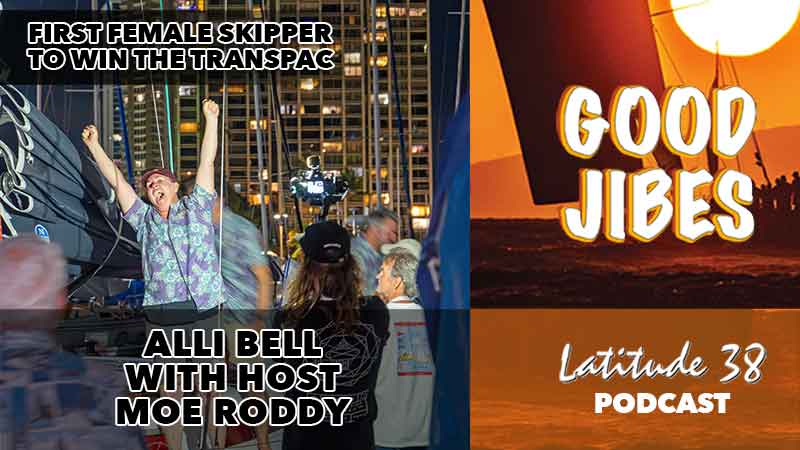
Tune in as Alli chats with Good Jibes host Moe Roddy about what she learned growing up in a sailing family, how to prep your boat for the Transpac, how to lead an offshore racing crew, the most memorable and bittersweet moments from winning the Transpac, and how we can get more female skippers in offshore racing.
Here’s a sample of what you’ll hear in this episode:
- What’s going on between Alli and Artie Means?
- Alli’s favorite offshore food
- Why a Cal 40?
- How Alli and her crew plan and do logistics for races
- Barriers for female skippers while offshoring
Check out the episode and show notes below for much more detail.
Learn more about Alli at TranspacYC.com and SDYC.org
Listen to the episode on Apple Podcasts, Spotify, and your other favorite podcast spots — follow and leave a 5-star review if you’re feeling the Good Jibes!
Show Notes
- Alli Bell on Being the First Female Skipper to Win the Transpac, with Host Moe Roddy
- [0:12] Welcome to Good Jibes with Latitude 38
- [1:00] Welcome back, Alli Bell, to the show!
- [2:56] Alli’s family sailing heritage
- [7:04] Alli’s dual sailing worlds: dinghy and big boat
- [10:21] Alli’s first offshore experience
- [12:44] Why a Cal 40?
- [15:43] How she found her specific boat
- [17:33] Check out the Sausalito Boat Show on September 19th-21st. Get your tickets now at SausalitoBoatShow.com and use the code GOODJIBES to save!
- The 2025 Transpac
- [18:26] Alli’s boat prep and upgrades
- [24:12] How Alli and her crew plan and do logistics for races
- [32:08] The 2025 Transpac race
- [36:18] Check out the Sausalito Boat Show on September 19th-21st. Get your tickets now at SausalitoBoatShow.com and use the code GOODJIBES to save!
- Sailing Leadership as a Woman
- [40:42] Reflecting on her winning moment as the first female skipper
- [44:55] Discussing Alli’s leadership roles of Rear Commodore and Vice Commodore
- [47:49] Barriers for female skippers while offshoring
- Short Tacks
- [52:53] Alli’s favorite book about sailing: The Princess Bride by William Goldman
- [53:20] Favorite book not about sailing: Papillion by Henri Charrière
- [53:40] Who would Alli have coffee with?
- [53:50] An important lesson she’s learned from sailing
- [54:09] What’s going on between Alli and Artie Means?
- [54:47] Alli’s favorite offshore food
- [56:40] Ending with gratitude
- Make sure to follow Good Jibes with Latitude 38 on your favorite podcast spot and leave us a 5-star review on Apple Podcasts
- Check out the September 2025 issue of Latitude 38 Sailing Magazine
- Theme Song: “Pineapple Dream” by Solxis
Transcript:
Please note: this transcript is not 100% accurate.
00:03
As long as something disastrous doesn’t happen in the next half hour, we’re winning this race.
00:12
Ahoy, it’s time to cast off, laugh, learn, and have more fun sailing. My name is Moe Roddy, and I am the host of today’s episode of Good Jibes, a podcast to help you experience the world of sailing through the eyes of the West Coast sailor. Each week, here’s stories and tips from the West Coast sailing community about cruising, racing, and just sailing. Brought to you by Latitude 38.
00:39
the sailing magazine for West Coast sailors since 1977. Make sure you visit our website and subscribe to Good Jibes to enjoy our weekly podcasts. You won’t be sorry. I’ll remind you again at the end of this podcast today and share with you a link to subscribe.
01:00
My guest today is amazing. I mean that sincerely. She comes from a family with a strong culture and tradition of offshore sailing and well, sailing in general. She broke the glass ceiling this year by becoming the first female skipper to ever win the Transpac. And I just have a feeling her family is beside themselves with joy. Please welcome back to the Good Jibes podcast, the formidable Alli Bell.
01:29
Allie, welcome. Thanks, Mo. How are you today? I’m good. How are you? I understand you’ve been sick. I have been a little ill, but I think I’m getting in front of that squall, so to speak. Yeah, well, you’re probably under a lot of stress. now that all that’s over, you can take a deep breath in. You can get sick. I always like to start at the beginning. I know a lot of people know you and know who you are, but may not know this part about you.
01:56
So where were you born and where did you grow up? I was born and grew up in San Diego, California. We have a lot of family in San Diego and LA, so I also spent a lot of time up in the LA area. Where in San Diego? I live now in Point Loma, but I grew up in La Mesa, which is East County. OK, sure. My mother owned a house in Carlsbad for a little while, and I don’t know this about you, but do you have brothers and sisters? I have three brothers. Get out. You’re the only girl.
02:26
I am. Where do you fall? Number two. And I like to remind them often that second is best. I’m an only girl and I’m in the middle, so I always say that middle was best. And when was the first time you were on a boat? I don’t remember it. It was the first year of my life. My grandparents have a lapper 50 called Westward. And I believe I got taken to Catalina when I was a few weeks old.
02:56
Maybe a couple months old. So your parents or your father grew up on this boat too? Well, how long did your grandfather have it? My grandfather bought Westward in the early 60s and she got delivered to LA in 1963, I believe is the right date. Before that, he had a boat called Westward Ho. So my dad grew up on both Westward Ho and Westward, which is still in the family. Westward Ho, we don’t know where it is, but.
03:25
What kind of boat was Westward Ho? Westward Ho was a custom nest built boat. My grandfather was the second owner. so um the Lyle, Lyle Ness, believe. Lyle Hess. Lyle Hess, thank you. yep. Lyle Hess built the boat. Ah, so it was probably uh maybe a Bristol channel cutter. He built those, yeah. I’m not familiar. I should be more familiar with Westward Ho, but.
03:51
So far gone by the time I arrived on this day. Yeah, yeah. Does your dad still talk about those days? There’s a family famous Westward hoe story that on its way back from a Transpac, they were in the middle of the high and so it was, you know, very light breeze and they were decided to polish the cookware and a whale decided to scrape its barnacles off on the keel.
04:16
And the lore is that we had a pot that was cleaner than the day it was made because whoever was polishing it just focused on polishing, not on the whale right beneath them. were probably a little scared. I would definitely think so. would be. Yeah, I know. Everybody thinks that whales are so beautiful offshore. My one time I was really frightened to death was a whale encounter that was so close to my boat and I was by myself and scared me.
04:44
Really badly. I agree. They’re beautiful and I respect them, but they can stay far away from me. Yeah. Oh man. You’re girl off to my own heart. So how did your mom and dad meet? uh Actually sailing. My dad sailed with my mom’s uncle. I should say through sailing. My dad sailed with my mom’s uncle. My mom was exiting a relationship and my mom’s uncle decided to introduce the two of them.
05:13
My mom claims she’s not a sailor, but somewhere deep down there she is. was. Did your dad stay friends with your, I guess your uncle now? My great uncle, yeah, I think they remained friends. I didn’t know him very well, but I think, yeah, they’re still friends. Yeah, pretty nice. So do you have cousins who sail? Yes. All the bell cousins sail.
05:40
Uh, or at least know how to sail. there’s the four of us in my little nuclear family. And then we have eight cousins. So all 12 of us grew up sailing in some fashion. Who’d you think’s the most competitive? That’s a good question. It’s sort of ebbed and flowed throughout life right now. Um, there are four of us who are still actively racing. My cousin, Graham, who was on the boat with me.
06:08
My cousin Mara who lived, actually she’s just moved back to the US, but lived and did a lot of racing in Japan for about the last 10 years. And then our cousin John, who is a decorated 505 sailor. Very sweet. Do you think there was much sibling and cousin rivalry when you guys were growing up sailing? Rivalry? No, we all, we get along so well, the Bell cousins.
06:36
We were all over the place and people like to joke that you can’t throw a stone in the Southern California sailing scene without hitting a bell. ah So I don’t think rivalry so much. We all pushed each other and now we often sail together. So I know my cousins, John and Graham sail together a lot. So we’re just more supportive than rivals. Oh, that’s really nice. And you came up through a sailing program. I did. I’m a proud graduate of the San Diego Yacht Club Junior Sailing Program.
07:04
I’m a huge supporter of the sailing program today. I really credit that junior program for making me who I am today. I’ve won a lot of races, but learned a lot of valuable lessons. My best friends are those who were in in Sabbaths with me throughout the junior program days. And I just can’t say enough good things about junior sailing. Yeah. Then when you were younger and you sort of outgrew the junior sailing program, did you then go into coaching?
07:34
in the junior sailing program there? I did. I was part of the sailing program until I went to college sailing after Sabbath sailing, FJs and lasers and other things. But I did coach. I coached sailing several summers. And in fact, it was the best job. And I look at junior sailing coaches today and think, oh, these are the days. Don’t let these go too quickly. Well, I have it on good authority and I don’t know who they are.
08:02
But you have uh trained or taught some of the top sailors that we all know today. They were at one time or another. You were coaching them. I mean, that’s giving me a lot of Somebody else is giving you the credit. I like to take credit for them too. But yes, you know, I’m so lucky growing up at San Diego Yacht Club. There’s so many great sailors that are around all the time and because it’s a good program.
08:31
The program tends to put out really good sailors and I had a hand in some of the very early stages of some of the sailors who are well known today. Nice. So what was it like, you know, to be part of this Bell family? um because you not only had a junior sailing program, you had cousins and siblings and uncles and grandfather, grandparents who all sailed and
09:00
took you out? mean, I can’t imagine that’s the only time you ever learned how to sail was in a junior sailing program. They must have taught you some things as well. Absolutely. I’ve been saying for a while that my dinghy experience came largely from the SDYC junior program. But a lot of my ocean experience came from being around Los Angeles Yacht Club, which is where my grandparents were members and a lot of Bells are members today.
09:27
And so it wasn’t just my grandparents and my uncles and my dad. It was a lot of members at San Diego Yacht Club, some of whom I’ve raced with and some of whom I currently raced against. There’s a big Cal 40 contingent up at Los Angeles Yacht Club. That’s kind of how I started wanting a Cal 40, because it’s the immediate next Lapworth design from the Lapworth 50. So I grew up sailing around
09:56
people who’ve been around their boats and around the water and hearing stories of going offshore. You asked what it was like. It was kind of like living in two different sailing worlds, because I had my little boat experience with the kids at SDYC. My parents don’t have a boat. We didn’t have a boat in San Diego. So all my big boat experience really was up in LA. Yeah. Who took you offshore for the first time?
10:21
For the other than Catalina, my first time offshore was actually with a San Diego yacht club member. And it was a lot later than people might think. If you’re talking truly offshore in 2009, I did a Norfolk to Antigua delivery aboard a deer foot 62 named moon shadow with John and Debbie Rogers. And that was my first like real.
10:50
offshore experience. I’d say I’ll take ins and outs and stuff, but you can always see land in this. Yeah. Yeah. Did you say, did you go to Bermuda first and then down or did you just make a Straight Antigua. Yeah. Yeah. Antigua. That’s a nice trip. I’ve done that several times and it was a deer foot. Do you have any memories or anything that you recall about that trip? Because that’s your first time really out of sight of land and everything. What was that like? It was
11:17
Amazing. mean, take time off work to go sit on a boat. And it was I was living in D.C. and it was in the middle of winter. It was like late November. Actually, no, we were there Christmas. So it was late December um and getting to go from where it was kind of snowy and gross to Antigua, where we spent, you know, weeks in bathing suits was wonderful. It was a nice break. The uh memory that I have most is you’re on watch by yourself for three hours and then the next person would come up and you’d be off for six.
11:48
There were just three of you. There were four of us, but two people did it. We sat stood watched together. So there was a one, a one, and then a two person. And I would come off, watch John and Debbie. The owners of the boat would replace me. And one time I was down doing my log and I hear Southern Cross Crosby, Silsanesh, the song come up and John calls me up and he says, Ali, come here. Cause I’d been talking about the Southern Cross. It’s my favorite song.
12:16
He goes, come here, there’s the Southern Cross. And then he looked at me and he said, you know, your grandfather would be so proud of you. And that moment with that song, it was all very emotional and touching. And I get a little teary now just talking about it. Oh, that’s so sweet. It was very sweet. When did your grandfather pass away? He passed away in 2000, July 2000. OK, so he doesn’t.
12:44
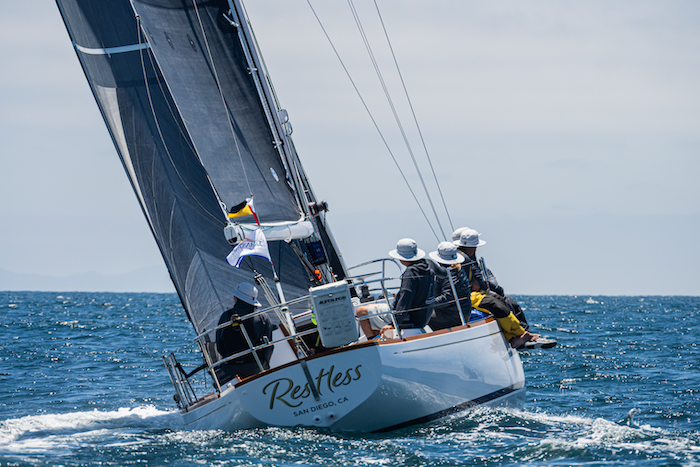
I didn’t know what you’ve done since. Nope. No idea. Or maybe he does. knows? So let’s talk about boats and boat ownership. Why restless? Why a Cal 40? So I grew up on this Lapworth 50 big wood, 50 foot canoe hole double ended and hearing stories about Transpac and hearing stories about how unruly the Cal 40 can be. I’m sorry. The Lapworth 50 can be in big breeze and, and
13:13
all these Cal 40s were all over the cove in Catalina. And they would talk about how this was the next design. And the first time a Cal 40 was on the TransPak course, Psyche of course just did, obliterated all the woodboats because she was fiberglass and had no bad habits and on and on and on. And so I just always kind of wanted a Cal 40. I don’t remember a time when I didn’t want a Cal 40.
13:42
I had boats like the Eddies, Kalisto and the Bevens Radiant and Psyche and others were always around and in my life. And I just remember thinking like, those are pretty cool boats. I kind of want one. I wanted something that was easier to handle than I had heard Westward was. I since have come to realize that Westward can be a handful, but so can all boats. I didn’t need to be quite so scared of that.
14:09
Um, so I just had always wanted one and then people say, well, how, when did you know you wanted to do TransPak on a Cal 40? And it’s like, well, is there anything else to do with the Cal 40? think that’s what they were built for. That’s what they should go do. I’d been hearing stories of Cal 40s from an early age, always wanted one grew up around some of the greats of, of Cal 40s, uh, like, um, the Griffiths, the honeys, the eddies, the bevins.
14:38
the people who the flams people who have long history with the boats and turns out my husband’s grandfather, Gerald Driscoll also had some Cal 40 roots. So Cal 40 was just destined, I think. What year was your what year was restless built? Restless is at 1967. Hall. She’s hall number 107. Wow. Later later side of the Jensen boats. What makes her so special in your eyes?
15:08
Well, we just won one Transpac for starters. No, but I mean, like, so yes to all of that. But is there, like, I’m drawn to, a Herschhoff because I love the lines. Is there anything special in your eyes that makes the Cal 40 a really pretty boat? Really, it’s the same lines as the Lapworth 50. Just enough bright work to have people row by and say, that’s a beautiful boat, but not so much that it’s all varnish all the time.
15:36
A cool story about Restless, I had been looking for Cal 40s ever since I thought that I could financially have a boat and I looked on the East Coast and up in LA. I had seen Restless. She was under covers at San Diego Yacht Club. She wasn’t for sale or anything and I didn’t pay much attention to her. And a family friend named Norm Reynolds who grew up in LA with my dad and my uncles and
16:04
lived in San Diego for a while. He’s no longer with us, but we were on the deck of SDYC one night and he says, you know, Ali, there’s this boat restless and I it’s here. And I think that we could convince the owners to sell her to you. I walked down to the boat and I thought, I don’t know if this is, don’t, I don’t know. And then more people came out and said, you know, there’s this boat restless that’s San Diego Yakov. So Norm, if I understand how everything happened properly,
16:33
Norm called Chris Young, who owned the boat, and Chris and I got together and he said, well, you seem like a good next steward of this boat, so I’d be happy to sell her to you. And in the meantime, the number of people who came out and said, I learned to sail on Restless when in her early days, she was at Cabrillo Beach Yacht Club. So all these people from my past actually learned to sail on the boat. then um a friend down here, Christy,
17:00
Crawford Donnelly said, well, know, restless was my first navigating, my first navigating experience. brought restless home from Hawaii and then went on to do a lot of navigation. So restless has a good story, which is in addition to being a beautiful boat is something that’s important to me. there, that’s what makes her so special too. uh You are listening to the good jobs podcast brought to you by latitude 38.
17:28
I’m your host, Mo Roddy, and we will be right back.
17:33
Set against the backdrop of beautiful Clipper Yacht Harbor, the South Slido Boat Show returns for its third year, September 19th to 21st. This is the Bay Area’s premier celebration of sailing with new and used sailboats from Nauce, Rifkin Yachts, Club Nauteek, and Seattle Yachts, featuring brands like Juno, Beneteau, Hanza, Lagoon, and Dufour. Beyond the docks, you can explore hardware, gear, and marine supply.
18:00
connect with sailing schools and dive into seminars covering everything from cruising essentials to fiberglass repair, diesel maintenance, navigation and marine electronics. Plus, don’t miss our intro to sail experience with Club Nauteek, a two hour sail on the bay that includes your show ticket. Get your tickets now at sausalitaboatshow.com and use the code GOODJIBES to save.
18:26
Welcome back. You are listening to the good jobs podcast with our guest today, Allie Bell. Did you have to do a lot of work to prepare for the Transpac? Yes. And we did more than I think was necessary, but enough that I felt comfortable going offshore. So I got restless. She had been used. She had raced her. She raced a lot. She raced in the 1975 Transpac. So she was no stranger to being on a start line.
18:53
When I first got her, I thought, you know, I’m going to keep the boat for a little bit and keep it as is for a little bit and figure out how I want to configure her both for TransPak, because I knew I wanted to do a TransPak, but also for being in Catalina and just hanging out. So we raised hot rums and we raised beer cans. Part of what happened, why it took till 2025, I bought her in October of 2019. And why it took so long to do a TransPak was, of course,
19:24
three months after I bought her, COVID showed up and the whole world shut down. So I spent a lot of time just sitting on the boat, which actually worked out because there were a lot of things that through just hanging out on the boat, I figured I wanted to change or move around or whatever. So my first thing when I first bought the boat was to clean up the tow rails. They were unfinished. And in doing that, I caused the boat to leak a little bit. A leak at the deck hull joint is common in the
19:53
in California because you know the cocking is 60 years old at this point and so there had been some it’s called natural cocking that had lodged itself into the like where the uh toe the teak toe rail meets the deck and in cleaning it I dislodged a lot of that and caused some leaks so knew that I needed to do that work and then again a rig uh inspection there were some
20:23
both standing rigging and spar items that came up. So I knew I needed to do that. And then once you start tearing a boat apart, there’s all these other things that show up. So we reduced the amount of track that was on board, put new batteries on, did some rewiring electrical. This one was definitely a cosmetic, but I felt pretty certain I wanted to have brand new head plumbing, which I just have a thing about that. I like my head plumbing to be mine.
20:52
I ended up doing a blister job on the bottom. I thought we were just going to do some of the bigger blisters, but we ended up doing all of the blisters. So that bottom is perfectly smooth right now. um Put new, almost all new wood, because when you start taking the old teak off, it breaks or you have some new and some old and just looks weird. So we have all new wood, um new rig, new to me rig, new boom, new standing rigging, almost all new running rigging, just
21:21
Once we got into it, started to make sense to if you’re in for a penny and for a pound, especially if you’re going to go offshore, especially if you’re going to go offshore. I mean, there was a lot that we could have lived with, but there’s a different kind of pressure when your name is in the person in charge box. And I didn’t want to leave anything to chance. And I’d been saving my whole life to do this. So may as well do it right. Yeah. Did you change any of the hardware? Like when I bought my boat, I moved on my winches.
21:51
closer to um the where I was sitting to steer from so that could reach it without moving too much. Did you do anything like that? We didn’t really change too much. I did switch the primaries and the secondaries on the winch island. So the primaries are now forward. They were after forward now for easier like general leads and things. And so people weren’t sitting in the back of the cockpit, which is no good on a Cal 40. So we did a few things, but.
22:18
Not a ton. We did, like I said, we eliminated, there was a ton of track on the boat. The California’s all had a ton of track on the decks, on the rails. We figured out kind of where we wanted leads to be and left track there and took the rest of the track off. Little minor things like that. Any leaks from that? No, because in taking the track off, we also redid the decks. Of course.
22:46
Just kept going new chain flakes, this, new that, a new rudder. Oh my God. And then of course you talk to somebody, right? The rudder is a good one. I thought we were done sort of with big structural things on the boat. I felt good. We’ve reported everything, measured, whatever. And then we had lunch with Park Eddie, who is a, he’s come from a California family and he said, well, do you have this new rudder? And I said, oh yeah, I have the new rudder. And he said, no, no, no.
23:15
do you have the new rudder? And I said, no, do I need it? And he said, yep. And so we put the new rudder on as well. Just everything. I’m done now though for anybody with any more advice, we’re done. It all worked. It worked well enough to win. So it sounds like you were thinking for quite a while about doing a transplant and then COVID got in the way.
23:45
Yeah, we got started on the actual, the big work of all the repairs later just because things were shut down. it actually worked out fine. This year was a great weather year for the California. So, you know, everything happens for a reason. Yeah. What was it like to be, like you said, that box where it’s checked person in charge?
24:12
There’s a lot of responsibility when you go offshore being that person. What was that like? It’s tiring. There’s a lot of responsibility both before and during the race that has nothing to do with how you’re doing in the race. It’s been really great since we finished. I suppose we’re going to talk about all that later, but it’s been great since we finished to have the recognition. mean, people are being so nice to us. Leading up to and during the race, it’s a
24:38
much different sense of responsibility than when I was just a crew or even a watch captain. Everything comes down to me. Everybody’s lives are in your hands. Everybody’s lives are in your hands. Yeah. And I found myself too. So I have a crew and a whole community full of really good sailors and I found myself having to be
25:01
more adamant than I felt like I wanted to be about decisions that were being made. you know, somebody would say, oh, do this, do that, do that. And both the responsibility, but also the, I don’t know what the right way to explain it, that all these opinions would come in and kind of reminding everyone like, no, no, no, no, no, this is my, like, this is my boat. This is my choice. This is how I want to do this particular thing was new for me. Right. Like in on every other boat I’ve ever sailed on, it’s like, well,
25:30
You could maybe do this. You can maybe do that, but I don’t have to make, I don’t have to be the final arbiter. And now I got to be, but also had to be. So it was a whole different level of responsibility. There’s something that goes with that captain word. At one point during the race, I will say we were talking about, we were switching, I believe it was when we were switching. Now it all, you know, melds together, but I think we were talking about going from the jib top to a kite and
25:58
It was really shifty and the wind was sort of both fluky and shifty. So we were right on the edge. I, I remember saying, well, I wish someone would just make the decision. Oh, it’s me. uh So, you know, lot of responsibility. Yeah. What sort of provisions did you bring? This is a long race. It is a long race. We brought both regular food and freeze dried and I planned for two weeks.
26:27
worth of regular food, like we finished with plenty of food, and then brought a bunch of freeze dried just in case something happened with mold or the wind or whatever. You we’re so lucky these days to have forecasts and weather predictions that are accurate enough that I knew we probably weren’t going to be out there for 20 days. But you know, if something goes wrong, you want to make sure that you have. So we did a mix. We had some people make casseroles and things for us.
26:57
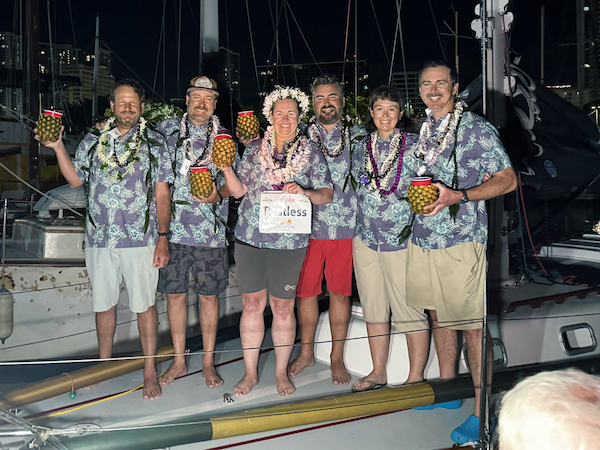
and we froze them and then would pop them in the oven. had sandwiches, I made some food. We didn’t really have a uh strict food schedule other than use the frozen stuff up. If you got hungry, you’d go down and make sandwiches for everybody. Or if it was dinnertime and I was driving, whoever was down below would handle it. So we just sort of worked it out. So who was on your crew? My crew was my husband, Steven Driscoll, my cousin, Graham Bell, and then two friends that I’ve had.
27:25
from childhood, Eric Heim and Greg Reynolds. We were supposed to be also joined by my cousin Mara Belhusina. She had a sailing accident about a week before our start and broke some ribs and couldn’t join us as a result. We missed her, but it’s better that she’s healthy. Yeah. Yeah. You didn’t have my phone number? Sorry, Mo. In my dreams. What did you do for weather forecasting? Granmar Navigator downloaded
27:55
weather from all the usual sources. The Cal 40 is slow enough. think if people were watching us, they saw that we were about 7 knots VMG the entire time. It’s slow enough that having a half hourly or hourly report doesn’t help us that much downloading just when they was fine. And your navigation. So did you follow a run line? Where did you go? What did you do? So we used expedition to route us.
28:25
There was a very light spot that we knew was gonna come. fought and so we tried to be as in front of it as possible. The boats on our day that were a little faster were able to get a little bit further away from it, which was great for them. We were right on the front edge of it about three or four days in. Graham routed us through expedition.
28:51
Which uses your pollers to sort of say what the optimal route is. The challenges is that it makes a lot of assumptions that maybe aren’t your experience on the boat while you’re racing. Stan Honey, who’s, you know, is a very famous navigator and a Cal Forte put out all his stuff like, watch out because expedition will take you.
29:18
more northerly than you would like to be. And if you get too far north, then if light days and you need to head up, you’ll spin out, which is light air. So we took Expedition’s opinion, took where we actually were and where we thought we’d go. And we ended up sailing rum line pretty much, I mean, kind of above and below it at some points, but rum line restless has become our nickname. Did you have any redundant equipment?
29:47
For the trip, we had quite a few pieces of redundant equipment. Some of it required through the US, which are the safety requirements for people who have not been through that massive list like a emergency rudder, for example, which we had a great emergency rudder, which was lent to us by Steve Calhoun of psyche, like a cassette plugged into some gudgeons that we had welded on to our backstage chain plate and.
30:14
We didn’t have to, but we think we could have steered as effectively, maybe not so much sale area, but as effectively as with our, our usual rudder. I brought a handheld GPS to augment our, our boat system in the USSERs. You have to bring a compass that you could steer by. So we had a compass permanently mounted. Also, you know, we went with a bunch of sales.
30:40
Anybody that saw my post on Instagram knows that I like to name my sales. So our workhorse was the Barefoot Contessa, which is an S4. I also had an older S4 that we brought along with us. We had the S2, the new S2 Grimace. And then Restless had two other S2s that one was affectionately named the last resort and almost had to come out in the Molokai channel, but didn’t. So we, you know,
31:08
Redundancy of systems of food. Like I said, we brought regular food and freeze dried. We bought brought emergency water and the water maker and went with our tank full wherever we could practically bring along something in case something broke a thousand miles offshore. did. Yeah. What would you consider your most important piece of safety equipment while you were offshore? That is such a great question. Life jacket. Number one. Several years ago, I got, I
31:38
got swept down the deck and around up. Ever since then, I have been adamant that if there is a spinnaker up, particularly a symmetrical spinnaker up, which is what Restless uses, and you’re offshore, there needs to be a spinnaker net up. I will not go offshore without a spinnaker net. That’s non-negotiable for me. I do consider that an important piece of safety equipment, as well as your um tether. I’m a stay connected to the boat kind of person.
32:08
It always helps. oh What kind of watch system did you guys keep? We did something that I’ve never done before that I loved. So we had two people on deck. You were on for two hours, off for three hours, and a new person came up every hour. Your first hour on deck, you trimmed, but we employed the Ronco watch system, which is set it and forget it.
32:36
Um, so trimming really only happened like when it got really shifty or really puffy, or, um, if we were squaring back or dropping the pole forward or something. And then your second hour on deck, you were driving and there were times, especially on those squally nights where if the person coming up on deck was 30 seconds late, you were like, someone get over and take this tiller from me. And it was, um
33:03
If you’ve seen the Little Mermaid when Ursula goes through her cave, all they see, the old, people that she’s put purse on sort of drop into their little holes. That’s what it was like. Take the tiller, you’re down, down below. And it actually worked out a lot. The best practice is that the people going off watch brief the people coming on watch. But because someone has been on watch for an hour already, they knew what was going on. So it made those transitions really.
33:30
Yeah, I’m always suspect when I hear people talking about, oh, we didn’t really bother with the watch system. I’m like, wow, I’m glad I didn’t go with you. Yeah, I want to know when I get to sleep. Yeah. And I want to know that I’m passing off and things are being passed to me so that I know that that light out there, you know, that’s rising is not a ship. It’s the moon. Right. Exactly. What were the weather conditions like for the most part? They were pretty. oh
33:58
idyllic really. The first day, the first sort of 24 hours, we were in about 9 to 15 knots of breeze. It did get really bumpy the first night. The first night of Transpac, the first couple days of Transpac are always sort of the why are we doing this window of Transpac, but it was pretty mild the first night based on my previous experiences. The sort of second and third day, it was really shifty and pretty breezy.
34:27
And then we had um fairly consistently like sort of 15 to 20 knots of breeze, good kite weather, but we had a really confused sea state for a lot of the race, which was different than what I was used to and expecting. Normally sort of the ocean organizes itself and you get really good surfing conditions, but we had this sort of like there was surf swell and then kind of a side swell and then all of sudden you get a swell from the other direction. So there was a lot of
34:56
One night we had the S2 up and it’s one of my two brand new sales and it collapsed a lot. And so I was happy when we could put the S4 up, which is a little heavier sale and I was worried less about. Yeah. Well, that was my next question. Did you break anything? We have one sale, the S4, that we’re taking to the loft just to get it checked out. And then one night we had
35:26
The guy let go and so then the sail was kind of flogging. And at the very end of one of my tracks on the tow rail, maybe two inches is pulled up a little bit. But other than that, no major damage. I like to think that sometimes that’s because as a woman, I don’t want to break anything. And so we tend to win races because we’re a little more cautious. sometimes it’s you just have to finish.
35:53
We were talking about that in the Molokai channel. It was really breezy, like 30 to 35 with puffs higher and then. And big seas. Yeah, huge seas, huge. And our lulls were like 22, 23, you know? You know, it’s breezy when you think, oh good, it’s only 23 knots right now. But in the Molokai channel, we hadn’t done the math. We had done some math, but then a boat finished when.
36:18
We weren’t expecting them. So we hadn’t done math for the new boat, like what we had to do to correct out on the new boat that had finished. And I remember thinking like, oh man, this is really going to be terrible if the whole thing ends because we broke something five miles from the finish line, you know, when we’d come all that way. Turns out we had plenty of time buffer, but we weren’t too sure then. So you are listening to the good jobs podcast brought to you by latitude 38.
36:47
and we will be right back.
36:51
The South Solito Boat Show is back for its third year, September 19th to 21st at Scenic Clipper Yacht Harbor in South Solito. There’s something for every sailor, from yacht club members to those just curious about life on the water. Step aboard sailboats from top brands, discover gear, local artists and makers, enjoy food and drink, family-friendly activities and live music on the waterfront. Learn new skills through seminars with Cruisers Academy, Spalding Marine Center, Helmets Marine,
37:19
H &M Marine, and many more, covering topics about cruising prep, Mexico sailing, fiberglass repair, diesel maintenance, and more. For a special treat, join us Friday evening for a VIP experience, Toppus and Tasting Soiree aboard three of the Bay Area’s finest luxury charter yachts, featuring tasting menus from three top chefs with local wine pairings.
37:44
Visit SouthSalidoBoatShow.com for more information and use the code GOODJIBES to save on your tickets. We hope to see you there!
37:55
All right, when did you and your crew realize that you were winning the whole shebang? You were winning the Transpac, when did you know? We saw the tracker just like everyone else. So we knew where we were standing. For the first several days, you think, well, that’s great, we’re winning, but it’s just our day really right now. There’s still two more starts. When the second day starters.
38:21
sort of languished in light air. thought, okay, all right, we could do pretty well, but the sleds and the big boys are still starting. And the sleds, know, somebody for sure will sail right by us. The second to last day, we were in a light spot. And I remember thinking, I had my little speech that was like, oh, it was so fun to be leading for all this time. It was really great.
38:46
But we expected that in the last couple of days, somebody would correct out over us. And so I kind of had that speech ready to go so that I would be ready when we hit the dock. Then we woke up the next morning, it was still pretty light and somebody had done the math. had average at that point, we had average like eight knots VMG. And I thought, okay, it’s fine. Like I’m ready. I have a whole day to process it. And then Mo, the wind picked up and I was like, oh.
39:16
we might actually do this. And we were coming down Molokai and the wind at that point was like 18 knots and the mood on the boat was just like, nobody said it. was, we did not talk about it, but the mood on the boat was just like light, right? Cause we’re thinking we’re like 60 miles away from this thing and the breeze is beautiful and we’re doing more than we need to do. And we watched our, we watched on the tracker, the corrected time.
39:45
come down and down and down. And then we got into the channel where it was really breezy and big, big waves. The forecast wasn’t for quite that much breeze or quite that big of swell. And I thought all we have to do is keep this boat together. That’s all we have to do. And we can do this. We jived at one point. And because the wind after the jive picked up so much, we had understood. So I knew two more jives were in it. After that,
40:13
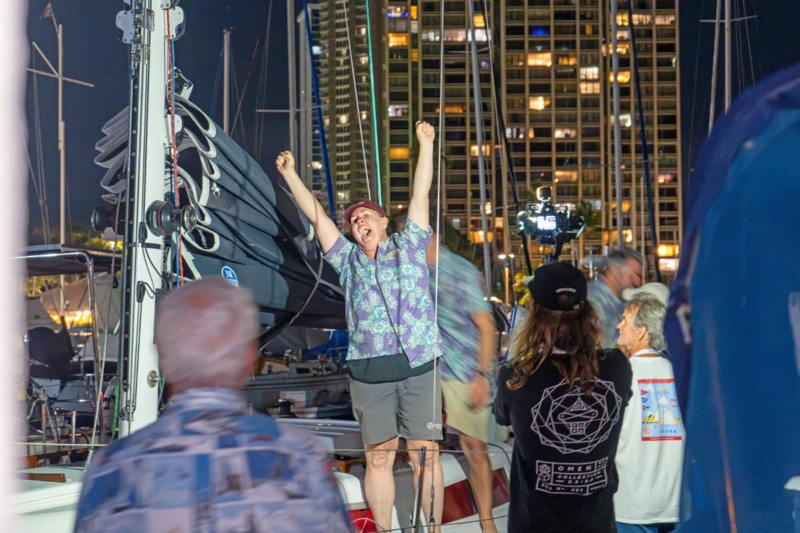
third jive and we were then like five miles from the finish line is when I think we kind of all were like, as long as something disastrous doesn’t happen in the next half hour, we’re winning this race. It was really right up until the end. That moment, that second, you cross the finish line. What did you do? How did you feel? I cried. I cried. I had to get off the helm because it was still super windy and now we had to take a kite down and I
40:42
I handed it back to the person who had driven most of the way across the channel. said, Greg, Eric’s on the bow, you take this. I don’t want anyone to get hurt. Now that’s the big thing at that point, right? Like if the boat breaks, that’s bad, but not race ending anymore. I don’t want anyone to get hurt. So I cried. called my uncle Sam, who I did my first trans pack with and who hasn’t been feeling great. And I said, Sam, I did it.
41:08
And he goes, you did it. And I said, okay, no, have to go because it’s still really windy. I love you. Bye. Uh, and then we got into like all those people standing there. was magical. It was really earlier in the race. I had gone back through the, um, trans pack archives and I knew that if by some stroke of magic we won, I would be the first skipper. And I.
41:36
said something one night to Eric, said, if we do this, not only did we do this on a Cal 40 that’s sort of like a community built boat, but I’ll be the first woman. That’s the only conversation we had about it the entire race. And so when I finished, he said, you did it. There you go. Wow. Well, it was very inspiring for the rest of us. I got to tell you. It’s an honor to be. It’s, know, I didn’t I want out wanting to do well in our division and
42:04
before the race, had many people say, it’d be so good for this sport if you would win. And I’m like, I can’t, I mean, I’ll do the best I can, but boy. No pressure. Yeah. Is there a moment that really stands out for you that you just was really special? Can I do two?
42:31
Yes, can. Allie, you won. You can do as many as you need to or want to. One is a little sad, but on the morning of July 8th, we got a text from my brother-in-law that my husband’s uncle had passed and he was a Transpac racer, Donald Wyatt. He’s a Transpac racer as well. And uh we were all awake. It was the morning. So we were, I just come down off watch. I think I was making biscuits and gravy at the time.
42:59
And there was just sort of this like, I don’t know, moment on the boat of very sad news had come and the five of us were together and not a lot was said, but it was just sort of this bittersweet moment. The other three people on the boat were very supportive and you if you two need to take a couple moments off. I mean, obviously there’s nothing you can do but.
43:28
finished the race, right? And one of the other guys said, well, now we got to win. Then one morning after, that’s my second one is one morning after a particularly squally night, was still raining in pockets and we sailed right through a rainbow. I’m very into, I’m not a religious person, but I’m very into the thought of people keeping an eye on us. And I thought a lot about Donald and my grandma and grandpa.
43:57
and Jim and Janet, Eddie and George and Millie Griffith and other people down at San Diego Yacht Club who are no longer with us thinking like, you can feel them out there and you can feel people. said earlier when did my grandfather die and he and my grandmother died about three years apart early in the 2000s. So neither of them saw this, but you could kind of feel their presence. Those are my two special moments. Very nice. Thanks for sharing that with us.
44:27
Once I stop crying and we’ll be able to talk again. Well, you got me crying too. So not only did you break the glass ceiling by winning, you’ve also been the Commodore of the Transpac and you are so your staff Commodore of the Transpac, right? I’m rear Commodore of Transpac. Your rear Commodore of Transpac. And vice Commodore of the San Diego Yacht Club.
44:55
I am. Yep. I have a hard time saying no. And I like giving back to the sport and the places that have given me so much. So I am doing those two things at once. I’ll be Commodore of San Diego Yacht Club starting in December, assuming they vote me in. And um I’ll be Vice Commodore Transpac Yacht Club, hopefully after the biennial meeting on November 9th. Cool. Well, I have one question for you about the being the Commodore.
45:24
of the San Diego Yacht Club when it comes around, if you get elected, which they’d be crazy if they didn’t. But anyway, what are you going to do about the vixen cruise? I think it’s going to be the first weekend in October will be our fourth vixen cruise. For those of you who are listening, we had our very first vixen cruise in 2019 when Jerilyn Beale was the second female Commodore of San Diego Yacht Club. There had been a biennial stag cruise.
45:52
But there was never, it was the Commodore’s crews and the Commodore had been always men in odd years. So there was no women’s crews. And the year Jerilyn was Commodore, she asked me and the person who chaired it, like, are you willing to stand by me? We’re going to have a Vixen crews instead of a Stag crews. The board of directors at the time, Tracy Miller, who was the Vixen crews chair. And I all told Jerilyn like, yep, we’re going to stand behind you. So we did it the first year and now we rotate.
46:22
The men go in odd years and we go in even years. So in 2026, October, you’re going to do the Vixen Cruise. We are. Yep. If I get down and grovel, can I come? Absolutely. You don’t even have to get down or grovel. Just bring your dancing shoes though. That’s saying about Vixen Cruise. We do a lot of dancing. When Jeralyn told me about it, it just sounds like so much fun. I don’t know if you know it, but I did interview Stan Honey.
46:51
on the good jobs. And one of the things that he really said to me about his early sailing is you used to be able to show up on the docks with a sea bag and somebody would invite you to go offshore. And it turns out that Stan’s first Transpac was tell us who I think Stan’s first Transpac was at least with my uncle Sam and Willie, I believe was on Sumatra, which was sister ship to Westward. So um yeah, I Stan I grew up
47:20
I mean, I’m following in Stan Honey’s footsteps. I think he was 17 years old and he showed up on the docks and your uncles took him took him to Hawaii. Yep. My uncles still like to say that they taught Stan Honey how to do offshore racing. Stan would agree. I know the first time they said that to me, was like, oh, sure. And then we were in a seminar where Stan Stan said, oh, Sam and Willie, who taught me.
47:49
have a navigator here. thought, oh man, now they’re going to hold that over me the rest of my life. Yeah, but it’s true. So what do you think? There aren’t more female skippers out there racing on these long distance offshore races. You know, I’ve been asked that a lot and have given a lot of thought. I know in my family, the longer sailing, so I’m the third generation female Bell to go offshore as well. My grandmother and my aunts went, they, there used to be like,
48:19
The cook line, if you look in the old Transpac programs, it’s like Skipper, Navigator, Cook. So a lot of times they’d go as the cook. I think gender roles are just hard to unestablish, de-establish. I think that goes, sailing will be one of the later conformers, just because in order to be in a point where you can skipper, you have had to be brought up.
48:47
Have the jobs have the financial resources do everything to be able to be a skipper of an offshore boat. I think we’ll see that change based on what I’m seeing at San Diego Yacht Clubs Junior program based on like. Education rates of men and women and employment statistics. It’s changing gender roles are changing slowly and so I’m hopeful that we will see this change. This is also the most female skippers that Transpac has had. How many of you were there?
49:17
We, it’s not going to sound like a lot, but six. So, you know, 10 % of the fleet, which is a lot. I think it’s just hard for women. It’s harder for women to get offshore. Um, I, I’m lucky I was raised around people know like you, Betsy Croft at Senesco, all these people, Wendy Siegel, um, Holly Scott, all these people, Peggy Slater, all these people who were real.
49:46
Advocates of women getting offshore are part of my childhood and part of growing up and part of my life I don’t think that’s true for a lot of women, but I do I sincerely do think it’s changing I was one of the only girls in the San Diego Yacht Club Junior program who raced all the time and now there’s this whole Group of girls down there who are racing a lot. Yeah, it’ll take time, but it’ll change Yeah, we’ve got the like the Carol Bowers now are showing us the way. Oh, actually for me it was Ellen MacArthur
50:16
Yeah. When, you know, I saw this little five foot two person, you know, handle these, these boats. was like, Oh, yeah. Why am I, why am I saying I can’t do that? You know, it’s like, I could handle a bigger boat. Well, it’s like so good that the movie Maiden came out and all these Don Reilly and all these people who are normal people that you can talk to. Yeah. I I think it’ll change. I also,
50:44
There is this sort of misconception about people who don’t know how to sail, particularly women who aren’t offshore sailors who think about going offshore. And I get this question like, oh, you were the only girl. How did you change? How did you? There is nothing less attractive than anybody after about 12 hours of offshore sailing, right? Like that’s the furthest thing from your mind. So I think another thing that will help is bringing people
51:12
From land offshore via social media or whatever to see what it’s really like. Yeah, we never closed the head door. Was I worried? No, because really? I know nobody really cares. I just how did I change? Well, I took what I was wearing off and I put what I was changing into on like just like, you know, it’s
51:33
That said, I have told people I will not go offshore with people I don’t feel comfortable being naked in front of because it’s confined spaces. I went offshore with 14 guys. didn’t like her. We were hot bunking, but I would close a little curtain and change in there and try not to get seasick while I was doing it because there’s just this little space in. You’re like up in this little tiny hot
52:01
Four peak trying to change. Yeah. Yeah. was gross. What would you tell your 10 year old self? Oh, keep going. I worried so much that I wasn’t winning races. Like I felt like I knew what to do. I just couldn’t execute or maybe wasn’t paying enough attention. Just keep going. It clicks for everybody at a different point. And also winning isn’t everything. Yeah.
52:26
It’s fun. It’s fun to win. uh now that you know what that feels like, you may never want to do it again. And that brings me to it. What do you see? Are you going to do this again? For the next couple of months? Restless is going to go up to Catalina at some points and have some time to relax. I think I will definitely do a Transpac again. I don’t know when I’m the race chair next race and I’m the
52:53
Commodore the race after that. So I don’t know if either of those two all do one, but I would love to go on TransPek again. Great. All Well, I’m going to switch gears and we do what we call short tax. And I added some questions here that you don’t know. Okay. And they’re just really real quick answers and it’s to help our audience get to know you more. Although you come across really great. This was really, this has been really fun, Allie. All right. So what’s your favorite book about sailing?
53:20
The Princess Bride. You’ll tell me it’s not about sailing, but it is. it? There’s some sailing in there. Okay. What’s your favorite book not about sailing? There’s this book called Papillon. So what’s your favorite trip you’ve ever taken? Transpac. uh Why did I even ask? If you could have coffee with anyone alive or dead, who would it be? That’s a good one. I think Peggy Slater. Really? Okay.
53:50
What’s the most important lesson you’ve learned from your professional career? Don’t stay in a bad situation. Okay. What’s the most important lesson you learned from sailing? Perseverance. The keep going thing. Just keep going. What’s going on with you and Artie Means? We have been friends since I was a little kid and he and I have a um competition about who can get to Hawaii first.
54:19
He is far ahead of me. He’s four to one. I’ve only beaten him there one time. Yeah, but you beat, you won. Has he ever won? He holds the record. He was on Mighty Merlot the year they broke the record. Oh. He’s winning. Well, I heard it’s a pretty, it’s a very friendly ah competition there between the two of you. Yes. He has a nickname for me that is
54:47
my name and expletive and then my last name. So when I arrive in Hawaii and I hear that being shouted out, I know that he gets another one in the W column. So who’s inspired you most in your life? There’s been so many people. m My family really has been the biggest impact. Grandma, grandpa, mom and dad. OK. What’s your favorite food to eat offshore? Turns out curry rice. Get out. Yeah.
55:15
and it’s easy to make and the stuff that you put in it lasts a long time. Potatoes, carrots, rice. And then we had canned roast beef that we put in it. It was really good. Nice. What’s your favorite place in the world to sail? Howlins Landing in Catalina. Oh, Catalina. OK. And what’s the one question I didn’t ask that you wish I had? And what would you say? You asked me this in a roundabout way, but I think
55:43
The question of like, what advice do I have for younger people who want to sail now or want to do something like this now? One is the same thing that along the lines of what Paul Elfstrom is famous for saying is that the number one thing you can do is create a good community, be respected by the people who you’re around a lot. You can think of people who are good sailors and yellers. That’s not who I want to.
56:11
be, right? One would be that and the other thing would be to do what you’re doing, keep going and don’t worry about other people’s opinions of you. Other people’s opinions of you are none of your business. Just keep going, do what you want to do. There’s always a way. Is there anything as we wind this down, is there anything you’d like to leave our listeners with? I do. I just want to say thank you so much to everybody who I’m going to cry again.
56:40
who has contributed both in big ways and small. My crew, my family, strangers who would reach out in the middle of the race and say, hey, we’re pulling for you. It is not lost on me that it was a good year for the first starters and for particularly a boat that could put up a big symmetrical kite and point the ballot Honolulu. And so I feel really lucky.
57:06
to have been given this opportunity and so grateful that so many people have helped us along the way. The volunteers, the people at SDYC, the people from afar, just everybody has been so great. So thank you. Well, on that note, I want to say thank you to you, Allie, for agreeing to be my guest today. That was a really sweet thank you. I know you’re overwhelmed still trying to get your life back together and come down and get back to normal.
57:36
So thank you. I also want to thank you, our listeners. Without you, there would be no Good Jibes podcast. Remember to visit Latitude 38’s website to subscribe to not only the Good Jibes podcast, but to the ‘Lectronic version of Latitude38. My name is Moe Roddy, and I’ve been your host today. Until next time, take the word impossible out of your vocabulary and dream big. Cheers!