

Episode #254: Planning a Cruise, Remembering Vadura, and Pacific Puddle Jump to College Graduation (Latitude 38 Verbatim)
This week we share three articles from the July 2023, 2024, and 2025 issues of Latitude 38 sailing magazine. Hear “The Basics – How I Plan a Cruise” by Gary Dickinson from the July 2023 issue; “Remembering Vadura” by Ernie Minney from the July 2024 issue; and “First the Pacific Puddle Jump – Then Our College Graduation” by Patrick Rabin from the July 2025 issue. Read by Good Jibes host Monica Grant.
Here’s a small sample of what you will hear in this episode:
- The rent-a-cop, two German shepherds, and fake newspaper reporters who finally got him to write the check
- Flying home from Nuku Hiva for graduation, then flying back to the boat
- Four college friends quit their jobs, bought a 1989 Beneteau, and set off to cross the Pacific at ages 22 to 26
- Crossing the Intertropical Convergence Zone
- Provisioning by meal list, tracking water, and diagramming your lockers
Follow along and read the articles at “How I Plan a Cruise; ” “Remembering Vadura;” “First the Pacific Puddle Jump — Then Our College Graduation.”
Check out the episode and show notes below for much more detail.
Show Notes:
- Planning a Cruise, Remembering Vadura, and Pacific Puddle Jump to College Graduation (Latitude 38 Verbatim), with Host Monica Grant
- [0:14] Welcome to Good Jibes with Latitude 38
- “The Basics on How I Plan a Cruise” by Gary Dickinson
- Read it here: https://www.latitude38.com/issues/july-2023/#74
- [0:43] Where are you going? How far can you sail in a day? And why Gary always calls ahead for a slip at Friday Harbor
- [6:16] Provisioning by meal list, tracking water, and diagramming your lockers so you actually know where things are
- [7:49] What a Coast Guard Auxiliary inspection actually covers, and why a dead fuel line will ruin your delivery
- [10:57] Check out the Latitude 38 Crew List to find a boat or crew
- “Remembering Vadura” by Ernie Minney
- Read it here: https://www.latitude38.com/issues/july-2024/#46
- [11:54] The 91-foot Alfred Milne schooner Vadura demolished in Richardson Bay in 2024 after decades of storied sailing
- [12:38] Ernie Minney‘s account of the Italian banker who bought Vadura and then refused to pay
- [15:09] The rent-a-cop, two German shepherds, and fake newspaper reporters who finally got him to write the check
- [17:10] Are you thinking of sailing to Mexico or across the Pacific? Latitude 38 has a resource page called “Heading South” & the “First Timer’s Guide” to help you prepare
- “First the Pacific Puddle Jump, Then Our College Graduation” by Patrick Rabin
- Read it here: https://www.latitude38.com/issues/july-2025/#58
- [18:06] Four college friends quit their jobs, bought a 1989 Beneteau in Santa Cruz, and set off to cross the Pacific at ages 22 to 26
- [19:54] Rough anchorages, a private Ha-Ha feel, and a mountain of Costco provisions sorted by Lauren
- [22:30] Seasickness off Cabo Falso, a skipjack tuna in the first hour, and the slow climb back to standing watch
- [24:12] Provisioning lessons: 117 eggs in the bilge, Romaine as the unlikely hero, and a full-blown spice crisis after the hot sauce ran out
- [25:39] Crossing the Intertropical Convergence Zone (ITCZ), swimming at the equator with a champagne breakfast, and nearly coming eye-to-eye with an eight-foot marlin
- [27:40] Landfall at Fatu Hiva plus the smell of flowers and wet forest hitting them before the mountains even appeared
- [30:17] Flying home from Nuku Hiva for graduation, then flying back to the boat
- Check out the July 2026 issue of Latitude 38 Sailing Magazine
- Make sure to follow Good Jibes with Latitude 38 on your favorite podcast spot and leave us a 5-star review on Apple Podcasts
- Theme Song: Pineapple Dream by SOLXIS
Transcript:
Please note: this transcript is not 100% accurate.
00:03
In 2024, three college friends and I quit our jobs and poured our savings into a sailboat with the goal of crossing the Pacific Ocean.
00:14
Ahoy, welcome to Latitude 38 Sailing Podcast, Good Jibes. We share the world of sailing through the eyes of the West Coast sailor with stories and tips about cruising, racing, adventure, exploration, or just plain sailing. This week, we’re going to stick with the theme of the month, July, and bring you a story from July, 2023 and July, 2024 and July, 2025.
00:43
Starting off with July 2023, we’re sharing a story by Gary Dickinson, the basics on how I plan a cruise. Gary Dickinson provides simple, straightforward advice on how to plan for a summer cruise in the Delta, the San Juan Islands, the Channel Islands, or anywhere else. For me, planning a cruise is the start of an exciting adventure. From the first cruise I planned many years ago to my most recent, the steps I take to
01:12
pair for each adventure, I’m happy to say, are the same every time. First of all, where am I going to go? The images that come to mind when one thinks about cruising can be as varied as the people themselves. I know sailors whose idea of cruising is going from the dock at one marina to a dock at another marina, much like glamping, you know, glamour camping. Each night they are tied safely to a dock with all the amenities of home.
01:42
This resort’s style of cruising offers power and water, laundry, groceries, restaurants, and in some cases, swimming pools, plus more. On the other end of the spectrum are cruisers who are always on the hook and only go to a marina or dock to get fuel or supplies. Most cruisers fall somewhere in between these two extremes.
02:06
There are also different thoughts about cruising in general. For some, it is always about the destination. While for others, the main attraction is the journey itself and what takes place in going from point A to point B.
02:21
to get from point A to point B. I start with the basic information needed for planning the trip. The weather forecast for the time on the water, my cruising speed and how far it is to my first port of call. When planning the voyage I need to realistically know how many miles I can cover in a day. Based on the speed of my own vessel I will know how many hours I will be at the wheel each day.
02:47
I also need to know if I can make it to my first port in a day’s run, or if it will require sailing at night. I’m not a fan of sailing at night, especially if there are crab pots or other obstacles that might be encountered on the passage. I try to avoid entering a harbour I’m unfamiliar with that night. I remember the time I left Marathon on the east coast of Florida for North Bimini in the Bahamas. I had never been to that island before.
03:15
And with a boat speed of six knots, I needed to leave during the night in order to arrive at North Bimini and clear customs in the daylight hours. That passage required me to leave at midnight, and I’m glad I did. When I entered the harbour after 90 miles at sea, it looked nothing like the cruising guides described. There are many resources I use to help plan a voyage. Most cruising guides list information on anchorages, harbours and other points of interest to the cruiser.
03:46
Another addition to those guides could be watching videos of cruisers sharing their adventures on YouTube. I enjoy watching videos of others who have cruised where I plan to go, and many times they give advice and information on what they learn from their adventure. Another resource I rely on when planning a voyage is the use of navigational programs. In the past I have used OpenCPN and SeaClear 2 for planning my passages.
04:15
but now I use the navigational app Navionics. I do this because I want to know what the route will be to my first point and other points of interest, including anchorages, which are shown on the electronic chart. I can be on the East Coast and use this program to plan a cruise for the West Coast, and the information at my fingertips is invaluable. I can even open the program, place the cursor anywhere on the chart, and the program will provide a wealth of information for that position.
04:44
Here’s an example from my cruise in the San Juan Islands. I launched my McGregor 26 at Cape Santa Marina in Anacortes, Washington. During this week long cruise, I decided that my first port would be Friday Harbor Marina on San Juan Island, which is in the heart of a beautiful archipelago bordering Canada and Washington state. I used the Navionics boating app as a planning tool and input my starting point and first destination.
05:16
Because the program already knows the characteristics of my vessel, it automatically plots the safe courses around the six islands to Frida Harbor. Looking at the route the program produced, I know the distance from Anacortes to Frida Harbor is 20 nautical miles, with a projected travel time of four hours based on my boat speed. If I planned on anchoring out, the chart shows two anchorages in the area. The first is Frida Harbor.
05:45
And the second is Brown Island. If I click on either of those anchorages, the program gives information about them as well as the amenities, services, stores, restaurants, etc. in that area. After trailering, launching and rigging the boat, plus making the passage from Anacortes to Friday Harbour, I will call ahead to have a nice spot at the dock for my first night in the islands. For me, the Navionics Boating App is a great planning tool.
06:16
What provisions will I need? Many of the provisions you take for your cruise depend on what facilities your boat has. For example, if you have refrigeration, a barbecue, stove and oven, the types of food you can take and store can be the difference between camping on the water and having all the convenience you have at home. If you spend all your time at docks and eating out, you’ll have much less provisioning to do compared with those who are more budget-minded cruisers.
06:44
where going to restaurants is a treat. I bet you can guess what kind of cruiser I am. If I plan on being gone a week, I make a list of meals and snacks for each day. From that list, I can determine all the ingredients that will be needed. It is frustrating when I go to make a particular dish only to discover that I’m missing a key ingredient. Depending on the length of the voyage, I just increase the quantity of the items to buy.
07:13
In addition to the items for meals, I make sure I have drinks and water. I know how much water I carry and how long that will last depending on how many people will be on board. I secure the provisions and lockers all over the boat. On long voyages, I have a diagram of the boat lockers and list what is in each location. Otherwise, I will not know where I put things. Once I have filled the water, topped off my fuel, plotted out my course,
07:42
and know how long the voyage is, there are still other things I need to know before I release the dock lines.
07:49
Is my boat mechanically ready to cruise? A good starting point is to have a safety inspection on your vessel each year. This is a free inspection done by the Coast Guard Auxiliary that goes over not only the required safety equipment for your vessel, but also will suggest additional gear and maintenance that should be checked before taking off on an extended outing. After all my years of boating, I’m still amazed at the amount of work a boat needs from just sitting.
08:20
I delivered a catamaran for a marine survey once and the owner said the boat was ready to go. I stopped and filled the fuel tanks at a nearby marina and headed out the channel to make the passage south to the haul-out facility. When I was less than 10 miles offshore, the engine died. I couldn’t determine what the issue was at the time and later discovered that the elements had taken a toll on the fuel line. There appeared to be no damage and no leaking was detected.
08:49
there was an air leak in the line, preventing the engine from running. Once I was towed in and the line was replaced, I was able to deliver the vessel for the survey and she went to her new owner. I check each system on my vessel and make sure they are working like they should. As I go through each system, I make a list of items that need attention. I usually end up checking the rigging, blocks and lines and take time to repack the winches for handling the sheets.
09:19
The number of things you might need to address depends on how much time you spend doing regular maintenance. It is important to replace fuel filters and check batteries, fuses and connections. Having a volt-on-meter on the boat and knowing how to use it has saved me on more than one occasion. Trying to fix things at sea that break would not be my first choice. That is, if I even have the necessary tools and parts to make the repairs in the first place.
09:49
Which brings me to the last point in this article. Other items I might need for the passage.
09:57
I have spare parts for those items that are commonly needed for my vessel. Basic hand tools are a must. Extra fuel filter, WD-40, fuses. The list could go on and on, depending on the complexity of the systems on your boat and your skill in making the repairs. In addition to the things I have mentioned, I always file a float plan and leave it with my contact person. When I cruise, I also use a Spot Messenger that allows me to send satellite images
10:27
of my location and text family and friends who follow my voyages. Following this basic outline will help you enjoy all your cruising adventures. You might end up adding more things to your own checkoff list before you release your dock lines. Fast, safe passage from Gary Dickinson. It’s interesting to note, given that this is 2023, so we’re now three years on in 2026 and with the advent of Starlink,
10:57
ah I wonder how many people actually still use a spot messenger versus just keeping in touch every day with Starlink or perhaps some other way of communicating. Hey good Jives listeners, are you looking to sail more? It’s the biggest mismatch on the California coast. There are thousands of boats not sailing because they need crew and thousands more sailors or soon to be sailors who want to sail but can’t find a boat.
11:23
For over 45 years, Latitude 38 has been connecting boat owners with sailors to sail, or race the bay, or travel far over the horizon. Some connections have turned into thousands of blue water cruising miles, or race winning crews, or long term relationships, or just happy days of sailing. If you have a boat or want a crew, add your name to the Latitude 38 crew list at latitude38.com. You don’t know where such a simple act will take you. Fast forward to July 2024.
11:54
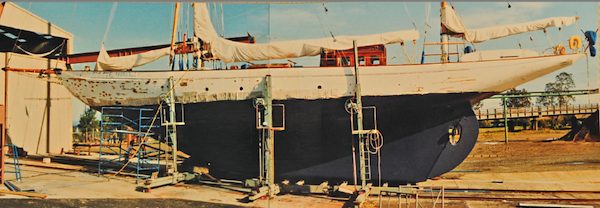
In February of 2024, the classic sailboat Verdura, a 91-foot Alfred Mill designed yacht that had become a derelict anchor out in Richardson Bay, was finally demolished for scrap. It was an inglorious end to a storied vessel that saw countless sailors come aboard as crew, mates and captains over the decades. The loss of Verdura generated many stories and many fond memories from those who sailed her.
12:23
Ernie Minney, who owned and captained Verdura for years, wrote to us to set the record straight about when he sold the boat. story is Remembering Verdura by Ernie Minney.
12:38
I actually sold Vajura to an Italian banker. He allowed me to have shipwrights install 15 feet of new teak stems, replace forward sections of the bulwarks, make changes to the galley, etc. He paid in full for the boat, and I advanced about 35,000 of my own funds for the work, supplies, etc. The sale of Vajura included my delivering the boat to Italy free of charge. When it was nearing our time of departure,
13:06
I notified him that when I received the 35,000 to reimburse me for what I had spent on his behalf, we would set sail for Panama. The banker wired me back a telegram that said, I’ll pay you in Acapulco. Please get underway. Numerous messages went back and forth. We were ready to sail. The crew was on board and supplies stowed. All we needed to do was purchase the food. The Italian was now giving me orders.
13:35
One of his telegrams stated that I was his captain and that he was ordering me to sail. Several weeks went by with several long distance and heated conversations. Knowing I would probably be fired, I sent him a telegram stating that we were impounding Vajira, putting a lane against the boat and that we had taken the propeller off and that she was chained to the dock in front of the popular Rusty Pelican restaurant with a US Marshall on board. I also mentioned
14:03
that local newspaper reporters were sniffing about. This really got his attention.
14:10
A few days after I sent the telegram, Commodore Tompkins from San Francisco showed up to survey Vajira and go over my records and receipts for the work that had been done. I had raced with Commodore several times and was pleased that such an outstanding and knowledgeable seaman had been hired to do dirt on me. Commodore spent a day on board Vajira and pretty much came to the conclusion that the banker was nuts, that he’d got about $100,000 worth of value.
14:40
and that Verdura was ship-shaped and ready for the long voyage to Italy. Several days after Commodore went back to San Francisco, the banker notified me that his attorney would meet me on board Verdura to go over my records. A few hours before the banker’s attorney arrived, we totally set the stage. I had Dick Higbee, a local attorney who dabbled in maritime law, represent me. We posted a big sign on the bow sprit that said, this vessel under
15:09
impound by the Supreme Court of California. I hired a rent-a-cop with big side arms to pace the deck right over the main salon. And we had two mean-looking German shepherds chained to the bowsprit. And most of my crew were on deck to glare at the arriving attorney. We also leaked out along the waterfront the time and day of the meeting. The rusty pelicans upstairs bar had a record afternoon as onlookers enjoyed the spectacle unfolding.
15:39
aboard Verdura directly below them. The meeting of the two attorneys went well as the rent-a-cop paced the deck above Verdura’s salon. The banker’s attorney found the bookkeeping in order and was totally distressed by the impound sign, a few friends who pretended they were newspaper reporters, the dogs and the large crowd peering down on Verdura from the Pelican bar. Two days later, I got a cashier’s check for 35,000 and a visit from David Fraser.
16:07
a popular Southern California yacht broker pretending to have an interest in the lovely bit catch.
16:14
The next day, as we were working out a food and provisioning list for our trip to Panama, the banker arrived with a lovely woman and was quite excited to see his stately ship with the decks freshly oiled and the brass glistening in the afternoon sun. After looking around his ship and after a few cocktails, he politely asked if we would take him and his girlfriend for a harbor cruise. We told him, no problem. The propeller was back on and we fired up the Detroit 671 diesel engine.
16:45
We had a lovely cruise and as we tied up in front of the rusty pelican again, David Fraser and delivery legend Bob Sloan, owner and builder of Spike Africa, came walking down the dock. As they neared the boarding ladder, the banker said to me, you’re fired. Mr. Sloan is taking Vajura to the David Fraser brokerage dock in San Diego to be sold. Talk about a teed off crew.
17:10
Sounds like a bad day for the crew of the Jura and Ernie Mini. Latitude 38 here. Are you thinking of sailing to Mexico or all the way across the Pacific or maybe even further? We just heard from Joanna and Cliff saying, my husband and I subscribe to Latitude 38 and enjoy the Good Jibes podcast regularly. They went on to say they’re headed to Mexico in the fall and will continue across the Pacific to Australia.
17:38
However, they’re looking to simplify all the choices they need to make to prepare. Of course, there’s tons of resources out there, but LATTA 238 does have a page on our website called Heading South. And we also have LATTA 238’s First Timers Guide to Mexico available to read online on the Heading South page or a printed copy that is available to purchase in our online store. There’s a lot to know, but LATTA238.com is a good place to start.
18:06
Moving forward to 2005, we actually have a story about a group of college graduates who do their first Pacific puddle jump. The story is titled, First the Pacific Puddle Jump, Then Our College Graduation, and it is by Patrick Rubin. In 2024, three college friends and I quit our jobs and poured our savings into a sailboat with the goal of crossing the Pacific Ocean. Ranging from age 22 to 26,
18:36
Jack, Lauren, Teddy and I found Open Range, a 1989 Beneteau, and restored her in Santa Cruz over the winter. We rewired electronics, overhauled the plumbing and engine, fine-tuned the rigging, and installed a few new offshore gadgets. What had started as a shared dream during college turned into a serious commitment. From the start, we’d agreed that the California and Baja coasts would be our main shakedown sail.
19:07
California proved to be a good training ground, and Baja taught us valuable lessons in coastal cruising.
19:15
Sailing from San Diego to Cabo was a great shakedown and felt like oh our own private Bajajaja.
19:23
At our first stop in Ensenada, we were greeted by a nice community of cruisers. Fellow puddle jumpers Curtis and Julie of SV Manor, who connected with Lauren on No Foreign Land, an app connecting cruisers, were waiting to catch our dock lines. We spent one night in Ensenada provisioning and treating ourselves to tacos as a reward for finally fleeing the United States. Between Ensenada and Cabo, we saw just one other sailboat in the Raleigh anchorages.
19:54
Jack and Lauren used the lee cloth in the forward cabins to avoid getting thrown out of bed. We took the bad anchorages in stride, knowing that there were many more to come and that challenging seas lay ahead. It was already late March and sailing to La Paz or Puerto Vallarta would have eaten up time that could be spent on boat projects, of which there are many. Sailing down the Baja Coast had checked all our shakedown sailboxes and we wanted to start the crossing as soon as possible.
20:23
to enjoy our time in the South Pacific before cyclone season. Cabo San Lucas and San Jose del Cabo had most of the boat parts we needed, and anything else was ordered online and brought in by family members who had come to send us off. We spent two nights docked in San Jose del Cabo to complete tasks that required flat water, like adding spa-tite to better secure the mast to the deck. The slip also made it easier to load up
20:50
organize and strip down the packaging from a mountain of provisions from the Costco. Lauren did an excellent job of categorizing and tracking every single morsel of food to ensure we would have more than enough nutrients for the entire offshore passage. The exorbitant slip fees discouraged us from staying any longer, so we spent the next few nights in Palmiller Bay, a lovely quiet anchorage with beautiful warm water and lively reefs.
21:20
We finished our essential pre-departure projects in the flat Pomela Bay Anchorage, though landing the dinghy between rocks and shore break grew old quickly. Teddy tackled the fridge air circulation, a broken alternator, the water heater’s relief valve and anode, and installed custom stove brackets. I replaced a cam cleat on the Traveller, solved GPS and AIS issues, climbed a loft to inspect the rigging,
21:47
refilled propane and installed a new Wi-Fi router to monitor Starlink data offshore.
21:54
Jack secured our loose rudder post, polished a tank of bad diesel, and dove under the boat to replace the sea cock. Lauren, on top of provisioning, added a fill gauge to our water maker, rebalanced the tanks, and changed the engine oil. Our newest crew member, Andrew, proved his worth with a bomb-proof fiberglass repair on the swim ladder, reshaping the hydrobane rudder, and helping ventilate the fridge.
22:22
Finally, on April 3, we raised anchor for the final time and set off for the South Pacific.
22:30
Just a few miles off the Baja Peninsula, the water turned to the truest shade of blue I have ever seen, filling an unknown lifelong satisfaction.
22:42
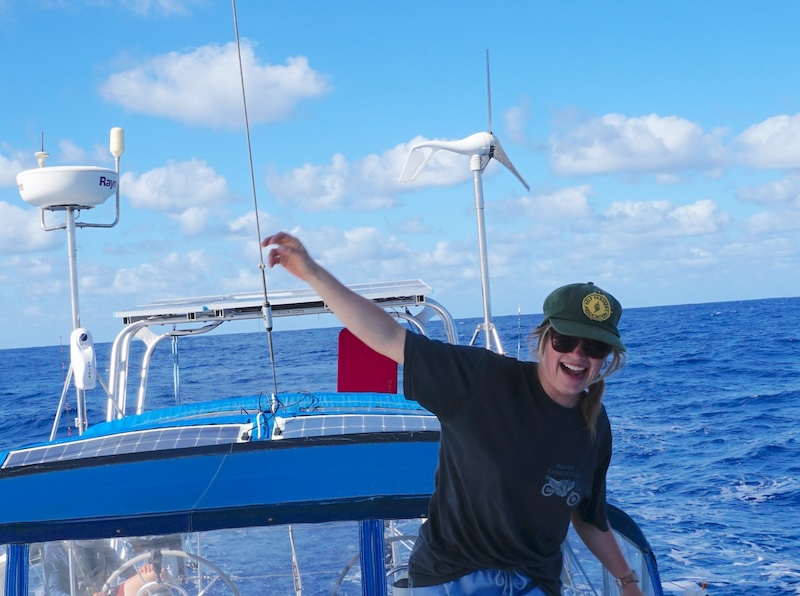
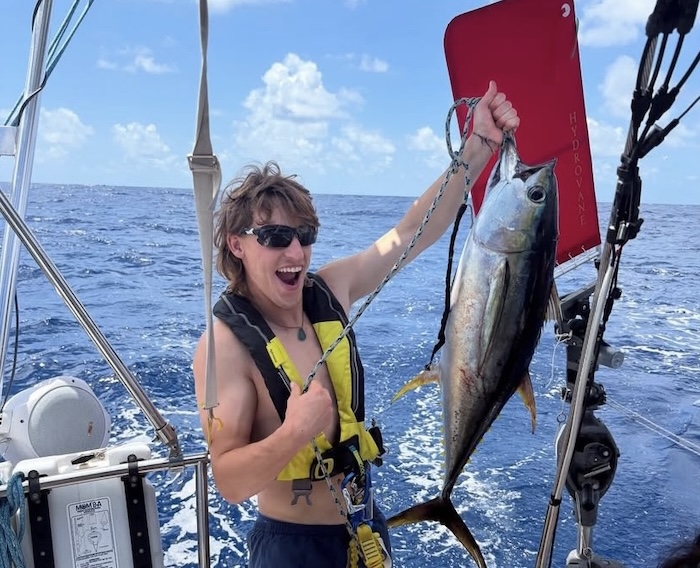
The first few days were rough, besides catching a massive skipjack tuna in the first hour. We made the mistake of pointing farther west rather than south to find wind. The Cape effect from Cabo Falso hammered us with sustained winds in the high 20s and low 30s, which fought the prevailing swell to create an angry and confused sea state. Teddy and I were severely seasick for the first 24 hours.
23:10
This made me nervous for the many miles ahead. It was my first time getting C6 since we’d left Santa Cruz in February, and I began to doubt my readiness and experience to take on a long passage. Luckily, the rest of the crew were very understanding and reliable.
23:30
The rough seas continued for a few days, but a single bonnie and got me back on my feet for the rest of the crossing. Every hour or so we took a wave over the deck, dousing the cockpit and smoking the helm’s person.
23:45
The sea slowly mellowed as we quickly acclimated and I was well enough to stand my first midnight watch. Provisioning for a month at sea came with plenty of lessons. Big wins included our frozen meat supply, especially the pre-cooked Costco bacon. Cheese and Greek yogurt held up well in the fridge and our stash of 117 eggs, some stored in the bilge, lasted the entire crossing.
24:12
Romaine lettuce was the unexpected hero of the produce draw, outlasting expectations thanks to careful packaging with paper towels. Tortillas, rice and pasta were our go-to carbs, while my homemade beer bread was a crew favourite. Beef jerky, Pringles, raisins and Oreos were hits, and everyone adhered, mostly, to the daily snack quota. On the flip side, cream cheese was overbought.
24:40
Mexico has no bagels in sight. Powdered milk flopped and the onions stored in a dark cabinet became a mouldy disaster. We learned to separate apples from other fruits during our trip down Baja and our cabbage, clementines, limes and potatoes lasted through to French Polynesia. Our hot sauces and spices ran out far too early, sparking what Lauren called a full-blown spices.
25:10
On the water, we began feeling the stillness of day 10 at around 6 degrees north, much sooner than we had expected. While we tried our best to forecast the whereabouts of the intertropical convergence zone, the ever-changing conditions made it difficult to time our crossing to minimise our exposure. We switched between sailing, motor sailing and all-out motoring until we reached the equator.
25:39
After officially crossing into the southern hemisphere, we stopped to celebrate. Lauren produced a bottle of champagne from her closet and I made pancakes for breakfast. The weather was perfect. Intermittent rain falls on the northern boundary of the ITCZ gave way to blue skies and crystal clear seas. When we jumped into the ocean to swim and celebrate the milestone, we took the opportunity to reckon with one of the beasts who had been stealing our fishing lures.
26:08
On a dive to check out the underside of the boat, I saw the outline of a marlin emerge from the depths. It must have been eight feet long and looked as if it had jumped off our boat’s logo. Nearby vessels were few and far between. I contacted one cargo ship over the VHF on day six and later in the crossing saw the lights of another vessel on the horizon. Predict Wind showed our fellow puddle jumpers throughout the crossing, but none ever passed within VHF range.
26:40
After a few weeks, we grew curious about our distant neighbours and emailed Pacific Puddlejump organiser Andy Turpin to get contact information for the closest sailboats. The closest, Pol Air Bear, came within just 15 miles of us and remained close for several days, just out of VHF range. We all joked about racing Pol Air Bear to the Marquesas while trimming sails and checking their location on the chart every day or so.
27:09
It’s a good thing the Pacific puddle jump isn’t a race. We would have lost. We caught up with Polair Bear at Anka in the Marquesas and enjoyed a proper introduction. Surface Interval and Amazing Grace, who were close behind for the second half of the crossing, are anchored right next to us off Uapua in the Marquesas as I write these words. We’d all long anticipated the sight of landfall. Who wouldn’t after 23 days at sea?
27:40
My eyes grew tired of the constant, albeit beautiful, blue of the Pacific waters and skies, and I awaited the striking green mountains of the Marquesas. Land emerged as the sun rose, and its overwhelming smell hit us all. Blooming flowers, fresh rainfall, and lush forests shed their fragrance onto the breeze of Fatuhiba, sweeter than any flower shop I will ever set foot in.
28:09
We dropped anchor at 11.30 on April 25 in the Bay of Virgins of Fata Hiva. Then we picked it up and dropped it again. And again. And again. We finally set the hook in 85 feet of water on the outside of the bay at around dusk. The small anchorage was packed with 14 other boats, most of which had just completed their crossing. Diving into the bay, I was instantly overwhelmed by the crystal clear visibility.
28:38
and vibrant coral reefs. I was swimming with an aquarium resplendent with reef fish, manta rays, octopuses, turtles, and few curious reef sharks.
28:52
Our first steps on land felt like walking on the moon, and we happily hiked to nearby waterfall to check out the local wildlife. Hanawave was welcoming, despite our lack of French and Marquesan language skills. Some residents handed out Pamplemousse and bananas. We ate dinner with the family in the village, together with our new friends on Espie’s Pinnacle and Nanooka. Our hosts served delicious Poisson Creux with Wahoo.
29:21
slow-cooked goat, papaya salad, and many glasses of corosol, which is a soursop juice. The wild, rich Marquesan landscape made for the perfect landfall experience, tying together our lifelong ambitions of sailing across the Pacific. Adam and Liv of Nanooka became great friends and sailed alongside us all the way through the Tuamotus. We enjoyed our Pacific
29:50
paddle jump experience immensely. Though we’d missed the in-person seminars and meeting other paddle jumpers in Porto Vallarta, connecting with the fleet online was invaluable. The PPGA website resources, specifically information about clearing into French Polynesia, were very helpful. And knowing the organizers were checking our location daily via Predict Wind gave us huge peace of mind a thousand miles offshore.
30:17
Two weeks after our crossing, I flew from Nuka Hiva to Los Angeles for my college graduation. I was overwhelmed by the chaos of cars and crowds. My friends picked me up and we drove to USC and celebrated together with our families. It was a joyful, bittersweet week and I realized how much I’d missed home. But now, back on the boat, my decision to graduate early for this journey feels more certain than ever.
30:45
Sailing across the Pacific with open range was the best choice I’ve ever made. And that story was by Patrick Rabin.
30:55
We hope you’ve enjoyed catching up on the previous three years of what happened in July in Latitude 38 and we look forward to sharing more stories and more conversations with sailors in the coming weeks. In the meantime, you can find more great stories online at www.Latitude38.com or collect your print issue from your favorite boating store or marina. winds until next time from the Good Jibes crew!