

Episode #238: Karen Prioleau on a Career of Teaching Sailing, with Host John Arndt
Welcome to Latitude 38’s Good Jibes! In this podcast, we’re bringing you the world of sailing through the eyes of the West Coast Sailor. Each week, you’ll hear stories and tips from the West Coast sailing community on cruising, racing and just plain sailing. Hosted by the team at Latitude 38 — the sailing magazine for West Coast sailors since 1977!
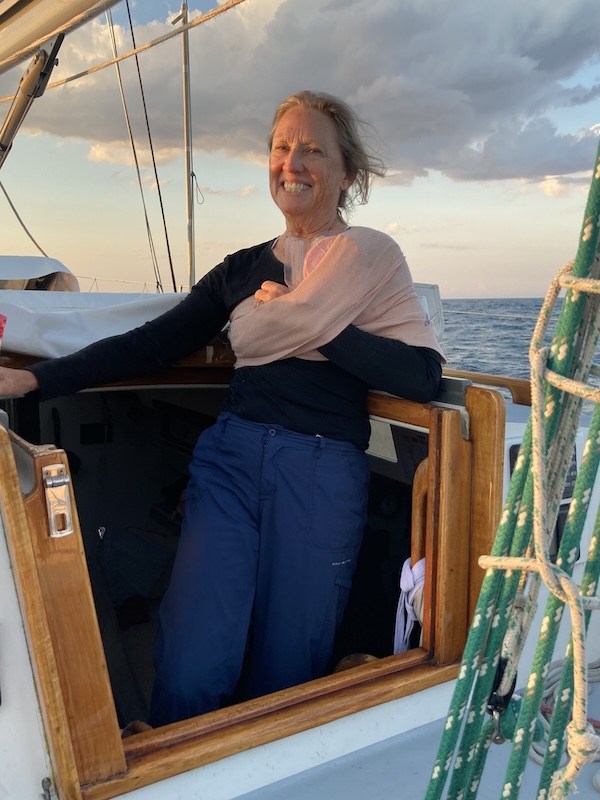
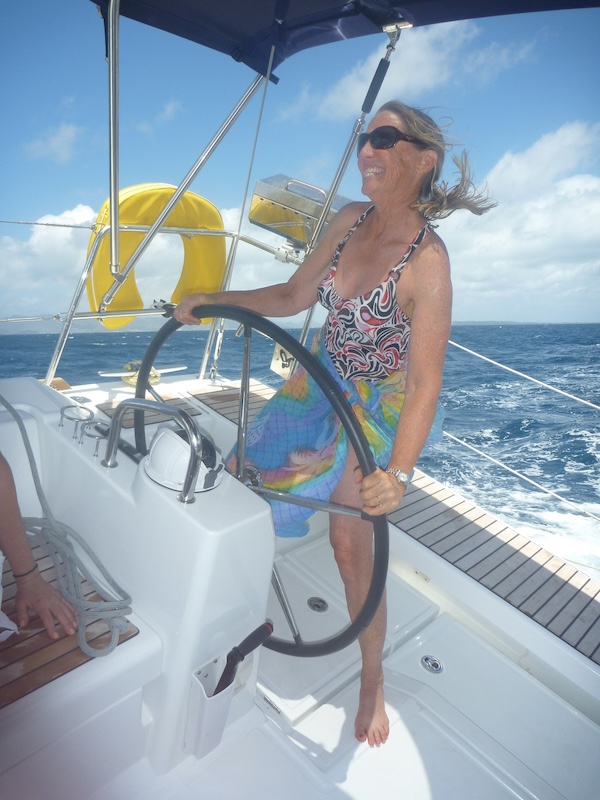
In this week’s episode we chat with Karen Prioleau about making a career of teaching all types of sailing. Karen has spent over 25 years teaching sailing at Orange Coast College and US Sailing, and has a ton of personal offshore sailing experience.
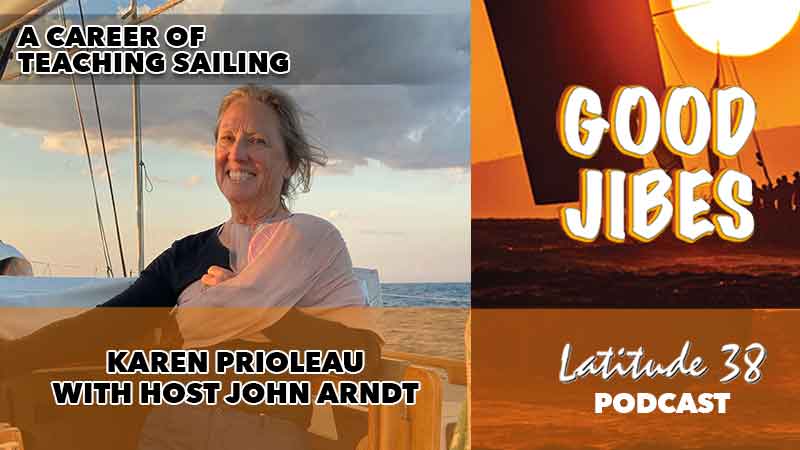
Tune in as Karen shares with host John Arndt her stories about how to become a full-time sailing instructor or sailing educator, her memorable trips on the Alaska Eagle, the most useful sailing courses to study and teach, what’s getting young people inspired to sail, and unbelievable examples of her safety training coming in handy.
Here’s a small sample of what you will hear in this episode:
- Sailing to Tahiti pregnant
- Alaska Eagle’s happy ending
- Life aboard a 41-foot wooden boat with a newborn and night watch duty
- Four years of cruising: Mexico, the Sea of Cortez, and a leaky seam that changed the plan
- Karen’s origin story: Sea Scouts, sailing at 12, and a 16mm film that changed everything
Learn more about Karen at OrangeCoastCollege.edu and USSailing.org
Check out the episode and show notes below for much more detail.
Listen to the episode on Apple Podcasts, Spotify, and your other favorite podcast spots — follow and leave a 5-star review if you’re feeling the Good Jibes!
Show Notes:
- Karen Prioleau on a Career of Teaching Sailing, with Host John Arndt
- [0:14] Welcome to Good Jibes with Latitude 38
- [0:38] Welcome aboard, Karen Prioleau!
- [1:34] Karen’s origin story: Sea Scouts, sailing at 12, and a 16mm film that changed everything
- [3:29] Drawing cartoons of Tahiti in a German textbook and then actually sailing there
- [4:48] Orange Coast College, Cal Berkeley, and falling in love with a 1938 wooden boat
- [8:08] Four years of cruising: Mexico, the Sea of Cortez, and a leaky seam that changed the plan
- [11:22] Sailing to Tahiti pregnant
- [12:52] Maupelia, Suvarov, Samoa, Tonga and coaching the King of Tonga’s rowing team
- [15:45] Life aboard a 41-foot wooden boat with a newborn and night watch duty
- [16:40] Check out our Classy Classifieds at Latitude38.com
- Teaching, Training & Alaska Eagle
- [17:09] Selling the boat in New Zealand and walking into Orange Coast College three days later
- [19:31] The legendary Alaska Eagle: Hawaii, Tahiti, Alaska, Panama, and beyond
- [23:47] Alaska Eagle’s happy ending: restored to Flyer and sailing again in Holland
- [24:44] Best trip ever: 24 days nonstop from Newport Beach to Easter Island
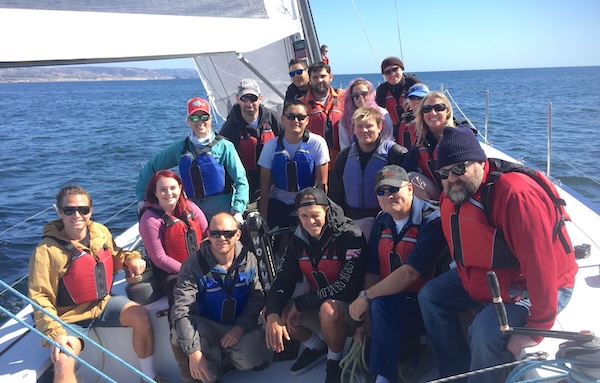
- [25:14] US Sailing safety training and 400 live man-overboard rescues on the Bay
- [28:25] The professional mariner program: tugboats, ferries, NOAA, and Disney cruise ships
- [29:19] Why sailors make the best boat handlers
- [32:14] Want to sponsor Good Jibes? Email [email protected]
- Orange Coast College & the Trades
- [35:06] Jimi Hendrix, the Fourth of July, and a rocket flare that came back at the boat
- [37:04] Master instructor trainer: teaching people how to teach sailing across the country
- [38:02] Women in sailing: from 100% male classrooms to 40% women and climbing
- [39:53] The LA Olympics, gender balance, and a long-overdue shift on the water
- What’s Next
- [40:22] Retirement, sort of: teaching at Long Beach YC and presenting on heavy weather
- [41:17] The new boat: a Swan 44 and dreams of returning to the South Pacific
- [43:08] Newport Harbor: more crowded than ever, but still a great place to learn
- Short Tacks
- [45:00] Dream destinations: the off-islands of New Guinea and going off the milk run
- [46:27] Navigation full circle: wayfinding, celestial, and the Hōkūle’a stopping at Newport
- [48:52] Advice for new sailors: crew for someone, bring snacks, and stay to clean the boat
- [50:46] Why young people are getting into sailing: TikTok, blogs, and the COVID dreamland effect
- [51:44] Favorite sailing books: Halsey’s Typhoon by Bob Drury & Tom Clavin, The Long Way by Bernard Moitessier, North to the Night by Alvah Simon, and Swallows and Amazons by Arthur Ransome
- [54:02] Final story: the best lesson ever taught aboard Alaska Eagle involved a giant cut of meat
- Check out the April 2026 issue of Latitude 38 Sailing Magazine
- Make sure to follow Good Jibes with Latitude 38 on your favorite podcast spot and leave us a 5-star review on Apple Podcasts
- Theme Song: Pineapple Dream by SOLXIS
Transcript:
Please note: this transcript is not 100% accurate.
00:03
It’s just amazing to be able to do those sorts of things as a job. It was incredible.
00:14
Welcome back to the board the good ship Good Jibes. name is John Arndt I’m the publisher of Latitude 38 in the host of today’s episode of Good Jibes It’s a podcast to help you experience the world of sailing through the eyes of West Coast sailors and today it’s brought to you by Latitude 38 the sailing magazine for West Coast sailors since 1977
00:38
And today’s guest is SoCal sailor, Karen Prioleau. Welcome aboard, Karen. Thanks for having me, John. Great to have you here. Very nice. And Karen and I have known each other for many years at opposite ends of the California coastlines, meeting up at Bocho’s and worked together at, well, I should say she’s been at Orange Coast College uh for 25 plus years and just retired. Is that right? That’s correct.
01:04
And yeah, so she’s been promoting sailing, teaching sailing and head of the uh professional Mariner academic program and did many trips on the Alaska Eagle. And so we’ve talked over advertising with the Alaska Eagle and also just how to get more people into sailing, which she’s done in spades. So looking forward to hearing more about that. But before we get started, Karen just wanted to ask you, like, what was one story that kind of cemented your relationship to sailing?
01:34
Something that just made you go, ah, what got me into this lifelong passion? That’s super easy, actually. So I’ll start with a short prelude to that. And that is that my mother enrolled me in a sailing rowing canoeing program at the Girl Scouts at the Boy Scouts Sea Base. And so that was fun. I liked it. And I wound up being an instructor’s aide at the age of 12, I think I was, or maybe 13.
02:03
put in five zero hours of free time and after that I got paid $1 an hour. Wow. Did they include a 401k plan with that program or anything like that? No, it included a lot of abuse, that’s not the point. But you stuck with it. That wasn’t the seminal. mean, that got me hooked on sailing and I loved it. And sailing, rowing, canoeing, it was all really fun. But the one thing that absolutely nailed it for me was
02:32
my best friend’s father was Andy Fitzpatrick. And he eventually ran the Sea Scout base, but at that time he didn’t. He took us to a schooner association meeting when his daughter and I were 14 and 15. Wow. And Ernie Mini, of Ernie’s Yes Surplus, showed his film from the 50s when he had graduated from Cal Maritime and his father decided they needed to take their schooner Kelpie to the South Pacific.
03:01
Oh, wow. So there we are in this room in the old, I think it was the Monterey still. And we’re by far, I’m sure the youngest people in there, the 16 millimeter is going. And I see the schooner in Tahiti. And that was it. That was it. I was sail to Tahiti. So Laura Fitzpatrick, who became Laura Morelli, she’s married to Gino Morelli. We all knew each other as kids. Laura and I shared a German book at school.
03:29
because we’re too cheap to buy our own. Yes. Well, in that German book, we would make cartoons of Argus, which was the Sea Scout boat. was a tall ship, 92 foot tall ship that the Sea Scouts ran. And we would make cartoons of us on the Argus in Tahiti. I was determined and I I did I sailed to Tahiti many years later.
03:54
Yeah, wow, that’s a great story. Yeah, see, that’s the fun thing about learning these things. This where that spark come from. It’s amazingly how common it comes up with sea scouts like I don’t think of sea scouting as the thing that gets so many people started. You you think of junior programs and all these things, but I know you know so many people sailing today. It was sea scouts and I don’t know if you’ve been engaged with them since then. Since then, I mean they’re active here. They’re active everywhere. mean, we have students that have come through the program and so forth, but.
04:24
Orange Coast College is right next door. We wave at each other all the time. We talk to each other. if you don’t have a family that stales and you don’t have access to Yacht Club or something like that, it was magic. So as kids, there was very little supervision at that time. And we used to get messages, go mess around in boats. It was really fun.
04:48
Yeah, well, that’s of course, that’s why so many people also like sailing. It gets them away from something and gets them out on their own and independence and all that good fun stuff. we, uh, or Moradi did a podcast with, uh, the sea scout base here recently and the director of that. And it’s just a great podcast. And one of the students was youth teachers was on board with a podcast and both were so enthusiastic. It’s a completely different kind of sailing program than the one we typically visualize.
05:17
I mean, they’re out rowing boats and all kinds of things. You’re absolutely right. So the boats were in various stages of disrepair and we had to learn how to make them go. And if you had something that broke, you figured out how to make it work. we didn’t have coaching in sailing and racing like you would in a normal program, but we learned all sorts of different things, which was really helpful in the rest of my life and career. Yeah, no, that’s been so, so it was that kind of
05:46
set in stone and you’ve been in sailing ever since or was there a alternate path along the way or it’s been sailing, sailing, sailing? That was, I mean, I rode, I rode for Orange Coast, was on the crew as a coxswain and I did some sailing and my husband’s a rower, but he’s also a sailor. My son rose and sails. I mean, there’s always that path too. Yeah. You know, we do other things like we ski, we bike ride and do all sorts of fun things like that, but sailing is pretty fun.
06:15
Yeah, well, could see I’m looking at you on the screen. People will be listening, but I see behind you are a couple of oars on the wall. So yeah, rowing is a big part of it. Yeah. So after all that adventure, where’d you go? you, what was the entree into sort of becoming a career? Career came later. I was on the Orange Coast Sailing Team. I was on the Cal Berkeley Sailing Team.
06:40
So we sailed there. Then I wound up in the Bay Area. Well, actually we went to San Diego and my husband worked for North Sails. And that was really fun. Only for a year, but he was in the Spinnaker department. And so we would go sailing and I would be invited along when they were testing sails and things. So that was really fun. And then from there, we moved to the Bay Area. We had a laser and we used to take the laser out in the Bay and go crazy. The two of us had to hold it down.
07:09
blown away, didn’t tear something or break a mass. But that was screaming fun. And then from there, we wound up buying an old wooden boat. eh And we were very young and very foolish and fell in love with this thing because it was in our price range. It did not have an engine, it didn’t have a depth sounder, but it had everything else and it was
07:37
a 1938 Stewart and Fellows Q boat. Q as in ours and James. uh Gorgeous boat. Absolutely beautiful boat, but obviously old and wood. So young and stupid. When we began to upgrade it and we put an engine in it and eventually put a depth sounder in. That was the boat we took off and went cruising in, which was your typical cruising boat.
08:08
Wow, how long did you go cruising? I didn’t know you’d even done that. right. Oh, yeah, we did that for four years. But I’ll tell you one funny story. The first time we went sailing, we were in a slip and it was in Alameda in Alameda Bay in Alameda, not Alameda Bay. That’s here in Alameda. And you walk down the slips. And then at the end of the slip, it was facing into the wind and to the right.
08:36
where the slips continued and then there was a long side tie and then there were the other slips on the other side. So it made this U shape. so it’s our first time sailing this boat. And I tell my husband, well, why don’t you just walk it to the end of the dock and we’ll go. We’ll put up the sails and go. Well, I didn’t communicate very well. the thing that got missed was we needed to wait when the main was up and then go.
09:06
Yeah, let go and then yeah, so he pushes off his bike We raised the man really fast and we take a right-hand turn now We’re headed towards this side tie of the you Yeah, there’s this very large powerboat and somebody having a lovely time up on this flybridge. Oh, no, so when he sees us coming full bore at him and
09:30
I jive around and miss them by probably four inches and wave very cheerily and off we sail. So if we learned early on, 100 % my fault, communication is very important. A lot of spouses probably work on that a lot, I would guess, in a lot of aspects of life. Yeah, that’s it. Well, and you’ve been teaching sailing, I’m sure, with all these other things, the communication is probably a lot of it. uh
09:57
making sure people on the board know what’s going on, especially new sailors. Sure. Yeah. We took that boat and we left and went to Mexico. went down the coast to California into Mexico, went down into Zihuataneo. Yeah. And then we’re headed back up. Our intention was to go across to the South Pacific. Yeah. But uh we wound up having a seam that had been repaired incorrectly. So we started taking on water and that was kind an
10:27
And sure, it’s a whole other story. But we managed to stem the leak and then we hauled out. And because we were delayed, we then spent a season up in the Sea of Cortez. Which was probably pretty nice. It was amazing. It was really great. We thought we knew how to fish and no, it the Sea of Cortez. We know everything about fishing. It was wonderful. And so we stayed there for a whole season. And after that,
10:55
discovered that I was pregnant. And so my husband and my brother took the boat across to the South Pacific and I stayed and worked for a few weeks. I used to run the IS department for corn nuts snack fade. For who is that? Corn nuts snack fade. Oh, I ran their IS department. Oh, okay. And so I came back and I did a little computer work while they brought the boat across.
11:22
And then I met them in the two motus and we sailed around the two motus and then we sailed into Tahiti and went back and forth to Moriah until my son was born. Wow. Well, did you fly back and had your son here or in the South Pacific? He was in the South Pacific. Yeah, he was born in Tahiti. Oh, wow. He’s our souvenir of Tahiti. Yeah, souvenir of Tahiti. Perfect. So he got started right in the water life as well. So you managed to sail uh
11:52
while being pregnant, because I think that’s a lot of people have trouble in their home while they’re pregnant trying to uh manage life, but you managed it afloat. It’s fine. I didn’t know any better. Yeah, yeah, that’s great. Wow. Yeah, that sounds wonderful. Then you brought the boat back and you went move to Southern California with it when you eventually came back. We did. We eventually well, we had some adventures along the way. So we sailed with him, obviously, which is if you sail with a young child, it’s much harder than single ending.
12:22
Yeah. On a passage, they get bored with whomever’s taking care of them and they want to they’re in there below a lot. So they want to wake up the other person. I mean, it was exhausting, but oh we uh went from. French Polynesia to a small island in French Polynesia, Maupelia, where there was only one person, which was pretty amazing. At that time, there was only one person. There’s a great history if anyone’s interested in the history and the war and all that.
12:52
We went to Montpelier and then we went from there to Suvarov in the northern cooks. Oh nice. That was a great adventure. There were only two people there and they were sort of caretaking the island and the supply boat had run out and so everybody was helping them because the supply boat was six months late I think it was. Wow. And then from there we sailed to American Samoa.
13:21
And then we stayed a season in Samoa and had some fun adventures there. And then we went to Tonga. And while we were in Tonga, the king of Tonga is an avid rower. he at that time, he’s no longer, he’s passed. He’s no longer king, but he thought it was really important for the young men to row and have physical activity and so forth. So my husband being a rower and a coach wound up coaching the Tongan rowing team. uh
13:51
And at one point the king came and he wanted to observe his team. So we took the king of Tonga out on our boat to watch the rowers, which was pretty wild. That’s pretty fun. He came on board with his retinue and they had a couple of people with guns and his position and then the royal umbrella holder because he didn’t want to get the sun on him. And yeah, this.
14:19
grandson and so the king of Tonga arrives and he arrives and he’s wearing a Hawaiian shirt and Hawaiian shorts and our favorite accoutrement to this outfit was his sombrero that said Mexico on it and yarn. Oh really? And then his grandson who is the crown grand prince or I’m ignorant I don’t know what they called him but he came aboard and he was wearing also Hawaiian style
14:48
you know, shorts and shirts with a Mickey Mouse mask. Oh, what? Mickey Mouse dive mask. Oh, That’s funny. Was it Rain Spooner brand Hawaiian? Yeah, wow. That’s that’s really fun. Yeah. Tonga is beautiful. That’s incredible. So you got to row. And did you be coxswain at any point in that? you get to know? Yeah, that’s a guy’s game there. Yeah. Yeah.
15:15
Well, you uh had a baby. I think a lot of people do night watch also at home when they have a young child, but they’re just in their house. But you had to do night watch and tend to baby on a boat. So this is on a wooden boat. didn’t know you did that. What size is this boat actually length and what is the beam to I imagine? It’s 41 and our beam was probably 12. She’s long and skinny with lots of overhang. Yeah, yeah. Classic old school boat. So not a lot of interior. No, low freeboard.
15:45
We could get ourselves on board. We were in foul weather gear when nobody else was, but you you’re young and it’s fun and you do all sorts of crazy things. Yeah. Yeah. Well, of course, talking about it now and listening to it now, it doesn’t sound crazy whatsoever because it sounds so awesome to do if you’re, if you’re young and what a great thing, what a great experience to have. Hey, good jobs listeners and latitude 38 readers. Have you looked in our classy classifieds lately?
16:13
It would be impossible for us to know how many boats have sold to new owners over the last 45 plus years of publishing Latitude 38. But we’re sure they have helped countless people realize their sailing dreams. Every month there are new boats listed that will fill someone’s sailing adventures. If you have a boat you want to sail or are looking for that next boat in your life, the pages of Latitude 38 will surely have something to suit your fancy. Pick up a magazine at a local marine business.
16:40
or visit our classy classified pages at latitude38.com to find boats, gear, job opportunities, and more. Then tell us your next sailing story. What brought you home? mean, that sounds- We sailed to New Zealand and my husband felt like, it’s time for me to do something worthwhile. So we sailed to New Zealand, we sold the boat in New Zealand, we came here, and he was working as a director of a local aquatic center and I-
17:09
walked into Orange Coast College because a friend of ours that we had met cruising had said, you’re always talking about how women don’t know what they’re doing on boats. Sorry, females. And it’s changed dramatically because people realized they need to know. But at that time, there were a lot of people that were just along kind of for the ride. And if something had happened to the skipper, they wouldn’t know what to do.
17:39
So said, you’re always talking about that. Why don’t you go down to Orange Coast and talk to them about teaching a class? That’s great. So I went in and talked to Brad Avery about the class. He said, well, what other experience do you have? And I walked out with a job teaching in the small boats. Literally the next, I think, three days later. Welcome home. Get to work. Start teaching. yeah.
18:06
So anyhow, I started in the small boats and then I taught in the shields. I taught on their bigger boats, the Cheaple Islands trips and on and on. And then eventually I became a relief skipper on Alaska Eagle and I sailed a volcano. If anyone knows the first, 64 volcano. It took her from Hawaii to Alaska. And it’s just amazing to be able to do those sorts of things as a job. was incredible. Yeah, no, it’s of course, and that’s a lot of people
18:35
Again, say sailing is so expensive. You know, it’s such a rich person sport. And I’m like, you gotta remember how many people crew and actually how many people get paid to go sailing. There’s a lot, it doesn’t have to be out of your wallet necessarily. It’s an option. It’s an option. If you have the wallet, do it. But if you don’t, there’s a lot of other options. But yeah, it’s amazing. Cause we just had our crew party last week at the Golden Gate Yacht Club here.
19:01
And one of the things that’s changed over the last 40 years of crew parties is the women, number of women, but the women who are boat owners or really capable crew, as opposed to people looking for a ride or just trying to connect with sailing. it’s definitely, you’ve been on the forefront of this and actually made this happen, trained a lot of women. And there’s just so many more women that were at the crew party who were the sailors looking for crew as opposed to looking to be crew.
19:31
Um, and a lot, obviously still looking to become crew, but it was, it’s, it’s definitely been noticeable transition over the years, um, to see that happen. Yeah. Yeah. So, um, with Alaska Eagle, which of course I think is one of the great programs that, that orange coast college had, you did a lot of skippering of that and what, tell us a little bit about Alaska Eagle. Cause I just think of that was really for us an iconic boat that was taking adventure sales and taking so many people in their first offshore experience. And you were.
20:01
a teacher on it and a skipper of it. How much did that boat do and how did you get aboard that kind of thing in doing it? That boat did amazing things. Brad Avery really hats off to him for having that and just the vision and so forth. And he had Rich and Sherry Crowe. The boat was donated to Orange Coast College. And there’s a whole story behind that. And you guys have done some good work on that.
20:28
She was launched at Lloyd’s and Rich was there and Sherry was with him. They weren’t married at that time. And the boat was dropped and it hit a bridge and had a bunch of damage and had to be repaired. was just amazing. then Rich wound up being there for quite a while at the beginning and he oversaw this, you know, the refit wasn’t a complete refit, but
20:55
all of the boat work that had to be done and so forth, and then brought it back to the college. so Rich and Sherry were very instrumental in it. But of course, they can’t do it all. And Brad would take sections of trips and so forth. And then eventually they rotated some more people into the mix. And I was one of the ones that got to do some pretty amazing trips. Yeah. So yeah, what was it? It’s itinerary typically. Or what were you taking people from where to where?
21:25
She would go in the beginning, she’d go to Hawaii and then up to Alaska and then back down the coast. But as time went on more and more adventures and the ones that I was lucky enough to do, she went from the mainland to Hawaii to Tahiti, back from Tahiti, the Tahiti, Alaska, Tahiti, Santa Barbara, know, Newport, several of those cross-ocean things. And then
21:53
We brought her through the Panama Canal. And so I did a trip as a third through the canal with, I think it was Kevin Mullen and I can’t remember the other mate, but went through the canal and then Rich and Sherry took over. And that was great because when you sail with people of that caliber, like when I would sail with Brad, I mean, I just would learn so much.
22:19
It was really fun. that particular trip, we went through the Panama Canal, Rich and Sherry then came on board. We went to another section of Panama. We went to Cartagena, Columbia, up into the British, actually US Virgin Islands. And then I got off because I had a family. So I was lucky enough to be able to do like a three and four week stint. Yeah. anyhow. Wow. Well, that 14 year old girl drawing pictures in the,
22:48
in the book, in the German book, got to go to Tahiti and all these places quite a few times. That’s a pretty good course to set early. That’s fun. Yeah, that’s great. think to give you an idea too, working with Brad, so I did skipper, obviously, my own trips and so forth, but working with Brad was always a blast because when you’re the mate, you don’t have the full responsibility. So that’s really fun. But I remember before a New Zealand trip, he said, all right, pretty low.
23:17
we’re going to tire these people out because it’s not an ocean trip. You know, we’re stopping a lot. Yeah. So we’re going to do as many stops as we can. And we did something like 27 anchorages in nine days. Oh, so they get a lot of anchoring practice. Yeah. It was a blast. We sailed that island all over. It was so much fun. Yeah. Wow. That’s great. Beautiful. It was an incredible boat. Where is the Alaska Eagle now? Actually, is it still out sailing?
23:47
a happy story in that uh she was then sold to a consortium in uh Holland where she was originally built and so forth. And so they reverted her to flyer. They painted her the original colors. They put her back into a catch and they’re doing trips on her now. Yeah. Yeah. That’s fantastic. Yeah. And any guess on how many people got a trip on Alaska Eagle? Oh my goodness. I mean, it has to be in the thousands truly because
24:17
There were some shorter trips to Catalina. were shorter trips that channel islands, but rich and Sherry took her around South America, Brad and really around the Cape Horn. Oh yeah. Oh yeah. They took her to South Georgia Island. They took her to, there was one trip to Antarctica. mean, crazy stuff. I was looking, my best trip was my, I think it was, I, it wasn’t quite my last trip, but
24:44
It was my longest trip. went straight from Newport Beach to Easter Island. Wow. And that was a phenomenal trip. It’s 24 days. We had to push the boat to make our timeline. You know, things happen along the way and you have to fix something that breaks and so forth. And that was pretty amazing. Yeah. Yeah. Yeah. I mean, that’s amazing. Yeah. A mountain people they taught, a matter of people you taught. You did some all women’s trips, too, right? I did. I did. Yeah.
25:14
So, and so from all that too, I think one of the other things you’ve been super involved in is US sailing teaching what instructor trainer, but also safety at sea, right? Which I think doing all that, were you doing life raft drills and all this with the Alaska Eagle or man overboard and a lot of training? We did do a lot of training. So US sailing is pretty phenomenal when it comes to man overboard training. And this wasn’t a US sailing sanction thing, but.
25:41
About a scary to think it was about 20 years ago when John Connolly, who was in the Bay area, decided that they should do live trials on man overboard. And he did one. And I went because I wanted one method on man overboard retrieval. And you go and you realize there’s not one method. So then a few years later, John Ramier, Chuck Hawley, myself, Ruth Wood from BoatUS, and I forget who the last one was, but
26:11
got together and decided, and John Connelly decided that we were gonna do a big one. And we did almost 400 live rescues in San Was that on the bay? Yeah. Yeah. Yeah, think we wrote that up or did a story, because I remember we have pictures of people jumping overboard in wetsuits and I think you brought most of them back, right? No, we brought them all back. Oh, good. Thank goodness. Yeah.
26:36
But then also US Sailing does a lot of that safety at sea, does a ton of that training. then obviously Alaska Eagle, we’d get everybody in their Gumby suits and et cetera, et As far as Orange Coast goes, then we have the whole professional mariner training. And so we do the basic safety training for them and they get the Coast Guard basic safety training where they.
26:59
do the life raft training and they do firefighting and medical and all those good things. Yeah. Yeah. And is that for commercial or recreational or both or whoever wants to sign up? It’s both. It’s both. It’s both. Yeah. In fact, they have been training Disney’s crew recently for the costume. Mm-hmm. Yeah. Well, they did a rescue a few years ago, didn’t they? Right? When they were in the Transpac. When was it?
27:27
John Sangmeister’s boat sank and Disney picked up the crew off the Transpac when they’re- Oh, that was on Paiwai. Yeah, I think that was on Paiwai, though. Right, right. That wasn’t a Disney cruise ship. Oh, I see. Oh, Disney cruise ship you’re talking about. I gotcha. I’m thinking of Roy Disney and Paiwai. Okay. So we do professional training for tugboats, ferries, cruise ships, NOAA, observers, all those sorts of- Wow. So that’s an Orange Coast College program. Right. Yeah.
27:56
So people can take it as part of their academic program. And that’s a 16 week safety at sea on steroids class, or they can take the just basic Coast Guard required class as a commercial voter. Yeah, right. Well, that’s one thing actually thinking about Orange Coast College’s programs. One thing we’ve been covering more is the maritime trades, the working waterfront, because partly I think too with AI coming along, people are looking for some more
28:25
tangible jobs with more concrete props or products and things. And also the maritime trade seemed to be short of people, like many industries, they’re really looking for people. tell us a little bit about Orange Coast College and what you did. You’re a professional mariner academic program, but what does Orange Coast College offer for people who want to get into the trades? Because it seems like they could be a tugboat captain and a sailor, and that’s a pretty good life.
28:52
Will Benedict here on the Bay went to Cal Maritime and he’s a bar pilot and also just won the Three Bridge Triasko and is J105. So it’s a great career combo to have a maritime trade job and also a sailboat. Well, they will tell you the advisory committee that I have is amazing and they will all tell you that sailors make the best boat handlers, period. ah So sailing is really…
29:19
a bonus for anybody going into the trades, but you don’t have to, obviously. So the uh classes that we offer, offer six core classes for a professional Mariner associate degree. And that would be, actually six core classes. And then there’s some additions. So they would take a maritime industries class, which covers all the industry, as well as what schools you can go to, to get additional training, like help Holly.
29:48
maritime as they’re called now. New name, yeah. And then the landing school, we try to give them as many options as they can. The Star Center in Florida, we tell them, here’s a wide range of things you can do. So they learn all about the industry and then how to go beyond just first steps and get even bigger steps. Then we have uh a maritime environment class, is
30:16
weather and environment and things like that. Navigation, boat handling and seamanship. Let’s see, boat handling and seamanship, have, oh, basic safety training and then a vessel and engine maintenance class. And they’re as hands-on as we can possibly make all of them. And additionally, we have radar. So they can get the radar observer unlimited. And we have RFP and W, which is rating, forming, part
30:46
navigational watch, which is also a risk concern. Yeah. And most all of that is for commercial maritime jobs as opposed to something a recreational sailor would sign up for. Yeah. And then they can also take sailing. mean, that sailing is part of that curriculum too. Yeah. And we have people that they’re sailors, they want to go offshore. So they take the 16 week basic safety training or they take radar because going to a community college, you can do all these things very inexpensively. Yeah.
31:15
And then of course, Orange Coast has that whole other side, which is the recreational side for the average boat, which is phenomenal. Yeah. How big a fleet do they have down there? How many boats are they operating in the docks? You asked me that because I don’t know off the top of my head. Well, there’s I think 16 or 17 Lino 14s. There’s probably 10 small power boats.
31:41
There’s a larger twin screw. There’s a Catalina 42. We don’t have a big boat. We don’t have Nordic Star, the big yacht that we would run. That was pretty fun to use for classes. And then we have, if anybody’s interested in buying a boat, there’s the whole boat donation program. Right. That’s right. I know that’s a great thing for Cal Poly Maritime and the schools they get, and you as well, it’s a good way to find a boat to buy, is the donations. And it helps the school, right?
32:11
So that’s good.
32:14
Hey, listen up. We hope everyone is enjoying listening to the stories of West Coast sailors on our Good Jives podcast. We’ve heard lots of great feedback from the 150,000 listeners who’ve tuned in over the last couple of years. And if you have a marine business, we’d like to give you an opportunity to connect with them during upcoming podcasts. If you’d like to be a sponsor of future podcasts, you can email Nikki, N-I-C-K-I, Nikki at latitude238.com to learn more about how your company can benefit.
32:44
from sponsoring good jibes. The Safety at Sea program I’ve known, I’ve never taken it, I really should, and everybody should I think, but we have the Baja Ha Ha coming up. Races like the Transpac, I think Pacific Cup and many offshore races require some of the crew to have taken that right before you can actually take your boat on the race. But maybe uh for our Baja Ha Ha participants with a much more casual event and coastal event, but it probably is still a good idea.
33:13
What would they learn and what’s why would a recreational sailor and how do they get how do they get into it? Because it seems like it’s not offered that often in that many places, but I’m I’m not sure. US sailing will post where those events are, but I’ve always thought the Baja ha ha needs uh safety at sea. I think it’d be great. There’s an online course you would take and that will get you so far and then you come that.
33:39
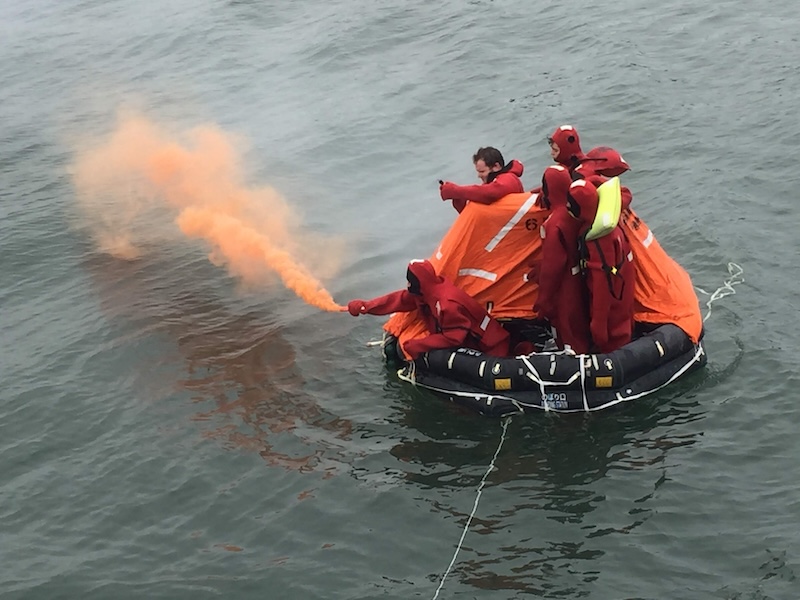
to a one day or you can go do two day class, skip the online and have lectures and presentations. uh Most people do the online and then they come for the one day. So you light off flares. If you’ve never lit off a flare, you get into a life raft. We don’t use the immersion suits, but you get into the pool with your inflatable life vest and make sure it can inflate because they don’t automatically inflate. A certain percentage does not.
34:08
So it’s good to know that auto inflate is actually your backup. You want to know how to pull the cord. And that’s really important because people jump in the pool and they don’t know where their cord is because it’s not standardized. Right. And then they get into the life raft. They learn how a life raft flips and how to ride it. They will use fire extinguishers. They will, depending on the venue and so forth, either see or participate in the demo for man overboard rescues.
34:37
And ah I don’t know, there’s several other things. Heavy weather and um damage control are really important topics that are covered, things like that. Yeah. Wow. Do you ever have an episode like that on Alaska Eagle? have you actually had to do this in real life? Or this has all been training and never had it? Which is the right way for insurance purposes and life is to have the safety training, but never have to use it.
35:06
Thankfully, no, I’ve had to put a few stereo strips on people. Yeah. things like, you know, in general, that’s been the most stereo strips or staples. There’s never been a major one. But I will tell you that we were shooting off flares in the middle of the Pacific. So we give out a secure a TAY over the VHF and so forth and make sure everybody knows we’re going to do this. And was at night on the fourth of July and we had
35:36
Jimi Hendrix blaring on the stereo, the Star Spangled Banner, of course. And everybody was able to, you we were cautious about it, off a light off a flare. And the grand finale was the cook, myself and Brian Fury, good friend, who had three rocket flares that we were shooting off. And we were one, two, three, we shot these off and two of them went off. And the third one caught a nice little
36:04
lift and came back at us. Oh, you’re kidding. And we’re sitting out there with no wind, just floating the engines off and everybody starts yelling. The cook dives and turns the engine on and somebody’s driving the boat backwards away from this coming at us. Screaming and laughing and the music’s going. I just remember thinking, how am I ever going to explain how we ruined the main sail?
36:35
Yeah, good. Yeah, well, there you go. Flair lessons are helpful and I don’t think that’s you’ve done a lot of Flair teaching probably and that’s probably not really happened most of the time. said that does not normally happen. Yeah, wow. Yeah, well, that’s well, that’s yeah, I think that safety at sea course seems like a really great offering from US sailing and and and I know it’s done here and and then you’re you’re also an instructor trainer for us.
37:04
What does that mean to those of us? mean, I think I know, but go ahead. know what the Peter principle is, right? You rise to your highest level in competence. Yeah. You’ve been doing that a long time. You obviously have been uh very confident at teaching people to teach, So I am a master instructor trainer in power and sale. And what I do is I go to different places in the country and gather
37:33
people together who want to instruct and teach them how to present and how not to just did this and interact and all of those sorts of things because kinesthetic learning is way more fun and it’s what we do, right? It’s called hands on when you’re on the boat. So that is a lot of fun. And then you evaluate their sailing skills or their voting skills and those types of things.
38:02
What in teaching back to the thing about women getting into all of this, what’s the ratio or change over the years and maybe the women you’re teaching or the percentage of women is part of this kind of thing. Cause I think that’s, that’s really changed a lot. And it’s interesting. think we did latitude 38 to the women’s issue in 1979, which seems really premature in a way, because we think so many women have paved the way, but you were there.
38:29
way early on and then up here, Jocelyn Nash and so many others were really accomplished sailors back then in 1979. There were some amazing women sailors, but there were fewer of them, I guess, this may be the thing. But what’s changed over the course of time there that you’ve seen in that? I don’t know why the change happened, but it’s a great change. And I will tell you that my class just started off
38:57
when I began teaching this academic program, they were 100 % male. 100%. And they were willing to listen? Honestly, they were great. But you also have to understand, I grew up with three brothers. I was on a men’s crew team. And I’m very hands on myself. So I get bored easily. I don’t like death by PowerPoint. So I try to incorporate a lot of those things into what I do.
39:25
and try really hard not to make it boring. So I had all males and then over time it changed and changed some more. As you get a few women, you get a few more and more and more. And I would say it’s at least 30%. Some classes will be more, there’ll be 40%. And it’s so much fun to see. Yeah, yeah. No, think sailing’s been increased.
39:53
Attraction to lots of women and certainly when you go to the docks after races now and as our crew party last week and so many spaces that used to be all male are definitely mixed and it does seem way more fun for everybody involved. So and of course the Olympics is coming up in LA and Southern California and it’s all it’s gender balanced. So there’s a lot of effort that’s been put into making sure that stays stays true. But again, you’ve done a lot of teaching out there to make that all happen. So that that’s terrific.
40:22
What about just want also just now what are doing? You’re retired from Orange Coast College. Are you comfortable with that word yet? And and what are you going to do? And that’s a great question. So it’s it is kind of odd to be retired, I will say. So last weekend I taught at Long Beach Yacht Club. Great. But it was a two day course and there was no homework and everybody was lovely. It was great. When you teach there, what do you what are you teaching?
40:52
They had a small, what is it called? A safe powerboat handling class and they usually team teach it and the other person they taught with wasn’t able to teach. So they asked me if I would do it and I said, sure. Great. It fun. It was really fun. So I’m doing that and then I’ll teach, excuse me, I’ll present at the women’s convention in Long Beach next weekend. They’ve asked me to do heavy weather, which
41:17
you know, you try to avoid heavy weather, right? So that’s number one on the hit parade for topic. Then let’s see a couple US sailing courses and things like that. And then my husband and I have just recently purchased from Orange Coast College. It’s a lease purchase agreement. It’s not completely ours yet. A SWAN 44. Oh, beautiful. Yes. And so we used to have an Islander 40.
41:42
Yeah. And he runs a large powerboat and sometimes he goes to Catalina and so then I bring our boat over and then he can go back and forth. He brings the ice over from the powerboat. Usual. ice. Powerboats have the ice, right? They do. So anyway, so I usually I have been single hand. I haven’t single handed this boat yet, but I’ll try. So um I’ll take this one over. We’ll take friends. We’ve already taken plans. We have.
42:12
two grandkids that were teaching to love the water. And then we’d like to cruise if our health and everything stays well, then when he retires, which will be not immediate, but when he retires, we’d like to take off and up for a year or two. Oh, great. And that’ll be Mexico and beyond or what? We’d like go back to the South Pacific. Yeah, I would. I’d love to go back. Yeah, yeah, those Tahiti drawing state.
42:39
etched in your mind forever and never mind the real life experiences. That’s right. Yeah. Wow. What about um Newport Harbor? I don’t know you want to share anything, but it seems like Newport Harbor has got a lot more crowded, a lot more difficult. It seems like full in Harbor 20s and things, is Newport Harbor still a, what’s it like in the sailing boating world down there with, because it seems like it’s, get little missiles from people about the challenges of the harbor and the crowded, but maybe.
43:08
Still a great place for Newport sailing and Orange Coast College, but any changes? The harbor is crowded, more crowded than it’s ever been, unless you go way back and try and dig out of the archives of film called The Boatmix, where they deliberately made the harbor as busy as they could. It looks pretty much like that many weekends. uh COVID exploded, obviously.
43:33
But the beauty of that is if you sail, it’s a constant challenge. And if you’re teaching, people have to learn to put their head on a swivel. It actually makes them pretty darn good fast. But it can be frustrating. Sure, of course it can. But it’s It’s active. We want people to use the water, right? Right. No, exactly. That’s what I’m loving to hear. Of course, we’re up here. As so many people say, there’s so many boats and marinas that don’t go anywhere.
44:02
uh And part of it is, you know, I sort of think of it like ski areas. When you come to the bottom of a ski run, there’s all this buzz and energy of people. But when you get to the marina often, it’s not as buzz filled and there isn’t a sense of that kind of same act action. So I love hearing harbors busy and people out and fun to see boat neighbors and all that kind of fun when you’re at a marina. What’s kind of fun is where our boat is on the mooring. We almost have every
44:32
a mooring ball, a sailboat in our row or work on that. Good. You’re an advocate. Make it sailboats. Yeah, that’s great. How about just maybe you might even named off all these trips? How about a best experience or maybe it sounds like there’s just too many. Jimi Hendrix and the Flair sounds good going through the Panama Canal, but any place you’d like to sail that you haven’t Sure. Lots of places. I’d really like to go to New Guinea. New Guinea.
45:00
off islands in New Guinea. think that’d be fascinating. there’s there. I mean, I think that is getting off the milk run. There’s a lot of places that are not so crowded and right. Right. And there are places that are more crowded. yeah. Are you going to put Starlink on your boat? Yes. You have it? Yeah. Not yet. Not yet. No, it’ll be there, though. That’s amazing. So one of those helpful things if you want to avoid those storms. Yeah. Right.
45:30
Yeah, right. Until somebody starts shooting them down or something. But yes, yeah, there’s a lot of them up there. There are a lot of a lot of those satellites that are interesting to watch. I know that um when the Ukraine situation started, that there was a section in Norway in that area that went down for a time. So it’s good to keep that in mind and think about that. Yeah. Yeah. Well, I think we think about that now with cell phones or any of these
45:59
devices that connect us to each other in the world, but it often seems fragile. Are you gonna bring a sextant and charts too though as a backup? We actually had to use our sextant on our first trip. Really? Yeah. Yeah, we did. We wound up the GPS sat down, went down and we wound up using the sextant. Really? Yeah. Yeah. Well, think the Navy, think the Coast Guard stopped teaching Celestial and then they
46:27
have brought celestial navigation back because GPS, everything’s for all the redundancies and work, everything seems a little more vulnerable these days at the same time. So, yeah. Well, when we teach navigation, we start off with wayfinding and actually we got the Hoka Leia to stop in at Newport, which was unbelievable. And they gave a talk at the planetarium, which was sold out standing room only. But we start with that and then we get into traditional
46:56
Western navigation. And then we give them a short course on celestial. Not a lot, not in depth, but short course. And then we bring them into the planetarium and we start with the stars that the wayfinders use. This is at the end of the semester. And then we get into the same stars. These are the stars that Westerners use. You can see they’re all the same. And then now we’re shooting our own stars up in the sky, right? Right. So it kind of comes full circle. It’s fun. Yeah.
47:25
No, that’s great. I just did a podcast with a guy writing about shipwrecks and he wrote one about a boat that went aground in 1875 in Vancouver Island. And they were, course, had no electronics and they were in a storm and fog and ran straight into Vancouver Island and lost a lot of loss of life. But it’s definitely, we seem to have much less of that these days because of the electronics and all the tools we have. But it’s nice to know how to do dead reckoning.
47:54
and all the rest of the things that provide backup. Yeah. All right. Well, maybe some quick questions for you here. But do you have a favorite boat if you had a dream boat? Is a Swan 44 in or is there another boat out there in the world that would catch your eye? Well, I have to say as lovely as the last Giga was and the Swan is wonderful. It’s amazing. But I think the favorite boat I ever sailed was Volcano de Preris. Oh, yeah.
48:23
It was amazing. Yeah. What makes a boat amazing to you? It was well laid out. It had roller furler so we could cheat instead of Alaska Eagles. All hands changing. really? Yeah. So that was easy. We didn’t take as many people. We could only take six. So I think we had eight total because myself, I had a mate and a cook, I believe. I can’t remember if we had a cook or not. So it was just a magical voyage. It was really fun. Yeah. Yeah. Great.
48:52
And yeah, that sounds that sounds terrific. Great boat. What about just people getting into sailing? You’ve taught a lot of people. Why do they come in or what would you say to someone who says I’m interested in sailing? Why should they do it? They usually come in and say I want to sail around the world. Really? OK, oh yeah, or they are going to get my captain’s license or something like that. Yeah, that that oddly enough is a lot of people, but.
49:19
People come in and they say, we say, just try it. Sometimes it’s on the bucket list during COVID. was a lot. They want to sail for a bucket list thing. Check. I’m in, I’m out. But to start sailing, what we do is if you have a community college like, or even Santa Cruz, there’s so many community programs around that it’s to start that way. And then what I tell my students is start figuring out who needs crew and
49:46
You help them set the boat up and you make sure you stay and clean the boat up and you bring some beverages and a couple of sandwiches or cookies or whatever it is, you become a good crew member. And then you get asked back and then you can continue on your way. And I’ve had several students that follow that. And we’ve got generous people in this Harbor that Balboa Yacht Club and the American Legion Yacht Club are really generous to the students. And some of them have wound up, I have one professionally racing in San Diego, another one that’s a rigger.
50:16
and has sailed all around the world. mean, if you’re devoted and that’s what you like, it can happen. Yeah, yeah. What about the age demographic? Because our crew party actually, again, there’s another reference recently, but it seemed like a lot more younger people coming in. Whereas we really think of sailing, one of the terms I’ve always heard, sailors are male, pale, and stale, old white men. But actually, it’s really changing. I mean, that’s a big part of the demographic. But it does seem like there’s a lot of young people that
50:46
are inspired oh to go around the world like they used to be. Are you seeing that? I think it’s because of TikTok, blogs, blogs, things like that. I think it’s all that social media. And so now they’re exposed to it. And there’s some really young, energetic people on boats, and especially because of COVID, where you’re trapped and you need a mental exercise in dreamland. Yeah, yeah, and fresh air.
51:14
And COVID’s all on land. It’s not offshore. it’s a great. How about a favorite sailing book? Is there one book you’d recommend everybody? No, there’s not one. OK. Or which? OK, I love to read. So I wrote some down because I knew you would ask that. OK, get your pens ready, everybody. OK. So if you’re I’ll start with the kind of cerebral.
51:44
If you are a, um, you like history, you like weather and you like rescues, Halsey’s Typhoon. uh Admiral Halsey, Halsey’s Typhoon. Admiral Halsey’s Typhoon. Yeah. So it’s Halsey’s Typhoon. They were uh getting the fleet ready for an assault in the Philippines and a Typhoon came through. And so it’s got weather, it’s got history and it’s got amazing rescue stories in it. All right.
52:12
That’s actually I have to admit that’s past weekend I was talking to someone I am blanking who was right now but they said their uncle was on one of the ships in that typhoon and they couple of the ships went down and this guy was in the water swimming and one ship turned around one of the Navy ships and to pick up people and his uncle was rescued out of the Pacific and they were neighboring.
52:40
sailors uh in the sailors in the water that were eaten by sharks while they were waiting for rescue. And yeah, I’ll have to read that. It’s good. Okay. Then uh I think a favorite Bernard Montesier, the long way. Yeah, great. I love that. He’s such a great writer. And then this is one that’s tough to read if you’re snowed in some place that’s north into the night.
53:07
Humber Simon. Have you read that? I haven’t read that. He’s a great writer, but you also read it and you think, is he a genius or is he a madman? It’s a good story. he he’s ices himself in into the northern latitudes. Yeah. Wow. And then I have to tell you the fun ones for kids that you may know. Arthur Ransom swallows an Amazon’s. Yeah. And we didn’t mean to go to sea.
53:38
We didn’t mean to go to see, I don’t know that one. Oh gosh, if you know the first one, you should read the second, it’s a riot. Oh really? Oh great, all right, good. Those are some new ones, because we do ask this question from most all of our guests and a lot of people love The Long Way or Joshua Slocum Sailing Around the World Alone, but these are nice to add some new books, so I’ll have to grab those. Sounds good.
54:02
Well, Karen, thank you again very much for joining us. And then I guess, are there any questions I didn’t ask or any other information you’d like to share at this point? I guess the funnest lesson that we ever had on Alaska Eagle was done by a cook that we brought. And he brought a gigantic chunk of meat. And in the middle of the Pacific during our afternoon lesson happy hour,
54:29
He cut it into all the different cuts of meat and explained how they were cut and what they were and how you use them. Wow. Did you have a giant freezer or a cooler? Not most boats could do that, I don’t think. It was big enough. was a top down freezer. so they could. Wow. Anyway, that’s just something that was the funnest. A unique angle. That’s a very fun thing. All the different adventures.
54:58
Jimi Hendrix and the Flares in the middle of the Pacific sounds a lot of fun too on the 4th of July. That sounds great. Well, Karen, thank you so much. It’s really been a pleasure having you aboard the good ship Good Jibes. And it’s been fun working with you when we’ve had the chance over the years. And I’m glad to hear you got a new sailboat and gonna keep sailing. That sounds fun too!