

Episode #229: Barry & Samantha Spanier on Fulfilling a Lifelong Passion Through Sailmaking, with Host Monica Grant, Pt 2
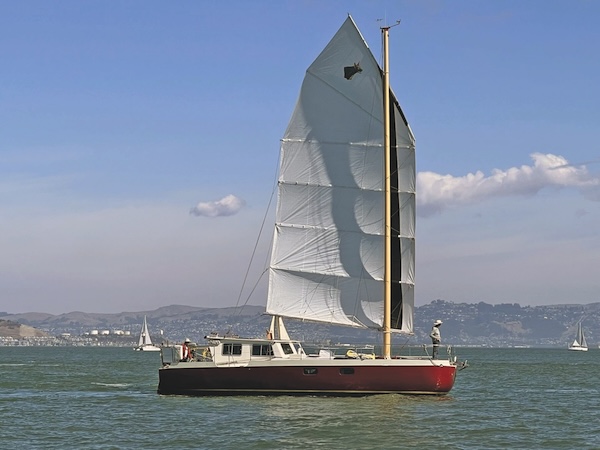
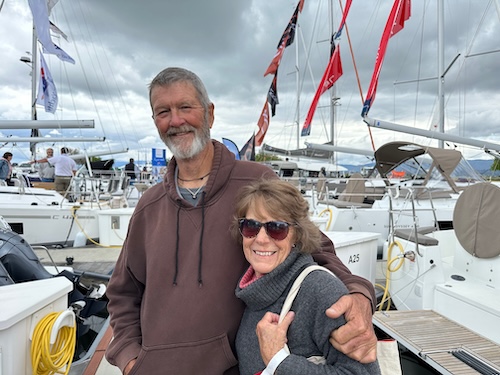
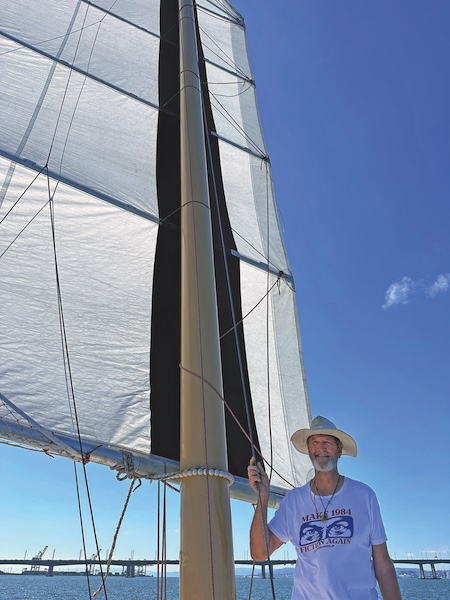
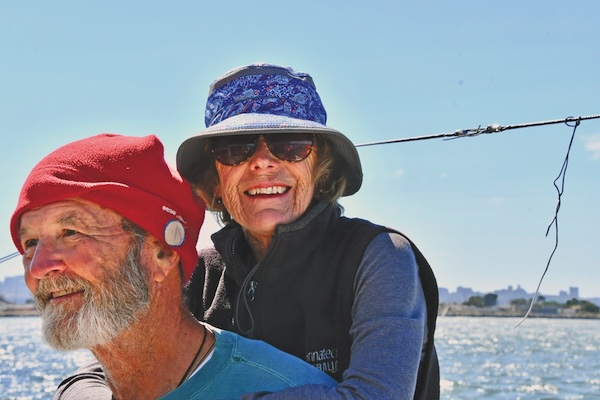
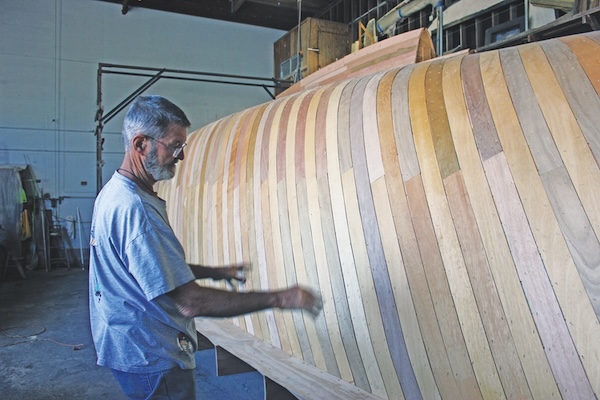
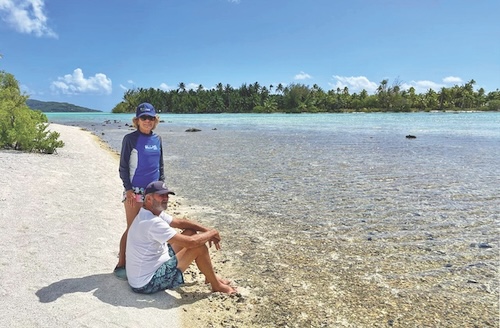
Welcome back to part two of our chat with Barry and Samantha Spanier. After impressive careers in sailmaking and advertising, they’re now living their dream on their custom-built scow bow junk rig boat Rosie G.
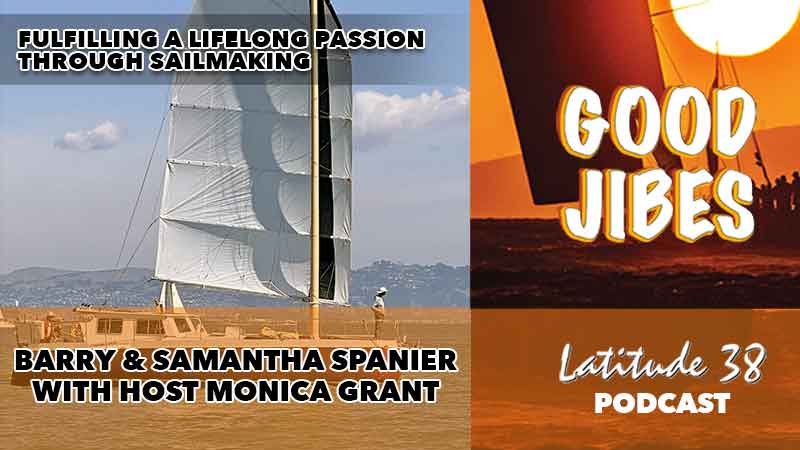
In this episode, hear Barry and Samantha’s ideas for recycling plastic and energy on the water, their “milk run” of smooth sailing, the fascinating people you become friends with around the world, what most cruisers get wrong about the sailing lifestyle, and why it’s not that hard to sail.
Here’s a sample of what you’ll hear in this episode:
- The Milk Run: San Francisco to French Polynesia
- The benefits of staying put vs. constant cruising
- Setting up Edward DeBair’s sail loft in Raiatea
- 15 months on a mooring in Apu Bay, Tahiti
- A service-focused sail loft in French Polynesia
Learn more at BarrySpanier.com.
Listen to the episode on Apple Podcasts, Spotify, and your other favorite podcast spots — follow and leave a 5-star review if you’re feeling the Good Jibes!
Check out the episode and show notes below for much more detail.
And if you missed Part 1, you can find it here.
Show Notes
- Part 2: Barry & Samantha Spanier on Fulfilling a Lifelong Passion Through Sailmaking, with Host Monica Grant
- [00:14] Welcome to Good Jibes with Latitude 38
- [01:01] Chinese Fishing Fleets and Ocean Conservation
- [03:33] The Baleen Project: Harvesting Ocean Plastics
- [09:43] Would Barry Build Another Boat?
- [12:15] How Rosie G Surfs and Sails
- [15:13] Four Years Living Aboard Since Launch
- [16:11] Join our crew list at Latitude38.com
- Adventures in the Pacific
- [16:40] The Milk Run: San Francisco to French Polynesia
- [19:18] Arriving in Australia and Dealing with Civilization
- [20:14] 15 Months on a Mooring in Apu Bay, Tahiti
- [22:56] Setting Up Edward DeBair’s Sail Loft in Raiatea
- [26:12] The Benefits of Staying Put vs. Constant Cruising
- [29:49] Commodore Tompkins: Sailing at 88 Years Old
- [33:10] A Service-Focused Sail Loft in French Polynesia
- [34:10] Are you thinking of sailing to Mexico or across the Pacific? Latitude 38 has a resource page called “Heading South” & the “First Timer’s Guide” to help you prepare
- Short Tacks
- [35:09] The Sailing Story That Shaped Barry’s Life
- [38:05] Favorite Boats and Sailing Grounds
- [42:20] Biggest Fears and Most Important Safety Equipment
- [44:43] Bernard Moitessier: Letters and Meeting an Idol, The Sea is Not Full by Charles J. Doane
- [47:34] Advice for Aspiring Sailors: Just Start
- Make sure to follow Good Jibes with Latitude 38 on your favorite podcast spot and leave us a 5-star review on Apple Podcasts
- Check out the February 2026 issue of Latitude 38 Sailing Magazine
- Theme Song: “Pineapple Dream” by Solxis
Transcript:
Please note: this transcript is not 100% accurate.
00:03
I saw pictures of him up his rig when he was 88. And I’m thinking, yeah!!
00:14
Welcome aboard for this week’s episode of Good Jibes, in which we head back down under to catch up with Bay Area sailors Barry and Samantha Spanier. This intrepid couple headed out the gate aboard the 42-foot scow bowed Rosie G. Their plan? To sail Rosie G the 8,000 or so miles from San Francisco Bay to Australia. Well, they made it and we are here to find out a little bit more about Rosie G and to learn what inspired Barry to design and build this boat.
00:44
We also dive into how his lifelong sailing journey developed from its beginning when he was 10 years old to a lifetime of sailmaking and cruising. So hop aboard, sit back, relax, and we hope you enjoy this week’s podcast.
01:01
Did you fish off your boats? you fish your Fished all the time. We fished off the rosy G, but we didn’t catch a lot. The fishing isn’t as good as it used to be. Well, that’s why you can hear all the big boats know, when we were crossing from Fiji to here.
01:19
We saw this AIS target kind of halfway between Fiji and…
01:27
And you know, there was a bunch of boats. So I started zooming in and zooming in and zooming in. I counted 94 Chinese fishing boats all together in this glob. They’re just taking everything. I saw something similar a couple of nights ago on the internet somewhere where there was a band, it literally an orange band and it was just boats, just Chinese fishing boats.
01:55
And it’s terrible. mean, it’s I believe that the reason why you don’t catch a lot of fish is because now there aren’t a lot of fish. They’ve been taken. And it isn’t just the South Pacific, it’s the Eastern Pacific.
02:15
It’s all over. They’re just coming with these giant fleets and they have factory ships right there and they just… Everything’s processed at sea. Scour and process and… Yeah, and we have that same issue here. It gets talked about a lot with the boats just literally grazing the ocean floor as well. Just taking everything. That’s why they have the trawl bands to stop the… It doesn’t always work though, does it?
02:44
I recently found out that the trawl bands actually made the shrimping worse because with the trawlers kind of tearing up the bottom a little bit, actually kept the whole shrimp population growing. you know, the shrimpers, they knew, but people in the government, they’ve got their own agenda, so they stopped all the…
03:10
Shrimping also hurt the shrimp harvest. Lately there’s been no scallops for four years. have been no scallops. you know, we can’t, we have to decide what we want. Well, that I guess brings me to, I guess environmentally another aspect, uh baleen.
03:33
There’s a boat that I see associated with your name is a double hull, like a plastic harvesting boat. Well, that’s something where. I see. I read about, we wrote about it in latitude in 2019. Yeah, exactly. And then I saw that you had written a letter to president-elect Donald Trump in 2016. And he wrote back and we went, not him personally, obviously, but.
04:01
his office. I have three replies. Okay. But he wrote to, that was 2016, but a couple of years before that when he did come up with Beilin. I wrote to Obama and got nothing. Obama and Pelosi and the two My mother’s representative and father’s was Pelosi. Hawaii and heard nothing from anybody. he came up with the idea of Beilin. You were in…
04:32
Cornelia, you were sitting there in one night. Yeah, I was sitting on the boat, Cornelia, and I’d been working on something and I just started thinking and drawing and then I rode home and I got my scale ruler and some other stuff and went back to the boat and I drew all these pictures and then I wrote this entire thing just like it just was pouring out of me.
05:00
And then I went back and then me and Samantha put together the stuff on the website and did a lot of research about how much plastic was there. And then all this other stuff came along as we researched. And you can turn plastic into diesel oil. You can incinerate plastic and make electricity almost directly with gasification. So I’m, well, if you build a platform big enough,
05:28
And you just go out and harvest all this plastic and then you process it on the boat, turn it into waste heat and electricity and diesel fuel right on board. So it never goes back onto land ever again. the waste product from the gasification is activated charcoal, which is a pretty useful thing, you know? And when it comes to the diesel process, it’s the same thing. There is no waste. It just directly turns the plastic into
05:57
diesel. And that’s going on around the United States in six different locations right now. There’s a company founded by oh a wonderful woman. I think she has a PhD in chemical engineering or something. She developed this whole thing. So the idea with Baleen would be that that process would power that vessel. Yeah. Not create more…
06:25
You could take that vessel back to shore and Well, more than power the vessel. Right, yeah. I mean, the vessel could be built so specifically that it never has to go more than two knots. You just take this thing, you build it. I even have a friend in the business who says, I’ll build you that in Mexico for $10 million. So that wasn’t what I wanted. I wanted it to be American built.
06:54
be financed by big corporations for pollute, right? Dow chemical or whatever. You call it the SS Dow something or other or whatever, know, give them the credit. They put the money out, build the thing, go out there and harvest the plastic. And then when we figured out that there was trillions of dollars worth of plastic out there, then that turns it into a whole different game. you have individuals could build their own little harvesting things and
07:23
It’d be water world out there, there’s no law, International law, but you know, you’re basically- a goldmine. It would be a goldmine, exactly. So it sounded good. I wrote a lot of letters, but then I got involved in all the other stuff we were doing and you know, you need momentum to keep stuff like that going. Oh, for sure. Is it something you think you’ll come back to?
07:47
I mean, I even wrote Mary Crowley and tried to get her interested, know, and said, Mary, you know, you shouldn’t be hauling this stuff back to California and turning it into park benches. That’s just more plastic. Let’s get rid of it once and for all, you know. And I’ve known her since she was like 20 years old. you know, she was part of the whole Pete Sutter, Jim Leach crew over there.
08:17
ocean voyages and all that. Anyway, I just lost the direction. And then we made the website. We tried to refer people to the website. And you know, there actually are some baleens right now. One of them originated in France and another one originated in Holland. And they basically have, that’s all that’s saying.
08:45
The Holland one, is that the fellow? Boron Slute, I think is his name. I don’t know how to say it. But yeah, it’s his… Well, it’s the whole thing of the ocean. His business, yeah. He picks up plastics and I think he works for the Bay I he’s doing it exactly the same way, but essentially it’s an easy thing. I mean, my friend John’s wanted, she says, oh yeah, I’ve got the right kind of…
09:13
stainless steel conveyor belts. We could have sorting things, because that’s what we do in fishing all the time. I could sort all this stuff and then you could micronize the plastic and gasify it or you could put it in that, he said, no problem, the whole thing’s easy. And as long as the boat doesn’t need to go 25 knots or something, you you just get it out there and then run it along a GPS grid and just harvest and harvest and.
09:43
and consume and use to fuel the craft. I figure if you did that on a bigger scale, you put five or eight or 10 of those things out there, you’d have them of cleaned up in 20 or 30 years. Sounds like a very good idea. Meanwhile, I’m working on my own thing. Another scale? Well, I’ve drawn pictures and I sent them to Jim.
10:12
He thought, oh, those are good ideas, you know, so. But you’re not going to tell Samantha because she says no, not another one. No, it’s, no, it’s if he wants to do it, then why? We’re not doing it the way we did. Right, yeah. I mean, also doing something the first time and then doing another version of you already have done a good part of the groundwork. It’s a completely different thing. I mean, first of all, you’d go, you’d find out. We even contemplated making a business out of
10:40
That’s where Red Dog Yachts came from. Red Dog Yachts was gonna make a, we thought, well, this 42 footer’s way too big for two people, totally unnecessary. So you could make a 36 that would be like a 42. You can make a 32 that would be like a 38. And so you could build three different size ones and have a little company. And that takes somebody with a financial mind and somebody who’s 40 years old.
11:11
Because, you know, when you get to be 75, things look different. When you get closer to 80, they look different. So, you know, would I do it again? Yeah, it would be really fun. I wouldn’t give up the boat we have now. Yeah, but I mean, you might find somebody who is 40 years old and does have that.
11:35
enthusiasm and interest and the money and you can work with them as more of an advisor, mentor, associate. and you know, you bring Jim in and everybody sits around and what about this and what about that. I bet you’d come up with something that would be cool. Right. I mean, even to the point of having dynamic stabilizers out there. Like, you know, there’s boats all over now that have these foil things. If our boat had these foil things and they were retrievable.
12:05
came up.
12:08
the sails all up above him and everything. would be…
12:15
This boat surfs like magic. And you’d be standing up on the bow and look at this boiling froth, a wave, and then it just disappears. And the next thing you know, you’re just running on clean water and the wave is six feet back from the That’s such a nice feeling because you’re almost like cruising over a mirror. And there’s no quarter wave. There’s no quarter wave. You look and there’s nothing. You look out the stern, it’s just flat, this trail of bubbles.
12:45
And you know, Jim sailed with us for three days and he was pretty impressed. And, you know, here’s something I designed and it works. And look at how it works. Really cool. Well, once we got to where we were really sailing the boat, you know, you could be going 10 or 11 knots, dead down wind with the wind vane driving like hardly varying off the course.
13:14
and looking at this wake for hour after hour for days. Well, that doesn’t happen all the time, but while you’re on a passage in the trade winds, you’re gonna get circumstances like that. Like when we went from Tahiti to Fiji, we had two and a half days where we were doing nine, 10, 11 continuously. That was when we had our 188 miles.
13:44
And if it had been blowing harder, we would have had 200 miles easy. It just wasn’t blowing hard enough. If it was blowing 18, we were doing nine. If it blowing 20, we were doing 10. The other thing about the Rosie G and that type of boat with that sail is if there was no wind, she would sail. And there were times when the wind said that it was four and a half knots and we were doing four and three knots.
14:14
Or it would say 2.7 on the true wind, and we were doing 2.5. So the wind vane wouldn’t work, right? Because there’s no apparent wind. So we had an autopilot, lucky. So the autopilot drove the boat, but we were just ghosting along. mean, literally just going as fast as the wind. And then when it would get up to six or eight knots, pretty soon you would be going. m
14:43
for, you know, and the wind vane was almost working. But by the time it’s blowing 10, 12, then you’re doing five or six. And it was consistent, dead downwind. And when you’re reaching and stuff, was like broad reaching to beam reaching. It was pretty much the same. The motion wasn’t as nice when you were beam reaching just because you’re beamed to the swell.
15:13
but dead downwind, was, you might as well have been on a caravan. It’s what it felt like. When I arrived, you mentioned that this is the first time you’ve been on or off the boat in, I forget what you said, how long was Since we launched it. February 2022. February 2022, so you’ve been on the go, on the boat, since February 2022, which is exactly, what, four years now? Yeah.
15:41
So four years on the boat, now you’re on land. Are you missing the boat? Yeah. Absolutely. Yeah. Hey, good Jibes listeners. Are you looking to sail more? It’s the biggest mismatch on the California coast. There are thousands of boats not sailing because they need crew and thousands more sailors or soon to be sailors who want to sail but can’t find a boat. For over 45 years, Latitude 38 has been connecting boat owners with sailors to sail, or race the bay, or travel far over the horizon.
16:11
Some connections have turned into thousands of blue water cruising miles or race winning crews or long term relationships or just happy days of sailing. If you have a boat or want to crew, add your name to the Latitude 38 crew list at latitude38.com. You don’t know where such a simple act will take you. John calls your South Pacific run the milk run. So that’s what I would call it too. Yeah. Except for all the spilled milk.
16:40
Really? Well, the trip from California is, you know, it’s different because you’re leaving California and you’re trying to make it basically towards the Marquesas. That’s a lot of close reaching. Right. And when you get into the equator, you know, that intertropical conversion zone, it’s just crazy. mean, there’s squalls and call.
17:09
There, you know, we, since we didn’t have power, we just sat there and drifted around in circles. I mean, if you look at our track, it looks like, uh it’s just like this. We were just, we just took the sail down for a long period and sat there in dead calm. But, you know, what else would we do? There was no wind for 50 or 60 miles. You’re just sitting and waiting. So we used the opportunity to rest and.
17:42
tinker around the boat. But the rest of it, you know, it was the Southeast trades and it’s the same thing. You’re still kind of reaching, you you’re not really running. It wasn’t until we left Tahiti.
17:58
That was some beautiful, beautiful downwind sailing. mean, just the choicest days of sparkling blue and nice breeze and warm and stars and everything you dream about. uh Where do you think you’ll go next?
18:22
We want to sail up and down the coast. I imagine you’ll be heading south for a while before you go north because we’re still on the tail end of the cyclone season. Well, we have a slip, so we’re okay. We’re going to be fine until the weather changes. Quite frankly, having lived in Australia for 30 years in Melbourne and traveled a lot. Right.
18:48
I have no desire to be in the water outside of Melbourne, Sydney, Gold Coast. Surfers don’t need to go there. To what? Just dole? Boring? Oh no, to sail, to be on our boat in that quagmire of other boats. Oh, I see. The traffic and the population. Well, no, but the shipping channel. Everything down there. Like when we entered Australia.
19:18
you’re coming along and all of sudden you have this AIS thing that looks like a superhighway, tankers. Well you probably watched them going past that. We’re getting there, okay, well we better, we want to hit that in the daylight, you know, because at least we can see what’s out there and what’s coming. It’s phenomenal, you know, when you look at the target names and stuff, boy they’re going to here and here and Singapore and this that’s great.
19:46
But we have friends that, know, we’re gonna go to Sydney for the fireworks, or we’re gonna go, you know, okay. This is a lot of civilization for us. Right. I mean, we smell it and we hear it continuously. wake up in the morning and the traffic roar is always happening. And you we lived in Apu Bay in Tahoe.
20:14
old friend of mine has a house on the beach there and he said, oh, come down. Now this is the same guy that owned Trilogy Excursions and I worked with him and ran a sale off for them for eight or nine years. He said, oh, come on down. You know, I knew this guy from the seventies and I got this house and you can.
20:36
You know, it’s gonna dock out in front water and there’s a freezer and there’s wifi and there’s a shower and you can have it all because we’re not there. Okay. So we just checked in. We sailed straight to Raiatea, checked in in Uttara which is the legal place and just immediately went over to Apu Bay and this other old friend lives right in the same little area.
21:04
So, take that mooring out there, you know, that’s my mooring. And we made an arrangement with him and gave him some money so it helped him out because he needed financial help. And we never dropped that mooring for 15 months. We just hung on that mooring. And you know, it was a place where you can’t anchor. So having a mooring there was like gold. And we watched hundreds of boats coming.
21:34
going, was like a parade of visitors and friends. And Ben Shaw came through there. And what’s her name? Heather. Heather came through with her little yellow boat and a bunch of other ones that, you know, from the Bay area, just visiting. But they could only stay for a day or two because the moorings weren’t available except for 24 to 48 hours. So here we were, we had this.
22:03
It was built for a Katana 55. Somebody put some big money down and made this beautiful mooring and then he just disappeared and left the mooring with my friend. So it was perfect. you’d wake up in the morning and it would be silent.
22:25
roosters and the dogs and the kids and there was no cars and no traffic and I mean you go walk on the road and knock it over no automobiles at all and maybe occasionally a scooter would go by and so the other benefit from that place was my same friend from Trilogy, Randy Kuhn, he says oh I got this friend down here his name’s Edward DeBair uh
22:56
And he’s just built this sail off that’s amazing. But he doesn’t have anything in it or m have a sail maker. And he said, I’ll just hook you guys up. And so while we were still at sea, we sent an email and as soon as we got within telephone range, we were talking and we picked up the mooring and the next day I walked down to his place and he’s about.
23:25
43 years old, and, hey, where’s Edward DeBerra? And this guy says, oh, he’s over there. And he’s down on his hands and knees with his elbows up in some muddy hole, all dirty and sweaty, and comes over and hi, how are you? And that was it. That’s my kind of guy, you know? Because, you know, he’s probably a billionaire.
23:52
Maybe not personally, but his family owns Stella Artois. He says, oh yeah, my family’s been in the same business for 900 years. So. That’s some serious family history. Yeah, so he built this sail loft and this place is like a cathedral of sail making. It’s all bare wood, beautiful.
24:20
kind of open ceiling with dormer windows with huge ventilation, big opening doors. But he had nothing in it. Right. It was empty. So we pulled our sewing machine off the boat and Barry set it up. And then Barry organized for him to get a couple more sewing machines.
24:43
and ordered materials and basically set up the sail off. I introduced him to all my old contacts in the sail making And then trained a couple of people before we left. That’s awesome. So now there’s a fully operating, good service super yacht sales. Did you get your machine back or you left it with him? No. I our sewing machine. But he got a new one like mine and then we bought him a custom.
25:12
super heavy duty machine from a guy I know in Melbourne, Australia. And it’s like a 800 pound sewing machine for sewing giant heavy work. Cordes is the name of the sewing machine. uh And, oh you know, so we became friends with these people uh the best way and they had amazing music, wonderful people working with them.
25:42
all these Tahitian families there, you know, not just some guy working for you, but you know, on Friday afternoon, the wife and the kids show up and the guitars and the ukuleles come out and the drums and everybody’s singing and playing music. And it was the best, you know, we talked about it like, well, geez, we should go other places. Well, what for? Yeah. Will you go back? Do you think? No, yeah. In a minute.
26:12
And you you could go all over French Polynesia and have a great time. It’s just beautiful. I mean, I’ve been to the Tuamotus and all the islands. You know, it’s French Polynesia. But what cruisers do is they go, I go in here. Oh, I’ve seen that. Oh, now we’re going here. Oh, I’ve seen that. Oh, let’s go here. Do they meet the people? Do they?
26:40
They take happy snaps and record it. And that’s it. Yeah. And so for me, at the age we were, I think getting involved in this community and meeting the mayor and going to the kids’ school and knowing a number of… So when you went walking down the road, everybody’s, hey, you know what I’m
27:11
saying they want to stop and talk story. We were trying to learn the language and going back and forth to shop at this other island and having the whole adventure of living there, not just hit and miss. Visiting, dropping in. People go, oh, I went here and I went there. I was, so what? Do you know the name of a single person or the place that you went and got? That’s what I found living in Australia.
27:39
and you’d get Americans mainly would come over and they would do Australia in one week and then go to New Zealand for a week. And I’d say, well, what did you see? Oh, well, I saw Melbourne, Sydney, Brisbane and Perth. I no, you didn’t. So Sydney Harbor Bridge. Yeah, yeah. No, no, I do understand. It’s definitely a different approach to travel when you’re cruising if you can stop and stay in one place for a period of time. mean, even a couple of weeks.
28:09
But you know, when you come to French Polynesia, you have 90 days. And if you enter in the Marquesas and you spend a couple of weeks there, and then you go into the Tuamotus and you go to six different islands and you spend four or five days in each one, that’s even outside generally. Before you know it, you’re down in Tahiti and you’re shopping at the Carrefour in Papua Ate to fill your garter up. And then you head off to Morea and then you go here.
28:38
go there before you know it, your 90 days is done. And then it’s time to move on. And what’s the next place? Well, you go to the Cook Islands. How long can you stay there? Maybe a couple of months. And then you go to, to, off on the way, maybe, or whatever. you’re only, you’re just, and then when we got to Fiji, you could see, well, this is like the end of the line. There were boats in the marina. That was it. They were getting sold.
29:07
or a delivery crew was coming to take them somewhere where the people didn’t, because that’s it. Once you go to Australia, you’re definitely at the end unless you’re gonna go.
29:20
continuing on around the world. And by the the political situation in the world right now, I wouldn’t leave here. Boy, you mentioned you’re going to travel up the coast a little bit after that. Where will you go? Back to Tahiti. Well, traveling up the coast could take a long time. Oh, absolutely. could. mean, long? Commodore Tompkins is my idol, right?
29:49
Ever since I was, you know, he’s 93 now, I’m 79. So he’s a lot older than me. So when I was a fiending racer with Louie Nady and Tom Wiley and all those guys, you know, we were in our early 20s. But the Commodore, he was God. If Commodore said, don’t do this, you didn’t do that. If he said, do this, you did that.
30:19
And it was like, okay, so you got Dave Walley, Tom Wiley, Commodore. They were all a crew together. They all sailed together. They built fantastic boats and they were winning races. And here’s this guy. He doesn’t even start building his boat until he’s 74. Wow. And then, you know, he gets it finished. Five years took him to organize it, I think.
30:49
And then he takes off and he’s sailing another four or five years. And I saw pictures of him up his rig when he was 88. And I’m thinking, yeah. So yeah, you can do it. Right. If you have a boat, that’s good for being older and it doesn’t take a lot of on deck management and stuff. I think you can do it for a long time, but eventually.
31:19
Even just moving around in a boat when you’re at sea as you get older is challenging. So our boat’s pretty good, but you it’s still, you better hang on. always. Yeah. You better have something to grab all the time and do it consciously or else you could be splattered here or bashed up or bruised or.
31:45
And can happen at any age. exactly. And so when you get older and your balance maybe isn’t so good, it gets harder to imagine sailing. Like if we went back to to Taha, we would have places to stay. Right. We could fly. It would be fine. The sail off. I talked to the guy about a week ago and he said,
32:13
They were having some issues still with getting all the final permissions from the government to be able to really operate. And as soon as it is good, I’m going to promote it. Because anybody cruising in French Polynesia would want to go there to get their sales fixed because he’s got super equipment. Yeah. The situation, you know, like you could pull in, take a mooring, put your sail ashore.
32:41
circumnavigate Taha for a week or 10 days, back and your sail would be done. And this is a cool thing because there’s no alternative. um you know, the loft on the Ryotea is totally overwhelmed with charterboat stuff all the time. And you go in there and try to get something done. It’s going to take a month and Tahiti’s the same way. So having this alternative place in Taha was a
33:11
Brilliant. You know, the guy’s a sailor. owns a Katana 50 and sailed from Europe. He’s a… uh Someone who understands. He totally understands. Yeah. He just said, I want to create a place where service is the key and somebody can sail in on their 80 footer with crew or not even be aboard. The crew’s just coming in and they can have help bringing whatever it is ashore. And he has a lift that…
33:40
pulls the stuff up into the loft. And we already did a bunch of big work on his boat. And the people that work there, they know what they’re doing now. Yeah. So that’s the way to go. Latitude 38 here. Are you thinking of sailing to Mexico or all the way across the Pacific or maybe even further? We just heard from Joanna and Cliff saying, my husband and I subscribe to Latitude 38 and enjoy the Good Jibes podcast regularly.
34:10
They went on to say they’re headed to Mexico in the fall and will continue across the Pacific to Australia. However, they’re looking to simplify all the choices they need to make to prepare. Of course, there’s tons of resources out there, but Latitude 38 does have a page in our website called Heading South. And we also have Latitude 38’s First Timers Guide to Mexico available to read online on the Heading South page or a printed copy that is available to purchase in our online store. There’s a lot to know.
34:40
but Latitude38.com is a good place to start. I would like to just ask a couple of questions. One is if we could just have a little idea of what would you think would be one sailing story that shaped your life, your sailing life? My mother had a sorority sister in 1956. I was 10 years old.
35:09
And she, her husband and she sailed a cholly lion named Simba on San Francisco Bay and they raced this boat. And this woman said to my mom, hey, would your husband and son like to come sailing with us? Oh, I didn’t know anything about sailing. was the farthest thing from my mind. And so me and my dad went out on this boat and
35:38
was typical San Francisco Bay, know, 20 knots, ebb tide, big chop, lots of water on the deck and everything and the boats heeling over and you know, it’s all this bustle of racing and, and my dad just hated it. I couldn’t wait. Right. That was it. You hooked. It happens like that. That was it. so.
36:08
This woman was so kind and so good. husband was Dr. Glenn Cross. He was the head resident at UCSF. was a neurosurgeon. And so he’s busy a lot. So she managed and raced the boat. And she would come and pick me up on race days, which were common all during the summer, you know, the whole YRA schedule and everything. And, eventually she got me C boots and, you know,
36:38
My parents were really financially nowhere compared to these people. So she made sure that I was good and we hung out at the San Francisco Yacht Club in Tiburon. you know, whoa. Then, you know, one afternoon sitting on the deck, Larry Grinnell was his name and he had a boat called the Red Witch. I don’t know what the design was, but.
37:06
He said, oh, I got this El Toro, La Brujita, I call it. And I said, oh, yeah. And so Eleanor says, well, would you sell it to Barry? has some dollars saved from working in the summer. And he said, oh, sure, that sounds really good. And so that was it. So I ended up going and getting my El Toro and started sailing on Lake Merced. And just sailed and sailed and sailed.
37:35
It’s been your entire life now. That’s it. just couldn’t wait. More is better, you know? Yeah. I raced every kind of boat I could get on. And that hasn’t dulled at all for you in all these years? No. Silly question. All right. Let’s get some short, quick answers here. I’m going to ask you a series of questions, are questions that we like to ask people. It’s just really a fun thing. If you had a favorite sailboat, make and model, what
38:05
- Yeah, I’d say that right now it’d have to be our own one. That’s Because you’re not going to get one of those anywhere else. Okay. And I mean, there are other boats I’ve sailed on. Yeah.
38:24
You know, they’re just sailboats. Well, to give you an example, and I don’t know if it’s appropriate to mention her name, but the marine surveyor that surveyed our boat, she watched it being built the whole time. Right. She sailed with us from Fiji to here. Okay. Francois Ramsey. Oh, that’s Francois. Yeah. And she said when she got finished, she said, and she has sailed on many boats, single-handed as well as crew, on the Pacific and the Atlantic. She said it is by far.
38:54
the best boat she has ever sailed on. Interesting. oh That’s good. She would be one for you to go. I’d have to do it by phone, but do a podcast with. Yeah, I mean, two single-handed crossings of the Atlantic and thousands of miles of deliveries. A lot of different trimerands, catarans, motorhalls. Okay. Well, it’s a good… It’s good. Okay. Racer or cruiser?
39:25
You’ve done both? Yeah, I’ve done both. Which would you say is your preference? Currently you’re obviously a cruiser. I was done with racing when I was 25. Oh, okay. That was it. You were off to cruising. I never did it ever again. I raced in the 505 Worlds with Hank Jotz. And you know, you’re a sailmaker for dinghies and you’re out there racing in the fleets with the people. And we got to the point where it was like…
39:52
we would finish a race and pack up and leave because you just didn’t want to get into the bar jargon and all the rest. And then a couple of races out on the bay where you’re eating wet cold sandwiches and sitting on the rail. And I was just done. I had no interest in it at all. I can actually relate to that. And I never ever, I’ve never been involved with any kind of sailboat racing since then. Longest voyage.
40:24
3,300 miles. Where That’s from Acapulco to Maui. Okay. When? 1976. And that was on Seminole? On Seminole. Right. Your favorite sailing grounds? Sounds like it’s the Tahiti area. I would say the entire South Pacific. Right. And that would it, I’ve never been into…
40:50
the northern part of the South Pacific, but there’s a lot of killer cool islands up there. And if I was younger, I would just go to Micronesia, the Marshalls and Carolines and all of that. I would just be exploring one tiny island after another. I wouldn’t even bother going farther south for a while. I’d just go straight into those areas because those areas are
41:21
You know, I saw something the other day where the woman said that there were the first boat in there in two years. Some really beautiful place. And you think, well, that’s the kind of place you want to go because it’s not, you know, like when you go to French Polynesia, now there are so many rules and costs, you know, if you anchor in Bora Bora, you have to, a guy comes and collects money. You know, there’s no more of this kind of how it was. That’s gone.
41:51
And I’m sure it’s much the same in lot of the Cook Islands and other places too. There’s restrictions and this and there’s no more of this kind of freedom of movement. So I’m sure when you’re up in northern South Pacific, that it would be really like the old days. your food might not be as good. You might be challenged to. oh
42:20
You know, navigate in some places. You know, planning your voyage around the weather might be a little more challenging, but you would be rewarded. It’d still be a good life. Yeah. right. Biggest fear on the water? Running into something, like a container or something in the water where you don’t know, you know, hitting a big log or… Right. Then your boat might be sinking. That’s a fear. That’s fair. You know, I don’t…
42:48
I’ve never sailed anywhere where I would fear things like piracy or that kind of thing. So besides a life jacket, what would you consider to be your most important part of safety equipment? Even Creep Artigy says, you know, I’ve never sailed on a sailboat where I felt so safe and comfortable on deck because we have 36 inch lifelines with hard rails. It’s like you’re really
43:17
in the boat. And no rigging on the deck. Right. There’s nothing to on. Yeah, nothing to fall The deck’s completely clear. You can walk all the way up onto the bow and sit down and dangle your feet over the bow. It doesn’t feel unsafe. And walking back alongside the doghouse, you only have a you know, have a handrail and a handrail. I can’t imagine how you could fall overboard. yes, I suppose it’s possible, but it’s not like having
43:46
28 inch lifelines that can kick you over by the knees. We have a six passenger life raft. That’s the thing you have on board you never want to use. I’d say the best safety gear right now is uh a functioning chart plotter and a GPS. Because that’s more important than anything is knowing where you are.
44:14
You know, I wrecked my boat because I didn’t know where I was. And if I knew where I was, if I had a chart plotter, I never would have wrecked my Never, ever, no way. So. Do you read sailing books? Favorite sailing book that you think everybody should read? oh I don’t particularly read them. Anything by Bernard Mortessey. I hear you met him. Is that correct? Yeah, spent a lot of time.
44:43
He built a sail for him. I built a sail for the Joshua. He’s a character. was like a dream to meet him. I read Charles Joanne’s book. Yeah, that was pretty good. What was the name of that book? Can’t tell you. The Sea Isn’t Full.
45:08
He’s the editor of Sale Magazine. It’s a pretty good book. And it turned out he also worked and sailed on the Constellation, which was even more fun. uh Charles Doan, right? D-O-A-N. But all the ones that inspired me, I I read a lot of them. I read them all, but Bernard’s the one. Because Bernard sailed with a philosophy.
45:38
His outlook on everything was cosmic. He corresponded with them. Yeah. mean, when I was building my boat, I wrote him letters off to places. You know, he was in Tahiti by that time and he had finished the time and a half around the world and he was in Tahiti. And so I knew I could just send this letter to Wapostal.
46:07
Papa E.P. And eventually it would get to him, right? So I’d send a letter and in two or three months I’d get a beautiful reply. written two or three pages, answered all my questions. And that went on for years. And so here’s this guy, he’s like famous whatever, but he was normal person.
46:37
that he was happy to communicate. And that was incredible. So then, you know, to sail into to Aje and anchor in front of his little uh hooch there that he was living in and have him paddle out in his inner tube and sit there and eat oranges from the big island and talk story with this idol. That was, that was it. know, it was.
47:07
And then to be able to stay in touch and hang out. We lived there, you know, and hung out at his place and helped him with his garden. It was like a dream. Nice. One last question. How would you encourage somebody who’s not a sailor but has a vague idea that they’d like to go and do it? What would you say? Depends on finance. You tell them that?
47:34
I would, because if you had sufficient funds, I’d say go charter a boat in a good place and experience what you’re dreaming about for a week or two. And then if you still like it, then just start reading and paying attention and maybe get a little boat. Like uh the guy that started sailing Delos, right, SV Delos, he was, hey, I…
48:03
this is curious, I’m gonna go buy a little boat, learn how to sail on Lake Union. So he got a little boat, 24 feet or something, and taught himself how to sail. It’s not hard to learn how to sail. I I learned how to sail on my own when I was 11 years old. So you get in the boat and you pull the string and you steer the thing and that’s about it. There I go, I pull in, I go, I let out, I don’t go. Oh, I have to go the other direction.
48:33
Oh, this is how you do it. It’s dead nuts simple and people have been doing it for 5,000 years and it’s just not that big a deal. The big deal is will you really like it and how you find out if you really like it. Well, if maybe you can’t afford to go charter, get yourself on the crew list at Lad 238. Get on board a boat in the bay and help somebody sail there with.
49:02
It’s available, you know, you want to do it, you just have to focus and do it. Sounds good. All right. Barry and Samantha, thank you very much. Appreciate your time. Lovely stories and nice to meet you both. We hope you enjoyed today’s episode and thank you for listening. Without you, there would be no Good Jibes podcast. If you enjoyed this conversation, please subscribe to the podcast to be notified of each new episode.
49:30
Oh, and tell all your friends so they too can feel the Good Jibes!