

Episode #224: Eric Jones on America’s Tall Ship Eagle & Cal Poly Maritime, with Host John Arndt
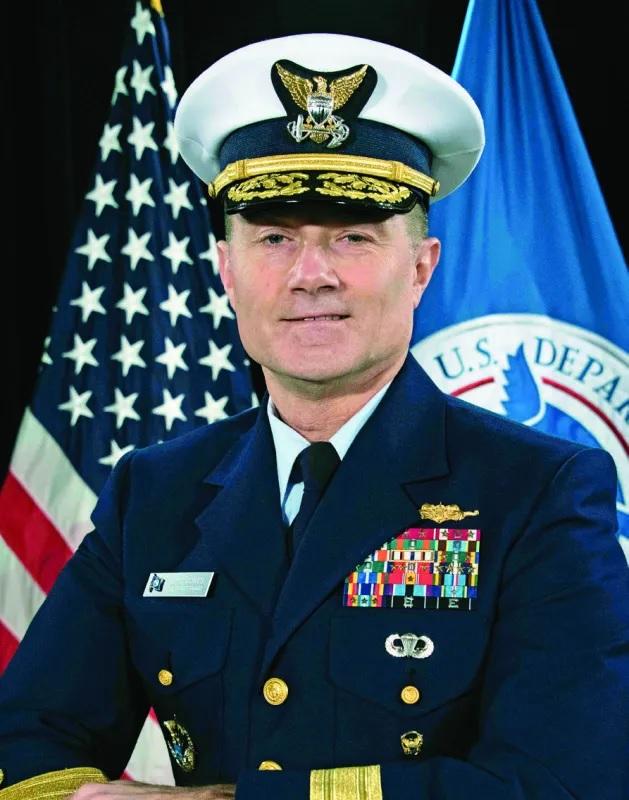
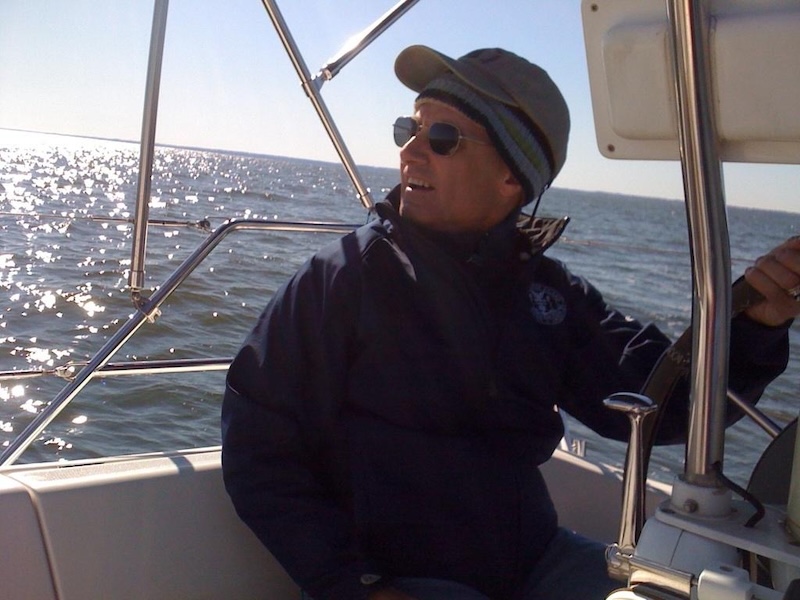
Welcome to Good Jibes where we chat with the West Coast sailing community to hear their stories and tips on cruising, racing and just plain sailing. This week we chat with 36-year U.S. Coast Guard veteran and Cal Poly Maritime Academy Superintendent Eric Jones.
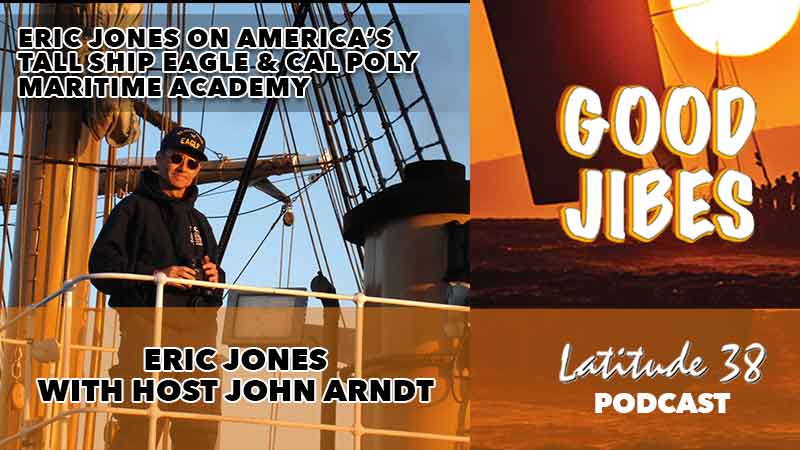
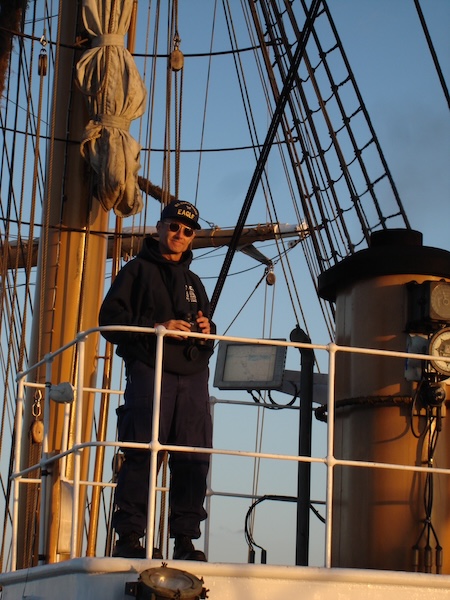
Eric has commanded three US Coast Guard cutters, including the three-masted training barque, USCGC Eagle. Hear the behind the scenes of commanding Eagle, what it’s like in the tall ship fraternity, crazy stories from sailing Eagle in storms, how Cal Poly Maritime Academy is combatting seablindness, and the value of a maritime degree today and in the future.
Here’s a sample of what you’ll hear in this episode:
- From Kansas deckhand to 35-year-old freshman
- Coast Guard Academy recruitment
- Teaching celestial navigation in the GPS era
- The tall ship community and sister ships across continents
- Working fishing boats at Pillar Point Harbor
Learn more at Maritime.CalPoly.Edu
Listen to the episode on Apple Podcasts, Spotify, and your other favorite podcast spots — follow and leave a 5-star review if you’re feeling the Good Jibes!
Check out the episode and show notes below for much more detail.

Show Notes:
- Eric Jones on America’s Tall Ship Eagle & Cal Poly Maritime Academy, with Host John Arndt
- [0:02] Welcome to Good Jibes with Latitude 38
- [0:36] Meet Eric Jones – Superintendent of Cal Poly Maritime
- [1:01] From Coast Guard Academy to commanding America’s tall ship Eagle
- [1:56] Working fishing boats at Pillar Point Harbor
- [3:52] Transition from fishing to Coast Guard career
- [6:05] Learning to sail: Coast Guard Academy sailing team and J-24 racing
- [8:00] Life aboard the Eagle – navigating and commanding
- [10:24] Training cadets on America’s tall ship
- [14:10] The Eagle can reach 16-18 knots under sail
- [16:00] The tall ship community and sister ships across continents
- [18:51] Racing the sister ships – Sailforth 250 planned for 2025
- [20:11] Crossing the Atlantic: Nine transatlantic passages on Eagle
- [22:06] Teaching celestial navigation in the GPS era
- [24:40] If you’d like to be a sponsor of future podcasts, email [email protected]
- [24:49] Worst weather: The 1984 knockdown during Bermuda-Halifax race
- [26:09] 52-degree heel — when Eagle laid on her side
- [28:00] Coast Guard Academy recruitment and cadet backgrounds
- [29:29] Combating “sea blindness” – Cal Poly Maritime’s enrollment challenge
- [31:18] Cal Maritime merges with Cal Poly as of July 2024
- [33:43] Career paths: From Kansas deckhand to 35-year-old freshman
- [35:05] Six state maritime academies across the United States
- [37:00] Training ship Golden Bear — 308 cadets per voyage
- [38:54] Maritime careers in an AI-driven world
- [40:44] Check out our classy classifieds at Latitude38.com
- [41:29] The Keel Haulers – Cal Poly Maritime’s varsity sailing team
- [43:24] Balancing Coast Guard licensing requirements with academics
- [45:19] Why choose Cal Poly Maritime? Leadership and global opportunities
- [48:12] New training ship and partnership with UC Berkeley sailing
- Short Tacks
- [50:59] Dream boats and races — Tartan 4400 and TransPac
- [51:28] The Three Bridge Fiasco — a jigsaw puzzle afloat
- [52:27] Favorite tall ships: Europa and Picton Castle
- [53:26] The captivation of sailing – finding the slot and perfect trim
- [55:22] Recommended reading: Joseph Conrad’s “Youth“
- Make sure to follow Good Jibes with Latitude 38 on your favorite podcast spot and leave us a 5-star review on Apple Podcasts
- Check out the December 2025 issue of Latitude 38 Sailing Magazine
- Theme Song: “Pineapple Dream” by Solxis
Transcript:
00:02
That was pretty frightening. Eagle healed over about 52 degrees.
00:14
Well, hi everyone. It’s time to cast off, loosen the dock lines again, and we will uh laugh, learn, and have a little more fun sailing. My name is John Arnt, I’m the publisher of Latitude 38 Magazine and the host of today’s episode of Good Jibes. It’s a podcast to help you discover the world of sailing through the eyes of the West Coast sailor.
00:36
Today we have a new guest, a new arrival, I’m learn more, Cal Poly Maritime Superintendent, Jones. Welcome aboard, Eric. Thanks so much, John. Happy to be aboard. Great to have you here and great to have recently crossed paths with you. A little bit of what I know about Eric, he is a former Coast Guard commander of America’s tall ship, the Eagle, which just cruised our coast this last summer, which was terrific.
01:01
He is a graduate of the Coast Guard Academy and also holds a master’s degree from MIT. And while at the Coast Guard Academy, he was a coach for Alameda Sailor and a former Good Jives guest, Krisha Pohl, who was on with Mo Roddy a while ago. And then after 35 years at the Coast Guard, he’s now in academia and serving as superintendent of the newly merged Cal Poly Maritime in Vallejo.
01:27
covering uh the Coast Guard Government Service, also a sailor yourself, and then also now uh in the maritime trades with the trade school up in Cal Maritime, Cal Poly Maritime. So that’s terrific. So as we get started, I wanted to just ask, maybe from all these sailing miles, maybe a personal story as a kid or maybe something aboard the Eagle, is there maybe one story from your sailing life you’d wanna share to kick us off here? Oh boy, that’s a great question. you first tied a bowlin.
01:56
Yeah, there you go. Well, that actually is that is a funny story. Thanks, John, for the nice introduction. My father is a Marine, and, I’m the oldest of three. And he was very interested in making sure that that we earned our keep. So and so he was very keen on us finding jobs when we were young. And so I actually landed one of my first jobs
02:25
was working at a dishwasher and bus boy at a greasy spoon, a fisherman’s cafe down at Piller Point Harbor in Half Moon Bay. It was called the Sea Witch. And for folks that had been around a while, it was the predecessor of Princeton Seafoods, ah at least the physical location. so ah I enjoyed working there. The owner, Peggy, did a great job and some great food there, but eventually she was bought out.
02:55
And my dad had already snooked out that her husband, Fred, was co-owner of a headboat company, Pillar Point Fishing Trips, that had purchased the old Gardner family headboats. And so he’d always snooked out that maybe there was a job I could get next door. So I stuck my head in and asked, it possible to get a job?
03:24
working on the headboats and they looked at me and I forget the exact time, but they were like, as long as you can be here by five in the morning, ah then we can put you work. Well, that worked out fine for me because I was having to get to the sea witch by 4.30 in the morning. And so I was at an extra half hour sleep. And so started working on the fish, on the fishing boats and it was
03:52
The skippers of those headboats that basically had said, I did not want to follow in their footsteps that I’d much rather go to Cal Maritime and find a job there.
04:07
Life took a different path. went to the Coast Guard Academy instead. Yeah, but now at least we can say it took me 42 years to get into Cal Maritime. Sounds good. His first time didn’t get there, but second time did. You started out actually working then in the powerboat and fishing in pillar point and actually talking to you. I maybe I didn’t connect uh earlier that you were originally in California and I sort of thinking of your Coast Guard tour duty, the Eagle and the Coast Guard Academy.
04:36
that you were more East Coast, but you actually started right here in California. Yes, I went to the Coast Guard Academy and I was shocked. No one had warned me that I thought humidity was fog. so the Connecticut summer was not comfortable for running around as a brand new swab at the Coast Guard Academy. When I graduated, I was able to join uh two classmates on a ship out of Long Beach, California, out of San Pedro.
05:06
adventurous. And then I had after those two years, I had I got to be the first captain of the Coast Guard cutter Tybee, you may have seen it in the movie clear and present danger. And I got to pick that ship up, bring it from New Orleans to San Diego. But in 1991, the Coast Guard moved me to the East Coast. And for the remaining 32 years of my career, they did not let me get west of I 95.
05:36
Oh, bummer. Well, you know, being an East coaster, I have some great fun originally. Been out here 40 years. I have some fun memories and time I spent there. yeah, this is a you would miss California. So somewhere along the way, you actually learned to sail, though you start out fishing, but you became a sailor. had a boat in the Chesapeake. Is that is that right? I drove a boat on the Chesapeake right now. But yeah, the way that actually transpired is I had sailed once on the bay as a teenager.
06:05
But when I got to the Coast Guard Academy and I was looking around for what sports to get involved in, the sailing team captured me after the first semester. And so I was on the sailing team the remaining three and a half years of my time at the Coast Guard Academy. And when I graduated, I continued to sail J24s and Shock 35s. I raced with the Coast Guard team in the J24 2000 Worlds.
06:34
That hooked me and that was my getaway every weekend, sailing up and down Long Island Sound and Block Island Sound. Oh, fantastic. So you’re actually a racer as well, but you own a cruising boat or what kind of boat do you have? It’s a 32 foot, do four classic, sloop rig. Great boat for two couples, very easy to handle. Yeah. And where do you sail out of there? Solomon’s Island. Oh yeah. Yeah. there at the Patuxent River. Okay. Great.
07:03
Yeah. that, you know, again, a cruiser racer, you’re, you’re a little bit of each you’ve done. Are you still doing or how did you do any racing after that initial pass through the racing circuit or did you race your do-for-call? yeah. I still occasionally, I did last year’s, Newport to Bermuda. Oh wow. Yeah. So 2024 Newport to Bermuda. There wasn’t a whole lot of racing when I was at Coast Guard headquarters and my time as an Admiral, but as a captain, I was still racing with the Mystic River Mudheads.
07:31
uh in Fishers Island Sound every Wednesday night. Oh great. I’ve sailed a few races in Fishers Island Sound as well around IODs around Fishers Island and uh yeah it’s an incredible sailing area though a short season. It is that’s that and some pretty wicked currents. Yeah yeah well and they’re uh yeah they’re just starting frostbite season and we have frost biting here but it’s not really frostbitten like it is there. It’s cold air.
08:01
Yeah. So how much time did you spend then on the Eagle? You went from sailing J-24s to commanding the Eagle. What was that like? Obviously as a cadet, I did sail on there for six weeks as an underclass cadet and then 10 weeks as an upper-class cadet. that was really neat. I’m sorry, five weeks as an upper-class cadet. Yeah. And that was in 1986. So that was the rededication of the Statue of Liberty with them. oh
08:30
President Reagan. So I some wonderful experiences there. And then the Coast Guard sent me to Brown University, obviously thinking of those folks with Brown in the news this week. Yeah, likewise. Yeah, well, that’s mentioned. And so I because I’d been identified to teach mathematics at the Coast Guard Academy. So I did my master’s program there. And there were no graduate courses at Brown during the summer at the time. So I called the Coast Guard Academy and I asked if there was anything
08:59
that I could do to help out during the summer. And I managed to talk my way into uh being the navigator aboard Eagle. One of the things that was fortunate about the boats I worked on at a Pillar Point, one of the old captains on a 85 foot wooden boat called the Chibosco, a tuna boat, taught me how to use a sextant and he taught me the stars. And so I had sort of a leg up when I got to the Coast Guard Academy.
09:28
So I was able to talk my way into being the Navigator on Eagle for the 500th anniversary of Columbus’s voyage in 1992. And so I ended up, that went well. And so for the summers of 92, 93 and 94, I was Navigator on Eagle. When I finished teaching at the Academy in 96, I was very
09:54
very fortunate to be selected as the executive officer or the chief mate on Eagle when we took her to Hamburg, Germany to celebrate her 60th anniversary. And then advanced a little over a decade later, I was able to come back as the master or the commanding officer of Eagle from 2009 to 2012. Wow, fantastic. yeah, well, I think we crossed paths at a tall ship meeting.
10:24
America’s tall ship down at the Bay model. so, you know, fun to have a sailor who’s J24 raced, tall ship sailed, and now a Cal Maritime doing this. uh You know, you obviously have a lot of connection, but yeah, what’s it like being on the Eagle and commanding a tall ship? I love that world, but I haven’t spent a lot of time there. I’ve met some really great teachers and people who love to work with the tall ship world. But yeah, what’s it like taking the Eagle around as a
10:52
ambassador for the US or training cadets? Well, certainly the ambassador mission and the public affairs side is wonderful because you’re literally traveling with your own spectators platform. So being able to have receptions or alumni gatherings or public affairs events or to be a centerpiece in a tall ship regatta is wonderful. That part of it is fantastic. uh
11:19
The teaching though is really the rewarding stuff and the underclass cadets, to be frank, it is pretty much a in your face exposure to going to sea. And cause everything on Eagle is hand powered there. It’s 139 lines controlling the 23 sails, 22,000 square feet of sail. Even though even the rudder is manually handled. So in heavy seas,
11:48
or at high speeds, can take six cadets to keep the rudder under control. so it really becomes a crucible on deck for teamwork. And we have a lot of valedictorians and salutatorians. It’s nice to have that humbling uh event where you’re not going to haul on that line by yourself, because you’re trying to a one ton yard. uh
12:15
You’ll go to the top of the mast fast if you’re alone. Then there’s the personal crucible of overcoming the anxiety of climbing into the rigging to set free or to furl the sails. uh Then you’ve got all the usual things because we run the cadets through the navigation, the weather, the engineering, the food preparation and cleanup.
12:43
the repair of the ship, firefighting, flooding control, all the things that you want as a basic mariner. So for the underclass cadets, you don’t necessarily get the big picture of sailing the ship. But when you bring back the upper class cadets and they actually now are put in charge of an entire mast or in charge of attack or aware on a square rig or aware is the equivalent of a jive. Right.
13:12
but to be the cadet in charge as one of those maneuvers happen is really wonderful to see as everything clicks and you watch these young men and women really get their minds around being in charge of an entire watch and having to practice the vigilance, having to compose the reports that have to be given to the captain or the executive officer for routine and emergency events.
13:41
So it really, it is really rewarding. And yes, she is, uh Eagle was built on the design of an 1880s nitrate trader, a true windjammer, but with extra safety margins because she was built as a training ship. So the yards aren’t as long as they could be. The sail area is a bit reduced. The shrouds and stays are a little heavier than a merchant ship of that time would have.
14:10
And so when you get her in the open ocean following the prevailing winds, you can get her up to 16, 17, even 18 knots. And uh it really is fun. Yeah, that’s fantastic. That must be amazing. the kids, mean, does everybody that goes to Coast Guard Academy actually do a turn aboard? that for all people graduating? Yes. Basically, the Coast Guard Academy puts out
14:37
roughly 50 % of the officers in the Coast Guard. We try also to have, whenever possible, have Eagle train our officer candidates, which is another 50 % of the remaining officers that go out into our field. And all cadets will get at least six weeks on her. One week during that initial swab summer and five weeks.
15:04
as a third class cadet in a junior unlisted role. We then, it’s a select group that are brought back because you have 120 underclass on board at any one time and about 20 upper class cadets that oversee the training and the management, the health and welfare of the underclass cadets. Yeah, wow, that’s great. And the tall ship fraternity, I guess, when you’re traveling and being an ambassador and going to
15:34
tall ship festivals maybe and other things. What’s the camaraderie like between you and other ships or are there any other sort of best buddy ships of the Eagle? Because it’s quite a small and elite group of people that are sailing the ships. And we have three come through the Bay Area this summer, which is amazing and rare, but that must be a really cool group to be part of. But what’s that like? It really is. mean, at the…
16:00
The ship community really gets at that whole concept of sailors, know, exploring new ports, new waterways. And we’re fortunate in this hemisphere that there are quite a few uh tall ships, especially in Central and South America. So over the years, we’ve had lots of fortune to be able to sail with the ships from Venezuela, Uruguay, Argentina, Chile, Colombia.
16:29
You had the Gloria up here just recently. The Quilte Moac from Mexico. uh The Perun has Union and Brazil has the Cisne Branco. So they’re a great set of ships and because of course that’s all part of the old Spanish Empire, the one Sebastian del Hilcano from Spain comes over frequently to sail with the rest of them. And then there’s there are whole group of other both Class A and Class B tall ships from Europe that come over to visit
16:59
Eagle herself, interestingly enough, gets to sail with sister ships. It turns out that there are still four sister ships that are afloat and sailing. They were all built by Blom and Voss Shipyard during the late 30s, early 40s. Wow. They kept building during the war? Yeah, they were using them as training vessels as those. so, but they did in
17:26
One of the ships was never completed, the Herbert Norquist, because of the height of the war. And by the end of the war, the ships were tied up and were no longer training cadets. At one point, they even had anti-aircraft guns on Eagle. It’s a frightening thought with all that rigging. Oh, can’t imagine. The ships that still sail and train today, Eagle is the second of the sisters. And then a Portugal ship,
17:54
Sagres II was the third, originally the Albert Leo Schlager, I’m not sure how you pronounce it. There was one that was built by Germany for Romania, the Mercia, and the Mercia is still on the Black Sea. We occasionally see her. In the 1950s, Germany was a little sad that everyone else was sailing her ship, so they used the masts.
18:23
from the unfinished Herbert Norquist to uh build the Gorsh Fog 2. And that is the sail training ship that uh trains the German Navy. She’s the fastest of the sisters because she’s completely welded hull much smoother than our half riveted half welded hull on Eagle. She’s got a little more streamlined propeller than we do, but they all. So when you’re match racing you’re.
18:51
Yeah, and you may have heard there’s a plan to uh have a Sisters Race next summer as part of the Saleforth 250. Yeah, will be a race. The course is pretty much around Nantucket and up the side of Cape Cod. But that’s uh planned to be uh between New York and Boston uh shortly after the Fourth of July. Oh, very fun.
19:19
Oh, that’s cool. So there would be five sister ships together racing or? Well, there’s only four sisters that are still sailing and I, the hope was to have all four. I’m not sure if, I mean, for Mercia to get out of the Black Sea, that’s, that’s quite the trip, but you can be sure that the Gorshvok 2 and Sagris 2 will do everything they can to be here for it. Oh, that sounds really great. What, what, um
19:46
How often did you go to Europe and do these boats that are in the west, the South American boats, go to Europe to be part of rest or some of these other tall ships? And what’s it like getting over there? It’s wonderful. mean, it’s actually about one third the effort and time to get Eagle to Europe than it is to get her to the west coast. Yeah. Just because of both the winds and the distance.
20:11
Yeah. So it’s actually, you know, catching the prevailing clockwise circulation of the North Atlantic Ocean. It’s pretty easy to sail out. And once you get off of uh Newfoundland to uh sail a great, great circle route to the British Isles, the winds tend to favor and you can sort of these days with modern weather forecasting, you can sort of watch the lows as they come off the U S and as long as you stay on the left on the south side of center.
20:41
You get some great winds to push you, push you east. And then basically the goal is to then sail down the Iberian peninsula, get yourself down into the Cape Verde islands and catch the trade winds back to the Caribbean. A lot of times we don’t have quite enough time to sail that whole circuit. So usually on our return trip, we’re usually just north of the trades and we may stop in Bermuda on the way back and because we try to.
21:09
divide the summer into two five week blocks for the sophomores, for the third class cadets. And then at the very end, roughly three one week blocks for the new uh fourth class, the new freshmen. so that tends to be uh how we line it up. And it just is a matter of getting the cadets to and from the ports that Eagle’s at. Yeah. Wow.
21:36
Sounds like you could navigate a transatlantic race. You’ve done this route a few times. You know where the lows are and how to line yourself up with the right. They’ve got to do the transatlantic nine times uh on Eagle. Well, then, yeah, you’ve got the navigation experience for some racing across the Atlantic. So actually, thinking about the navigation, you’ve got these cadets coming aboard. Are you teaching them Celestial or what are they?
22:06
What are they all learning? Are you still learning celestial navigation in the Coast Guard? We are, we are. I would say, right, we’ve sort of flipped what it used to be where basically you had to be able to be able to use the sextant to a reduction by hand before you were allowed to use a computer to actually do the reduction. These days with everything else that’s accumulated in the curriculum, we really teach them to become proficient with the sextant and allow them to use the
22:35
programs to see if their eye is in fact calibrated properly to swing the arc. And then for the upper class cadets, we try to encourage them to then learn how to do the reductions by hand. Interesting. Okay. I I think there was a period of time where the Navy, maybe the Coast Guard too, had because of GPS and all modern electronics stopped teaching this extant.
23:01
but maybe brought it back. that the right memory? There was a few years there where I can’t speak specifically for the Navy other than what we’ve all read in the paper in the media. for us, it got to a point where it was almost an afterthought, almost a familiarization. Then it built back up because, know, Mariners know when I graduated in 87, even though GPS was only then becoming
23:31
commercially available, we still had Omega, Loran-C. Loran-A was pretty much done. You had HF beacons up and down the coast. You had transit satellite. So you had many different systems that you could use. Today, sadly, you pretty much have the global positioning systems of the US and Russia, China, and India.
24:00
and celestial. Yeah, I thought I’d read China actually hung on to Loran somewhere. Oh, maybe maybe they do have some Loran Jones operating. Yeah, but there’s not many stations probably broadcasting and for you to work with. Huh, interesting.
24:19
Hey, listen up. We hope everyone is enjoying listening to the stories of West Coast sailors on our Good Jives podcast. We’ve heard lots of great feedback from the 150,000 listeners who’ve tuned in over the last couple of years. And if you have a marine business, we’d like to give you an opportunity to connect with them during upcoming podcasts. If you’d like to be a sponsor of future podcasts, you can email Nikki, N-I-C-K-I, Nikki at latitude38.com to learn more about how your company can benefit.
24:49
from sponsoring Good Jibes. So Ed, so what about just sailing the eagle and like storms? What’s kind of been the worst experience out there or the kinds of worst weather you’ve had with that? Let’s see, I’ve been in the tail of a hurricane and that was, it was either the summer of 96 or 97. We were on our way from Europe to Bermuda. That was pretty, pretty.
25:18
heavy, I would say probably the scariest ones would be some of the squalls down in the Caribbean. And you know, basically just a cell with a sudden downdraft and you know, as you’re moving, as both that cell is moving and you’re trying to move away from it, keeping the wind to back the beam to prevent the ship from getting knocked down. uh
25:42
The absolute worst I had was as a cadet, the 1984 knockdown during the Halifax, I’m sorry, Bermuda to Halifax race, the same squall that sunk the Barque Marquez. Oh yeah. With the loss of, think 19 lives. That was pretty frightening. knocked Eagle, healed over about 52 degrees. You’re kidding. No, no. And we lost.
26:09
three sails that parted while she was laying on her side and two head sails and a stacil. ah And thank goodness no one was seriously injured on Eagle, but that was a frightening night. Wow. So, I mean, that seems, when I think of tall ships and healing over 52 degrees or more, if that’s even, it seems like there’s a point of, what is it, vanishing stability like that.
26:35
They don’t seem like a kill boat that’s going to pop back up again. mean, what, what keeps them coming up right engine in the building and fill. Yeah. mean, yeah, just, mean, yeah, that’s the great, I think, wasn’t, was it the premier that was lost because her grain, her grain shifted. Yeah. It would be our biggest fear on Eagle would be the ballast. If the ballast were to shift and you suddenly no longer had the same writing arm that you’d normally have, uh, that would be, uh, your, biggest concern, but yeah, they,
27:05
The ship itself with the ballast in place and lashed down, they do have a positive riding arm even at 90 degrees. And there’s enough watertight. The good news is even though the ship wasn’t originally subdivided for watertight integrity, she went through a major refit in the mid 70s. And so she’s now completely compartmented with watertight doors. And so it’s that.
27:33
that helps a lot with the comfort that everyone can be safe. And we’ve also modernized the birthing where it’s not huge bays of cadets. And it also allows us to accommodate most any gender mix that we get aboard the show. Yeah, interesting. And the cadets that get aboard, uh how many people going to Coast Guard Academy or joining the Eagle are?
28:00
sailors before or boaters or do people come in green from the Midwest and say, I want to figure out going to sea. mean, you had a youthful boating waterfront experience, but how many are just coming for the dream? The Coast Guard Academy does get a lot of folks that have had no exposure to the sea. Certainly because we’ve got a very active, both dinghy and offshore program and a great crew team. We’ve got a good
28:30
We do draw on a good number of folks who grew up on the water. And of course, New England, probably not surprising, just like most of the folks at Cal Poly Maritime are from California. A lot of the folks at the Coast Guard Academy come from the New England area and New York and New Jersey. So that helps. So we have lots of talent that gets drawn sailing wise. Krisha Pol is a great example of a California sailor who wanted to get to a reputable sailing team. Yeah, that’s right.
28:58
That is a bigger issue here at Cal Poly Maritime. If you were to wander around the campus, it’s safe to say that when you introduced yourself to a wandering cadet, you’d probably could flip a coin. 50 % chance that that person is either the child of alumni or has already worked in the industry. really, that’s one of our big challenges is getting more
29:29
young people to be willing to dive in and give it a try. This school, until we integrated with Cal Poly, among the 23 California State University campuses, it had the highest job placement and highest starting salary for 10 years running. But over the course of those same 10 years, enrollment dropped from almost 1,500 to under 800.
29:58
So we sort of coined the term sea blindness. We really need to help folks. If you don’t know anyone in your family or have a close family friend that’s worked in the maritime, it’s awfully hard for a lot of folks to overcome the jumping into the unknown. Yeah. Well, that’s, uh, you know, wanted to talk more about Cal Poly maritime and that’s a great segue. Cause I think
30:26
The challenge, we feel that we’re thinking a lot more about that at latitude 38 just for the recreational marine market, because a lot of our advertising customers, boat yards, sailmakers, whatever, waterfront businesses are also not seeing as many people growing up in the marine trades. And I think it’s a conversation throughout the coastlines looking for people who want to get into the marine trades, whether commercial, recreational, and like yourself, it’s often both.
30:53
You have a sailboat and you also like to be in the commercial trades or the Coast Guard. But yeah, Cal Poly Maritime, we’ve loved covering the keel haulers and their racing life. There are a lot of sailors. know uh lots of people who are birthed next to me at the, the Crinthian Yacht Club who are uh Cal Poly or Cal Maritime at the time graduates who are also very active sailors.
31:18
I guess what’s your new, how long have you been at Cal Poly Maritime and sort of what’s your thinking about helping improve that? Because we, that waterfront blindness or sea blindness, I think is something we combat as well, even though we have a bay in the middle of the Bay Area. Well, yeah. And so for those folks that don’t know on the 1st of July of this year, Cal Maritime began an integration with Cal Poly. The majority of the work in doing that will happen over the course of this year as we bring
31:48
IT systems, course catalogs, uh pay systems all together. So the folks that graduate this coming spring will actually still get Cal State University diplomas. It will be the folks that graduate in the spring of 27 that will have uh Cal Poly maritime diplomas. And so that’s exciting, but coming together, the advantage of that that we’re all excited about is
32:18
just the energy and the brand of Cal Poly. I hope to be able to use that so that with Cal Poly’s comms and marketing and their strategic enrollment management, we’re hoping to get the word out further. And let’s face it, you talked about the maritime trades themselves. We really need to get young people interested in the maritime when they’re in middle school, seventh or eighth grade, and let them use
32:47
those high school years to find out, do they want to become a welder, do they want a rigger? Do they want to become an assistant captain on a San Francisco ferry? Or do they want that unlimited license either in deck or engineering? Yeah, and I guess, I mean, I’ve certainly known a Cal maritime for a long time, no graduates and sailors, but.
33:13
I mean, is there a reason to understanding why enrollment declined at all? What’s the sense of, are people just looking to be software programmers and not go to see? What’s the sense of the reason? I don’t know from talking to young folks that it’s even that intentional, that they don’t want to. I think it’s more of a fact is they just don’t know. It’s such an unknown. I have a 35 year old freshman this year.
33:43
Yeah. Decided to leave Kansas because they didn’t see a future in Kansas. Came out here, eventually became a deckhand on a San Francisco ferry. And eventually she said, I want to be in charge. I don’t want to be a deckhand anymore. And so I’ve got a 35 year old freshman. She knows that’s one of the neat things about when you walk around on this campus, there’s not this is not really a campus where people go to find themselves.
34:11
come here because they know that they want to work on the water or on the waterfront. Not everyone here is in a Coast Guard licensing program, but almost all of our majors, yeah, all our majors have a maritime component to them. And so we’re very much facing the water. Yeah. And the other thing is it’s pretty, it’s the only maritime college on the West coast. Is that right? I mean, there’s not even that many of them, but how many
34:37
Thanks for, that’s a great thing to point out to folks, right? Everyone knows there’s a federal Merchant Marine Academy at Kings Point, the US Merchant Marine Academy, and that, like the Coast Guard Academy or Annapolis or West Point, that is uh fully funded by the federal government with a payback program. But there are also uh six state maritime academies that are overseen by
35:05
by both the Maritime Administration and the US Coast Guard. And what they allow you to do is to not only get a bachelor’s degree in four years, but also to sort of accelerate the time you need to get an unlimited tonnage third mate or unlimited tonnage third assistant engineer merchant marine credential. And because you’re going to see
35:32
at least two of your summers on the training ship where you’re standing both watches and sitting through classes, you’re able to accelerate your sea time. So if you were to come up through the Haws and to try to get that same third mate or third assistant engineer unlimited tonnage, it would probably take you about eight years to do it. When you say through the Haws, what is it? Someone growing up in the industry without the opportunity of going to a maritime academy. Like a Haws pipe?
36:02
Is that the word? Exactly. Coming up on hot, actually that’s what they call them. Haas pipers. Yeah. Really? Haas pipe. And yeah, I should say that instead of the Haas, the Haas pipe. Yeah. Well, that’s not, we want to learn the lingo. I don’t want to be on the inside. Yeah. I mean, I think one of the better known sailors that we all know is Gary Jobson and he went to Kings Point, right? Is that right? Yeah. So I think that’s the crossover between sailors in the maritime industry, merchant marine is really much bigger, I think than.
36:31
I appreciate, think many of us appreciate there’s so many people that just like you as a kid, know, in a fishing boat or for some reason found love for the water and suddenly they find themselves crossing oceans or in a career there. So if you go to Cal Maritime, you also like the Eagle if you went to the Coast Guard, you get sea time on a ship or you can, that’s an option. Yeah. Well, that’s part of, that is part of the very specific requirement that the Coast Guard demands. So right now we have the training ship Golden Bear.
37:00
which is a former uh USNS ship, the Maori. She was a hydrographic survey vessel from the mid 80s to the mid 90s. So we’ve been sailing her. can hold, uh unlike Eagle, it can hold 140 cadets. The Golden Bear can hold 308 cadets, so quite a bit bigger. we typically, each one of the state maritime academies, you have one in Maine, one in Massachusetts, one at SUNY.
37:29
SUNY Maritime New York, and then you’ve got one up on the Great Lakes up in Traverse City, Michigan, and Texas A &M has the sixth state maritime academy down at Galveston. Every academy does it a little bit different, but if you come to Cal Poly Maritime, you’ll sail from the early part of May to the early part of July, both your first summer between your
37:55
freshman and sophomore year and your last summer between your junior and senior year. And then we’ll try to use that middle of summer to get you out on a commercial vessel. As an internship kind of thing? Yeah, you know, they’re basically sail and accumulate your sea time on a tank or a dredge, a tug, potentially a cruise ship. uh So that’s we try to get uh all of our students so they not only get the intense uh training that the
38:25
training ship can provide, a good exposure to the commercial maritime working life. Yeah. Huh. Interesting. I think at this point in time in history too, seems like there’s more opportunity for Cal maritime Marine trades. Just my sense of the AI and the conversation with how careers are really radically changing and what a college degree is worth or needed or used for. But it seems like a program like Cal maritime.
38:54
would be coming in more demand just because the way people are rethinking what careers look like and the types of opportunities might be available for long term. Is there any sense of that, of how a feeling that that AI and sort of the digital world may be making younger people think more about a more hands-on career? Well, I mean, certainly there’s the concerns that some jobs in software industry and the IT
39:23
You know, is AI going to eliminate some of those jobs, especially as we come across the realization that AI can do coding and things, things like that. We’re certainly not immune in ship operations or ship building and ship repair. mean, many automated and advanced manufacturing technological breakthroughs are helping out. And of course, the systems on board ships today are much more complex, especially when you’re trying to turn around a container ship as quickly as possible.
39:53
to keep the costs uh as low as possible. And so we keep getting bigger and bigger container ships. But it is, I think this is an area for young people that want to see the world. enjoy it. They don’t necessarily find themselves in their element in a classroom, learning out of a book, the opportunity to actually
40:20
have a practical application of what you’re learning in the classroom, coming to a maritime academy is a great way to sort of uh feed your interests, especially in the engineering side. If it breaks down at sea, you better be able to fix it. There’s no AAA, as they say.
40:44
Hey good Jibes listeners and Latitude 38 readers. Have you looked in our classy classifieds lately? It would be impossible for us to know how many boats have sold to new owners over the last 45 plus years of publishing Latitude 38. But we’re sure they have helped countless people realize their sailing dreams. Every month there are new boats listed that will fill someone’s sailing adventures. If you have a boat you want to sail or are looking for that next boat in your life, the pages of Latitude 38 will surely have something to suit your fancy.
41:14
pick up a magazine at a local marine business or visit our classy classified pages at latitude 38.com to find boats, gear, job opportunities, and more. Then tell us your next sailing story.
41:29
And what about the Cal Poly sailing team? mean, that’s uh Cal Poly. I shouldn’t say that again. I’m switching off too quickly here. Cal Maritime, and Cal Poly has a sailing club, right? And Cal Maritime has a sailing team, the Keel Haulers. How’s that going? Are you part of that? I help with, that’s certainly a big interest of mine. Obviously all the students that are in the program are folks I’m interested in, but because of my past,
41:57
offshore racing experience. I was very excited about coming here and seeing the sailing team at work. And yes, the sailing team is a varsity sport up here where the vast majority of the varsity sports for Cal Poly are down at San Luis Obispo. We have both the dinghy team and the offshore folks and we’re already in the midst of uh inviting competitors for the Harbor Cup next March down out of LA.
42:27
uh LA Yacht Club. so excited, you know, 10 competitors, offshore, uh great, great regatta, and that will continue uninterrupted. We’re very fortunate that unlike the NCAA that will say that not only can there only be one NCAA team per university, you can’t even have another like NAIA, which is typically a smaller
42:54
athletic conference, you can’t have any NAIA teams. The ICSA, which governs collegiate sailing, they’ve been wonderful. They basically said, we are okay if there’s a sailing team out of Cal Poly Maritime and a sailing club out of San Luis Obispo. And so they frequently get to race against each other. In the Harbor Cup, there will be both a Cal Poly Maritime team and a Cal Poly San Luis Obispo team.
43:24
Yeah, right. Cal Poly coming and joining Cal Maritime, is that expanded curriculum opportunities up there in Vallejo or what’s happening? Eventually, well, I think that’s part of what and maybe even expand the majors that are available. Yeah, I think that’s exciting. have to because Maritime Academies are somewhat caught between Cillian and Charybdis ah because you not only have the
43:52
accreditation for the academic program that every college goes through. But every course that applies to your Coast Guard license has to be reviewed and audited every five years by the U.S. Coast Guard. And so we’re somewhat in a tension where we’ve got to make sure that we cover all the baccalaureate requirements to make sure we’ve got a good solid Cal Poly degree that’s going out the door. But we also have to meet all the Coast Guard requirements.
44:22
And those got tougher about 12 years ago when the US adopted the STCWs, which is part of the International Maritime Organization’s requirements. So it does make for a very full curriculum. And so we need to make sure that we’re deliberate. If we add uh a new major, say naval architecture or ocean engineering to the campus here, or if we were to take our oceanography program, which is currently not licensed.
44:51
and put a licensing option into that. We’ve got to make sure that we can fold in the Coast Guard requirements without diluting the academic requirements. Hybrid challenge there. Well, maybe if I were 18 getting out of high school and you’re at the recruiting events and trying to say, hey, come to Cal Maritime rather than Cal Berkeley or going east to some other liberal arts college.
45:19
Why should a young 18 year old think about going to Cal Poly Maritime? What’s one of the great parts of that career or future? Well, certainly the future would say, hey, here’s a chance for a career in the maritime and with exciting opportunities like finding cleaner, more sustainable ways to fuel and run ships. That’s oh excitement of wind and potentially nuclear ammonia, LNG. Those are all things that are out there.
45:48
uh the chance to be out on the water to visit ports. One neat thing about the golden bear is she gets to head out into the Pacific. So frequently the South Pacific and even Korea and Japan become port calls during those summers. Oh, you’re kidding. That’s amazing. And then while you, you know, being part of a Corps of Cadets, because if you’re in the licensing program, you’re in a uniformed Corps of Cadets. Yep.
46:14
And a lot of people could say, boy, that’s a hassle. I don’t want to wear a uniform every day, but really it’s not a military academy. The goal is to build professionalism because we’ve got one year to get all those cadets ready to stand watches on the golden bear. so having them cognizant of their personal appearance, the way they present themselves, being able to make it to formation on time, three times a week.
46:44
to be held accountable for times when you don’t make the mark. These are all things that help to inculcate the standards and the expectations for folks that are gonna become the officers. So the folks that oversee the operation of a ship, whether up on the bridge or down in the engine room. And so that, I think that’s exciting, especially for someone young who wants to work and get into a leadership position early. ah It does, you can ask on any seven.
47:14
at seven in the morning on a cold Monday morning. There’s not maybe a lot of excitement at formation, but the folks are there. They know it’s what they’ve got to do. It’s part of the path they’ve chosen. Yeah, yeah. No, great. I think too, of course, a lot of our readers and listeners are sailors and you’ve done this commercial or a maritime career, but also been J-24 sailing, had your own sailboat. So if you’re a sailor, this sounds like a lot of a very complimentary
47:43
activity to keep you close to the water and have good sailing time and time to see the world, which is why a lot of people sail. Yeah, no, it’s and the sailing team here, the alumni are huge supporters of the sailing team. They make we had a single hander compete out at ODU on the East Coast at the national championships just a month ago. Nick Mueller, the alumni make sure that they’ve got a coach that they can get their travel out there taken care of. And right now, even though
48:12
where you’ve got a bit of a disruption on the campus because we’re building a new pier for the new training ship. Yeah. You’ve got a new ship coming, right? You’ve got a new ship coming. We’ve been able to team up with Berkeley, Cal Berkeley, we are now, our sailing team is practicing with Cal Berkeley out at Richmond Yacht Club. And Richmond has been so gracious in hosting our teams out there. Yeah. It’s fun to see the dinghy sailing. Actually just got some great shots of the
48:43
Richmond Midwinners, dinghy regatta. Yeah, such a great collection of small boat sailing. it’s sometimes you forget about that’s how active that is when you see the big boats on the city front all the time. it is, yeah, really great shots. One last question about sailing out here. Have you done any sailing in the Bay Area? you a East Coast sailor still? Or? I have not. I’ve.
49:07
I’ve, you over the years I’ve sailed a few times, but I’ll be honest, since I got out here on the 1st of July, my schedule has been such a whirlwind. I’ve actually, the couple of times I’ve gotten invited, I’ve had to gracefully decline, though I’ve got some good leads with some folks ah to get in, get in on some races here ah soon. And I’m looking forward to that because I just…
49:32
I love these waters. I definitely have to buy another layer compared to summer New England uh sailing. I’m looking forward to getting out there on the water. everywhere I’ve stopped by, whether it’s been Richmond Yacht Club, St. Francis Yacht Club, folks have been so gracious and welcoming and all excited for the changes that are happening at Cal Poly Maritime. And so it’s really
50:00
Neat to be out here and Corey Cook, the new vice president here on this campus. And I just love being part of this community and hopefully folding more locals uh into our student body here. Yeah, yeah. No, well, it’s really great. Obviously for Latitude 38, we’re passionate advocates of sailing and sailors. And uh of course, when you get into the maritime trades or the Coast Guard, there’s a lot that goes on. It has nothing to do with sailing, but it’s
50:30
Great to have sailors in the midst of that whole mix because I sailing brings a great perspective to life and to the kinds of institutions you’re uh growing there. So that’s really, really great to hear from our standpoint. Well, let me ask you a couple of quick tasks as we uh get to the end here, a couple of quick questions, uh just dreaming as a sailor, do you have a favorite boat, a maker model that you might dream about that you’d want for yourself? Oh gosh.
50:59
besides your Do 432. Oh, I’d love to. I’ve always loved looking at the Tartan 4400s. Those are always gorgeous boats to see. Great. And then any races you wanted to do, maybe an ocean crossing race or some that you wanted. Oh, I definitely want to get in a TransPak or a Pak before I finish up in this job. So I definitely want to make.
51:28
uh make that happen and there’s an odd one. forget the name of it again, but it’s coming up at the end of January, an odd one where you’ve got to make your way around, I think the three bridges. Oh yeah, the three bridge fiasco. That’s a great project. sounds very intriguing. Yeah. Oh, that’s one of the best. It’s a jigsaw puzzle afloat and I really wanted to put it together. Yeah, it’s like you almost wish there were more sailing rules to it because too many decisions.
51:57
Yeah, that’s a very fun challenge. How about cruising? Have you got a favorite place you’d want to charter or sail in the world just as uh you’ve gone all over on the Eagle? And the Caribbean I’ve been able to do. I do want to eventually do some chartering uh over in Europe. You know, in the Greek Isles would be absolutely wonderful to get there. And I wouldn’t mind getting uh back up into the Baltic. I think those are some beautiful areas I’d love to do more exploring.
52:27
Yeah, beautiful. Right. And maybe just thinking that all the tall ships you’ve gotten to know and skippers, is there one tall ship that stands out amongst all of them that you would love to skipper or sail? Oh, boy, that’s the Eagle. Obviously, I’m partial partial to Eagle. But I think the Europa is probably one of the ones that is one of the or the the Picton Castle, just because of the long ranging that they
52:57
try to program for including round the world uh voyages. just think uh they are some of the most, mean, obviously the Coast Guard sails Eagle to train officers. it’s not, the tall ship is not an end to itself learning to sail tall ship. But those two programs are really just incredible reputations for uh really uh getting right at square rig sailing.
53:26
We did have this start Amsterdam, call in San Francisco Bay a couple of years ago and they were on a circumnav two years circumnavigation. think, and that was great to go aboard and see that ship and to have ships like that while having that voyage. How about just as a general feeling you got, you were started out in the fishing docks in pillar point, but what is it about sailing that captivated you? Yeah, I think especially I had a great, great sailing coach. I named Jim, John Brooks, and I just,
53:56
learning about finding the slot and having the sails work in unison and just the peacefulness of that. uh Just sailing across Block Island Sound on a stormy tricell around Block Island Race. Having things, even Eagle is not totally quiet because you always have generators going, but be on a 40-foot sloop.
54:23
and just have everything dialed in just so it’s, there’s nothing like it, especially if you’re in the Gulf Stream and you’ve got the photo fours all lighting up in your, in your uh stern wake. Yeah. Yeah. I mean, there’s just nothing like it. And so I think that really, and I love that the head game of, of all the, all the things you have to keep in mind when you’re racing, you know, your, your trim is just the first, your, your trim and your boat speed are just the first step.
54:53
and everything you’ve got to take into consideration in getting around the buoys. Yeah, yeah. Well, that’s one of the great things about the Bay for sure. The currents are very, very interesting. You got the winds coming over the Marin headlands. There are so many variables. It’s not just an even piece of breeze across the water. It’s a really intriguing place to race. ton of fun. ah One last question. Got a favorite sailing book that you like or recommend or suggest?
55:22
Sailing Tale or? The Hydrodynamics of Sail uh is a great book for the techie. But I would say what I think is one of the coolest books out there was Joseph Conrad wrote a short story called Youth. it’s a wonderful quick read. But if you want someone to understand just the exuberance and drive of a young seagoing officer amidst all sorts of chaos and adversity.
55:51
It’s just a great read to get you fired up and just realize that going to see some in many ways is for the young. Lucky some of us try to stay young at heart as long as possible. yeah, that’s a, I think that’s a wonderful read. And it’s Joseph Conrad, it’s called Youth. Youth. Yeah. Huh. That’s a new one for our reading list. That’s great. Here, I’ll dig it up. Sounds good. Well, Eric, this has really been great and great to learn more about.
56:19
your career, your sailing, and also Cal Poly Maritime. Great to hear that it’s got some new energy and new direction and will be a school that’s really a San Francisco Bay West Coast landmark that’s really, I think, underappreciated. And so great to hear it has got some new energy and new things coming. I’m really honored to be here. And please look forward when folks want to come and visit the campus. Please come on down, let us know. And John.
56:47
Thanks for your time today. I look forward to seeing you out on the water. Yeah, Eric, well, maybe we can get you out for a Friday night race out when I get sailing again in the spring. That would be fun to get you aboard and great to have you here. So we’ll to get on the water locally as well as East Coast. All right. Well, thank you very much for your time. Thanks so much for joining us.