

Episode #223: Laura Muñoz on the YRA and Racing, With Host Fritz Baldauf
In this episode of Good Jibes, we chat with Laura Muñoz, the executive director of the Yacht Racing Association of San Francisco Bay (YRA).
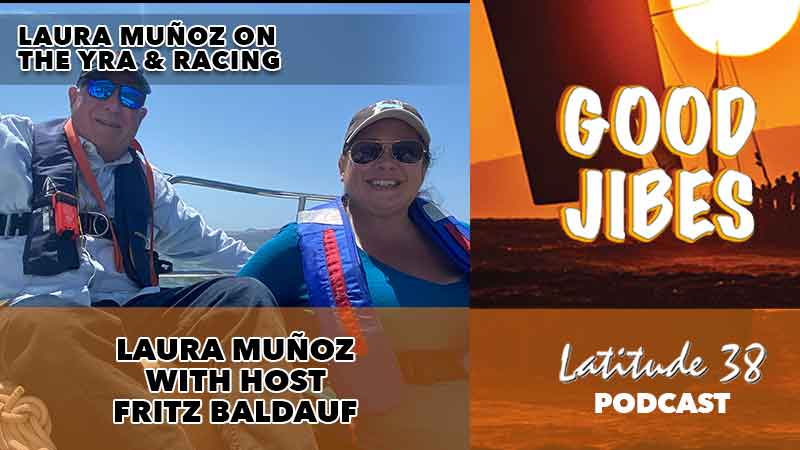
This week’s host, Latitude 38 Racing Editor Fritz Baldauf, makes his Good Jibes debut as he and Laura talk about how she found the YRA after working in the equestrian world, the behind the scenes work the YRA does with the US Coast Guard to get regattas approved, the YRA Women’s Series, how the organization’s growing opportunities for beginning racers, and the story of her broken ankle on the water.
Here’s a sample of what you’ll hear in this episode:
- Launching the YRA Women’s Circuit in 2025
- How to obtain a PHRF certificate
- Why join YRA and support Bay Area sailing infrastructure
- Rule number one: Don’t hit anything. No touchy.
- Working with clubs to expand women’s racing opportunities
Learn more at YRA.org.
Listen to the episode on Apple Podcasts, Spotify, and your other favorite podcast spots — follow and leave a 5-star review if you’re feeling the Good Jibes!
Check out the episode and show notes below for much more detail.

Show Notes
- Laura Muñoz on the YRA & Racing, with Host Fritz Baldauf
- [0:02] Welcome to Good Jibes with Latitude 38
- [0:42] Fritz Baldauf introduces his first episode as racing editor
- [1:06] Meet Laura Muñoz – Executive Director of YRA of San Francisco Bay
- [1:26] Laura’s sailing journey from East Coast family racing
- [2:25] Racing aboard a CNC 35 Mark III out of Raritan Yacht Club
- [3:24] Career transition from horse industry to nonprofit sailing
- [5:46] The history and evolution of YRA since the 1930s
- [7:10] Behind the scenes: Coast Guard permitting process
- [8:35] San Francisco Bay – most active permitted area in the entire country
- [10:28] What defines an offshore race (passing Point Bonita)
- [11:54] Handling incidents between racers and commercial shipping traffic
- [13:45] YRA’s biggest event: The Great Vallejo Race with 125+ boats
- [15:38] Are you a reader? Check out our virtual bookstore at Latitude38.com
- Bay Area Sailing Infrastructure
- [17:03] Launching the YRA Women’s Circuit in 2025
- [18:50] Working with clubs to expand women’s racing opportunities
- [20:16] New for 2026: Intro to Racing Series – free three-part program
- [22:07] Rule number one: Don’t hit anything. No touchy.
- [25:24] Getting started: How to obtain a PHRF certificate
- [27:20] Biggest barriers: Finding crew and equipment misconceptions
- [29:47] Why join YRA and support Bay Area sailing infrastructure
- [31:40] Youth sailing program launching at Benicia Yacht Club
- [32:35] Sailing Long Island Sound and racing through the East River
- [33:06] Racing two races on a broken ankle at Red Grant Regatta
- Short Tacks
- Laura’s favorite boat
- Advice for new racers
- Laura’s favorite sailing book: Simon Le Bon’s Duran Duran The Book of Words
- Her favorite sailing movie: Summer Rental with John Candy
- Make sure to follow Good Jibes with Latitude 38 on your favorite podcast spot and leave us a 5-star review on Apple Podcasts
- Check out the December 2025 issue of Latitude 38 Sailing Magazine
- Theme Song: “Pineapple Dream” by Solxis
Transcript
Please note: this transcript is not 100% accurate.
00:03
Don’t hit anything. Don’t hit another vote. Don’t hit the mark. Like, no touchy.
00:14
Ahoy, it’s time to cast off, learn, laugh, and have more fun sailing. My name is Fritz Baldauf and I’m the racing editor for Latitude 38 and the host of today’s episode of Good Jibes, a podcast to help you experience the world of sailing through the eyes of the West Coast sailor. Each week, hear stories and tips from West Coast sailors on topics from the sailing community on cruising, racing, and just plain sailing brought to you by Latitude 38, the sailing magazine for West Coast sailors since 1977.
00:42
This is my first time hosting Good Jibes since taking over as racing editor a little less than five months ago. And I think it’s appropriate that I’m joined by a fellow Good Jibes first-timer as our guest today. Today’s guest is Laura Munoz. Laura Munoz is the executive director of the YRA of San Francisco Bay, which has over 700 members and represents 2,500, well, over 2,500 Bay area sailors.
01:06
She’s responsible for PHRF handicaps for area G and works on PRHF handicaps for Northern California as a whole. She is the wire raise liaison with US sailing and the local US Coast Guard branch. And she’s responsible coordinating over 850 sailing events each year.
01:26
Laura, welcome to Good Jives. Thank you. Thanks for having me. Yeah, I’m super excited to have you. Before we get into all the nitty gritty of everything that goes on with the YRA, can you tell us a little bit about your life as a sailor and how you got into the sport? Yeah, I come from a sailing family. uh I grew up on the East Coast. uh started, my dad bought a day sailor that we would take to a local lake when I was probably in middle school.
01:55
And had that for about a season before we decided to need a bigger boat. And we moved up to like an old Pearson Triton, had that for a year or two, joined a yacht club, got into racing and then decided we needed more of like a family racer cruiser. So we got a CNC 35 Mark three, and then race that as a family for a long time. That’s how I kind of got started. What yacht club did you race out of? uh Raritan yacht club in Perth Amboy, New Jersey.
02:25
can’t say I know it, but it’s awesome. Yeah. It’s a great club. Still around, still going strong. Snacktician, that’s always an important role on the boat. Yeah, that was my mom. My dad, my brother and I raced. My mom was not a racer. She loved to go on family cruises, but when it came to racing, she kind of took the snacktician role and let the rest of us go out and actually race. It’s an important role. need food. Yes. You got to the crew fed.
02:55
So you’ve been involved in sailing for as well far beyond the past time for the last few years. So can you tell us how you got into working with the YRA? I sort of ended up in a career in nonprofit association management. I was working in Colorado and was ready for a change. I ended up moving to California in 2005. And it just so happened when I moved out here, the YRA was looking for a new
03:24
executive director, it just matched up perfectly. Like I had the background that the YRA needed and I had the sailing experience having grown up sailing. And so it was just a really good fit. Um, I applied, went through several interviews, um, and then ended up getting the job in March of 2006. So it’ll be 20 years this coming March that I’ve been with the YRA. That’s wow. Yeah, that’s really, it’s unbelievable to me too. Um, yeah, in 2006 I was in.
03:54
preschool. ah Wow. oh You’d mentioned to me that you were in the horse industry before you were. Can you talk a little? I’ve always been a wannabe cowboy in a way. Oh, yeah. Yeah. I grew up not only sailing, but riding. had had horses my whole life. Went to college in Colorado, went to Colorado State University, have an equine science degree. After college, ended up working for a horse breed association. um And
04:23
got to travel all around North America. ran all of their national horse shows. There was youth nationals, had Canadian nationals, the US nationals, and really loved it. ended up the association went through a merger with another association. And it seemed like a good time to maybe try something new. A friend of mine lived out here in California, and my college roommate actually, and my best friend. And she said, you know, I have an extra room, come stay with me.
04:51
Let’s see what you can find out here. And so I took her up on it and ended up out here. It’s uh always been fascinating to me how similar the horse industry and the uh sailing industry are. um know, they’re sort of niche industries. both, you know, in, in sailing, have us selling as our national governing body and the horse industry. There’s what’s called us Equestrian, which is sort of that overall.
05:17
You know, they’ve got your national awards and you’ve got your like regional air associations that manage things. And you’ve got individual clubs that run, you know, horse shows or regattas. You know, it was really fascinating to me at first how similar the industries were. So it was a really easy transition from, you know, the horse breed association into the YRA. Yeah. I grew up as well as sailing. grew up fencing and it kind of felt similar with niche sport, like U.S. fencing, U.S. sailing. m
05:46
similarly run, similar logos even looked almost the same. The niche sport niche community world is really cool. So speaking of the YRA, can you tell us a little bit of the history of the YRA and how it was founded and how it’s of become the entity that it is today? So from what I understand, it originally started back in the 30s and it was sort of just a collection of yacht clubs. And then we
06:16
officially incorporated, I believe in the early seventies. Back then the yacht clubs weren’t really running races the way they do now. And so that’s really where the YRA kind of came in was to run all of these races that people could participate in. And then as time has gone on, that role is sort of shifted where most yacht clubs are running their own races. Now the YRA definitely still run some races, but then we ended up taking on some other big roles like administering
06:44
for the area. And then the big thing is we became like the liaison with the Coast Guard to handle all the permitting that happens. Yeah, that’s like some of the behind the scenes work that as you know, say, I guess really before starting working with Latitude and as you know, we’ve corresponded that I didn’t really feel like I knew much about. like, can you talk about some of the interesting behind the scenes stuff that goes on specifically with the Coast Guard? Like how much of a process is it to get
07:10
permitting for certain regattas, being able to use certain marks or parts of the bay for racing. Luckily we’ve been doing it so long that I have such a good relationship with the Coast Guard now that like, just sort of send them everything and said, here, here’s what we’re doing next year. And they sort of assume that we’ve made sure there’s not going to be any traffic issues. And you know, that our racers are going to know to stay out of the way of commercial traffic. And so.
07:39
They then create a couple of different permits. actually end up with like a blanket permit that covers about 80 % of the events. Any event that has 10 or more boats is going to be included in that blanket permit. And then we get a special permit for events that have more than a hundred boats because they just need a little bit more visibility within the Coast Guard. And then offshore events are the ones that are a little bit different where each individual offshore event gets its own permit.
08:07
I have to provide documentation about each individual offshore regatta to the Coast Guard. They want to be able to access who’s entered in each offshore race and be able, you know, if something were to happen, they want to be able to quickly pull up that boat and find out, you know, who the skipper is, who are the people on board, you know, how old are they? All of that information has to be available to the Coast Guard for any offshore event. And then
08:35
In some years, we’ve had over a thousand events. This year, we ended up with 909, which is a lot. And the Coast Guard has told me we are the most active permitted area for them in the whole country by a lot. Like nobody even comes close to the number of events that get U.S. Coast Guard permits than we do here in San Francisco. Kind of makes sense. mean, it’s such a great racing area, great clubs.
09:04
I’ve always, the one thing that was- oh do. That’s what I was going to say. Houston area is actually number two. And it’s just because of all of the commercial shipping that they have there with all of the oil tankers. Oh yeah. Yeah. It doesn’t make sense. Yeah. Yeah. Yeah. But I was shocked when they told me Houston was number two. It’s like, never would have saw that coming. That wouldn’t have cracked like my top 10.
09:31
guess Long Island sounds, places like New England, Long East Coast, Biscayne Bay, SoCal, San Diego. Yeah. Yeah. No, Houston. Who would have thought? Yeah. Right? There’s a lot of sailing in Texas. I have friends who grew up sailing in Texas. Yeah. But yeah, just don’t, I feel like us Californians, really don’t think Yeah. And I do think that they’re including not just regattas, but any permitted on the water event.
09:59
out here, it’s not just regattas, they also permit paddling events and swimming events. And so I think in the Houston area, it also includes all of that as well. So you mentioned that for each offshore race requires its own special permit. I’ve actually never done any offshore racing myself. is obviously a bucket list, I don’t know mine to like do a Transpac, do other offshore races. But what just for those who…
10:28
those of us who don’t know, like what qualifies in the eyes of the Coast Guard a race as an offshore race? Like when does it switch from, like I’ve done some more distance races. did the Ensenada got out to point Bonita this year. that’s it right there. If you go past point Bonita and not just round it and head back, it’s considered an offshore race. Okay. Yeah. I mean like Spinnaker cup and the Draft Bay race. those are, no, those are like,
10:55
one night or not sometimes not even a full day race is at that point it’s offshore. Yeah. As long as you, as soon as you pass point Bonita and like I said, don’t round it and head right back. Um, in the coast guards eyes, that is an offshore race. And I think we have about 14 that get permitted every year. Okay. Cool. Yeah. With getting the permit races, like obviously throughout the year, and I’ve, I’ve been in regattas where this has happened. There are incidents.
11:25
I mean, I’ve never seen the bound with like with traffic, with shipping traffic or the one that I remember clearly was at the Swiftshire or got it St. Francis a year and a half ago, we had two tankers going in the same direction, right as a bunch of boats were going up wind. uh that was a, mean, and we ended up getting a lecture at big boats series because of that. So how often do events like the issues like that come up and then how does that affect the wire raise?
11:54
work with the Coast Guard? it just the conversation or? Yeah. mean, it does come up. There was one actually at the double-handed race, what was it? December 8th, we had an incident. em And so I generally get a call Monday morning after there’s been an incident from the Coast Guard saying, hey, you know, we got a report of five blasts or we got a report from a, you know, a bar pilot of this
12:21
boat being in the way and we’re wondering if it’s one of you. So they do a little bit of homework to find out if it was one of our boats from one of our events. And that’s usually pretty easy to figure out because they’ll give me a sail number. em And then, you know, once we determine, it was from a race or no, it wasn’t, then I can go, whew, not my problem and say, have a nice day. But if it was something that happened during a race, then usually it’s a, an education issue and, know,
12:48
I give them uh my mea culpa and say, well, you know, talk and make sure that, you know, we reinforce the issues or the, you know, rule nine, basically, and that people need to stay out of the way. Yeah. And sometimes, too, it’s sometimes it’s just bad luck. Sometimes. Yeah. Yeah. Sometimes things happen. They can’t help it. You know, there’s something happened on the boat. I mean, it just that’s what we always try and stress. It’s more of an education issue than they do have the.
13:16
mechanisms to penalize people pretty significantly with a financial penalty. But they have not done that in quite a while. We really just try and focus on the education aspect. Yeah, it makes sense. obviously, you know, it’s important. mean, I’ve, yeah, we’ve, anyone who’s sailed, we’ve all had times where we’re like, Oh, there’s a tanker coming. Kind of after that, another race plan. Yeah. Shifting from issues with the Coast Guard, what’s your favorite event that the YRA organizes and why?
13:45
Probably the Vallejo race. It’s our biggest event that we put on. We get 125 and hopefully up some boats every year. I’ve worked with Mark Littlefield over at the Vallejo Yacht Club now for probably over 10 years on that race. And I really like working with him. It’s a fun event. It’s great to see everybody at the
14:13
party afterwards. There’s the whole tradition of it too. know, it’s just, everybody knows the Vallejo race and looks forward to it every year. Some people it’s the only race they do every year. And it’s just, it’s a lot of fun. And what makes it so popular? it just like anything aside from the tradition of it? it- Yeah, I mean, there is a lot to be said for tradition. think people, they’ve been doing it for so long. I people love-
14:39
They’ve done it so long they can put all those flags, you know, up and down the the halyards and show them off. it’s the beginning of the season, you know, early spring. And it’s the one time when people from all over the Bay Area can get together and like, you know, they got great beer and you can share your stories of the race. And it’s just a huge fun party because of all the people that are there.
15:06
Hey, Latitude 38 listeners. We also hope you’re readers, and we are kind of partial to reading since we’ve published a sailing magazine since 1977. And if you go to our website and go way down to the bottom of any page of our website, you’ll find a link to a bookstore where we have books from many of our past Good Jives interviews and conversations with readers and West Coast sailors. And we’d also like, since it’s the month of December, to remind you…
15:35
A book is a great Christmas gift and if you go to our bookstore you can find many of the books that have been recommended by our Good Jibes guests or books that we’ve had suggested in our current December issue of Latitude 38. And author and editor John Rees did a review of several sailing books which I’ll mention here. The Way of the Sailor by David Kilmer, Kathy Simon, World Sailor. He also read and enjoyed The Track of the Typhoon by William Washburn.
16:04
Cruising Around the World by Captain George Greenberg and Under Wide and Stary Skies by Nicholas Coughlin. Then we also have a couple other books which include Ben Neely’s book, A Misspent Youth and three books from Julia Chauvin. All of these books are written up in our December issue of Latitude 38 and I think most are available on the Latitude 38 bookstore at the bottom of our website.
16:34
And we have many books, including the good old favorites like Joshua Slocum’s, Sailing Alone Around the World, Robin Lee Graham’s Dove, but hundreds of others that have been recommended by Good Jibes guests or Latitude 38 authors and readers. So enjoy a book, they’re great under the Christmas tree, and also visit the Latitude 38 store where you could pick up a ball cap, a t-shirt, or anything else that might please a sailor on the West Coast or anywhere. Thanks.
17:03
shifting a little bit now. The YRA woman’s circuit, how does that work? mean, that’s, you know, something, you know, woman sailing is something that John and I have focused a lot on covering over the last few months. And, you know, it’s been really cool getting all the stories coming in from it. So can you talk a little bit about the history of, yeah, think that circuit going and, you know, empowering women in sailing, obviously it’s a theme, not just in sailing, in all sports too, especially here in the Bay area. I mean, you look at the success of.
17:32
the in soccer and then the Valkyries in the WNBA. So we started this path 2025 was the first year for that. And I had to give credit to Chris a path. She is the uh wire a secretary. um She has an Olson 30 that she races and she kind of came up with the idea of creating a circuit for women where
17:54
It wasn’t just women on board. was women and men, but women were in the power positions. They were the tactician. They were the driver. And the crew could be, you know, a mix of men and women, but it was women who were in control and were in those power positions. And it was just a great way to sort of normalize women being in charge on a boat and sort of highlight just the amazing women sailors that are here in the Bay area.
18:24
We didn’t want it to be like a women only type event. We wanted it to be a really competitive uh series where you had your women in the power positions and then a crew of just good sailors, regardless of gender, who would be able to come out and compete. And we had three races this first year. We’d love to maybe add another one. We’re definitely bringing it back next year. had, I want to say around 10
18:50
10 or 12 boats sign up this first year. I’m hoping that’ll grow. We think it well. was really people who participated in it loved it. Is there a way to like work on combining that with the various different women’s events? Like I think about like the J 105 like woman skipper event, know, things like that. Like the 105 fleet, that’s the biggest fleet in the Bay in terms of the amount or at least one design fleet. Is there a way to kind of work with that to kind of
19:18
I don’t know, incorporate it in some way. Yeah, we actually reached out to a couple of clubs last year. Ensenal and Sequoia were the two that hopped on board right away. And the only thing that we want is to keep the rule that it’s a woman driver and tactician and that the crew can be a mix of gender. em And some events have not wanted to allow that. They want to keep it all strictly women.
19:47
Which is great. mean, I don’t want to take away from those races at all for this series though. What we want is to have that mix in the crew. But yeah, I mean, any race that would like to join, we’d love to talk about it and get it added to the series. Yeah. And think that makes sense too, to allow the mix because that will just get more votes on the line too. Absolutely. Yeah. I mean, yeah, I would think that could probably, I don’t know the math behind it, but I would guess I could get like 40, 50 % more votes on the line.
20:16
Yeah. Yeah. Otherwise, but that’s super cool. Yeah. So is there anything new coming in 2026 to the YRA calendar? mean, obviously, you know, the latitude 38 and YRA sailing calendar will be coming out in the next few weeks. Yeah. Is there anything that, you know, racers and aspiring racers should know about? Aspiring racers, yeah. We, one thing we noticed this past year is there’s a healthy number of boats racing that rate 117 and lower.
20:45
you know, like from like a Cal 40, you know, down to the faster boats. There’s lots of those out there right now, but there are not a lot of, you know, the old Newport thirties and Cal thirties and boats like that, that aren’t really racing anymore, but we see them all over. You see them in marinas, you see them out. Um, and so we’re trying to figure out how do we get some of these boats back out?
21:11
And one thing that we came up with is an intro to racing series that we’re starting to hopefully encourage some of these older boats that are sitting in their marinas, um just sailing to come out and try a race and even especially if they’ve never raced before. And so it’s a three-part series. The first two are sort of classroom work. It’s going to be online where the first one we’re going to talk about, you know, all the things that you need to have on your boat, you know.
21:38
radios, PFDs, things like that that you need to just actually go out and race. And it’s not a lot, you you don’t need to have fancy sales, you don’t need to have high tech technology on board, you can go out with your Dacron sales that are 10 years old and still have a great time and race against boats that have the same. And then the second class will be sort of the basic rules, which, you know, the big thing we’re going to focus on is don’t hit anything, don’t hit another boat, don’t hit the mark.
22:07
No touchy. General good strategy. Yeah. That’s the number one thing. We’ll cover a little bit what to do at the start, things like that. Then the third part of it is an actual race that we’re going to run. We’re trying to figure out if it’s going to be like over in Southampton or maybe more behind Treasure Island, somewhere that’s central but somewhat protected waters. We’re even going to have a chase boat out with some coaching that’ll go on.
22:35
Um, just to get people’s feet wet in this first race, the whole series is free. You don’t need a PHF certificate. Just, you know, bring your boat out and give this a try. Grab your family. You know, I grew up in a family where we all raced and it’s some of my favorite memories is, you know, racing as a family. So, you know, grab your kids, you know, come out, do this race. And then from there, if you like it, you know, we’ll help you take the next step, which would be like your local beer camp.
23:03
That’s great. I I feel like there’s so many, there’s not so many, there’s not that many opportunities for specifically for adults who don’t necessarily grow up racing to learn how to race. Like even if you know how to, okay, I can take my boat out. I can trim in the sails, whatever. But yeah, I mean, it’s. So what do I do at a start? Like, what do you do at a start? What do I do when someone comes and attacks to lure it of me? Like exactly. And they’re screaming at me and now, now this isn’t fun anymore. Right. Or, know, they.
23:31
they see these boats out there with their fancy, you know, black sails and you know, they’re all this high tech stuff on the boat. And they think, I don’t have that. can’t, I can’t go out and race, but well, you can, there’s lots of races where you don’t need any of that. Yeah. And so level of racer do you want to be in? You’re no, it’s, it’s nice for anyone who’s, know, learning the race to jump in and, know, not be in like a super competitive one design fleet right away because exactly, you know,
23:59
No one likes losing. If you jump into like the A fleet of the J105s or the NAR fleet or any of the big one design fleets, if you’re relatively an experienced racer, mean, the reality of it is you’re probably going to have a pretty rough day. Exactly. That’s a really cool, I mean, I think the only other program I can, correct me if I’m wrong on this, that I can think of that’s similar to that is like modern sailing with their sort of learn to.
24:27
That’s sort more of like a race team that they sponsor. Right. Yeah. So how do you think the, do you have any idea how the, how, like what the levels of participation for that are going to be yet? You know, we don’t, we are definitely in the starting to spread the word about it phase right now. We put a page in the Latitude 38 magazine or calendar that’s coming out. The Wirie delegates meeting is actually tonight. We’re going to get hopefully the yacht clubs to help us promote it.
24:55
we’re probably going to go around just hang posters on marinas and, know, try and get some of these people that definitely aren’t currently racing, but how many new port thirties are out there that have raised a ton over the past, you know, 30, 40 years that are just not racing anymore. Like we got to, how do we get to those people is what we’re focusing on right now. So in the theme of getting people racing that either haven’t raised before or haven’t raised in a long time, um, beyond like going to this seminar, like what are,
25:24
the basics that they need to get started specifically with wire a sponsored events. Like how do you get a PHRF certificate? What are the sort of the nuts and bolts of that? Yeah. So for this first, um, for this intro to racing series, you don’t even need a PHRF certificate. You don’t need to be a wire. Remember literally just bring your boat out and we will help you get started. If you like it and you decide, Hey, this is for me. I’m going to go do a couple of beer cans. And that series says, Hey, you need to get a PHRF certificate.
25:53
Then, PHRF is actually pretty straightforward. We have an application that you have to fill out. The sale measurements are all just self-measured. um So you don’t have to go get them measured by anybody special. You can do it yourself. A lot of them, you’ll be able to find that information online. A lot of the information on the application will be straight from your boat’s brochure. know, what’s the length on the waterline? What is the length overall? What’s your draft? What’s your displacement? You know, all that stuff that sort of
26:24
for short details about the boat. And then a lot of them, especially some of these older boats, we might already have it on file. So you can always just call the office and say, hey, I have this boat, here’s my sail number. Do you have it on file? And if I do, I’ll just send you everything we have. You can verify if it’s still accurate. And then we get your certificate updated. And we have like 6,000 boats, I think, in the PHRF database at this point. So in the theme of…
26:51
you know, getting started racing. There are so many boats that just sit around. mean, all three of the fleets that I race and there’s at least like in the J105 Nar and Express 27 fleet, think in each of those fleets, there are at least 10 to 20 boats, depending on the fleet that I can think of that are just sitting there collecting dust. What do you think prevents people from racing their boats? I mean, I’m sure there are many reasons, but what are some of the big ones in your opinion?
27:20
I think from what I’ve heard from people finding crew is probably one of the biggest issues out there. And that’s, you know, that’s a hard one to, you know, it’s how do you get more crew and how do you reach those people that could become crew is a question we’re always sort of asking ourselves. Um, and then, you know, there’s always that misconception that I gotta go buy new sales and I gotta go buy, you know, all this new software to be able to be competitive. And that’s not.
27:50
necessarily the case. You might have an Express 27. That’s a great boat to race. You don’t need to go out and race in the one design fleet right away. If you’ve never raced before, go do some beer cans, learn how to race the boat. You don’t need to have expensive stuff to do that. And then you can, you know, as you get more experience and start meeting some of the other people that are racing and get some advice, then you can start to move up and then look at those fancy sales. If you think you’re really wanting to make a run at being competitive, but you don’t need that to start.
28:20
And in the theme of finding crew, because I feel like that is an issue both ways. Because I mean, I know so many people who are sailors from elsewhere, know, some really good former college sailors that I know who live in the Bay Area now who want to keep sailing, but don’t really know people who own boats or they know people who own boats, but their boats like they already have a regular crew. Yeah. And I know people who have similar problems elsewhere in the country, in the Northeast.
28:50
the South and so on and so forth. do you think, what do mean, obviously Latitude 38, we have our crew list function on the website, but beyond that, do you think there’s a solution to that in general? And do think there’s a solution that like the YRA could, is that something that you guys want to try and create a sort of solution for? And what would that look like if so? Right now, what we do is direct everybody to the Latitude 38 crew list. We kind of try and funnel everybody there.
29:19
It is something we do talk about a lot. Like how do you get more people just interested in racing that don’t have to have a boat, like just want to go out and race. We haven’t figured that out yet. Uh, like I said, our big thing is just to point people to the crew list for a lot of 238, but it’s something that, you know, it would be nice to have an answer to. a sort of similar theme, why do you think, why should people join the YRA specifically? I
29:47
The YRA was something, because I grew up racing at St. Francis, I felt like I knew about loosely, but didn’t necessarily, and also I’m not a boat owner myself, uh but didn’t really totally know what the company did. What are the perks for people joining the YRA? Membership, we have a pretty small budget for what we do. so, know, memberships help us sort of do everything that we do.
30:15
There’s a handful of races. run about 25 races every year, handling PHRF certificates. That’s a huge part of what we do. We maintain several racing marks around the Bay area. The Knox Bowie, the Bobby Tosse, the Blackhawker, we help maintain all of those. The work that we do with the Coast Guard, we’re sort of like the main liaison between the Coast Guard. We are the Regional Sailing Association for US Sailing.
30:44
All those membership dollars help us continue to do that. Switching gears a little bit from why race stuff to you as a sailor, you talked a little bit about your sailing background at the top of the show, but do you talk about your favorite types of sailing to do now? mean, growing up, you said you sailed, you raced in this lake with your family. Yeah. But like, who are you as a sailor now? You know, truthfully, I don’t get out much anymore. My dad.
31:12
uh He’s a member at Richmond Yacht Club. so um I occasionally will grab my kid and go out with him. My husband is not a sailor at all. He gets a little green when he gets on a boat. So we don’t get out very much. But I am a member at Venetia Yacht Club where I live. And um I’m currently helping them get the youth sailing program.
31:40
up and running, which we’re all really excited about. We’re currently looking for instructors. If anybody out there interested in being a youth campus, really? let’s talk. I coached for several years at same time. Yeah, are getting a camp up and running for the summer. then hopefully that camp will turn into sort of an ongoing program.
32:06
to have a pretty strong youth program up here in the North Bay, Carquina Strait area. I know my kid will be in it and a bunch of his friends, my mom friends have all said they’re going to get their kids signed up. So we’re pretty excited about it. Okay. And what’s a favorite sailing story that you have from any point in your life? Yeah. kid is an adult. Also could be a wire related thing with some crazy regatta. Like I said, I grew up sailing on the East coast and
32:35
We used to take our boat up to Long Island Sound a lot for just sort of family getaways. And that was super fun. Sailing the boat up the East River and going through like Plum Gut and like up into Long Island Sound was just some of my favorite memories as a uh kid. then, you know, racing with my dad who uh took it very, very seriously. It was very competitive. And at one time I actually, we were in a race and uh
33:06
My job was to trim the mane and it was a two race day and before the first race, I jumped down into the cockpit to grab something. I don’t remember what and uh landed on a line that was laying down there and it rolled my foot and I broke my ankle and uh I popped back up. was like, I think I broke my ankle and my dad’s like, five minutes to the gun. Get up here. We raced the whole race. I like went down, got some ice after the
33:32
first race was over and then the second race came around and I’m like, can we go to the ER? And he’s like, no, we won that race. We got to go race again. Maybe we race all your races on the broken hand. Right? So I ended up doing the second race with my broken foot and finally got them to take me to the ER once we were done racing. it worked out fine, but it’s a funny story I always remember. That’s fun. That’s like the second version of the intense sports stat. Yep. Yep.
34:00
Yeah. It’s great. Oh my God. Not great that you broke your foot off. Yeah. We got me one. So yeah. Hey, if it works, it works. It’s worth it. Depending on the race, like if it was like to win Rolex Big Boat series or a world championship regatta, like I’d break my ankle to win a race. Yep. I believe it was the Red Grant regatta at Verdon Yacht Club. That’s awesome. Yep. Oh my God.
34:28
What’s favorite thing about the sailing community specifically here in the Bay Area and something that maybe makes it unique, you think? It has to be just the people that I’ve met doing this for so long and the backgrounds that all of these sailors come from. It’s just fascinating. everyone I’ve met has just been fantastic. Working with the PHRF committee has been one of my favorite parts of just being with the YR8, sitting around a table with
34:58
those guys is a privilege. mean, they’re just so smart and hearing them talk about boats and their incredible knowledge is just, it is an honor that I get to sit and absorb their knowledge every month. I’ve really loved that. But just overall, the people that I have met here through the YRA has been the favorite part of my job. So I think we’ll probably move into
35:27
the last section of the podcast and short tax borough. ask you a few rapid fire questions. Just a little more about yourself as a sailor. Okay. But yeah. So what’s your favorite sailboat make and model? Got to be a CNC 35 Mark three. That’s what I grew up racing. I still love it. Yep. That’s it. Awesome. Yeah. And what percentage racer versus cruiser are you today? It would be a hundred percent a cruiser.
35:57
Hey, life’s as good when you’re relaxed. Right? What’s the longest voyage that you’ve ever done? That’s a good question. You know, I’m not sure, probably around Long Island. It’s got me beat. Yeah, that’s great. And would you prefer to sail on the East Coast or the West Coast? So someone who grew up on the East Coast but now lives on the Coast. Oh, that one’s hard too. I mean, it’s nice you get to sail all year round out here, but I also really miss being able to sail in shorts and a t-shirt.
36:25
I don’t know. I don’t think I could pick. When I was a college sailor, I would always get so jealous of all my friends who coached on Long Island Sound in the summer. Right. pictures of them in like tank tops and t-shirts. Yep. Meanwhile, I’m in like seven layers and. Exactly. Coldest winter I ever had was the second. I mean, where I grew up, Fallies were for like actual foul weather. Yeah. It would be pouring rain or something. night, just random leafy Exactly. Yeah. Yeah.
36:53
What would you tell local sailors to encourage them to try racing? You don’t need anything fancy to go out and do it. Grab your family. mean, racing as a family is an awesome, awesome activity and like grab your family, get out there and give a racing a try. Start small. So you, I mean, you mentioned the, the sort of YRA intro to sailing series seminar that you guys are working on, but outside of that, if you’re going to try racing, what races would you suggest to someone?
37:22
who is just starting to get into it? Probably, you know, find what’s your closest local beer can and start there. Start with the beer cans, you know, in a weeknight race, they’re usually low stress and more fun. And it’s a great place to get started. What’s your favorite beer can race you do in that theme? Oh, that’s not fair. We won’t impact your name to the answer. Right? I can’t answer that. I like them all.
37:52
uh My answer would be current theme, not clubs. love that. Yeah. Yeah. For PHRF, for one design, St. Francis. But, okay. Yeah. Do you have an answer or are you just going to be diplomatic? I’m going to be diplomatic. Fair enough. Fair enough. So I had written down, what’s your favorite sailing theme book, but I want to say favorite sailing theme book and favorite sailing theme movie, if you have one. I was born in the early seventies. I am a child of the eighties. oh
38:20
a massive Duran Duran fan. So I will never forget when Simon LeBond was doing the fastnet and his boat drum lost its keel. And I read that book like cover to cover the day it came out because I was a huge Simon LeBond fan and a sailor. And so that’s one that always stuck with me. And then my favorite sailing movie. This one’s actually pretty easy. It is Summer Rental with John Candy.
38:48
And I absolutely love that movie. Ever seen it? Oh, you got to watch it. is perfection. John Candy has to win a regatta to save his summer, basically. And it is perfection.
39:04
Yep. That sounds great. Yeah. Yeah. No, I’ll have to go check that out. Yeah. Summer rental. Laura, thank you so much for taking the time to… Oh my God. Thank you for having me. good drives and looking forward to having you on in the future and… Yeah. …hope that anyone who is thinking about getting into racing goes and checks out all the wire-raised opportunities to get out sailing. The sport is obviously a great sport and the wire-raised and Laura do so much great work for the sport. So thank you so much and until next time.
39:35
Sounds good, thank you!