

Episode # 221: Commodore Tompkins on 600,000 Miles of Sailing, with Host John Arndt, Pt 1
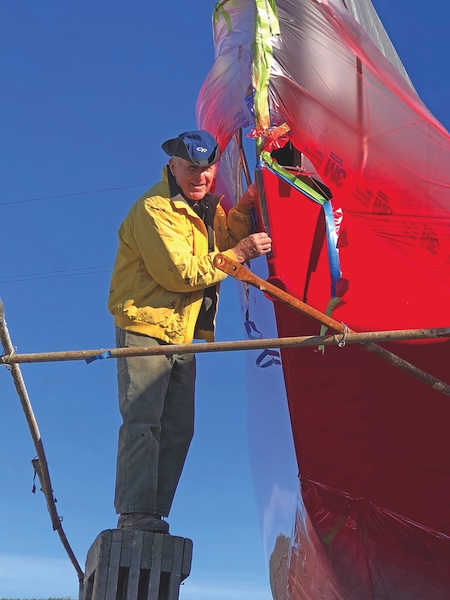
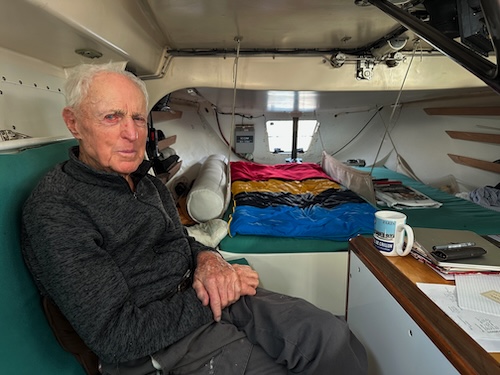
This week we’re joined by one of the great legends of the sailing world, Warwick “Commodore” Tompkins. The 93-year-old Commodore has sailed over 600,000 miles and has essentially been sailing since birth.
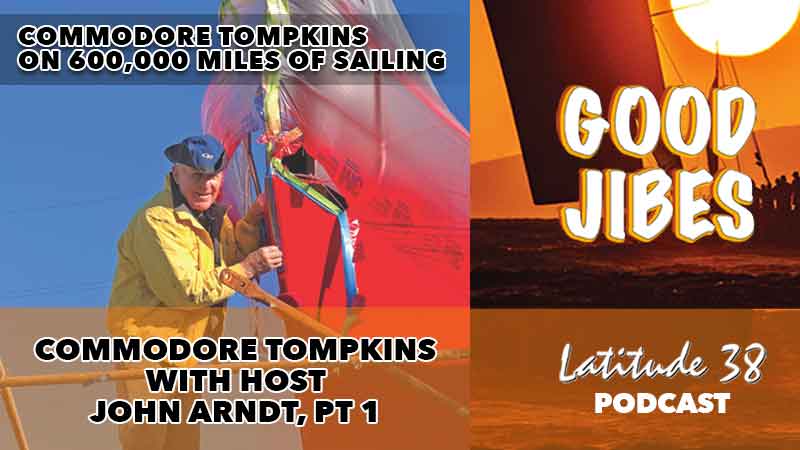
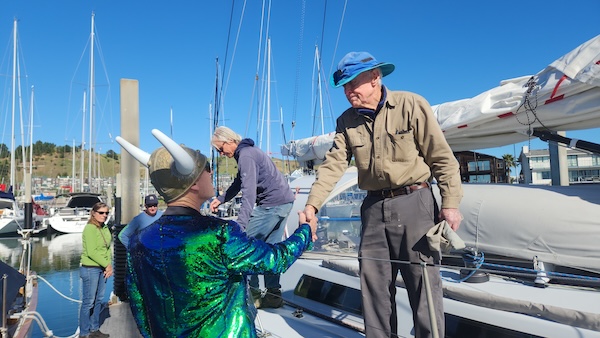
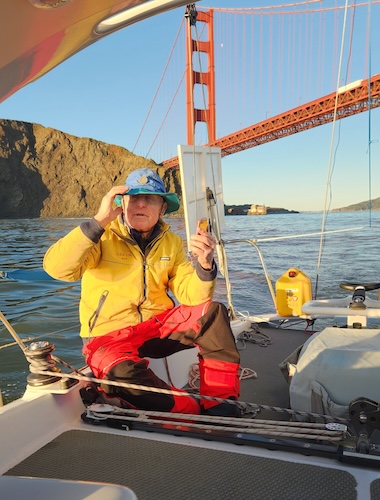
In this Part 1 — recorded in-person on Commodore’s custom Wylie 39, Flashgirl — tune in as Commodore chats with Good Jibes host John Arndt about the health scares on his recent 48-day passage, the lifetime of sailing inspiration he credits to his father, his unbelievable memories from sailing around Cape Horn at age four, how they became the 1st sailing vessel to cross under the Golden Gate Bridge, and how he started working professionally on boats.
Here’s a sample of what you’ll hear in this episode:
- How Konrad Lorenz explained Commodore’s destiny as a seafarer
- Rounding Cape Horn at age four and sailing without an engine in 1936-37
- Commodore Tompkins childhood at sea
- The origin of “Commodore”
- Wander Bird’s tragic sinking
Read about Commodore in Latitude 38 sailing magazine here: Commodore Tompkins On the Move Again.
Listen to the episode on Apple Podcasts, Spotify, and your other favorite podcast spots — follow and leave a 5-star review if you’re feeling the Good Jibes!
Check out the episode and show notes below for much more detail.
Show Notes
- Part 1: Commodore Tompkins on 600,000 Miles of Sailing, with Host John Arndt
- [0:02] Welcome to Good Jibes with Latitude 38
- [0:14] Welcome aboard the legendary Commodore Tompkins
- [0:58] Aboard Flashgirl – a unique cruising boat designed with 600,000 miles of wisdom
- [3:10] Recent voyage at age 93 – returning from a 40-day passage from Wake Island
- [5:13] The imprinting story – how Konrad Lorenz explained Commodore’s destiny as a seafarer
- [8:19] The origin of “Commodore” – born aboard the schooner Wander Bird in 1932
- [10:43] Father’s journey – from Gallipoli to blackbirding in Papua New Guinea
- [14:14] Are you a reader? Check out our virtual bookstore at Latitude38.com
- Wander Bird
- [16:50] Acquiring Wander Bird for $1,300 – beginning the charter adventure
- [17:20] Childhood at sea – crossing the Atlantic and experiencing life aboard
- [19:08] Rounding Cape Horn at age four & sailing without an engine in 1936-37
- [21:18] Historic arrival – first sailing vessel under the Golden Gate Bridge in 1937
- [23:01] Through the hurricane – voyaging to Tahiti as a young crew member
- [24:37] Wander Bird’s fate – 50 years in Sausalito, then the tragic sinking
- [28:02] Sausalito waterfront life – the early days with Myron Spaulding and others
- [29:17] Naming Ramblin’ Jack Elliott – a chance meeting on the railroad tracks at age 17
- [33:25] Becoming a professional sailor – the birth of Sailing Yacht Service
- [36:32] First major racing campaign – Transpac to Honolulu aboard a Hinckley 40
- [40:31] Racing partnerships – sailing with Kim Desenberg and others on the West Coast
- [41:41] Have a sailing story? Send stories and photos to [email protected].
- Make sure to follow Good Jibes with Latitude 38 on your favorite podcast spot and leave us a 5-star review on Apple Podcasts
- Check out the December 2025 issue of Latitude 38 Sailing Magazine
- Theme Song: “Pineapple Dream” by Solxis
Transcript:
Please note: this transcript is not 100% accurate.
00:02
We were the first sailing vessel to cross under the bridge.
00:14
This is John Arndt, Publisher of Latitude 38, and I’m happy to be sitting here with Commodore Tompkins, one of the great legends of the West Coast sailing world, of the sailing world in general. He is going to be part of this next podcast telling us a little bit about his 600,000 miles of sailing, which could probably fill 40 podcasts, but, um.
00:36
We are very happy to have him board and have had so many stories on Commodore Tompkins in the pages of Latitude 38 through all these years. And wanted to do catch up here on our good jibes to share another story of a West Coast sailor, but one that everybody should know. If they don’t know, they’re gonna learn a little bit more now.
00:58
We usually like to say welcome aboard Commodore, but I’m on your boat. you are aboard Flashgirl. We’re aboard Flashgirl and a very unique and special cruising boat for sure. It’s supposed to be a very unique. You’re the editor. You’re not supposed to say very unique. oh should. Oh, okay. It’s either unique or not. It’s unique. It is unique. It is unique. It is unique. yes, it’s kind of.
01:25
The cruising boat, somebody with 600,000 miles under their keel could design and probably very few would understand it. You don’t have the miles, but it’s got a lot of wisdom incorporated into what’s been created. This boat had a lot of thought. Yes. Yeah. It is the nexus of my experience. Yeah. No, it’s really within the financial limits.
01:49
on myself. Yeah, yeah, well that’s it. And then also with a favorite designer out there that you’ve worked with for years, Tom Wiley. Yeah, Myron Spalding taught me when I worked with him that you should think about the weight of the boat in the same sense that you think about buying a pound of butter. You buy a pound of butter, you buy 10 pounds of butter, it costs 10 times as much as the first one.
02:15
And similarly with the boat, because you’re buying lead and cordage and fiber. em So this boat was as big as I thought I could afford. Actually, it’s a little bit bigger than I could afford. So it has those compromises and it’s designed to be a little board boat, which was a good sailboat. mean, went up wind and down wind. It does. It has done. Yeah. Well, it’s also a cruising boat with a tiller.
02:45
which is pretty unusual. Well, you know, if you’re cruising seriously, most of the time you’re going to be using an autopilot if the autopilot functions. ah it doesn’t matter whether you’re, in my opinion, it doesn’t matter whether you’re a tiller or a wheel. I like a tiller because it’s simple and clean and it’s no machinery or almost no machinery.
03:10
Yeah, well that’s it and you get to feel the helm and go as you say. Well, so I want to, know, I want to get back to the beginning, but I want to just start. You’re now 93 years old and recently, I hate to remind you, but these are just facts, right? But you sailed back in under the gate at 93 years old after a 39 day passage from Wake Island. Well, what is part of that’s right, John, but there was a 48 day passage. Forty day day passage, okay. Pompeii.
03:40
I was 93 and I was very nearly crippled when I got back. The Kaiser doctors have told me that I have heart failure. So my heart isn’t pumping as much blood as it’s supposed to. Yeah. Whether there’s any kind of reversing of that or improvement, I don’t know. Yeah. They are not very articulate about that. Yeah. I did find when I picked you up, when you first got back, you were definitely
04:08
slow down and recovering, uh, I’m in bad shape. I’m not as anywhere near where I was. Yeah. Most of my life I’ve weighed 170 pounds, 160 to 170 pounds, and I currently weigh 139 pounds. So I lost a lot of muscle.
04:27
Yeah. Well, I gotta say calling you to get together, your voice sounds stronger than when I saw you on arrival and you look and sound stronger than when I first saw you on arrival. So, um, I’d say the trend lines are the right ones. Yes. It’s trending in the right direction, but it’s, it’s a task task for my patients.
04:48
Yeah, I’m being trod. Yeah, sure. It’s no fun to have to do that. But so, so tell me though, how did you end up on this passage on this boat at this age? I mean, you know, I mean, you know, this is the kind of age where you would be settled down with your remote clicker on your TV, but you don’t do that stuff. So you went sailing. I’m a
05:13
My whole story, John, it hasn’t been properly examined by anybody, including Richard when he interviewed me, Richard Spindler. It really starts with my father. If you’re familiar with an author named Conrad Lorenz, that’s K for Conrad, L-O-R-E-N-Z, he writes that imprinting is the way that nonverbal creatures uh
05:41
teach their offspring what’s going on. That’s a expression. And I was imprinted and I have this story from my father.
05:52
Lorenz was in Los Angeles researching his last great book, which was called On Aggression. What a well worth reading. They had an almost instant love affair. These two men just really responded to one another. So my father invited Lorenz to come to the desert where my father had homesteaded the property. The Homestead Act was still in force or may still be in force. What year was that with your father?
06:21
20 years ago, I guess now. Something like that. 1920s, not 20 years ago. 20 years ago, that’s right. Yeah. That your father, no, and your father was meeting Conrad Lorenz? That’s right. Lorenz came to Los Angeles to research this book. Okay. So they met, and I won’t go into the details there, but Lorenz gets invited and accepts the invitation to go to the desert, to this homestead property near 29 Pops. So it’s morning.
06:52
The morning after that he arrives and they’re out there, my father’s tinkering with a generator or something like that. And know, stone building outside the house. And they do what men do. They ask about their families, they ask about what they do for a living, they ask about what the children are doing and that sort of thing. So my father,
07:16
launched into a description of his children. My sister was two years old and I was two years old. And this Conrad Lorenz guy was trained to observe animals. So he never missed a nuance. So it’s a remarkable character in that regard. And so when my father talked about me, he showed great pride and pleasure with my prowess as a sailing man.
07:45
but he almost certainly finished on a descending note because I never succeeded in the American ethos of wealth. I never made any money. And I’m sure that that showed in my father’s presentation. And I’m sure that Conrad Lorenz picked up on it. And Conrad Lorenz said to my father, according to my father, he told me this, he said,
08:13
Your son had no choice but to be a seafarer. He was imprinted from birth.
08:19
Right. Well, and that’s maybe a good, even better starting point is your name Commodore and tell us about the first four or five years of your life and how you got that name Commodore. Cause not everybody’s heard that story. Uh, no, Collin, Collin is a nickname. I’ve never been as sociable enough or popular enough to be elected. Wanderbird had a great cabin aft and when people came to the schooner, my father, we showed them through the schooner starting forward.
08:49
immediately after the stem was a pantry and then a galley or the big fireplace of a constantly running stove, in this case an auger, Swedish design. So the cook and after that was the formist and then the bosom and bosom’s cabin with the cook and then after that was the main cabin with bunks down both sides and the crew.
09:15
And after that was the main list and another fireplace, solid fuel. And the mates quarters, little cabin just a chart table. So this particular tourist someplace in Europe, Spain, I think was given the tour. And it touched all the spaces. So we walked into the after cabin. This is 1932. The school had been in my father’s hands for four or five years at that point.
09:45
So this guy walks into the after cabin and in the top drawer of a chest of drawers, I can show you the chest of drawers, it shows in the magazine. Oh really? Yeah. It’s an infant. Yeah. And this guy wisecracked, and I suppose having met the cook, the bulls and crew, the mates, I suppose this is the Commodore. Ah. That’s how the nickname occurred, and it’s stuck because I was a junior.
10:13
You’re a junior, yes, right, commander. And so you were born right into the sailing life. That was your imprinted. I was born in Boston. Born in Boston. Yeah. But you’re brought home from the hospital to live aboard the Wonderbird. Yes, correct. Yeah, amazing. So, and your dad at that point, what was he doing with the Wonderbird? Wonderbird was an early charter vessel. this is very interesting story. My father traveled a lot.
10:43
The age of 18 and 19, he was traveling and then he ran away and joined the Navy. Didn’t like the Navy. Didn’t like Merchant Marine. Didn’t like the Merchant Marine. Ultimately, he goes back to Europe and he meets there somebody who comes in from, been, he had met at University of California because he spent a couple semesters there. So let’s call this guy Alan. He says, what are you doing, Alan? Alan.
11:11
He says, you remember I used to like history. Oh yeah, okay. I said, well, I figured out a scan that’ll work. I can advertise for tours around the great architectural wonders of Europe. And if I take the right number of books and the right kind of books, then I can read the book in the evening.
11:36
come across as an expert the next morning. And I can charge enough for the people on the tour to pay for myself a little bit. And I get to see all these things I want to see. my father goes, bingo, I can do that with a boat. That’s great. How did your father, was he a sailor at that point? he, how did he get into sailing? my father’s history is just astonishing, John.
12:04
He ran away at 17, joined the Navy. He served at Gallipoli as a signalman. Oh, wow. He didn’t like the Navy. He was born in 1900. He didn’t like the Navy, so he joined the Merchant Marine. And the other obvious thing to do, he didn’t like the Merchant Marine for, I would consider obvious reasons. And he got off in Queensland. He got off the Merchant Marine in Queensland. He answered an ad in a local newspaper.
12:34
for a master of a retired yacht from Sydney to go up into Papua New Guinea and recruit laborers for the sugar cane industry in Queensland. it was, they called it blackbirding in those days. Because what happened is, what my father was doing is he’d take the vessel off the Fly River and he had a translator.
12:59
Woggy was his name, beautiful man, very native, very New Caledonian. And they stayed friends throughout their lives. Anyway, the translator would go to the village and say, okay, I wanna sign up 20 people to go to Queensland and work in the sugar cane fields. And if you do that, you’ll get the equivalent of one cow a year.
13:22
for 10 years, which makes them fantastically wealthy. Provided they didn’t subtract the cost of the PX, the women, the booze, everything. They were lucky to come back alive. It was called Blackberry, and I’ve got pictures of that. He’s a fantastic story. He taught himself how to sail. He never had a mentor, my father.
13:49
That’s amazing. So then he ended up back in Europe, got Wonder Bird. Went back to Europe and he met this guy, Alan, that has scribed and Alan was doing his pleasure with these tours of the cathedrals and monuments like that. And somehow he got wind of Wonder Bird. I don’t know the details of that. And she is much bigger than he wanted.
14:14
Yep. But he was an opportunity he couldn’t pass. He bought it for $1,300. $1,300. Yes. Wow. It just had a $2 million refit, right? It’s a $1,300 boat. $1,300 when he bought her. Yeah. I’m sure that the copper cost more than that when she was built. Yeah. She was designed in 1878 and she was launched in 1882. Wow.
14:44
Perfect, so 147 years old now or something like that. Yeah, amazing. Hey, Latitude 38 listeners. We also hope you’re readers and we are kind of partial to reading since we’ve published a sailing magazine since 1977.
15:02
And if you go to our website and go way down to the bottom of any page of our website, you’ll find a link to a bookstore where we have books from many of our past Good Jibes interviews and conversations with readers and West Coast sailors. And we’d also like, since it’s the month of December, to remind you that a book is a great Christmas gift. And if you go to our bookstore, you can find many of the books that have been recommended by our Good Jibes guests or…
15:29
books that we’ve had suggested in our current December issue of Latitude 38. And author and editor John Rees did a review of several sailing books, which I’ll mention here. The Way of the Sailor by David Kilmer, Kathy Simon, World Sailor. He also read and enjoyed The Track of the Typhoon by William Washburn, Cruising Around the World by Captain George Greenberg, and Under Wide and Stary Skies by Nicholas Gorglen.
15:59
Then we also have a couple other books which include Ben Neely’s book, Misspent Youth, and three books from Julia Chauvin. All of these books are written up in our December issue of Latitude 38 and I think most are available on the Latitude 38 bookstore at the bottom of our website. And we have many books including the good old favorites like Joshua Slocum’s Sailing Alone Around the World, Robin Lee Graham’s Dove,
16:28
but hundreds of others that have been recommended by Good Jogs guests or Latitude 38 authors and readers. So enjoy a book. They’re great under the Christmas tree. And also visit the Latitude 38 store where you could pick up a ball cap, a t-shirt, or anything else that might please a sailor on the West Coast or anywhere. Thanks.
16:50
So then you were born onto the boat. Obviously this is born in Boston, born in Boston, but into the, were imprinted early by then crossing the Atlantic several times before you were seeing my father at work. Yeah. Seeing yourself. Right. Right. And he was, was, he was girlish. was intelligent. He was well read and articulate. And he has a lot of good things. He knew how to run the boat.
17:20
and people were happy aboard. I think 350 people sailed in Waterloo. Oh really? And these were paying passengers that were doing transatlantic voyages or what were they? Passenger is the wrong word to use. They paid to be on the scooter. finally learned something about sailing and cooperation and working together and voyaging. And so they got to see Europe a little bit.
17:46
and had the experience of sailing in a sailing vessel in a close-knit community. All those things. Wow. Amazing. And then at some point, why did you decide to come to California and you sailed around Cape Horn at some young age? uh Wunderbird was built in Germany and she was, my father found her in Hamburg and he refitted her. But his family came from California.
18:16
And he originally, he was born in Troy, New York, my father. So my history is really not complete unless you understand my father as well. His family moved to California later in life and he wanted to be here. Actually his mother and, is it grandmother? I’m a little confused about the family situation. Boy, they were in Berkeley. Oh He brought them to spend around here. But over and above that, John,
18:45
A passage east to west around Cape Horn is the pinnacle of the sailing activity. It’s crazy. It’s crazy in a way. He did it in a sailing vessel without an engine in 1936, I guess, or 1937. So all that earlier, it didn’t have an engine that whole time either then? No. Wow.
19:08
Not until the Germans screwed it up. Yeah. Wow. So, okay. So, so it, it never had an engine under your father’s ownership? No, never. oh she, Waterbird was built as L5, one of the 13 designs that, that section. And apparently there is an essay about her written in German, which I’ve never been able to read.
19:37
It’s in my computer somewhere.
19:39
essentially lost. But apparently the designer of the boat was influenced by the design of America. Oh, interesting. So the sections in the schooner are quite good. She’s a good design. She was a good design for her time. 1880. That’s a long time ago. Yeah, that’s right. Schooner America was 1850 or and then so it 30 years up. So it was fairly current at that time. Anyway.
20:09
Yeah, she was built in Germany and my father picked her up and onboard he outfitted her and he wanted to sail. He wanted to test himself. So he sailed around Cape Horn. I was four. You were four. Yeah. My sister was six. Yeah.
20:22
Do you have any memories of that voyage? that? Very, very faint memories. I can remember, I told this to Richard when he was interviewing me. I said, I have one sort of technicolor image of the schooner hove 2. That means deeply re-force only. Laying in this well and the seas were really quite big, but the deck was dry. comfortable, it was comfortable in all motion to speak of.
20:51
My mother was sitting by the wheel box knitting. She was knitting something red. don’t remember anything else about it. While you were down near the horn, hove two. Yeah, hove two off the horn, west of the horn. West of the horn. And I remember that you look up like that at the crest of the sea. Yep. And down like that at the 12th. Wow. Big. That’s about all I remember. Wow. that’s… Big seas. That’s a classic The seas were 40, 50 feet. Yeah.
21:18
Wow. Really? Yeah. that was not breaking at this point, but just the big Southern Ocean rollers. Wow. And then, so you are on your way to San Francisco. So you arrived in San Francisco Bay. We were the first sail of sailing vessel to cross under the bridge. Oh, you’re kidding me. No, under the Golden Bridge. can find it in the records of the Chronicle. Oh, is that right? The first.
21:43
1937 or yeah, that’s interesting. So, so the Golden Gate Bridge was built and the Wonderbird was the first vessel to go under it. sailing. For sailing vessel. Sailing vessel. And so how old were you at that time? Four. Four years old. that’s. Four and a bit. Yeah. And then Wonderbird pulled into Sausalito and that became home for.
22:04
Yes. eh And Wanderbrook came in as Sausalillo and he continued his charter type activities. They weren’t charter activities. A charter activity would be you making arrangements with my father to use the vessel. Yep. And so he would charter the boat to you. Okay. But in his construct, he advertised the fact that the vessel was going to be sailing in
22:33
Pacific was going to go to Tahiti. So he was going to go to Tahiti and then come back via Honolulu and San Francisco. People would sign up to join that. Wow. So to that extent, it was a charter boat, but no, it wasn’t a charter boat in the other sense. Like a one week charter of wine and cheese. Yeah. So when he was chartering out to the South Pacific, were you aboard as a four or five year old crew member? Oh yeah. Oh yeah. Yeah.
23:01
So you were… The bull went through a hurricane on the way to Tahiti in 1941, I think it was. Good grief. The Second World War started on the 7th of December, was it? Yep. In 41. And the schooner had sailed to Tahiti that year and back. My sister and I lowered the mazel on that particular occasion. And it was one of the few times I was ever sent below on a water group.
23:30
during the hurricane. There was enough water on deck so the hashes were almost on the only probably.
23:38
that much water washing around on the deck. have swept a five-year-old or six-year-old right away. That’s right, a kid. Yeah. So I got sent below. Yeah. And it’s one of the only times that I was ever sent below. Wow. That’s unbelievable. So how long did your father keep chartering the boat? And then at some point it settled down in Sausalito and became a home and you went to school. He sailed her to Sausalito. He had a couple of trips into the Pacific, including the last one, which went through Tahiti in that storm. And so in
24:08
1941 he tied her up. The war happened. Yeah. So there’s no further sailing and she lay there for 50 years I guess. Really? And ultimately was sold to a triumvirate of people from the northwest. Yep. It’s up near Seattle and from there she was sold to the German outfit called the Hamburg Maritime Stiftung and one of my remaining goals is to
24:37
revisit the boat. She was sunk as you know. Yes, right. She rammed and sunk. Four or five years ago or three, four years ago. Which is, that particular issue is a fascinating issue to me. I’ve spent my life sailing and I’ve been in command of many boats, not my boats. And the master is responsible, right? Yep.
24:57
So the Master of Wonder Bird when she was sunk was clearly responsible. He made what I consider a stupid blunder. Yep. They happened. Well, it was worse than that because he had time to correct it. Yeah. I’ve seen the movie. I’ve seen the video. So the video. Yeah. And he had time to correct it, but he didn’t. Yeah. He didn’t have the ability or the knowledge or both. don’t know. Yeah. No, I’ve seen the video too and it just seems.
25:26
sort of easily available, avoidable. mean, he, it just seems shocking that it could happen, but you know, maybe it’s a deer in the headlights kind of moment where you freeze or who knows. do you, how do you select? I mean, clearly this guy had been selected to be in charge of the schooner and he fucked up big time. He did. He did. And, oh and so how do you select the right guy? Yeah. Well,
25:53
Maybe you could tell us that you’ve been selected by a lot of people. If I had been in command, it wouldn’t have happened. Yeah, I’m sure of that. Yeah, I’m absolutely certain of it. I mean, even if I had mistaken the order, he gives the order helm to port. Yeah. Yeah. Well, in German, I translated. um And he says hard to port. What he should have meant is make the boat go to port. Right. Right.
26:21
They put the tiller. He was no doubt a merchant marine captain accustomed to steering with a wheel. Right. Well, there you go. So they put the tiller to port. They put the tiller to port and it got sunk. It got sunk. Yeah, that was tragic. I find that a fascinating issue. I can’t get an answer out of the home boarder guys. I know a couple of people who were aboard her when she was sunk. Oh really? Yeah. I talked to them.
26:49
And this is a fascinating part of the whole thing. My friend, Hauke Mulder, just his name, very German. He says, everybody has been cleared, including me. He had some kind of authority, a position, Hauke did. Except the captain. uh I said, well, what do know about the captain? And Hauke was defensive of the captain because…
27:18
The rules of the road say you’re meant to pass this way. Port to port. Port to port. But. And so here’s this fucking idiot trying to get across the bow with not enough sail. He just didn’t have a grasp of what he was doing. Mulderich was defensive of him. And apparently the Germans let him off the hook for that basis. Really? They were sailing in restricted waters and all he had to do is turn to port.
27:47
And the worst they’d had was a glancing blow. Yeah. Yeah. Yeah. Yeah. It happened. Well, I mean, it shouldn’t, but it, you know, humanity is filled with errors like this. And so it does happen. so.
28:02
Thinking back now to Sausalito, mean, there’s a piece of history that’s shifted a lot since you landed there. You were there through all the years with Ramblin Jack Elliott and Myron Spalding and so many others. Maybe give us a little glimpse of like Sausalito life. And I got here in the eighties. So I don’t, you know, I sort of feel like I missed the heyday of the, what was it? 60s, 70s and even prior, but it was quite a,
28:32
front. John, it’s hard for me to describe what you’re asking because I wasn’t a part of it. I wasn’t really a part of it. I was always interested in sailing in small boats. Yeah. I had a small boat from when I was quite young and that’s kind of an interesting story but it’s…
28:49
Far of aggression. But I met Jack Elliott on the train, on the railroad tracks when we were both 17. Oh, you’re kidding. And I gave him his name. And that story is worth telling. The man we know as Jack Elliott, his real name is Elliott Adnopoulos. Oh, really? Okay. And Adnopoulos, his father was a physician in Brooklyn. Oh. And when I met the young man, he was carrying a guitar and he’s my age.
29:17
And it was a natural and we just hooked up right away. So he starts telling me about his adventures. I’m Elliot Adnipolis and I’ve never been good with names ever then or now. I just immediately rejected Adnipolis. mean, that’s just not on. Well, you’re remembering it. That’s pretty good. And well, you’ll see why.
29:44
So he told me he ran away from home in order to join a Rodeo. m
29:50
They called him Buck at the Rodeo. Oh, yeah. And he went back and he spent time with Woody Guthrie. And Woody Guthrie is a big name. Yeah. And we didn’t like the name Buck. He said there were lots of bucks, you know, it’d be something else. So anyway, there’s a lot of confusion about this kid’s name. Yeah. But it turned out that one way or another, another another intriguing part of the story is he had read my father’s book, 50 South. Oh, interesting. At the age of 17.
30:20
49 or 50. Anyway, he read the book and he wanted to see Wonderbird. Wow. So these two 17 year olds, would be 49 or so. And we were standing on the tracks and he said, come with me. We’ll go down to the school nurses right down here. So we walked down and if this was Wonderbird and the bow was going where you are, it was a plank driven more or less in midships out to port.
30:49
and a ramp leading up to it. And my mother was standing just in short, inside of the bulwars. And I walked down the dock with Jack. And well, no, Nipols. And Nipols. I down the dock with Elliot Adnipols. And I said, hi, mom, this is Jack Elliot. And that just plucked out of thin air at the moment.
31:14
It was an amalgam of the names he’d given me. I mean, Buck, Jack, all that shit. Anyway, I was seriously confused about the names and Jack went with it, okay? And he stayed with us for a while. 40 years later, Jack is now a big figure in country of Western music game. It turns out he’s performing in the East Bay and I’m having lunch at the San Francisco Yacht Club with some people.
31:43
the news comes out that he’s performing. Did anybody want to go see him? Well, I did. So I went with a friend’s wife and the two of us went in there. And the room was roughly the shape of this table top. And you entered over there and full of seats and over here where my computer is, there was a stage. Then this little alleyway here in the green room where you get ready to go on stage is back here. Well, we were given a table right here.
32:12
right next to the stage. Great. so I made our presence known to Jack, but he was primping. He was getting ready to go on stage and perform. He was adjusting his neck, neck or chief. He didn’t want to talk. So he walks past us, gives us a high sign, goes up on the stage, and he tells the story about how we met. Oh, great. And that’s where I learned it. Oh, really? And what he said was,
32:40
when he was introduced as Jack Elliott. He didn’t want to embarrass me in front of my mother. Yep. Showing really nice manners. He’s always been that way. But he also said, Jack Elliott sounded pretty good.
32:55
He liked it. Good ring to it. So that’s what happened. That’s how he got his name. Oh, that’s pretty good. So you’ve got your own nickname story, Commodore and Jack Elliott has his you passed on the tradition there. I guess so. Yeah, I never thought of it that way. Like maybe fast forward uh somewhere. You got to be one of the first pro sailors and delivering boats and rigging boats and taking care of race boats. What was your first kind of racing boat or program that you got into?
33:25
I’d be curious, like you made, you were working on the waterfront your whole life and then became a really renowned racer and person who sped boats up. I had a problem because, through my father, I was aware of the economic nature of our society and what it took to be a successful person in the United States. And I found anathema. I wasn’t going to do that. I wasn’t going to.
33:53
In order, as you know from running your magazine, if you hire 100 people and you pay each of them $1 less than each worth, then you make $100 a year or $100. Whatever that period, yeah. So that’s the phenomenon. That is the formula. And I wasn’t going to do that. I didn’t want to manage people that way. I wanted to sail. And so I started doing that.
34:20
As a part of that, I decided I wanted to work for Myron Spalling. He was the only boat builder in Sausalito. So I approached him and got permission to come into his shop. And we’ve had several falling outs, maybe three, at which point I take my toolbox and leave. three different times.
34:43
Okay, so you’ve seen the shop. It’s no different than it was. It was built by Ron Wise, you know, that shop. And he’s now deceased. Ron Wise sailed up here in a little boat, a little double-ender from Australia. And Myron found him on the dockside and hired him.
35:03
to do this working. That’s great. Anyway. What were you doing for Myron? What kind of work was? One of the reasons I couldn’t stand it because it wasn’t what I wanted. I wanted to learn how to use tools. Yeah. And he had me screwing piles and getting rid of the muscles and shit like that. Yeah. Jacking up the building and all these things. I learned a great deal from Myron without knowing it. And he was a great instructor. uh He had real style and manner.
35:33
So there was a guy named Mitch in the shop and Myron and me. And the telephone would ring and Myron would be down on the dock measuring a boat for racing. And I would answer the telephone. you know, it’d be Joe Schmuck and he wanted to talk to Myron and he said, well, I’m afraid Myron’s busy right now. I’ll get him and call you back. Well, frequently Myron wouldn’t call back, as happens. This happened repeatedly over, you know, six months or so.
36:03
I got to a stage at one point where I asked the caller, said, maybe I can help. Yeah. And I learned that I knew a lot more than I thought I did. And it’s certainly a lot more than Joe Schmuck did on the other end of tunnel. And that was your value. And that was the beginning of what I call sailing out service. Yeah. So what happened was a guy named, Ooh, he was mixed up with.
36:32
French bakery in San Francisco, can’t remember his name. It’ll come to me, but he asked me if I was interested in racing to Honolulu on a friend’s boat. And I said, maybe. I wasn’t terribly interested. Ultimately, a meeting took place at Nell’s in San Francisco, at the bottom of Columbus Street in those days. So I was asked by this fellow, Marvin Carton.
37:01
who was big in Syntex as a of So he owned quite a lot of stock in Syntex and the birth control pill. Did I want to race a Honolulu on his boat? And I said, well, not really. What was your hesitation? What kind of boat do you have? had a Hinckley 40. Oh, a Barrier 40. And he was relatively shoal.
37:31
fat and it was more or less patterned after you finished it. Yeah. Yeah. Carl Mishra spoke. Anyway, he asked me in more detail and I said, well, you know, Marvin, I like racing. I like going to sea, but I don’t like to go to sea with strangers and people.
37:51
must rely, but I can’t count on him. And he said, well, what would it take to make him interested? And I said, well, I want to have two or three people on the boat with whom I’m familiar. And that’s what he set up for. eh So ultimately, he sent me the boat and came on a train. The boat had a big rolling, whirling boom.
38:12
He shipped the boat out here from the East coast to do the Honolulu race. Yes, he did. And it had a roller for like, boom. You remember them? Yup. I was fitting at the front. Yup. And the fucking thing was probably 10 inches in diameter. Horrible thing. And weighed 500 pounds more than your step here. That’s right. He had, uh, whoever had rigged the boat for transport and hung the thing.
38:35
from handrails on each side. So there was a sail tie from each side at the front end and a sail tie from each side on the back end. So this thing was like a battering ring. Oh yeah. Oh good grief. And it just beat the shit out of the bulkhead and everything on it. The boat shows up and I go below on it and I find all this damage and I call Mr. Carter and I said, your boat suffered a lot of damage on the way out here. And he’s…
39:03
He completely unruffled. He said, well, send me a bill on your letterhead for if he’s seeing it and put it right. uh I said, I don’t
39:14
What are you talking about? That’s how that all started. That’s the answer to your question. Yeah. You got started as a pro like right there. Did you come up with letterhead? Yeah. um Sailing Yacht Service. Yeah. That’s great. That was the name of the company. So then you started crewing or taking other people’s boats, managing their boats and also, but as you just said, you like to go with people, you know, who was your go-to crew? Like you had some people, like maybe a few of the people in your circle. really. uh
39:44
I identified people as I went along, of course. And I sail a lot with Raymul Patry, who was a school classmate of mine at Tamalpais. ah Not a great sailor, but a great guy. Yeah. That’s important when you’re offshore. That’s correct. So, no, don’t have, there was no particular go-to guy. Robert Daniels sailed with me a lot. I met Ron Holland through George Gaskadden.
40:12
Yep. And, uh, which is another interesting story, but you don’t want to hear. And it’s Ron sail with him for awhile, but I sailed with Wiley and Wally and Dave Wally, Kim Desenberg and all these guys. Well, and Kim Desenberg’s boat.
40:31
Checkered Pass though. No, Checkered Pass is recent. Yeah. But it’s interesting. It’s six slips down the dock here from where we sit. And that’s also a Wiley 39 hull. She’s a Wiley 39, meant to be the same hull as this. Yeah. But uh somewhat radically different boats, but very much on the same hull form. Yeah. Well, that’s, mean, you were sailing together. What were you sailing with Kim Dessenberg prior to this Wiley era? He sailed with me in a California.
41:01
to Acapulco. really? Okay. Wow. So with that we’re going to sign off and we would ask you to give us a thumbs up on
41:12
Apple podcasts or wherever you listen to your podcast. We’d love you to stay aboard and subscribe with Lata 238 print magazine or go out and pick one up at any of your local retailers, marine retailers on the waterfront stretching anywhere from Seattle to San Diego. But with that, we hope you can get out on your sailboat in California soon. It’s a 12 month sailing season. The Christmas holidays are ahead. New Year’s is ahead. But in the midst of all of that, there’s some great sailing ahead.
41:41
Thank you for listening. Thanks for being part of the Latitude 38 Good Jibes and California Sailing Community. hope to see you on the water soon. Or have you sent us your story to be in changes, sightings, electronic latitude? Send stories and photos to [email protected]. Fair winds to all and best wishes for the holiday season!