

Episode #215: Stories from the Sea: Wooden Boats in Film & Fiction, Part 1
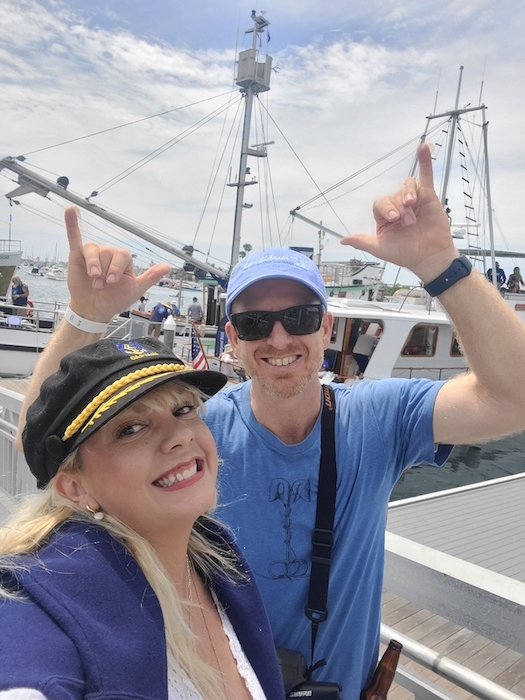
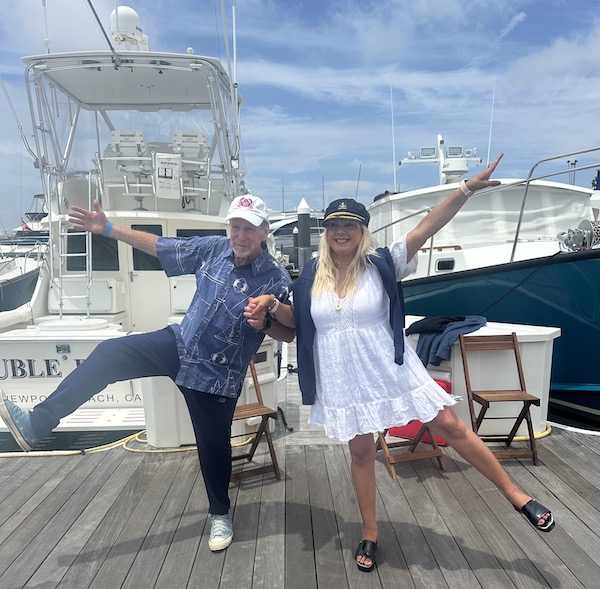
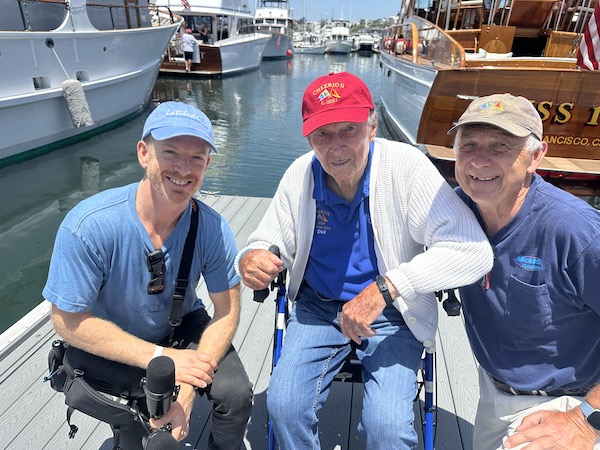
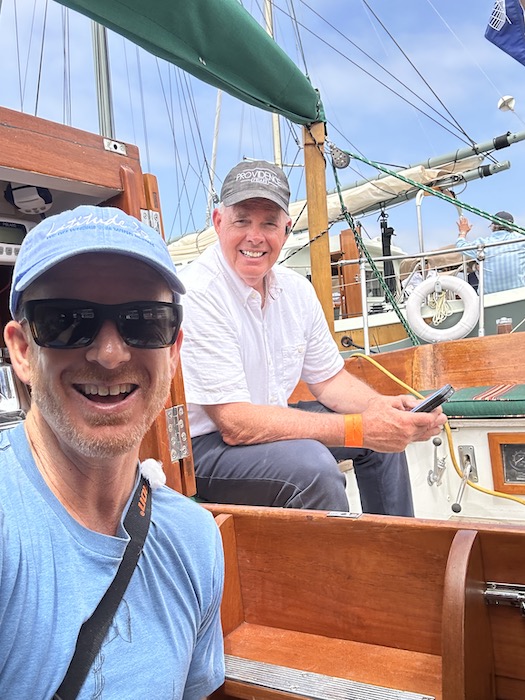
In this week’s episode, Good Jibes host Ryan Foland goes on location at the Newport Beach Wooden Boat Festival, which took place June 13-14, 2025 at Balboa Yacht Club. This was the 9th Annual Newport Beach Wooden Boat Festival, this time with the theme: “Stories of the Sea: Wooden Boats in Film & Fiction.”
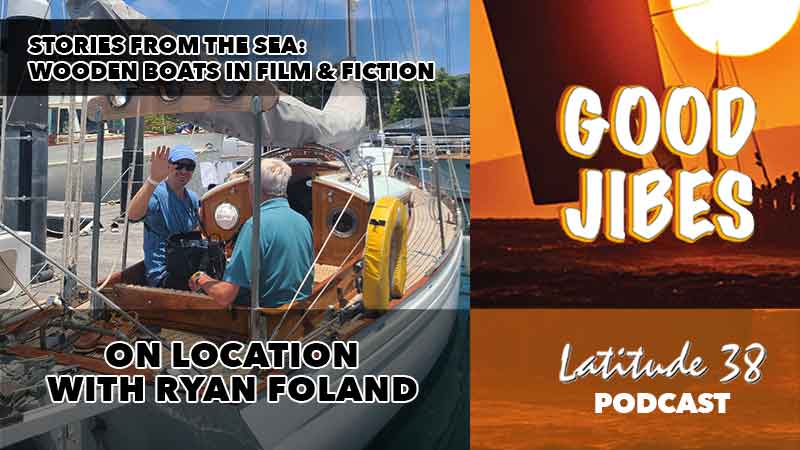
In this episode, you’ll hear from this year’s featured artist Steve Sandborg, hang out with wooden dragons, tour the coolest wooden boats out there, take in the history of John Steinbeck’s Western Flyer, and meet Captain Paul Tate in the pilot house.
Here’s a sample of what you’ll hear in this episode:
- Steve Sandborg discusses painting wooden boats
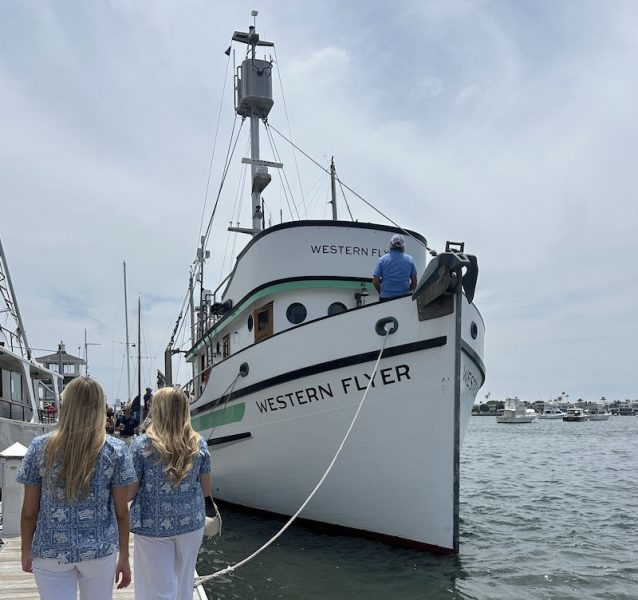
- Exploring John Steinbeck’s legendary research vessel
- Exploring dragon carvings
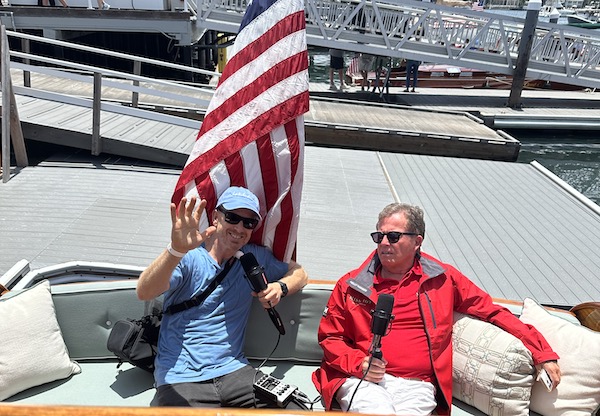
- Interview aboard Josephine
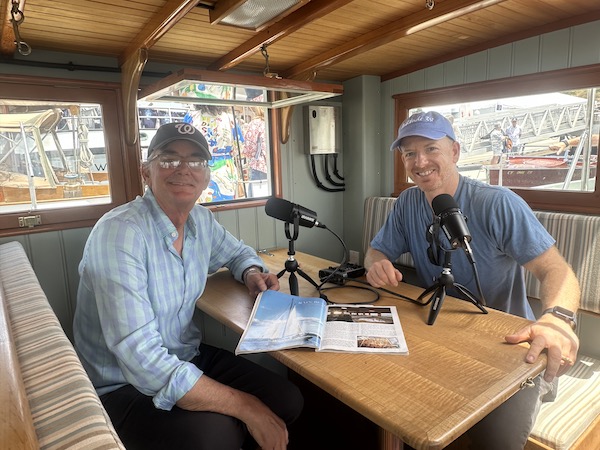
- Interview with Captain Paul Tate aboard the Western Flyer
Learn more at NewportBeachWoodenBoatFestival.com and connect with Ryan at Ryan.Online.
Listen to the episode on Apple Podcasts, Spotify, and your other favorite podcast spots — follow and leave a 5-star review if you’re feeling the Good Jibes!
Check out the episode and show notes below for much more detail.
Show Notes
- Part 1: Stories from the Sea: Wooden Boats in Film & Fiction, On Location with Host Ryan Foland
- [0:12] Welcome to Good Jibes with Latitude 38
- [0:44] This episode is brought to you by OceanPlanet Energy
- [1:19] Arriving at the Balboa Yacht Club for the Newport Beach Wooden Boat Festival
- [1:49] Interview with Camilo Landau about the Cheerio II – a 1931 wooden yacht
- [3:15] The Errol Flynn connection – Hollywood history aboard Cheerio II
- [4:16] Welcome from Commodore Brett Hemphill and festival host Steve Paljieg
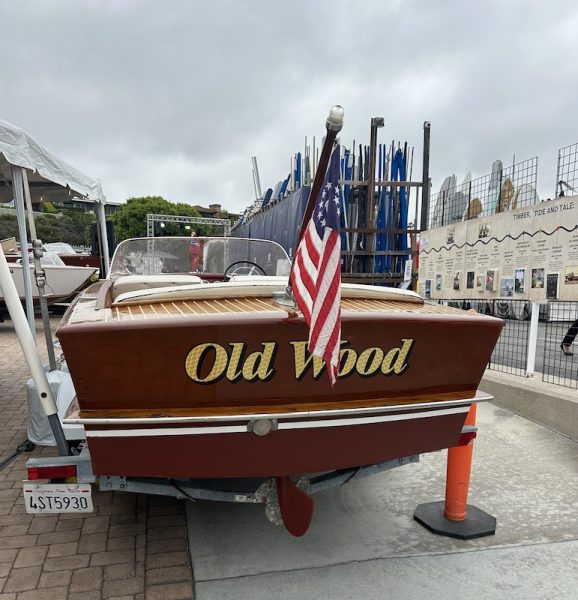
- [5:47] Classic runabouts from the 1940s and 50s on display
- [6:06] The Western Flyer – John Steinbeck‘s legendary research vessel
- [9:45] Featured artist Steve Sandborg discusses painting wooden boats
- [11:12] Steve’s background – 55 years of scuba diving and 10 years of sailing
- [13:08] Painting the Western Flyer signature piece for the festival
- [14:06] This episode is brought to you by OceanPlanet Energy
- Intricate Carvings
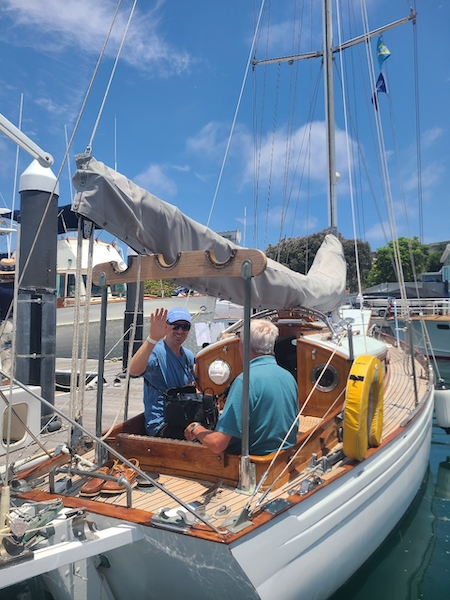
- [15:04] Tour of the Easterly Wind – a 1963 Bermuda sloop designed after Herreshoff 28
- [20:19] Exploring the dragon carvings and teak interior of Easterly Wind
- [22:11] Interview aboard Josephine – a classic wooden vessel
- [27:10] The Log from the Sea of Cortez by John Steinbeck – Steinbeck’s favorite book
- [30:34] The Western Flyer’s journey – from fishing boat to near destruction
- [33:27] John Gregg‘s rescue of the Western Flyer and restoration vision
- [36:20] Sustainable restoration using Forest Stewardship Council (FSC) certified wood
- [37:31] This episode is brought to you by OceanPlanet Energy
- Retracing Steinbeck’s journey
- [38:27] Interview with Captain Paul Tate aboard the Western Flyer
- [39:22] 3-month expedition to Baja retracing Steinbeck’s 1940 journey
- [41:12] The hybrid diesel-electric system – sailing at 8.5 knots efficiently
- [42:38] Tour of the captain’s cabin where Carol Steinbeck lived during the expedition
- [43:43] Reading the final passage from The Log from the Sea of Cortez
- Make sure to follow Good Jibes with Latitude 38 on your favorite podcast spot and leave us a 5-star review on Apple Podcasts
- Check out the October 2025 issue of Latitude 38 Sailing Magazine
- Theme Song: “Pineapple Dream” by Solxis
Transcript:
Please note: this transcript is not 100% accurate.
00:03
Take a look to your right. Oh my gosh, the big dragon. I didn’t even see that!
00:14
Welcome to Latitude 38’s Good Jibes with this latest episode brought to you by our friends at Ocean Planet Energy. Ahoy and welcome to another episode of Good Jibes, a sailing podcast for West Coast sailors to talk about West Coast sailing stuff. I’m here on location for a podcast where I will be podcasting from the Newport Beach Wooden Boat Show. I decided to opt out of the free shuttle, which was a parking far away. And so I’ve decided to find the closest furthest parking spot.
00:44
I am standing on my skateboard with my mobile podcast rig, which is a little handheld zoom recorder with four inputs I’ve got two microphones a rolled up Latitude 38 a GoPro that’s got a 360 to get some footage. I’ve got a power bar and a little meat stick I just put on my sunscreen and now I’m gonna roll because I’ve got I don’t know about Mile or so that I get I get to skateboard to to catch the part of the opening show here on Saturday
01:13
Good jibes on location. All right, I’m gonna get skating.
01:19
So I’ve just rolled up on my skateboard here, had a fun little roll down the hill, and the bike lane turns into the actual lane. So I was able to just cruise downhill, and the cars had to wait. Where are we? We are here at the… We’re here at the Balboa Yacht Club. And what’s happening today? Today is the Newport Beach Wooden Boat Festival at the Balboa Yacht Club. I’d like to point out that he just looked at his shirt. This is good, because he’s wearing a shirt that’s got it on it. Tell us who you are and what’s going on with you in this show today.
01:49
Yeah, my name’s Camilo Landau and I sailed down here on my neighbor’s dad’s boat. Nice. It’s the Cheerio 2. Okay, tell us about the Cheerio 2. I do like Cheerios. Cheerio 2 is a 1931 wooden boat. It’s a y’all. And we sailed down from Channel Islands Marina. It was a 14 hour sail. We left before dawn. We saw
02:17
How was Literally hundreds of dolphins. Just hundreds, thousands. Hundreds, probably thousands. Probably thousands. was lousy with dolphins. It was pretty awesome, amazing. Lots of beautiful sights. Have you made that trek down here? This was my first time doing this trip. How was it? I mean, we know the dolphin group. was It was a good wind? Did you get a good trip? We left real early, so there wasn’t a lot of wind. We motored for a good ways. And then we did raise the sails, and we motor sailed for a while.
02:47
We’re doing like seven, eight knots. Nice. And at that point, we’re like, let’s shut the engines off and just sail. So we did that for a while. We’re still doing about six knots. Now, slow and pro is how these sailboats go. And I know the theme today is all about storytelling in Hollywood and stuff like that, right? Yes. Do you know of any good stories behind the Cheerio 2? Yeah. I’m going to try today to get some stories off of these boats. So any good stories? For sure.
03:15
Thousands and thousands of dolphin listeners are listening to us right now. Yes So the Cheerio 2 at one point was owned by actor Errol Flynn. Okay, it was registered to him We know in 1937 38. Okay, we have some documentation Where was the boat then? was that? Santa Monica yacht club. Okay. Yeah and Santa Monica Marina There’s a beautiful photo of Errol Flynn at the helm No shirt shirtless movie star at the helm of this beautiful old wooden boat
03:44
pretty good photo. Is his spirit there? Did you hear him? it creaky? Is it haunted maybe? Yeah. Yeah. And I think the photo appears to be sort of just before Robin Hood came out. When he like really probably got the real check. And then he, you know, maybe got a, I think he got a bigger boat. He got Cali, or he got, he got Tiro 3 at that point. And then 4 or 5. Hey, well, this is awesome. I’m going to, whoa, I heard something pop. I think we need to go. All right. Maybe it officially started. All right. Thanks buddy. We’ll see you soon.
04:16
delighted to bring you all to the Balboa Yacht Club and this wonderful celebration of stories of the sea, wooden boats in film and fiction. So I’m going to turn it over for a moment here. I want to introduce the Commodore of the Balboa Yacht Club, Commodore Brett Hemphill, and he’ll do a quick welcome and I’ll be right back with you.
04:44
Welcome everybody. It’s going to be a great day today and there are plenty of great posts to look at and we encourage you to look through the interactive exhibits that we have on the land and on the water. There’s food, beverages all around, food’s over here, beverages over here as well. enjoy the day and get involved in having conversations with these boat owners. They’re happy to share their stories. Thank you for coming. Back to Steve.
05:16
Thank you, Comrade.
05:18
So listen, as you’re wandering the grounds, there are some highlights I want you to take a look at. Over on the south lot, which is immediately to my right, you’ll see a collection of wooden rowing craft. We have not had this before at the festival, or at least not the number of these wonderful vintage skulls and shells. And we did this in collaboration with the Newport Aquatic Center, and we want to thank them for coming and doing that. So see the south lot, right in back of you as you entered. If you haven’t taken a look yet at these beautiful
05:47
runabouts. These are some classic runabouts from the 1940s and 50s. Again, a rarity here in Newport Beach. We get a lot of ocean going boats, but we don’t often get a lot of runabouts. So take a look at them. Behind me, we have a real treasure here. We have a boat that’s on the National Historic Registry. It’s the Western Flyer. I’m sporting her cap, okay. Western Flyer took an author named John Steinbeck and his companion, marine biologist named Ed Ricketts down to the
06:17
of Cortez. Go see the Western Flyer. The crew is so welcoming and also stop by here this morning or this afternoon for Sherry Flumberfelt’s talk about the Western Flyer’s journey. you can see the boat, you can hear her history right here. Only place in Southern California you can get that experience here at the Newport Beach Wooden Boat Festival. We have on the water one of our largest collections of boats. We’ve got Stevens from the 1940s and 50s. We’ve got just
06:47
a number of beautiful boats and what Commodore have told is really rings true. Talk to these boat owners. They want to tell their stories about their boats, interact with them.
06:58
For our little sailors, I want to note that the Newport Beach Public Library system is here. So if you’ve got a young sailor or an old sailor, stop by and visit the library. They’re behind the food section. We’ve got some great librarians that are ready to do story time, do some crafts, and uh actually sign you up for the library if you don’t have a library card.
07:20
I just want to say have a wonderful day. We’ve got so much going on. We’ve got the calendar of our speakers and our entertainment right behind you as the exit to tent. And we’ve got some artist painting over there. They just started up from Laguna Beach. Go discover. I do want to say a word though about our sponsors too before I leave you this morning. We’ve got a wonderful array of commercial sponsors here. Our presenting sponsor for the first time in the festival’s history is Whittier Trust. So thank you Whittier Trust for your generous
07:49
ah They have a great little uh collecting card.
07:57
memorabilia for the festival here. So look for the stands that have little baseball cards that tell you about the boats or about the stories and then visit the Whittier tent to have your memorabilia assembled in a nice little keepsake that you can leave the festival with. We also have Kaiser Permanente. Kaiser Permanente is a great sponsor of ours too. They are doing skin screenings. So it’s a great time now before summer season to make sure everything checks out okay. Again in the south lot where the
08:27
Rowan Craft Art, please visit Harsha Permanente. You can sign up. You get screened by a professional dermatologist and you get to know on the spot whether you’re good to go for the season ahead of us or whether you need to have something taken a look at. Other sponsors of note, F &M Bank is sponsoring this space uh for us today. We’ve got great support from Visit Newport Beach. The Log uh newspaper is sponsoring the South Lot. uh Please take a look at the sponsor banners.
08:57
It’s a privilege for us to have such great support. So listen, I’m done talking. Go have a great morning. Go have a great afternoon. Check back here. There’s so much going on. And enjoy our festival. Thank you.
09:16
He’s a much better artist than a sailor. So it’s really great to have him here. I’m also very proud to own one of his original paintings that hangs in our room with all of our half-holes, because I think he’s just an outstanding artist. But you should be very excited to learn about uh Steve and his work and his process, which I look forward to hearing about also. uh
09:45
Let’s have a warm welcome please for Steve Sandborg, our featured artist. Well, hi everyone. And thank you for joining me. As Peter said, my name is Steve Sandborg and I’m honored to be this year’s featured artist at the Wood and Boat Festival, especially given this year’s theme, Stories of the Sea, Wood and Boats in Film and Literature, Film and Fiction, I guess. And so before I get going too much farther, I want to just back up a little bit and thank.
10:14
uh Steve Kaljig and Denise Archambault for inviting me to be part of the Wooden Boat Festival this year and uh Peter Reschker for inviting me to do this presentation today and helping with the technical aspects of the presentation. So today I’m going to share with you a little bit about how I approach painting and boats, especially wooden boats, including some of the processes and techniques that I use to make my paintings more interesting to viewers.
10:44
I’ve been painting and drawing, you know, on and off most of my life. And in more recent years, I’ve been fortunate to spend a majority of my time, not all my time, but majority of my time painting in plain air and also in the studio. And while I can’t tell you there was a master plan to how I crafted my background relative to the paintings that I do today, what I can say is I’ve spent a lifetime enjoying the outdoors, exploring places with dramatic beauty.
11:12
including coastal locations, harbors, marinas, even majestic mountain landscapes, all the way down to enjoying sunsets and little simple settings in life. I’ve a scuba diver for over 55 years, that’s formed a lot of my love for the ocean and I’ve been fortunate to be able to visit a lot of beautiful, beautiful places. And as Peter has mentioned in his…
11:40
I’ve been a sailor for nearly 10 years and trying to become a serious sailor, mind you. But one thing I’ve learned is in the number of years I have left on this planet, I’ll never catch up with the sailors who I’ve been fortunate, the very experienced sailors I’ve been fortunate enough to sail with. So from diving warm water coral reefs, oh to sailing overnight across open water, to sailboat racing, I’ve drawn deep inspiration from the ocean’s energy.
12:09
predictability, its solitude, and its beauty. So it should be really no surprise that boats have figured largely into my painting subject matter. And when you look at my paintings with this in mind, you’ll see that that connection with my experiences, you know, on boats and in harbors. And so whether I’m, again, racing sailboats here in Southern California, or, you know, on a journey to a remote uh
12:38
coastline in Mexico that might end with a day relaxing in a very, very hidden cove, you know, after a day of adventure. uh Or even enjoying, like I say, a sunset or just hanging out in the harbor, enjoying a sunset. And sometimes it’s even the simple scenes that you really enjoy. And I talk about an emotional connection oh to those places and to those moments. And that’s why I’m trying to communicate and that’s why I connect with viewers.
13:08
So here’s just a few examples showing how scenes and locations may have turned ultimately to paintings. Here I was asked to do a signature painting for the festival. So I painted the Western Flyer, a boat rich in story and character. For those of you who don’t know the story, in 1940, John Steinbeck and his biologist, Becks, and his biologist friend Ed Ricketts, set out aboard this wooden fishing boat on a scientific and literary journey.
13:36
to the Sea of Cortez and their trip was memorialized by Steinbeck in his book, The Log of the Sea of Cortez, which by the way is a great read and uh I encourage all of you to read it if you haven’t. And though the flier fell into disrepair, even sank, you know, she was raised, restored and now sails again, inspiring a new generation as a reborn research and education vessel. As you I think already know, the Western flier is actually here with us today.
14:06
And following my presentation, you will hear from the executive director of the Western Flyer organization about the Western Flyer’s timeless journey. I encourage you to join her when she comes up next. Hey listeners, this episode of Good Jibes is brought to you by our friends at Ocean Planet Energy, founded by two times solo circumnavigator, Bruce Schwab, and later joined by Nigel Calder. Ocean Planet Energy delivers optimized power systems designed for serious offshore cruisers and racers.
14:36
Their custom engineered solutions combine American power systems, high output alternators with solar panels, lithium ion battery systems, and smart power management to keep you reliably running quietly and efficiently at sea with minimal fuel use and recharging time. Proven in the Vendee Globe and over hundreds of thousands of blue water miles, Ocean Planet Energy Systems give you the confidence to explore the most remote corners of the planet.
15:04
Learn more at OceanPlanetEnergy.com. They’re good guys and would love to know you heard this on the Latitude 38 Good Jibes podcast. Well I have officially made it to the first sailboat here on… What is the name of this vessel? This is the Easterly Wind. The Easterly Wind. Well the wind has blown me here and on good jibes we go where the wind blows so this is great. Now I’m looking at the sign this is…
15:29
Mr. Daniel Martin. Daniel, introduce yourself and we want to hear some stories about this boat. Sure. Well, actually, I’m a fairly new owner of the boat. I bought it a year ago. Wow. Congratulations. Thank you. It is a 30 foot Bermuda sloop and it was designed after Herschhoff 28. Herschhoff is sort of royalty in boat design. Typically the Bermuda sloops by Choi Lee, the manufacturer, were typically catches.
15:58
So it’s a little bit unusual as a sloop. And this particular boat is from 1963. So the boat is 62 years old. Wow. She’s in great shape. And this is a huge cockpit, by the way. It is. For a boat that’s only 30 feet, we could probably comfortably have five or six of us in here with no issue. And we could crowd more in if we needed to. Yeah, we could stack them up. I’ve got a 1977 Cal 34.
16:26
totally different ballgame but feel one of the favorite things is that space in this cockpit area it’s so great it really makes it enjoyable so you are a new owner of the boat yes were there any stories that you fell in love with that made this thing seal the deal ah do you know how much of the history do you know you know i don’t know an awful lot the gentleman who owned it before did a meticulous job taking care of it and to the extent that it was needed bringing it back and so the shape that the boat is in is very much ship shaped
16:54
I can’t wait to peek inside. It’s very much to his credit. The most free, the most headroom I’ve seen so far. Yeah, this is for 30 foot boat to have six foot of headroom is impressive. I’m a little over six foot and in the galley and the salon I can stand up straight. Basically he, the gentleman who owned it before, about half the time didn’t even have the mast on it. Okay. He’s somebody who is very detailed individual and loved doing the work.
17:23
ah But when we took it out for the, you know, for the sea trial during the survey, it was, let’s see, only the third time the boat had been sailed, I believe, since 1997. Wow. Now, he would take it out and motor it. Okay. But he was not somebody who particularly enjoyed or was comfortable being at the helm sailing. Yeah, this looks like this would be pretty high performance. And it was the first time that had actually, that the jib had been flown.
17:50
since he’d owned the boat. my gosh, did anything roll out? everything was great. Like I said, he took tremendous care of the boat and I’m very fortunate. Well, the thing is, now you get to make your own stories. Yes, absolutely. You’re obviously going to sail this thing. You’re going to go out there. So tell us a little bit about the stories that are going to come on this boat. What are we going hear about? Well, in terms of this boat, you described this high performance. I wouldn’t suggest that, but Troy Lee
18:19
I had a… How would you describe it? Well, I raced on a 44 foot Choy Lee back east years ago, decades ago. They’re heavy, they’re very stout boats. People have taken this boat and boats that are a little bit smaller, wooden boats made by Choy Lee from here to Hawaii and back. And so they really can be set up, you know, to be blue water boats. This one isn’t set up for that right now.
18:46
But it certainly, you know, it has it in its bones. it in your future? You gonna bring it? Has it in its heritage. No, it is not. Well, when you decide to, if you want to do Transpect, let me know. I’m still trying to get on there. Very good. We could rock this thing. Fair enough. And I say high performance because these types of size of boats excite me because I love this type of size. high performance for me. I even think my boat’s pretty high performance, even though it’s just a very slow slug and it’s relative to what performance is. Very good.
19:13
Any final words here as we step inside or actually as I peek in here, you can probably describe the boat better than you can. Yeah, basically it’s got a small galley. It’s got two quarter berths in the salon and a V berth up front. And each of those can accommodate somebody who’s six foot tall. Six foot tall or more. When are we going to Catalina? Exactly. Happy to happy to have you on board for that.
19:42
Well, if you ever want to jump into the Blue Water concept and channel the spirit of this, I belong to Blue Water Cruising Club. Our facility is in Big Geiger Cove in Catalina Island. We’re in Anchorage and this thing would look really nice in there. We get Easterly sometimes too, so it would be perfect. Okay, very good. Do you make it out there? uh You know, I haven’t yet, but that is some of the stories yet to come. Yes, okay. Well, I’m excited to see what stories come. Thanks for letting…
20:11
me on this boat and talking. I’m going hop inside and just like check it out. Absolutely. All right. Great to meet you buddy. too.
20:19
Okay, so I’m on the boat and I am looking at all this crazy teak. What is this? So the boat is manufactured, as I indicated, it’s designed after Herschhoff 28 and yet there are wood carvings on the interior of the boat that are, take a look to your right. Oh my gosh, the big dragon. I didn’t even see that. Just amazing wood carvings. There’s literally across the entire,
20:44
What? The of the boat. entire width of the boat. There’s this dragon which is sort of facing off against another mirror dragon and really dark wood in here, which is a nice like deep contrast. And then there’s a pennant here also from Choi Lee that came with the boat. Oh, very cool. OK. And one of the other things that’s fun about it is that there are green striped cushions on the boat and uh the cushions were were custom designed for the boat and they were brand new when the prior boat
21:14
when the prior owner acquired the boat in 97 or so. And he kept them in an extra bedroom in his home. They were largely never on the boat. Yeah. They looked like they’re, they look like they’re totally fresh. were actually, they were actually done, um, fabricated meticulously, um, by two owners ago, but they are effectively brand new. Love it. This is what you get with. the, the, the two that I took out that I, oh
21:41
For this show I took two of them out of the two in the v-birth I took them out of out of the plastic They may have never actually been out of the plastic before these seats are seeing the first light since the 90s. Yes, that is awesome All right. Well, I’m gonna get a picture. You look very bossy or in the cabin with the microphone Cheers, you may end up in latitude 38. This would be awesome, but you have landed on the show So if good jibes the podcast isn’t on your radar yet, you should check it out. Very good We do all kinds of stuff. Thanks, buddy
22:11
Alright, we’re here. I’m about to step on this boat Josephine, except I met somebody stepping off the boat. And what’s your name, sir? Frank. Frank, so you were just on this boat, tell us a little bit about you, and then I want your impression of this boat, and then I’m gonna go take a tour of it. Because the captain isn’t here, so you’re the pseudo captain. I wish I was the captain, but yeah, it’s a pretty cool boat. It’s sort of a, what is this, about a 40 foot? Looks definitely 40 or 40. Do you know the make, by chance? Beautiful. No, I don’t.
22:41
There’s so many makers of old boats. Yeah. Yeah. But that canoe stern is really nice. Glides through the water really well. I’m sure it’s a deep keel. The cabin looks huge. Like it looks cabin is huge. Yeah. This big salon area, big windows and the, it’ll be, uh you know, you’ve got the galley and a place to sit and then… This cockpit looks like a whole boat in itself. Yeah. Cockpit is huge. massive… Do you see how… Look at how long the boom is. The boom is almost as long as the mast. Do see that?
23:07
It’s almost like three-fourths the size. You could have, you know, ten people here comfortably. Yeah. How is the inside? Pretty… Well, you know, looks… like a big trawler inside. Yeah, it does. It does. It’s similar to a trawler. There’s a name for this boat and I forget it, the style. I’ll ask Stefan Munro about it when I find them. It must be a… I don’t know if it’s a Stefan. Oh, maybe it is a Stefan. That’s a maker of a boat from the 50s.
23:35
Okay. this boat would be… No, oh, is that the name of the… I got it. Usually that’s a boat owner’s name. The name of the boat is Josephine. Yes. But the make of the boat, I believe… I think that’s their name, Steven Monroe. Because I was just talking with Dan over there. Or maybe that’s the name of the captain. The name of the captain, yeah. We don’t know what we’re talking about. You know what? This makes for the best type of content because we’re just here experiencing the show together. How was the show for you today? Wonderful. Wonderful so far. Are you a boat owner? I am. I am. I have an old…
24:03
CHB trawler an old wooden trawler from the 1970s awesome, so I’m sort of restoring it so makes me jealous to see these boats that have You know I’m doing mine on a shoestring budget with my own money as I’m retired here So I’ve got a long way to go awesome Well, I have a feeling you’ll end up where wherever it is It’s gonna be on a beautiful boat even if it’s a sailboat that looks like trawler And it’s still about all the same the owners of these large boats over here are here that boat miss 102 yeah
24:33
was that he told me it was originally owned by the Pabst, you know, beer. Yeah. Pabst Blue Ribbon. Award winning. Yeah. And originally owned by them and unbelievably beautiful boat. Been restored from the ribs up. Miss 102. You know what? After I check out Josephine, I’m gonna go check out Miss 102 just for you. I’ve been on about five of these boats so far and that is by far the coolest boat. Sweet. Well, with the name Miss 102, it’s kind of hard not to be a cool boat. Yeah. He brought it down.
25:01
Francisco he said. Nice. So I think the owner would be a good person to interview there. Well see this has been super helpful I’m gonna go check out Josephine you have a great rest of the day sir and thanks so much. Thanks, okay.
25:14
I just had a great conversation with somebody coming off of this boat. I’m going to step onto the boat. Big boat. Huge cockpit. Big step. Oh, just hit myself. Boat bite. OK, well, there’s cold Pacifico’s in a bucket. I like that. Wow, this this is amazing. Over here on the port side, you’ve got a little sink top and it looks like little two little old school ice box. No, that’s just under the sink. Oh, those are just the cabinets. That’s cool.
25:44
Lots of teak drawers. You got your nav station over here. Okay, we’ve got dive knives. Yes. Old stuff coming down. All right, it’s kind of a split, half and half. You have a bunk on the port and a bunk on the starboard. Huge master. Oh, this is cool. Looks like an old school heating device. Pushing in towards the bow. Let’s see what this looks like. Oh, wow. The V-Burth. If I’m walking in here, literally the height is at my chest.
26:13
So this is interesting. This must be major storage underneath. No, that’s the actual wooden boat right there. OK, so this is cool. You got to climb up into bed. Smells like fresh fresh teak. Watch your toes. All right.
26:33
I have to not hit things with my microphone equipment. I can see Chitlin on this hanging out, cruising around. One of the seats comes up and has all kinds of storage behind. Very cool. Josephine, you were one sexy gal. All right, I’m cruising. I’m on the move.
26:54
This little trip of ours is proving to be an important expedition and that out of it are coming some fairly significant contributions to invertebrate zoology, to marine sociology, and even, I wouldn’t be surprised, to human thought.
27:10
So what is this book about? It’s somewhat of a non-fiction memoir. It’s a travelogue that combines marine science with philosophy and adventure and environmentalism and it has a really strong focus on ecology, which was pretty cutting edge for the time in 1940. The San Francisco Chronicle at the time called it a Chapino of travel, biology and philosophy, which I think is perfect.
27:35
And Steinbeck himself would tell his wife Elaine that Sea of Cortez was his favorite among all of his books. So that doesn’t convince you to read it. I don’t know what will. His trip, this trip on the Western Flyer, inspired several other books. He talking about stories and storytelling. According to Sparky and Ian, one of the crewmen, when they’d sit around at the end of the day and drink beer and tell stories about Cannery Row, that’s what sparked the idea for Cannery Row, which was published several years later.
28:04
The pearl is actually told within the book.
28:08
And so then, seven years later, he wrote the book The Pearl. And of course, these turned into movies. And Ed Ricketts himself lives on through many of Steinbeck’s characters, which some became movies. Most famously, he inspired Doc in Canary Row, if you remember Doc Ricketts, played by Nick Nolte in the movie. He also inspired the character of Jim Casey in The Grapes of Wrath, who here is played by John Paradine. And even Lee in East of Eden is before he was inspired by his
28:38
Steve part and played by Steven Park I read you a quote because the Western flyer It wasn’t just this the boat that they took on this journey It was actually a character in the book a really important character, which is why it became so famous So I’m gonna read you a little bit of a long quote How deep and sorry this is from see of Cortez it’s not obvious How deep this thing must be the giver and the receiver again?
29:07
The boat, designed through millenniums of trial and error by the human consciousness, the boat which has no counterpart in nature unless it be a dry leaf fallen by accident in a stream, and man receiving back from boat a warping of his psyche so that the sight of a boat riding in the water clenches a fist of emotion in his chest. A horse, a beautiful dog, arises sometimes a quick emotion, but of inanimate things only a boat can do it.
29:37
and a boat above all other inanimate things is personified in a man’s mind. When we have been steering, the boat has seemed sometimes nervous and irritable, swinging off course before the correction could be made, slapping her nose into the quartering wave. After a storm, she has seemed tired and sluggish. Then with the colored streamer set high and snapping, she’s very happy, her nose held high and her stern bouncing a little like the buttocks of a proud and confident girl.
30:06
Okay, that didn’t age very well. Some have said they have felt a boat shudder before she struck a rock or cry when she beached and the surf poured into her. This is not mysticism, but identification. Man, building the greatest and most personal of all tools, has in turn received a boat-shaped mind and the boat, a man-shaped soul. You guys got the wrong one, because we’re at the boat festival.
30:34
So what happened to the Western Flyer after this famous 1940 trip? Well, we now know that the Western Flyer continued its life as a fishing boat. Captain Tony Berry continued fishing for sardines until the end of the 40s when the fishery collapsed. Then it went up to the Pacific Northwest and it became a trawler, trawling for a bottom fish or ground fish, Pacific Ocean perch. It went up to Alaska, it was a crabber. At one point it was grounded and nearly lost there. There was a salmon tender at one point.
31:03
lived a long life as a fishing boat. It even was a research boat for a little bit, a stint in the 60s surveying off the coast of British Columbia and Alaska. The boat changed hands several times. And do you notice anything different about this picture, for those of you can see it? Yeah, here it’s called the Gemini. So one of the owners, Dan Lakita, changed the name to Gemini because he had an interest in space exploration. And the Gemini finally ended up in Washington next to a casino
31:33
where it sat for very long time. But people were looking for it. People were wondering, where is this amazing boat from the log from the Sea of Cortez? What ever happened to it? Including this guy. So this is Bob and Nia on your left. And he is actually the nephew of both Sparky and Nia, the crewmen, and Captain Tony Berry. And so Bob is a retired school teacher from Salinas and interestingly coached a swim team in the 1972 Olympics.
32:02
year it was. But he decided to try and get the boat and bring it back to Monterey to do some kind of education. Hadn’t figured it out yet. the captain wasn’t interested in selling. At the time it was still fishing. Many years went by and finally in about 2010 when the boat was in terrible shape, captain called up Bob and said, okay, I’ll sell it to you for $50,000. So Bob started a nonprofit, his own different than ours called the Western Flyer Project, started to fundraise, made about $10,000.
32:31
and it went into the Monterey Herald and a developer from Salinas caught wind of it and swooped in and bought it. And he was very excited because his plans were to make a restaurant out of it, to break it apart into little pieces and make it into a restaurant. So here’s my AI rendition of what the Western flyer may have looked like had the story ended there. But then what happened is it just sat there like sitting dormant.
32:59
and everyone knows you can’t just leave a wooden boat sitting there in the water. So eventually a plank ruptured and the boat sank. And at great expense to the owner, had to refloat it. And then a few more months went by, another plank ruptured, the boat sank again. And this time it sat underwater for six months. So by this point, you can imagine people had given up hope. That was the end of the story for this famous old boat. We’re never gonna hear from it again.
33:27
And that’s when this little guy comes into the picture. You may recognize him with a few more wrinkles. This is John Gregg, who is sitting over there. But John Gregg, who’s our founder, in the late 1960s, a little after this picture was taken, when he was a kid, he picked up a copy of the log from the Sea of Cortez and thought, oh, this is, he picked it up by accident, first of all. He used to go to these bookmobiles and try and,
33:56
get the most exciting, adventurous looking titles like Jules Verne’s 20,000 Leagues Under the Sea or Jack London’s White Fang. On one of those trips he saw the log from the Sea of Cortez and it looked really exciting, the title page, and he thought it was an adventure story. But he picked it up, read it, realized that this is about real scientists and they’re going on these cool adventures and drinking beers with their buddies and that sounded like fun. So he decided to become a scientist himself and it really changed his life.
34:24
He ended up becoming a successful scientist. This is him all grown up right now. He ended up becoming a marine geologist and founded a company that does environmental and geotechnical sampling on land and in the water. And he always thought about the boat and he also was searching for it, asking fishermen up and down the coast. And one day a friend called up and said, guess what? The boat is still there and told him what was happening. So he reached out to the developer in Salinas and tried to start negotiating. And John says,
34:54
At first he didn’t take his calls, but after the second sinking he started to take his calls and I love the story He says that in 2015 they sat down and met at a restaurant in Salinas and the developer this guy Kehoe was this rough and gruff old Irish guy and this minute he looked into John’s eyes he knew he could get him to overpay and John knew it too. I love using John’s. So this is the
35:23
The boat of John streams when he imagined he was buying for a million dollars, would I fail to mention that. And this is what he got. It was covered in seaweed and barnacles and was pretty much a complete mess. But John had just seen another beautiful old boat, wooden boat, being carted off to the landfill. And people were grabbing all the old artifacts and he couldn’t bear to think that this is it.
35:51
There’s a possibility he could help it. It’s worthless, but priceless. So he was determined to restore the boat with a vision of putting it back into service, not just to make it a showpiece, but to actually put it back to work doing science and education and inspiring people like Steinbeck and Ricketts did. So the restoration began in 2015, and the goals of the restoration were to duplicate the look and feel of the vessel when it was first launched in 1937.
36:20
to maximize the use of wood harvested sustainably and certified by the Forest Stewardship Council, to incorporate a hybrid diesel-electric propulsion system, and to configure the vessel to serve as an education and research platform. He hired the very talented crew of the Port Townsend Shipwrecks Co-op, who are well known for their traditional woodworking skills. And if you’re interested, uh check out our YouTube channel. Has anyone seen our YouTube videos?
36:49
Right, a few of you? Yeah, they’re great. And it talks you through the restoration. People seem to love them. So as I mentioned, the goal was to use sustainable wood. So 90 % of the hall had to be replaced in the end. And about 10 % of the wheelhouse, or the cabin. So we were able to protect most of the cabin. The original boat was made from white oak for the ribs, primarily, and old-growth Douglas fir for the plankton. So for the white oak, we went to Berea College in Kentucky.
37:19
where they picked out the trees that they wanted and they were harvested using horses to minimize the impact on surrounding forests. So was very sustainable.
37:31
Hey listeners, this episode of Good Jives is brought to you by our friends at Ocean Planet Energy, founded by two-time Solo circumnavigator Bruce Schwab and later joined by Nigel Calder. Ocean Planet Energy delivers optimized power systems designed for serious offshore cruisers and racers. Their custom engineered solutions combine American power systems, high output alternators with solar panels, lithium ion battery systems and smart power management.
37:58
keep you reliably running quietly and efficiently at sea with minimal fuel use and recharging time. Proven in the Vendee Globe and over hundreds of thousands of blue water miles, Ocean Planet Energy Systems give you the confidence to explore the most remote corners of the planet. Learn more at OceanPlanetEnergy.com. They’re good guys and would love to know you heard this on the Latitude 38 Good Jibes podcast.
38:27
All right, so we’re here and this is in the pilot house of the Western Flyer, is that correct? That’s correct. And so would you introduce yourself and tell us, who you are? I’m Paul Tate, I’m captain of the Western Flyer. I’ve been doing this for about two and a half years in the final stages of reconstruction and outfitting for doing ocean research and marine biology training and outreach to schools and…
38:53
anybody that has an interest in the sea. that’s what the foundation does. It’s owned by the Western Flier Foundation. And I work for them. That is awesome. And I hear you guys were just on a little adventure. that correct? We just finished a three month trip down to Baja. Tell me about that. That sounds crazy. It was. It was crazy, but it was also like this has been done before. We were retracing the trip that John Steinbeck and Ed Rickards did in 1940 on the same boat. We went to the same places.
39:22
They saw things differently then. They were almost looking at the culture as much as the marine biology that they were studying in the intertidal areas. But we went down there specifically to outreach to people and people in the villages and the towns and work with nonprofits that are trying to get people to protect the environment. You know, that’s our interest and that’s their interest. So it was great to see what they’re doing down there to get fishermen out.
39:52
which they’re already doing to protect your own fishing areas. They know how to do that. So that sounds like a very successful trip now. Are you going to write a book about it? No, I’m not, but either or will be a lot of material come out of it. A of outreach is that will end up being in articles and pictures are already out there on the internet. Yeah. Awesome. And I was sharing, but just before we turned on here,
40:17
This is a podcast by Latitude 38 and you’re new to the magazine, but you picked it up and it was a good one. Yes, it was. I predict I loved the fact that there wasn’t a piece. Well, it was more like an advertisement about the wooden boat show, which we were coming. We were on our way here and it was a beautiful painting of the boat. I loved it because I didn’t know until I talked to the artist last night that actually he was in a Baja setting. He was very familiar with the East coast of Baja and he wanted a sunrise.
40:42
view with the mountains and the seascape behind them, the steep mountains with an early morning light on it and you figured out how to do the boat and I just thought it was beautiful and so appropriate. Well, tell us anything really cool about this boat that you want to tell a whole bunch of sailors. Now, this is a power boat. talking to sailors. I’m curious, is there a sail on the boat? No, no, we sail her, but that’s in the technical term, making the boat go. She’s powered by a John Deere diesel, modern diesel.
41:12
Tier 3 we put that in when she came out of the the physical restoration was done in Port Townsend We took her down to Seattle and installed a John Deere engine and with a hybrid Transfluid unit okay to work together you can use one of you choose between one or the other Thanks. So we the option of going quiet and electrically. Oh really? That’s cool How how fast does she sail she sails at eight and a half knots nice or Hallspeed?
41:40
Now that’s a hull speed. So if you were in danger, you need to push a pass. That’s it. Burn a lot of fuel. You can go 10. Okay. Okay. Good. She’s very efficient. She’ll go one mile on a gallon of diesel. Wow. Eight and a half knots. That’s a major one. Eight and a half knots. She just slides through the water, but you can’t push her beyond her hull speed. You can’t push her all the This is such a cool, like there’s just what? Four big old port holes. That’s right. That’s what they had. They didn’t have big sheets of tempered glass in those days.
42:07
So you get used to this. look in sectors, you move around. You can see the wheelhouse is small. It’s very small. of space for good reasons, but also gave you the incentive to move around a lot. Okay. You’re always on your feet in here. And you’ve got this little cabin, little nav station, and a little bed as well. Is this where you hang out? go ahead and look in there. Oh, No, no, I’m gonna test. This is the captain’s cabin. Oh, this is sweet. And it was also the communication. They had a shortwave radio in here that John Steinbeck used to listen to what…
42:38
and Sparky would talk to the other fishing boats. Living in here was Carol Steinbeck at the time. this 1943. maybe like five feet by five feet and the desk is about three feet? Probably about seven feet by about five feet. Yeah, it’s super cool. You got a couple little portholes there. Yeah, they’re nice for ventilation and light. And a brand new Mac laptop. I love the combination of God and Heaven. I know, there it is, yeah. But you know, is Carol Steinbeck’s picture is in there because she lived in here.
43:06
during the expedition in 1940. Very cool. Well, it’s cool to occupy the same space with so much history on this boat. Well, Paul, keep up the good work. Thank you. yeah, no, this is exciting. And I see the book right there as well.
43:20
people stick around to go on that read them with last paragraph and last chapter. yeah? What’s a good, you got a good favorite quote or a certain part of the book? I would read you the last paragraph. Why don’t you do that? This is maybe how we’ll shut… There are some other things I could keep you in here But check this out, this might be the end of the show. This is like the perfect time. we end with… This was the end of John Steinbeck’s consideration of many years.
43:43
about the 1940 expedition and revering his friend Ed Ricketts who was on and what was it all about? We came down to the final couple of sentences to speak about what they accomplished, what they felt looking back and it said, the Western Flyer hunched into the great waves towards Zedros Island. The wind blew off the tops of the white caps and the big guy wire from ballot to mass took up its vibration like a low pipe of a tremendous organ. It’s saying it’s deep note into the wind.
44:14
And there you have it. And with that, that ends this Good Jibes podcast here with Mr. Paul. No, this is the perfect closing scene for me. We’re closing with it. We’re closing with that. And, you know, do you ever listen to podcasts? Are they ever? OK, well, you might like Good Jibes because you can hear yourself on this show when it comes out and you can hear other West Coast story sailors. I haven’t been doing much of that, but I’ll start. All right. Well, give me the incentive. And there you have it. What a day at the Wooden Boat Show.
44:42
And I’m here on this crazy boat with so much history. And so I’m definitely going to read that book. I hope you do too. Thanks to all the volunteers here. It looks like a great event. Everybody super helpful. Everybody’s having a good time. It’s great to see all the wooden boats and all the folks. if uh you have an event or if you have some cool thing that you want us to come cover, that would be cool. You should come check it out and find us wherever you get your
45:11
podcasts, make sure to follow Latitude38 on social media and share, tag us, make us part of your social media experience. And if you want to connect with me, you can find more about me at ryan.online. And if you want to email me because you’ve got a great guest or an idea for a fun show, or you want to come take me out on your boat so we can go sail and turn it into a boat cast, just email me at [email protected]. And finally, if you are a marine business and you want to do some business. oh
45:40
and you want to do a sponsored episode, you want to talk about how to get in front of our amazing Latitude 38 Good Jibes crew, and just email me as well and we’ll figure out what to do. All right, here on the Western Flyer, I’m gonna go check out the rest of this stuff.
45:56
And thanks again to OceanPlanetEnergy.com for sponsoring this latest episode of Good Jibes!