
Max Ebb — Puzzled
The wind went light and backed around to the north, and we could finally tack onto port in a much smoother sea. This was after days of beating north in the trades.
Lee Helm usually works summers in her chosen field, naval architecture and computational fluid dynamics. But her cred as an ocean racer had reached the point where she was offered a well-paid gig as a delivery skipper. She decided, just for a change, to bring a Transpac racer back from Hawaii. It had to be on her terms, though: “No motoring and no jerry cans of diesel fuel strapped to the lifelines,”
she insisted. “It’s a sailboat.”
That sounded OK to me, so in a moment of irrational exuberance I signed on as one of Lee’s crew. Though the morning after I signed Lee’s Articles of War for the voyage, I recalled a legendary sign in Merlin‘s cabin. Put up for the delivery crew, it read:
“DIESEL FUEL IS CHEAPER THAN SAILS.” But this boat was not Merlin, and displayed no such reminder.
We all knew what to expect for those first few days: Close reach to get north, small jib, mainsail reefed, don’t let the boat go fast enough to pound. It was still a nasty motion down below. I had brought fishing gear, but no one felt like dealing with a live fish on deck, so we spent most of our time horizontal, except Lee, of course, who remained almost annoyingly cheerful.
The first real challenge had been deciphering her watch-rotation scheme. With five on board, in cruise mode, we each had only one three-hour watch during the day, and one two-hour watch at night. Five people standing watch for five hours each, for a total of 25 hours covered. But a day is only 24 hours long. Where did the extra hour go? We could figure it out later. The schedule seemed easy enough. Instead of just “on watch” and “off watch,” there was a “standby” position so a second person was always on call. Also, we each had the same hours every night, a feature I was sold on after a couple of days.
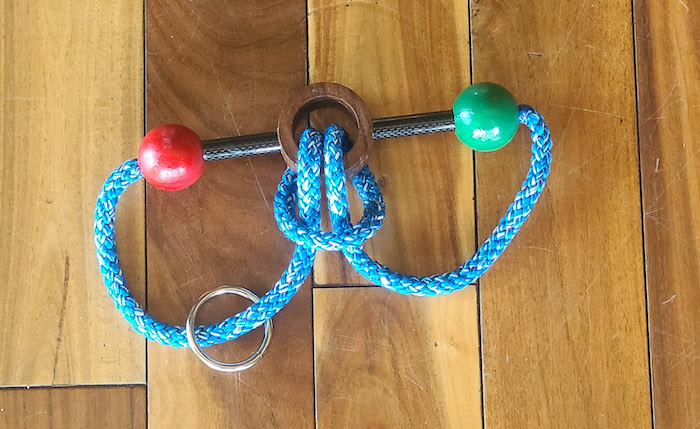
Over a large breakfast, now that our appetites had returned, the second challenge was produced by one of the other graduate students that Lee had recruited — a physicist studying string theory — so naturally he’d brought a rope puzzle for us to solve.