Hurricane Marty Overview
September 26 – Sea of Cortez
The following is the overview of Hurricane
Marty that will appear in the October Latitude 38 issue,
due to hit the stands next Tuesday, September 30. At the time,
it was the most current information available:
Hurricane Marty, the most destructive storm
to ever hit the cruising fleet in Mexico, traveled the 700-mile
length of the Sea of Cortez September 21-24 with winds reportedly
as strong as 120 knots. She left dinged, damaged, and destroyed
boats on both the east and west shores of the Sea, as well as
on the islands in the middle.
It’s impossible to come up with hard numbers
of the damage, but it seems that about 35 boats were sunk or
driven ashore, a dozen were dismasted, and more than 100 suffered
over $10,000 in damages. In most cases, the damage was to cosmetics,
bow rollers, unfurled jibs and dodgers.
Prior to Marty, the worst Baja/Sea of Cortez
cruising disaster was the Cabo Storm of ’82, which claimed 28
boats, and the early ’90s storm that claimed about 15 boats in
San Carlos. Not even Marty, however, ranks among cruising’s worst
disasters. When Hurricane Hugo tore through the little Caribbean
island of Culebra in 1989 with 200 knots of wind, 250 mostly
medium to large sailboats were pulverized on the shore. Six years
later, Hurricane Luis damaged almost as many in St. Martin’s
Simpson Bay Lagoon.
Some cruisers claim Marty is the first
storm to have run the entire length of the Sea of Cortez at near
or above hurricane force. We don’t know if that’s true, but Neil
Shroyer, who has lived in La Paz for 36 years, calls Marty “a
once-in-25-years hurricane.” Lisa, in ’76, is the only one
he can recall being stronger. The heavy rain from that storm
caused an earthen dam near La Paz to break – killing 10,000 people!
Marty is known to have claimed two civilian lives in La Paz,
but there have been no reports of cruiser injuries or deaths.
Many cruisers have been emotionally scarred,
however. The Sea is popular with retired cruisers, and for many
their boat is their most valuable possession. And probably half
of these boats are not insured. Even those whose boats survived
unscathed aren’t in the best of emotional shape. “We spent
a lot of time hugging and crying today at Marina de La Paz,”
reports Tonya Rickman of the La Paz / Eureka-based Amazing
Grace, which had just been repainted and survived undamaged.
“We embraced friends who either suffered great loss or who
– like us – are suffering from ‘survivor guilt’. Our hearts are
breaking for those who did not fare as well.”
Marty was most destructive in La Paz, although
selectively so. Based on weather reports, everyone was anticipating
70 knots of wind – similar to Hurricane Ignacio, whose winds
they’d weathered without much trouble a month before. But Marty
became ferocious. After about six hours of wind to 60 knots,
in the early morning of the 22nd it blew for about two hours
at an estimated 105 knots, with gusts to 120 knots. After a calm
of about an hour as the eye passed over, Marty started blowing
at nearly 100 knots again, this time from the opposite direction.
You can’t appreciate the force of such winds unless you’ve lived
through them – or stuck your head out a car window while doing
130 mph.
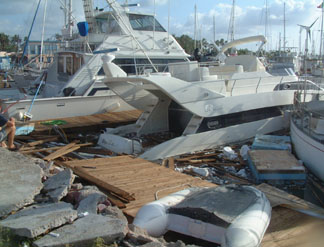
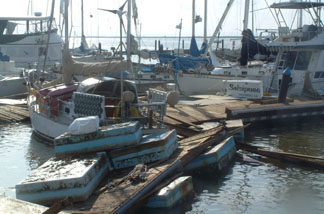
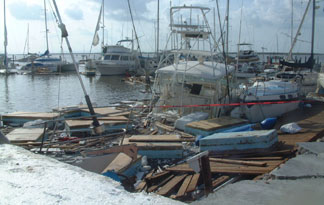
The greatest and most concentrated destruction
took place at Mac and Mary Shroyer’s Marina de La Paz, and the
adjacent Marina Abaroa. Both, according to Neil Shroyer, are
95% destroyed. Virtually all of the 100 boats in the former,
and 40 boats in the latter, suffered somewhere between extensive
cosmetic damage and complete destruction. Marina de La Paz, which
started with just six berths in 1982, had a floating as opposed
to rock breakwater on three sides, and wood docks as opposed
to newer and stronger concrete docks. These may have been two
major factors in the destruction, as just a few miles up the
road the larger Marina Palmira, which has a big breakwater and
concrete docks, was able to withstand the storm surge and six-foot
waves without significant damage to the boats.
Another spot with concentrated destruction
was Puerto Escondido, 115 miles north of La Paz. The almost entirely
enclosed one mile by three-quarter mile bay is a popular place
for cruisers to leave their boats unattended during the hot summer
months. Steady 65-knot winds, with reported gusts to 85, combined
with six-foot chop, causing boats to drag left and right. Seventeen
boats were sunk, driven ashore, or blown out into the Sea.
As of September 24, we patched together
the following picture of the storm and its aftermath, based on
phone conversations with those who lived through it, emails and
secondhand reports. The following information is certainly not
going to be completely accurate, but we think it gives a reasonably
good idea of what happened:
Cabo San Lucas – Marty passed just to the
east with Category II winds – 96 to 110 knots – which was much
higher than had been forecast. Cabo Isle Marina Office Manager
Norma Flores nonetheless reports the marina and boats came through
without significant damage. Almar’s Randy Short reports the biggest
problem is that seven semi trucks coming down from the States
with additional new docks are stalled somewhere south of Santa
Rosalia because of washed out roads.
La Paz – After a six-hour prelude of 60-knot
winds, which is what they were expecting, La Paz cruisers were
shocked by 105-knot winds gusting to 120 knots. It was so bad
that Neil Shroyer and crew at Marina de La Paz, who had been
on the docks retying boats, had to crawl on their hands and knees
to shelter in the marina office. It was at this point that the
marina – with some 20 boats whose roller furling jibs had unfurled
– started to come apart. After a lull of about an hour, the wind
came almost as strong from the opposite direction, bringing with
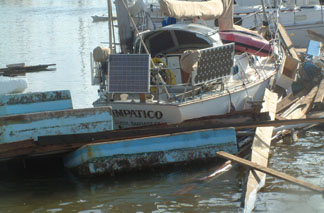
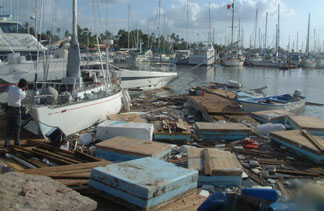
it some 25 boats from the Abaroa Marina. The change of wind direction
and onslaught of boats completely wiped out the docks, creating
a pileup of boats five and six deep against the eastern cement
embankment. About six boats on the inside of the pileup, plus
some others, sank. Many others were just jammed together, causing
tremendous cosmetic damage.
“My Rhodes Pearson 41 Novia,
which has been my home for 18 of the last 27 years, 13 of them
in Mexico, started to meet her demise when the docks at Marina
de La Paz broke loose, carrying her with them,” writes Neill
Randall, describing what happened to his boat. “She then
struck a broken-off piling, which holed her on the port side,
sending her to the bottom. That left Bill Robertson of Shazaam,
my loyal friend, to have to jump for his life. Novia was
finished off when a 60-ft expedition boat blew down and crushed
her, then sank on what was left of her. Now that I’ve lost all
that I own – including my professional tools – I’m emotionally
overwhelmed by friends coming to my aid. Although I’m recovering
from back surgery in California, it’s going to take more than
Marty to keep me down and off the water.
As previously mentioned, Marina Palmira
suffered little damage, as did the Berkovich Boat Yard. Astilleros
Dry Storage made improvements to their boat stands after many
boats were knocked over by Juliette in ’01. All the boats on
stands survived Ignacio, but three of them were knocked over
by Marty. We haven’t been able to get any specifics on how many
boats were anchored out in the bay – who would know – and what
happened to them. We presume that most of them, like Clipper
de Haro – were lost.
As for the future, Mary Shroyer, who with
husband Mac was in San Diego when Marty hit, says they will rebuild.
“What else is there to do?” she asked, not sounding
particularly bitter or sad. “The biggest problem we have
right now is clearing the six or so sunken boats out of the way.
Most of the other boats have been able to move down to Marina
Palmira, which fortunately had a lot of open slips, or other
places.”
Puerto Escondido: Cruisers in this small
bay were lucky that it was daylight when they were hit by 65-knot
winds with gusts to 85 knots. Even so, there was so much rain
and spray they often couldn’t see the boat nearest to them.
Craig and Marsha of Shaula report
that the following boats went aground: Ollie, Black Tender,
Debutante, Distant Vision, Ericazona, Kathleen II, La Serena,
Sambita, Toy Boat, Wild Flower and Mahayana. Boats
that sank include Vagabond Lover, Revellededos, Hi Jinx, Zinfandel
and Discover Baja.
Two days after the storm, Tim Schaaf of
Casual Water reports that the 20 or so crews on hand –
many of the boats were unattended – had begun starting to pick
up the pieces. La Serena and Toy Boat were refloated
with no apparent damage. Ollie was left aground because
of a hole, as was the trimaran Distant Vision, which was
found in the mangroves. Mahayana, having been blown out
the entrance, was found about 10 miles away at Isla Danzante
with a giant hole in one hull. A 20-foot patch was put on her,
and she was towed back to Escondido, listing badly and in need
of major repair. Winsome had also floated out, and was
found very high and dry between Escondido and Canderleros. But
she can probably be saved. Wildflower appears to be undamaged
in the mangroves, but is so high up it may be hard to refloat
her. Debutante has been secured and should be fine.
Schaaf reports that there have many big
heroes in the aftermath at Puerto Escondido. One is boat watcher
Elvin Schulz “who has been everywhere in his panga, in the
harbor to several miles away, helping nonstop. He has had no
rest.” Then there is Larry of Champagne, “who
seems to have spent every waking hour underwater, probing, patching,
and repairing.” But Schaaf has saved the indispensable heroes,
Robin and Martin of The Cat’s Meow, for last. “The
Cat’s Meow is the big, classic, single screw wooden trawler,
and she’s the only vessel around with the oomph and willingness
to drag, tow, or haul anything in the harbor. Her big single
screw has been working overtime. Sometimes with dinghies pushing
on her sides like bow thrusters, she has been central to every
bit of heavy lifting and dragging and towing that we have done.
Robin and Martin have been absolutely unstinting in their efforts.”
Santa Rosalia: It was reported that six
boats rode out tropical storm force winds inside the harbor –
“although the docks broke apart, as usual.” The boats
tied up to the pilings and survived.
Conception Bay: Although the wind peaked
out at 75 knots, four boats weathered the storm at Santa Barbara
Cove. A small, locally-owned sloop went ashore.
Puerto Don Juan (near Bahia de Los Angeles):
At least 24 boats chose to ride out Marty in this well-known
hurricane hole. Although the storm went just east of them, they
got a reasonably light 55 knots of wind and suffered no significant
damage. This might have been partly the result of scrupulous
preparation. Before Ignacio was scheduled to strike Don Juan
last month, all the boatowners gathered for several seminars
on how to best prepare for a hurricane. They must have been good
students.
Bahia Willard: This well-protected but
seldom-used hurricane hole had three boats – believed to be Patches,
Island Sonata and Suka – riding out the 40-knot winds.
All three survived, having come over from Puerto Refugio.
Puerto Refugio: “Hurricane Marty was
supposed to go to San Carlos so that we would only feel the peripheral
effects at Puerto Refugio,” report Rich and Donna aboard
the Catalina 38 Aries. “In the 90 years of recorded
storm history, no hurricane-strength storm has ever gotten this
far north, so we elected to stay put. Then Marty headed straight
at us, so there was nothing we could do but make the best of
it. If we’d anticipated wind over 30 knots – much less 65 knots
– we would have removed all sail and the dodger. As it was, the
jib came unfurled and shredded, the dodger exploded, the steering
cable snapped, the anchor snubbers broke, the anchor tore out
of the bow roller and, with a stanchion, bent the roller 90 degrees.
Alive and without major structural damage, we have learned to
never, ever let your guard down when it comes to hurricanes.”
The Crealock 37 Spirit Healer went
up on the rocks, suffered a very large hole, and was last seen
almost submerged. The husband and wife crew spent the night ashore
in a small cave in the company of two marooned pangueros.
The sailboat Mirador also went up
on Refugio, but had better luck. Even though she landed on sand,
her hull cracked, and it was assumed she’d be lost. But then
there was a 180 degree windshift, so the skipper set the jib,
and after about 20 minutes of grinding her hull on the sand,
sailed back out to deep water!”
San Carlos: Compared to the boats on the
Baja side of the Sea, those in the San Carlos area did pretty
well.
Marina Seca Dry Storage: Out of 600 boats
in dry storage, only Blue Moon, Sun Ray and Glen David
partly tipped over. After a previous hurricane, Marina Seca
uses special hurricane proof stands.
Marina San Carlos: Two boats broke loose
on the marina office side, but the staff dealt with it quickly
without damage to the boats.
Bahia San Carlos: The marina people towed
as many boats as they could into the marina, so only about 10
were still out in the bay. Of those, Viva, Canta Mar, Toad
and El Dorado all went on the rocks or the beach on the
side toward Marina Real. Three boats weathered the storm while
still on mooring balls. Toru dragged her mooring and two
anchors across the bay, but stopped short of going on the beach.
Marina Real Dry Storage: Poppy,
a DownEaster, is tipped over against the next boat – looks like
damage to both. Dream Catcher is tipped also, and Sasi
Lee lost part of her bridge. It’s also reported that Magic
Mist, a Freeport 36 was tipped, dismasted, and suffered damage
to a rail.
Marina Real Marina: Sections of dock in
various locations in the marina pulled loose, and some ended
up against the shore open the side opposite the banos.
One boat lost her mast and there were lots of shredded jibs.
Many of the houses on the beach at the old Club Med site were
destroyed by high waves.
That’s the best we’ve been able to put
together in one day, we’re sure they will be more next month.
This is just the beginning, of course. The next stage is insurance
claims and repairs. Will the claims be handled quickly and to
everyone’s satisfaction? Right now there are rumors that one
popular policy has language saying it is void if a boat is stored
or layed up with the sails left on. What, everyone is suddenly
wondering, is meant by “stored or layed up”?
Lastly, there is sure to be discussion
about boats left unattended and/or with furling sails left on
during hurricane season. Do these boats pose an unacceptable
risk to other boats? Should these practices be made illegal?
|