Skip to content

May 8, 2002


Photo of the Day

May 8 – Brittany, France

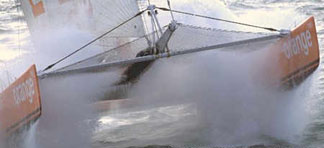
Today’s Photo of the Day is of Bruno Peyron’s
Orange, and comes from the madforsailing.com
Web site, which today features the first segment of an excellent
two-part interview with Peyron.


Photo Gilles Martin-Raget/www.martin-raget.com

Folks not familiar with Peyron might assume
the 46-year-old – who had sailed around the world twice non-stop
on multihulls and came up with idea of The Race – is some kind
of wild man. Au contraire! Despite having done 280,000
ocean miles on big multihulls, Peyron is a very conservative
sailor, and told Boyd that a big part of picking his crew was
getting guys who would accept the philosophy that with a big
multihull, unlike a monohull, you don’t always sail with the
pedal to the metal. The reason is that big multihulls are capable
of such great speeds that catastrophe would be the result of
never backing off. Indeed, on both his Jules Verne record runs,
Peyron opted to heave to. How do you drop the main to heave to
in 60 knots of wind? Check out the interview at madforsailing.com.


Getting Bashed on the Way Up Baja

May 8 – Baja California

Bob Fraik of the SC 52 Impulse has
the latest on boats getting hammered doing the Baja Bash:

“Two boats, Wings and Blarney3,
diverted to San Carlos to help Rob and Kristen on the Pearson
36 ketch Sol Mates, which lost her steering. Wings
had the parts to make the steering cable repair. Adam on Blarney3
arrived this morning and was going to help Rob with the repair.
We’re still not sure if we are going down to help them bring
Sol Mates the rest of the way home. I talked to Adam and
Rob briefly this morning via SSB and it sounds like they have
everything under control, so I probably will not need to go.

“Another unfortunate situation has
developed with the boat Brass Ring. During this morning’s
Amigo Net, Brass Ring called in with a medical priority.
The skipper reported that the boat’s engine is out and that she’s
slowly taking on water. The skipper has leukemia, was extremely
fatigued, and was having medical issues. He requested assistance,
so I called the Coast Guard, who then contacted the Mexican Navy
Search and Rescue. We have been in contact with the Coast Guard
several times today, as we have been trying pass messages back
to Brass Ring. The Coast Guard has arranged for a helicopter
to pick up the skipper – who is apparently singlehanding – from
San Juanico. At last word, Brass Ring did make it into
San Juanico.

“I also overheard that Fantasy
dropped their rig. There were no injuries reported. I’m not
exactly sure where they are.”

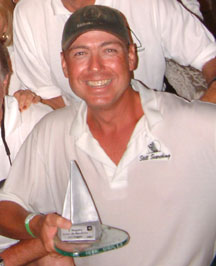
As we reported earlier, Rich Mullinax of
the Martinez-based Beneteau 446 Still Searching decided
to come north using the Clipper Route as opposed to doing the
Baja Bash. It worked out well for him. Check out his report in
the June issue of Latitude
38.


Rich Mullinax
Photo Latitude/Richard


Volvo Ocean Race

May 8 – Atlantic Ocean

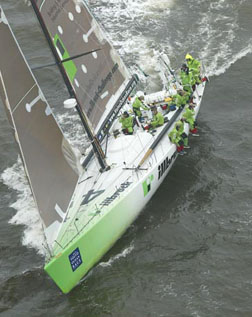
John Kostecki and illbruck continue
to maintain about a 40-mile lead over Mark Rudiger and Assa
Abloy
in the transatlantic leg of the Volvo Ocean Race. Kostecki
and illbruck seem to have profited from their extreme
preparation for the race, as they’re almost always just a little
faster than the competition. If illbruck wins this leg,
they virtually have the event wrapped up.

For what it’s worth, Volvo paid $7.5 million
to acquire the rights to the event, and another $25 million to
run it. Are they getting their money’s worth?


Photo Daniel Forster/illbruck Challenge


It Was No Bash Up the Red Sea

May 8 – Red Sea

If there’s one common passage in the world
of cruising that has a worse reputation than the Baja Bash, it’s
the northerly trip up the Red Sea. It’s about the same distance
as the BB, and the battle is against the same strong winds on
the nose. Ironically, some boats had an extremely unusual – and
easy – trip up the Red Sea this year. Tom Rakelly and family
of the Portland-based Cascade 36 Voyager, for example,
reported that they only had 17 miles when the wind was on the
nose. To our mind, this is the equivalent of having summer winds
out of the east on San Francisco Bay for 29 out of 30 days. In
fact, we wrote to ask confirmation. This is the reply that we
got:

“The wind was reported to be abnormal
this year by the Harbormaster Philip at Abu Tig Marina in Egypt.
But we don’t know this as a fact, being that this was our
first trip in the Red Sea. However, we only tacked
into the wind for 17 miles, all the rest of the time
the wind was coming from behind the beam. We did use Wetteronline.com for
our weather forecast. Each morning on the radio net, a yacht
would read the Wetteronline four-day forecasts. They proved to
be very accurate. There were several yachts – Sea Glass
out of Dana Point and Star of the West out of Auckland
– that sailed the entire way without sailing into northerly winds.

“Tony and Terry of the Richmond-based
Ericson 39 Maverick – often featured in Changes
– are stuck in Abu Tig Marina getting their engine rebuilt. The
two of them wanted a Red Sea experience to remember, so
he sailed non-stop from Massawa to Abu Tig, bashing headwinds
almost every day – and ‘wine-ing’ about his helpless state every
day on the morning net. His story has a sad ending, as it
only took us three more days than them to get north, and we got
to see so much more of the coast and the reefs, which were just
beautiful. Tony is a great guy and a better man than me for sailing
the Red Sea non-stop, but I think we did it a better way.”


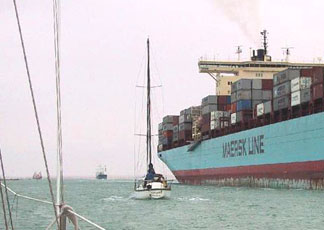
Voyager in the Suez Canal
Photo Courtesy Voyager


Three Men Overboard

May 8 – Santa Cruz

“The recent Moore 24 Nationals at
Santa Cruz featured three days of good racing in mostly 15-20
knot winds and three-foot seas,” reports Skip Allan of the
Wylie 28 Wildflower. “You wouldn’t think falling
overboard was a serious risk in such conditions, but during Race
3, one of the leading boats did a windward broach while planing
under spinnaker – and two cockpit crew and the helmsman were
flushed overboard. After spending about five minutes in the 52-degree
water, two of the swimmers were recovered by their remaining
two crew, who did a great job in dousing their spinnaker and
making a return. Their helmsman, however, was in trouble and
sinking fast. His race-required lifejacket was not keeping him
afloat, and only the top of his head was visible when I pulled
him alongside using a Life-Sling polypro rope. Being a singlehanded
spectator to the racing, I was unable to lift him aboard amidships,
but did manage to get him aboard via the stern ladder. Despite
coughing up a lot of water, he was recovering well by the time
we reached the dock. But it was a near thing, and in another
minute he may well have sunk for good. I feel the direct cause
was the Musto Regatta lifevest he was wearing did not provide
the minimum flotation to keep him afloat. This popular brand
of lifevest is worn by many sailors primarily for its comfort,
not for its life-saving ability. It is not Coast Guard approved,
and only gives nine pounds flotation when new. It appears the
flotation of bubblewrap filling is subject to deterioration,
especially when hiking hard against lifelines. If you go overboard
wearing cold water sailing gear and boots, this type of lifevest
may not keep you afloat.

“With all the comfortable, Coast Guard
approved, foam filled lifevests now available, it is a mystery
to me why regatta organizers currently allow such non-approved
vests to satisfy their PFD requirement. Judging from the Moore
24 incident, this is a false sense of security and nothing more.
If you or your children rely on such a vest in Northern California
sailing conditions, I would give it a second look. The tragedy
of Larry Klein is too fresh to be forgotten.

“My participation in the recovery was non-heroic, but rather
what any professional seaman would have done in the circumstances.
Nonetheless, it was discouraging to me that about 12-15 racers
passed in proximity to the swimmers, but nobody stopped or came
back, except for the boat that had lost the crew over! The two
excuses that I heard were ‘we were going so fast that by the
time we would have doused, we were past them,’ and ‘we saw other
boats in the vicinity, and thought they were taking care of things.’
I don’t wish to make an issue of this separate part of the day’s
happenings, other than to point out that the very first racing
rule of Part 1, Fundamental Rules, Rule number 1 is ‘A BOAT OR
COMPETITOR SHALL GIVE ALL POSSIBLE HELP TO ANY PERSON OR VESSEL
IN DANGER.’ Which brings up an interesting question. At what
point is a person overboard ‘in danger?’ In the tropics, it may
be one thing, and in 52-degree water with wind waves, it may
be another.

“Interestingly, as I sailed close-hauled
on starboard tack to the scene of the three swimmers, a port
tack tailender, not under spinnaker, came barreling at me, shouting
‘get out of the race course!’ When I pointed out the swimmers,
they stopped shouting at me – but sped right on by. Again, I
do not wish to criticize the participants in the Moore Class
Nationals, as many are my friends. In the heat of action, sometimes
decisions can get blurred. But lives could have been lost in
this situation.”

Can we all agree that any sailor who has
gone overboard in Northern California waters is ‘in danger’,
and that nobody should ever sail by someone – or group – who
has gone overboard, at least until they are absolutely, positively
certain that a successful rescue is underway?


YOTREPS

May 8 – The Pacific Ocean and Cyberspace

Who is out making passages in the Pacific
and what kind of weather are they having? Check out YOTREPS –
‘yacht reports’ – at http://www.bitwrangler.com/yotreps/


Weather Updates

May 8 – Pacific Ocean

San Francisco Bay Weather

To see what the winds are like on the Bay
and just outside the Gate right now, check out http://sfports.wr.usgs.gov/wind/.
The National Weather Service site for San Francisco Bay is at
www.wrh.noaa.gov/Monterey/.

California Coast Weather

Looking for current as well as recent wind
and sea readings from 17 buoys and stations between Pt. Arena
and the Mexican border? Here’s the place – which has further
links to weather buoys and stations all over the U.S.: www.ndbc.noaa.gov/stuff/southwest/swstmap.shtml.

Pacific Winds and Pressure

The University of Hawaii Dept. of Meteorology
page posts a daily
map
of the NE Pacific Ocean barometric pressure and winds.

Pacific Sea State

Check out the Pacific Ocean sea states
at: http://www.mpc.ncep.noaa.gov/RSSA/PacRegSSA.html.

For another view, see http://www.oceanweather.com/data/global.html.


Top
/ Index of Stories /
Subscriptions
/ Classifieds
/ Home

The De-Naming Ceremony
I once met a man in Florida who told me he’d owned 24 different yachts and renamed every single one of them.