Sydney-Hobart Racers Approach the Finish
December 28 – Hobart, Tasmania
Five of the Volvo Ocean 60s and the Swedish
maxi yacht Nicorette have rounded Tasman Island and are
sailing, albeit slowly, the final 30 nautical miles across Storm
Bay and up the River Derwent of the 57th Sydney Hobart Yacht
Race. They have set the stage for one of the closest mass finishes
in the history of this event. The leaderboard on the Volvo Ocean
Race Web site has the leaders changing places frequently, and
we won’t know the winner until the gun has gone off. illbruck,
the leading yacht at the last sked (position report) did not
report in at Tasman Island. The Australian Volvo racer, Team
News Corp, was first to report their rounding time to Race
Control at the Royal Yacht Club of Tasmania at 0242 hours this
morning (local time), giving an ETA at the finish off Hobart’s
Castray Esplanade of 0745 hours. Her time was only two minutes
ahead of Tyco, at 0243 hours. Then came Amer Sports
One at 0253, followed by Nicorette at 0258, both yachts
improving their positions since the last sked. Next came Assa
Abloy followed by djuice.
Reports indicate less than 5 knots in the
area south of Tasman Island, and Assa Abloy and Nicorette
appeared to have made the best time over of the past six hours.
Tyco is not eligible for line honors in the Sydney-Hobart
and even if she finishes first across the line will not get a
gun because the Race Committee has scored her DNF for failing
to comply with the strict safety rule requiring yachts to report
in when abeam of Green Cape. Tyco has indicated that she
will seek redress against the Race Committee’s decision, with
an appeal to the International Jury.
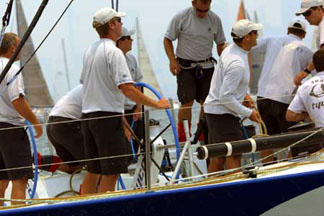
Tyco at the start of the Sydney-Hobart
Photo Peter Bentley/madforsailing.com
SEB has
retired from the Sydney-Hobart, as well as Leg 3 of the Volvo
Race, after the main rudder’s bottom rudder bearing went to pieces
last night and the rudder broke away from the hull. The crew
managed to salvage the rudder before it went to pieces and installed
the emergency rudder. The damage occurred 70 miles north of Tasmania’s
northeast tip while doing 10 knots in strong southwesterly breezes.
A great deal of water flooded the boat until before the watertight
hatches were closed and the hole in the hull, due to the missing
rudder, was plugged. When the damage to the bottom rudder bearing
was discovered, it had already broken from its hull fastening,
and the main issue was ensuring that the rudder would not break
to pieces or damage the hull. “This is a very hard blow
for all of us in the team, being stopped for the full leg by
things like this is very unfortunate,” reports skipper Gurra
Krantz from onboard. SEB will get only one point for this
leg.
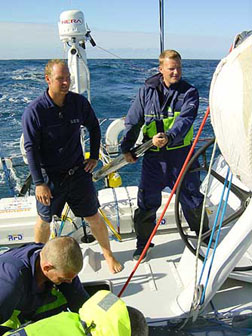
Steering with emergency rudder
Photo Magnus Woxén/Team
SEB
SEB is
now motoring in almost no wind, and is expected to get in to
the docks in a few hours. After having examined the rudder damage,
the crew is estimating the same rudder blade can be used, and
that the damage can be mended fairly quickly.
A pressurized part of the water ballast
system on Amer Sports One exploded and almost drowned
Pete Pendleton plus one of the navigation computers. Roger Nilson
reports that, “Water was spraying everywhere and suddenly
we were badly wounded. Pete and Pepe Ribez got very busy starting
the repair work as we found ourselves and all other boats becalmed
under a cloud of smoke from the bush fires. We did not dare to
take out the ballast water on port side, but when new breeze
filled from southwest we had to drop it all. We were on starboard
tack where we still could fill water. An hour later, when a scary
waterspout approached, ripping off the surface of the ocean with
60 knots of furious winds, we blew out jib #3 while taking it
down. As the spout passed and turned the wind into southeast
we had to tack to port again. But now we had no water ballast
and had to nurse the boat under three reefs and storm jib as
the wind was still 35 knots.”
It takes a lot to scare a hardened ocean
racer, but even John Kostecki admitted to being seriously frightened
after a waterspout chased illbruck across the Bass Strait.
“At the same time I saw the waterspout to leeward, Richard
[Clarke] noticed one developing to windward of us. This one developed
quickly and formed a vertical funnel cloud down to the water.
It was an incredible sight. Those of us who have sailed offshore
a lot have seen several of these, but normally from a distance
of 5-15 miles. This one developed quickly about two miles from
us and started racing right at us. So we tightened sheets and
tried to make some windward gauge on it. The spout started moving
to leeward of us at a quick pace of 40 miles an hour. Then, it
started changing direction. I guess the southerly winds started
to steer it more and it was headed directly at us about half
a mile away. Scary sight. We bore away and tried to run away
from it and we dropped our jib. The wind built to 50 knots as
the waterspout got closer to us. I asked for everyone onboard
to have their harnesses on and to be ready for anything. We started
running away from it and it appeared to be passing to windward
of us, but then suddenly it changed course again, the warm westerly
winds started pushing it offshore directly at us again. Now it
was only 400 meters away, blowing 60 knots and this huge spiraling
cloud was nearly on top of us. We had to change course again,
90 degrees up so that it could pass to leeward. There was a moment
where we were all just silent hoping that it would pass by us.
It came very close to us, about 200 meters, and it slowly passed
in front of us and went to leeward. We saw 63 knots on the windspeed
dial at that time. We had a helpless feeling, where this freak
of nature was chasing us down. Nobody onboard has ever experienced
anything like this and we all hope we never do again.”
SEB’s
Gurra Krantz observed that not all the Sydney-Hobart fleet emerged
as unscathed as the hardy Volvo 60s. The waterspout, he said,
looked “like a gigantic vacuum cleaner coming down to suck
away all the tiny boats littering the water. It was formed very
quickly and picked up speed immediately. It went for the maxis
Wild Thing and Nicorette, as they had to take the
sails down. Wild Thing ended up right in it and had to
retire with torn sails.”
Nicorette’s
skipper thought he might die. Ludde Ingvall, one of the most
experienced sailors in the fleet, said: “I really feared
for my life. It was the most unbelievable thing I have ever seen.
I saw it coming and tried to out-run it. It looked like it was
going behind us, but then it turned and got us. I was looking
up a tunnel of water and could feel my jacket riding up my back.”
The water spout rained hailstones the size of golf balls down
on Nicorette, shredding its new mainsail. The Swedish
79-footer lost the lead and dropped back to ninth after the incident,
and is racing under her spare main. Nicorette had been
the Sydney-Hobart pre-race favorite.
‘Lectronic Latitude will be visiting more
southerly latitudes next week, so for results of the Sydney-Hobart
Race, see www.s2h.tas.gov.au/2001/home.php
To follow the Volvo Ocean Race, see www.volvooceanrace.com
|