Blame It on Corporation Law and/or the America’s Cup Deed of Gift
January 31 – San Francisco
For the last six months, everyone – ourselves included – assumed
that the negotiations between Oracle Racing and the St. Francis
YC of San Francisco would result in Oracle competing for the 2003
America’s Cup under the burgee of the St. Francis YC. After all,
Oracle’s Larry Ellison races his maxi ‘Sayonara’ for the St. Francis,
and many of the key players in Oracle Racing have deep roots with
the club. Nonetheless, Oracle Racing and the St. Francis announced
on Saturday that they would be unable to reach an agreement because
“the St. Francis YC could not satisfy Oracle Racing’s requirements.”
What the heck, we wondered, was it that Larry Ellison wanted
from the St. Francis YC that they were unable or unwilling to
give? Money is always a prime suspect in break ups, but as Ellison
is the second richest man in the world, that surely couldn’t be
the case. And wasn’t. Indeed, when Ellison first met with the
club, he told them, “I don’t want your money, I want your
support.” Well, perhaps Ellison wanted a permanent slip for
his 192-foot motoryacht ‘Izinami’ in front of the club so that
he wouldn’t have to drive all the way from Sausalito. Naw, that
couldn’t be it, either.
Before we go any further, we’ll let you in on the surprise
ending. Ellison still plans on winning the America’s Cup. He still
plans on defending it on San Francisco Bay. But the way things
look right now, he may have to do it under the burgee of a Southern
California yacht club!
During a telephone conversation this morning with St. Francis
YC Commodore Steve Taft, we were told that the negotiations between
Oracle Racing and the St. Francis YC – which were always “most
amicable” – broke down over the issue of control of the America’s
Cup effort. “Ellison wanted the St. Francis to amend its
articles of incorporation and by-laws so that he could put three
of his people on the board of directors. But since the St. Francis
is a California corporation, the law requires they be elected.
So the club couldn’t legally comply with Oracle Racing’s request
even if we wanted to. Other possible solutions were explored,
such as appointing three directors that would only have control
over the America’s Cup effort, or somehow being able to guarantee
the results of an election of a slate of board members. But after
checking with our lawyers, we found that we couldn’t legally do
any of these things.”
If the America’s Cup Deed of Gift stated that the competition
was between individuals, Ellison would surely compete while flying
the St. Francis burgee. But the deed states that the competition
is between yacht clubs, which means they – rather than individuals
such as Ellison – control the event. As such, it’s possible that
Ellison could put up $80 million to win the 2003 Cup for the St.
Francis – and then have the club’s board of directors at that
time decide to hold trials for a defender for the next cup. As
such, it’s possible that Ellison could win the cup for the St.
Francis and then not be able to defend it for them. This is a
possibility that Ellison – who is accustomed to usually getting
his way – apparently would prefer not entertaining. And who can
blame him?
So the bottom line is this: No matter how good the friendships
are between the members of the St. Francis YC and Oracle Racing,
the St. Francis is legally prohibited from giving Oracle Racing
the control Ellison feels he needs. Thus the inability to come
to terms.
What now? Oracle Racing is apparently approaching the California
YC of Marina del Rey, which unlike most yacht clubs in California,
is a private club. In fact, it’s owned by the Hathaway family,
which owns golf courses and other clubs. Because it is a private
club, it’s possible that the California YC can give Ellison the
control of the America’s Cup effort that he requires. Ellison
could, of course, buy just about any private yacht club he wanted
and thereby control his America’s Cup effort. In any event, Oracle
Racing has told Taft that no matter what happens, they are committed
to bringing the America’s Cup to San Francisco Bay.
The Race: A Month Already, Time
to Take Stock at the Halfway Mark!
by Pierrick Garenne
Translation by David Palmer/SeaSpeak
January 31 – Southern Ocean
It was exactly one month ago today that The Race started in
Barcelona for a no-limits dash round the world. On January 31,
2001, at 1900 GMT, ‘Club Med’ had exactly 12,579.6 miles left
to go to the finish in Marseilles. By yesterday evening the leading
boat had covered 13,796.15 miles at an average speed of 19.00
knots. That is an exceptionally high speed and exceeds the speed
expected on paper which stood at 17.00 knots yesterday… So
it’s time to take stock of performance, technical aspects, medical
aspects, weather and general day-to-day matters whilst ‘Club
Med’ continues on her way towards New Zealand and had at 1100
GMT today a 726.6 mile lead over ‘Innovation Explorer’. Both
boats have been sailing at the same average speeds over the last
24 hours, or 24.4 knots for the first and 24.9 knots for the
second.
Performance-wise… The two leading catamarans have shown
their extraordinary potential by lining up several days in the
Southern Ocean of more than 500 miles. The speedos have been
nudging instantaneous speeds in excess of 30 knots, and ‘Team
Adventure’ has recorded several peaks of over 40 knots in steady
36 knot winds. The best days were recorded in the Southern Ocean
for ‘Club Med’ (600 miles on 1/25 at 25.02 knots), ‘Innovation
Explorer’ (604.47 miles on 1/30 at 25.19 knots) and ‘Warta-Polpharma’
(506.80 miles on 1/26 at 21.12 knots). For ‘Team Adventure’ it
was along the Brazilian coast in the southeasterly Trade Winds
(617.44 miles on 1/17 at 25.73 knots). For ‘Team Legato’, it
was in the Northern Hemisphere, or in the northeasterly Trade
Winds (429 miles on 1/13 at 17.87 knots). So it is ‘Team Adventure’
that currently holds the record for the greatest distance covered
in 24 hours in The Race: or 617.44 miles at an average speed
of 25.73 knots. That is very close to the mythical outright record
for the distance sailed in 24 hours, just 8 miles or 14.8 km
short of it… But the race is far from over yet!
The Cape to Cape reference time has been beaten twice in two
days during The Race. The theoretical distance between the Cape
of Good Hope (18°30′ East) and Cape Leeuwin (115°10′
East) is 4,546 miles (distance calculated between their respective
longitudes along a great circle route, or the arc of a circle
that wraps round the Earth’s surface). This distance is shortest
at 40° latitude. If we were to provide a concrete example,
the distance between these two capes is equivalent to a Route
du Rhum, or an Atlantic crossing between St Malo (France) and
Pointe-à-Pitre (Guadaloupe). It was ‘Club Med’ that was
the first to beat the reference time held by Olivier de Kersauson
on ‘Sport-Elec’, which he set on his successful bid for the Jules
Verne Trophy (8 days and 23 hours). ‘Club Med’ cut the longitude
of Cape Leeuwin on January 28 at 0400 GMT taking just 7 days
and 18 hours to join the two capes. Two days later, on January
30, ‘Innovation Explorer’ beat this new reference time. She sailed
further south meaning that the distance sailed between the two
longitudes was shorter (4,000 miles to 3,997 miles). She took
exactly four hours less than ‘Club Med’ or 7 days, 14 hours and
10 minutes. Her average speed was 21.97 miles.
Breakages? “No structural problems but rather peripheral
problems,” analyzed Denis Horeau, The Race director. “The
breakage situation is satisfactory after one month into the race
and more than 12,000 sea miles, even more so when you consider
that some of the boats were launched just a month before the
start.” What can we note in practical terms? A problem with
delamination of the central beam fairing repaired during a forced
pit-stop in Cape Town for ‘Team Adventure’, problems with the
hinges of life raft compartments breaking (‘Club Med’ and ‘Innovation
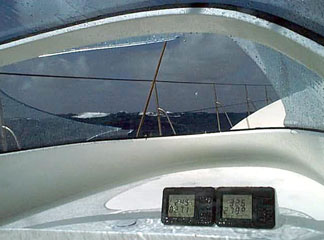
Explorer’), breakage of the Plexiglas windows of the cockpit
companionway cuddy (‘Club Med’ and ‘Innovation Explorer’) and
numerous padeyes. Also to be noted, more or less significant
sail wear (‘PlayStation’ and ‘Innovation Explorer’). ‘PlayStation’
pulled out of the race because of damage to a daggerboard and
the mainsail, on the morning of Sunday, January 14.
How are they doing physically? After a month of racing there
have been a number of medical incidents on each boat. These have
been essentially injuries following falls or knocks. Bruising
to the face, cuts and traumas of the joints, to the hands and
skin infections … All of them problems well known to ocean
racers. But the most serious incident concerned ‘Team Adventure’.
In a very violent impact with a wave, Michael Lundh who was working
on deck fell over backwards. Very shaken, he complained of an
acute pain in the neck which necessitated immobilizing it immediately
with a neck brace. Jeffrey Wargo, who at the same time was standing
up in the cabin, was brutally thrown forwards against a bulkhead.
He lost consciousness and suffered severe pain in the small of
his back, his condition was also considered to be preoccupying.
The two medical referents on board, Jacques Vincent and Frédéric
Carrère, did a magnificent medical assistance job as far
as their stopover in Cape Town. And last but not least, an ailment
that the organism has had to cope with: fatigue. Damp, brutal
motion, dreadful noise, stress and the de-phasing of biorhythms,
all these elements combine to alter the quality of sleep. “But
for the time being it seems to be going quite well,” analyzed
Dr. Jean-Yves Chauve. “But they must however remain very
attentive. On these extreme machines the slightest slackening
of attention can be very quickly sanctioned. So take care!”
Broken Plexiglas on Club Med
Photo Courtesy Club Med
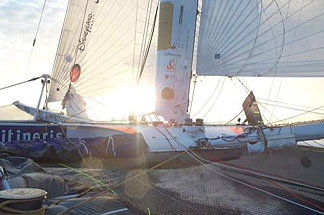
Aboard Innovation Explorer
Photo Courtesy Innovation Explorer
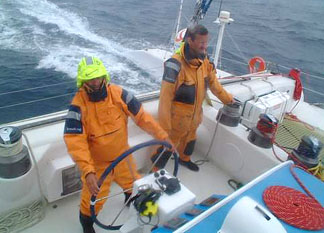
Fred Dahirel and Vyachesal Sysenko work the
cockpit on Team Legato
Photo Courtesy Team Legato
Weather analysis: “None of the maxi-catamarans have made
any strategic errors,” noted Gilles Chiorri of Météo
Consult. If we were to qualify the routes of the three catamarans,
one could say that ‘Club Med’ has been showing her mastery of
sailing in a fleet (like the Whitbread) with straight courses
seeking to keep the adversary covered. ‘Innovation Explorer’,
conscious of her speed handicap due to her lack of foresails,
has been forced to play the strategy game differently. And finally
‘Team Adventure’, the gambler, made the most of the Atlantic
to try out some daring options. Navigation in the Southern Ocean
is very different requiring the boats to follow and anticipate
weather patterns, which is quite possible with the speed potential
of these boats. Only the passage through the Cook Straits might
shuffle the pack ‘meteorologically’ speaking!
Where were they today at 1100 GMT? ‘Club Med’ was 775 miles
from the entrance to the Cook Straits: two short days sailing
unless ‘Club Med’ falls into the expected anticyclone that could
block the approaches to the New Zealand coast. ‘Innovation Explorer’
was following 726.6 miles behind. ‘Team Adventure’ is in tricky
headwinds forcing them to struggle along at 13 knots average
while ‘Warta Polpharma’ was heading northeast at 20 knots. ‘Team
Legato’ was ‘flashed’ at 26 knots instantaneous speed.
Ranking of 31 Jan 2001 19:00:00 GMT
1. Club Med / dtf 11,995.3 miles
2. Innovation Explorer / dtl 762.8 miles
3. Team Adventure / dtl 4,245.2 miles
4. Warta Polpharma / dtl 4,827.8 miles
5. Team Legato / dtl 6,180.2 miles
See www.therace.org
for situation and analysis updates every four hours.
YOTREPS
January 31 – The Pacific Ocean and Cyberspace
Who is out making passages in the Pacific and what kind of
weather are they having? Check out YOTREPS – ‘yacht reports’ –
at www.bitwrangler.com/yotreps/
Looking for current as well as recent wind and sea readings
from 17 buoys and stations between Pt. Arena and the Mexican border?
Here’s the place – which has further links to weather buoys and
stations all over the U.S.: www.ndbc.noaa.gov/stuff/southwest/swstmap.shtml.