Raising the bar of multihull innovation
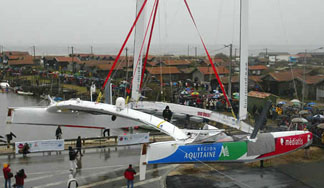
yet another notch, Yves Parlier’s just-launched 60-ft catamaran Médiatis Région Aquitaine is certainly one
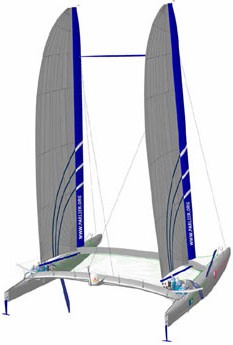
of the most radical multihulls ever built. Her design features
two identical masts (one mounted on each hull), an unconventionally
wide beam of nearly 50 feet and radical hull shapes employed
to create minimal drag.
Purpose-built to challenge the current
crop of 60-ft trimarans, Médiatis Région Aquitaine’s
4.5-ton weight is a full ton lighter than the tris. Parlier,
a veteran of three Vendée Globe Races and winner of a
numerous Open 60 campaigns, is expected to begin test-sailing
his newest toy soon in the waters of southwestern France. He
has already entered Médiatis in this year’s Transat
(ex-OSTAR).
The twelfth annual Banderas Bay International
Regatta will be held March 25-28 at Paradise Village Resort and
Marina just a few miles north of Puerto Vallarta in Nuevo Vallarta.
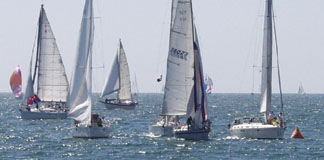
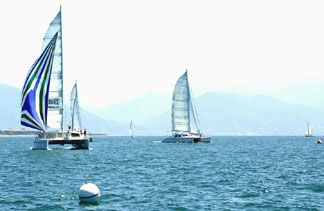
Banderas Bay Regatta start
In addition to a great racing venue Friday,
Saturday and Sunday, activities and entertainment are scheduled
every day throughout the regatta. “The Vallarta Yacht Club,
the State of Nayarit, and the Paradise Village Resort and Marina
all help sponsor the regatta to make it a fun-filled week and
very inexpensive for participants,” said regatta organizer
Terry O’Rourke. “The entry fee is just $48 per boat and
per person which includes attendance to a performance by the
famous Ballet Folklorico at the Paradise Village Resort’s 400-seat
outdoor amphitheater Thursday evening and the gala awards banquet
poolside Sunday evening,” he said. Tickets can be also be
purchased individually for the Ballet Folklorico ($16) or the
Awards Banquet ($36).
The Vallarta Yacht Club is also having
a two-day open house for everyone, with great food and live entertainment,
Friday with country band Redneck Mothers, and Saturday with world-class
Flamenco guitarists Latcho and Andrea, the ‘Gitans Blondes’.
Entry forms are available on the regatta
Web site at www.bbregatta.com
and can turned in via the Internet, fax, snail mail or in person.
All racing skippers need to complete their registration and get
them in by March 12. Registrations received after March 12 will
incur a 500 peso late registration fee.
Big cats maneuver to the start line. Yes, that’s Profligate on the left. Photos Courtesy Banderas Bay International Regatta
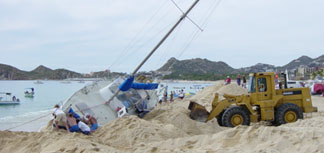
‘Petite Hurricane’ Beaches Yacht in Cabo
February 6 – Cabo San Lucas, BCS
Susie Woodrum of Sausalito, who sails the
Moore 24 Frenzy out of Tiburon YC with husband Lon, has
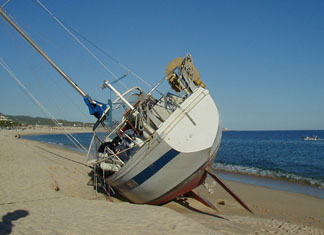
a sad story from Cabo: “We arrived here on January 19 to
stay in a friend’s villa (fancy word for a fancy condo) on the
beach. We saw this poor Coronado 41 high and dry. Nearby, living
in a tent, guarding her possessions, were the owner and her little
dog. She told us there had been a ‘petite hurricane’ the Wednesday
before. Three boats dragged anchor and ended up on the beach.
The two others were able to get off with minimal damage. She
was waiting for her insurance, the authorities, the fork lift,
etc., to all come together to get the boat to the yard.
Photos Susie Woodrum
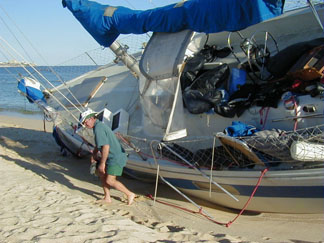
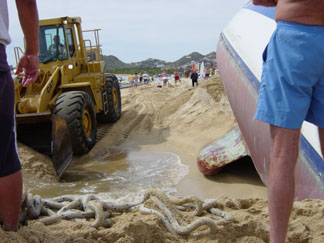
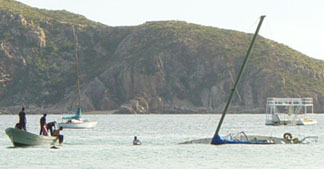
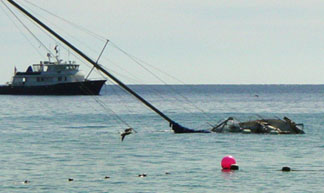
“A week later, after we had left to
come back home, my friend Pat Tostenson took the photos showing
the disastrous rescue attempt. What were they thinking? The owner
had specifically told us the boat was holed. Why they thought
it might float long enough to get it to that thing in the water
that sorta looks like a floating drydock, I don’t know.
Photos Pat Tostenson
“The name on the dinghy that had been
on the davit was Silent Sam. She said she was from Manhattan
Beach.”
Profligate’s
Progress
February 6 – St. Barth, FWI
We spent most of Wednesday at St. Kitts,
which is a lot like Catalina – except that it has a tall volcano
and a big rainforest; they have monkeys instead of buffalo; the
climate is tropical instead of temperate; the biggest crop is
sugarcane; most of the population are descendants of slaves;
it’s home to a huge fort; and it was the site of many battles
between Caribs, the French, and the Brits. We suppose what we’re
trying to say is that St. Kitts and Catalina are about the same
size.
St. Kitts isn’t the easiest place to clear
into. There’s really no place to tie your dinghy at the commercial
port. We ended up tying to a big barge that could have left at
any moment. And the clearing procedure was the all too common
fill out a bunch of papers nonsense that seems to us to be a
waste of time. In fact, lots of folks simply never check in at
the various islands down here. There aren’t many patrol boats,
so not many seem to get caught.
In many of the official offices in the
Caribbean, the radio is tuned to some music, and lots of the
officials seem to groove with the beat. At St. Kitts, we got
a kick out of the fact that the radio was playing, and the port
official was rocking to the beat of Sweet Aloha.
At least the man and the woman in the office
were friendly. We wanted to tour the island, and they got us
a great taxi guide – even though the Queen Mary 2, the
largest cruise ship in the world, on her very first cruise, was
in town, and her passengers were gobbling up most of the taxis.
Leroy, our very friendly taxi guide, charged us $60 for a four-hour
tour – or about the same price as a light lunch in St. Barth.
The tour turned out to be an excellent deal.
We like the funny stuff you find out about
places. For example, we asked if locals still harvest the sugar
cane on St. Kitts. “Oh no,” said Leroy, “none
of our people would do that. We bring workers in from Guiana.”
We also got a kick out of the fact they were building some ‘low
income’ housing on a little bluff about 150 feet above the Caribbean
Sea, with a great view. We told our driver they’d be million
dollar lots in California. He just laughed and said, “Everybody
on St. Kitts has an ocean view.”
The highlights of the tour were Basseterre,
the capital of St. Kitts & Nevis, which is one island; the
rainforest; Romney Manor, an old plantation that’s now a botanical
garden; Brimstone Hill, the ‘Gibraltar of the Caribbean; the
prime minister’s house; and an overview of the southern third
of the island. Here are some photos:
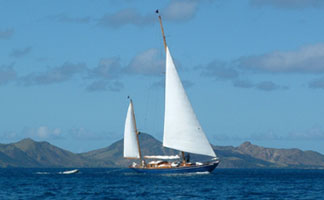
David Ray’s Newport, Rhode Island-based Nirvana, built
by Hinckley in about 1950 and meticulously maintained, enjoys
a close reach with St. Kitts in the background.
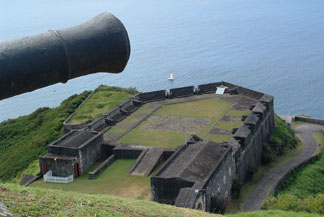
After the Brits and French joined together to massacre the Carib
Indians, with the help of a traitorous Carib woman, they split
the island. The French got the two ends while the Brits got the
middle. Yeah, as if that was going to work out. So the Brits
built Brimstone Hill, the biggest fort in the Caribbean, with
a commanding overview of the sea. They had scores of cannons
with a range of three miles. Had one of them been operational,
it would have been easy enough to lob a cannonball on the unsuspecting
Sunsail chartercat motoring below in the photo. In fact, we suggested
that the tourist attraction could dramatically increase attendance
if they’d only have live demonstrations of the cannons. Alas,
we think this great idea will go nowhere. In any event, the Brits
aimed all their guns toward the sea, overlooking the fact that
the clever French might attack from the rear. Which is what they
did, of course. After a month or so, the 8,000 French starved
out the 1,000 Brits.
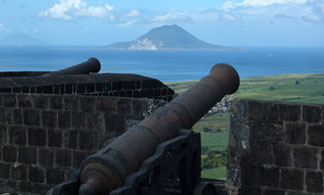
Another shot of Brimstone Hill, showing Saba on the left, and
Statia in the distance. The cannon is pointed toward Le Select
Bar on St. Barth, about 40 miles away.

St. Kitts basically has one road that follows the coast around
the island. That leaves the entire upper elevations to the rainforest,
and inhabitants such as this little monkey. We were alternately
told that the monkeys came over as pets of the Europeans or escaped
a ship that wrecked on the shore. In any event, there are now
more than 100,000 of them – about three times the number of humans
on the island – and they drive the farmers crazy.
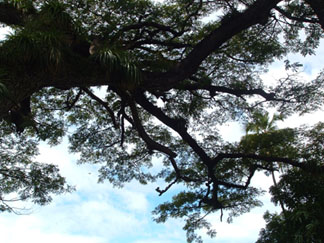
This is one tiny fraction of a single massive tree at Romney
Manor. Before Hurricane George hit, it was said to cover over
one acre! Even now, it has about 250 other plants growing on
it. A better journalist would have remembered the name of the
tree.

Doña de Mallorca always wanted to know what she’d look
like in dreads. Here she tries on some red ones.
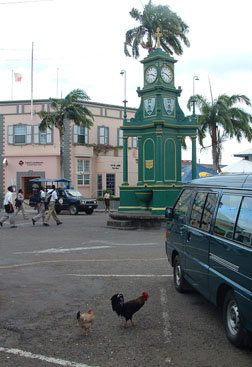
The main circus in Basseterre, capital of St. Kitts, was modeled
after Piccadilly Circus in London. You can tell this isn’t the
one in London because there aren’t any double-decker buses. Oh
yeah, and because of the chickens strolling around.
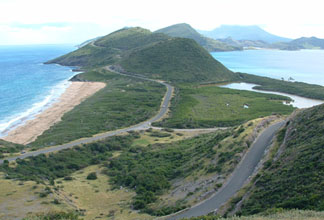
The folks of St. Kitts have, to our mind, come up with a good
plan. If non-islanders want to buy land, they can only do it
on the undeveloped south end of the island. This keeps rich foreigners
from driving the price of housing on the rest of the island out
of reach of the locals. Ironically, the south side of the island
is one of the most beautiful, and is almost totally undeveloped.
Until recently, that is. A Canadian plastics mogul apparently
put up $400 million to build a gigantic Marriott Hotel, at what
we feel wasn’t a very good site. Hilton, on the other hand, is
apparently going to build at the site seen in the photo, where
the rough Atlantic and the smooth Caribbean are separated by
only a couple of hundred yards. If you’re looking for isolated
anchorages in the St. Kitts/Nevis area, the south side of the
island is the place. There’s nobody around.
Scotland? It only looks like it. It’s actually one of the numerous
remote anchorages at the south end of St. Kitts. And it only
looks cold. The water and air are very, very warm, thank you.
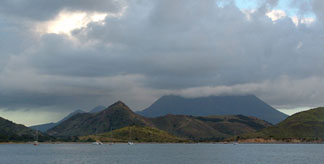
Actually, this is more than St. Kitts, as the cloud shrouded
volcanic peak in the background is Nevis, which is separated
from St. Kitts by less than two miles.
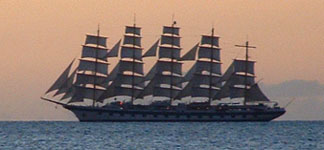
You see a lot of great boats and ships in the Caribbean, such
as this five-master. Germans apparently go crazy for these kinds
of cruises, for this is almost new and was built specifically
for the purpose. Count the number of sails! Photos Latitude/Richard
Green Light for Cheyenne
February 6 – Plymouth, UK
A reasonable weather scenario is coming
together for an imminent Round the World start. Steve Fossett
and his crew plan to take the 125-ft catamaran off the dock at
Plymouth Yacht Haven today and make the 120-mile trip to the
official Round the World Record start line at Le Stiff lighthouse
on the French island of Ouessant (Ushant). This transit to Ouessant
should take 10-12 hours – mostly heading upwind.
Their next leg will be a little longer
– totaling 21,760 miles in fact: Ouessant to Ouessant, via the
three capes – Cape of Good Hope, Cape Leeuwin and Cape Horn.
Fossett expects to cross the start line Saturday morning 0300-1200
GMT.
Cheyenne’s
target will be the 2002 record as certified by the WSSRC (World
Sailing Speed Record Council) of 64 days, 8 hours, 37 minutes
and 24 seconds – an average speed of 13.98 kts, set by Bruno
Peyron and crew aboard the 110′
catamaran Orange. See www.sailspeedrecords.com/ratified.html and www.fossettchallenge.com.
Help from the Coasties in Mazatlan
February 6 – Mazatlan, Mexico
Susan Meckley, a 70-year old singlehander
sailing Dharma, reports from Mazatlan: “I had the
water pump rebuilt the day before I left La Paz. It failed again,
about 100 miles at sea. Upon arrival in Mazatlan it was rebuilt
again, but it failed after 10 minutes. The rebuilder did not
replace the impeller. There is no replacement impeller in Mazatlan.
“But USCG Cutter 724 (Monro
out of Alameda) was here. I approached them not knowing if I
would get shot as a terrorist or what. I showed them my retired
ID card: 32 years in the army – and the engineering department
went to work fabricating a new impeller for me. It took 2 hours
– now that is what I call ‘above
and beyond’. The Coasties were there – and they helped! Thanks,
Coast Guard.
“Mazatlan is now charging $9.00 US/day
to anchor in the old harbor, $6.00 for the port captain, and
$3.00 for the dinghy dock. Better to spend $20.00/month and go
to the marina at Isle Mazatlan. The Marina entrance in Mazatlan
is open ONLY 9:30 to 10:00 am, 2:30 to 3:00 pm, after 6 pm each
day and all day on Sundays. The dredge is in operation at all
other times.”
Baja Ha-Ha Committee Currently Hibernating
February 6 – Tiburon
Although the start of the 2004 Baja Ha-Ha
cruisers rally from San Diego to Cabo San Lucas is still nine
months away, anxious would-be entrants are already calling and
emailing the Latitude 38 offices daily for dates and info
on the event. Although Latitude 38 founded the rally –
which is now in its 11th year – the Ha-Ha is now a completely
separate entity. And, unfortunately, the entire Rally Committee
has gone into hibernation until May 1, when the 2004 event will
be officially announced.
Before they slipped into deep slumber,
however, we learned that the event will begin with a Kick-Off
Party Sunday, October 24, with the start the following day. The
final activity will be the Awards Ceremony on the evening of
November 6.
The Baja Ha-Ha Web site, www.baja-haha.com,
has recently been updated with dates and details. Prospective
applicants will find the answers to many frequently-asked questions
on the site as well as a photo gallery of last year’s event.
YOTREPS
February 6 – The Pacific Ocean and Cyberspace
Who is out making passages in the Pacific
and what kind of weather are they having? The YOTREPS daily yacht
tracking page has moved to www.bitwrangler.com/psn.
Looking for current as well as recent wind
and sea readings from 17 buoys and stations between Pt. Arena
and the Mexican border? Here’s the place – which has further
links to weather buoys and stations all over the U.S.: www.ndbc.noaa.gov/Maps/Southwest.shtml.
Pacific Winds and Pressure
The University of Hawaii Dept. of Meteorology
page posts a daily map of the NE Pacific Ocean barometric
pressure and winds.