|
 |
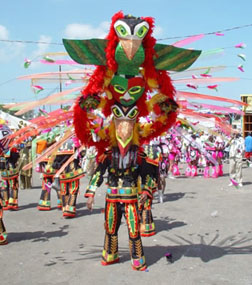
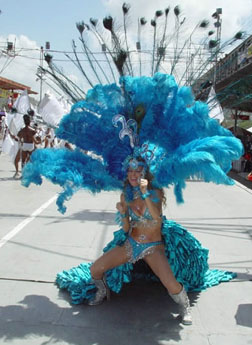
Photos of the Day: CarnivalFebruary 23 - Trinidad Today's Photos of the Day come from Carnival, which is celebrated all over the Caribbean, from Trinidad, where it almost dominates life on the island. 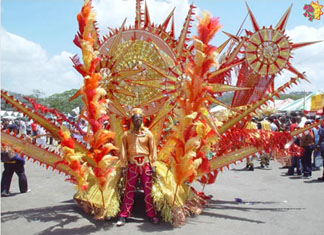 Photo Bert Allette What's Carnival all about? Here's what the folks in Trinidad, who consider themselves to be the ultimate experts, have to say about it: "Some trace Carnival to the rites of Bacchus, in ancient Greece. Some to its position in the Christian calendar (for the word 'Carnival' means farewell to the flesh' and marks the approach of Lent and its sober disciplines). Others emphasize the importance of African rhythms in the music so essential to the festivities. It is further theorized that, early in the last century, the working population took to mimicking and 'mamaguying' the colonial authorities at Carnival time, by means of extravagant costumes and an incomprehensible patois. Around the occasion, a colorful cast of Carnival characters grew up devils called Jab Jabs (from the French 'diable'), human donkeys called burrokeets, bandits called Midnight Robbers, clowns called Pierrot Grenade, giants on stilts called Moko Jumbies. Today, while their origins may be hazy, these figures can still be seen, in all their poetry, during the Carnival season. 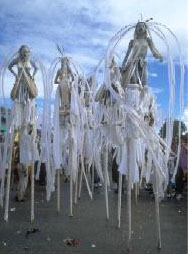 Moko Jumbies "Most countries settle in for a calm January and February before Carnival, but not Trinidad and Tobago, where the Carnival arts are public property, analyzed and judged even as they are being created. Rehearsals are attended as avidly as finals. So as you stride out into the pulsating Port of Spain evening, what's on offer? Panyards, for one. The larger steelbands invite onlookers to attend their rehearsals in their panyards throughout the season. It's serious business for the players, but there are bars and delicious snacks for visitors. You can sit and chat, sip a beer, or just drink in the sound of up to 130 pannists perfecting their crafts. 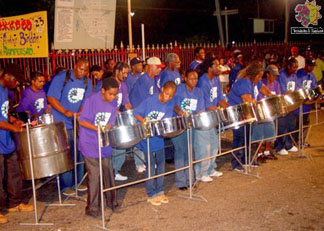 Photo Bert Allette "Then there are Calypso Tents. Trinidad & Tobago is the home of Calypso. Visitors are welcome at the several Calypso Tents that stage shows nightly throughout the season. Here, the true practitioners of the art can be heard. Up to 20 singers may perform in an evening, in an atmosphere of friendly banter and expert opinion. Nowhere will you get closer to the soul of the Trini than here. "Carnival is not a mere spectator event. The full joy of Trinidad Carnival is to play in a band yourself. Parading Bands all have headquarters, known as Mas Camps. (Mas as in 'Masquerade'.) Which band you play with is up to you. Most locals have their favorite, but a visit to the different Mas Camps will show you what costumes are available and broaden your understanding of Mas! From January onwards, the parties never stop. Trini parties (or fetes) are high intensity affairs, thanks in part to the DJs, but in particular to the astonishing standard of the live bands. While each has its own songs, each also plays the popular songs of the year. Tickets for fetes are easily acquired. Five minutes listening to a local radio station will tell you where and when! "What stokes the fires of Carnival? The music. Calypso music the very sound of Caribbean joie-de-vivre, born here in Trinidad and Tobago. Calypso, as an art form, seems to have sprung from the 'chantuelles', whose music precedes the Carnival bands of the last century, with songs parodying the issues and gossip of the day. The healthy practice of airing the ills and thrills of society never faded, and today the calypsonian still has an artistic permit to comment, poke fun and satirize. Throughout the season, the top singers are to be found nightly in the Calypso 'tents'. These are no longer actually canvas, but date back to a time when Calypso was performed in humbler circumstances. Calypsonians adopt intriguing sobriquets, so don't be alarmed to find Stalin performing alongside Baron or the Mighty Shadow. The season's songs are judged, come Carnival weekend, at Dimanche Gras, when nine of the best Calypsonians meet the defending champion, to decide who is that year's Calypso Monarch. Competition is intense. "Since the seventies, Calypso has produced an energetic offspring Soca. Soca uses the same basic beat, but speeds it up and adds a laid back bass-line and a touch of Indian drumming. It is Soca, nowadays, that keeps Trinis hard at work at their national hobby partying. Fetes are Soca exhibitions, climaxed, of course, on Carnival Tuesday. "The Frenzy. Each year, at 2 a.m., Carnival Monday morning, the greatest show on earth is born. In the early hours, the first revelers hit the streets jumping, dancing, shouting abetted, it must be admitted, by the fine local rum, but fueled more by the exhilaration of the occasion. This early 'Mas', known as 'J'Ouvert', (a contraction of the French 'jour ouvert', or 'day open'), is for the true die-hard player. It's a ritual enacted to the accompaniment of mud, oil, pitchforks and pointed tails! An elemental celebration of the darker side of human life. Hieronymous Bosch would have felt at home playing J' Ouvert. 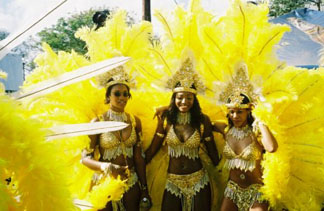 Photo www.poison.co.tt "Come daytime, 'Pretty Mas', with its massed costume band takes over. In the riot of color, sounds and movement that ensues can be found the heart of Carnival the world's largest, most peaceful, most euphoric street party. Where is the fun, (you may ask), in traipsing around, under a blazing hot sun, behind a blaring music truck, from dawn to dusk? Listen, Carnival is an occasion for release. It is a time when any and everyone is permitted to come out of themselves. Carnival gives you a license to 'play yourself', to forget what people might think, to reveal in the noise and excitement of music, people, life. It is better therapy than therapy.
"The Kings and Queens. At the peak of this extraordinary creativity are the kings and queens. Each Carnival band whether 50 or 3,000 thousand strong has a symbolic leader. Taking their inspiration from the band's theme, band designers create king and queen costumes out of wire, wheels, bamboo, feathers, anything that comes to hand. The result are images of such beauty, it is hardly possible to believe that an ordinary man or woman stands at their heart. Later in the year, Kings and Queens from Carnivals in many cities will come to Trinidad to compete in the Carnival King and Queen of the World Competition. This is in acknowledgement of the birthplace and inspiration of the art. Trinidad, Mother of Carnival." |