

October 9, 2000
Photo of the Day
The New Passes Beneath the Old
October 9 – London
| On October 6, Grant Dalton’s state-of-the-art maxi cat ‘Club Med’ passed under centuries old Tower Bridge on the way to a London publicity event for the upcoming The Race around the world race. This had to sting more than a little for the Brits, as just the day before their own $6 million ‘Team Phillips’ entry, led by former Royal Marine Pete Goss, broke down again after just 24 hours with problems related to the bottom bearing of one of the two radical unsupported windsurfer style masts. Goss’ initial assessment upon the boat’s return to her base is that the problem “is not serious.” With so little time left to qualify for The Race, even little problems are becoming big problems. Meanwhile, Cam Lewis of Maine reports that he hopes his near |
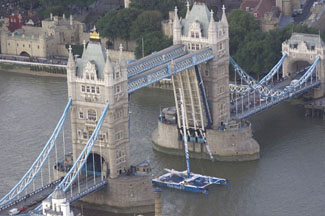 ‘Club Med’ Motoring under Tower Bridge Photo Kos Picture Source |
Weather Funnies
October 9 – Pacific and Atlantic Oceans
Something weird is happening in the tropical Pacific: the water
temperature isn’t running unusually warm – El Niño – or
particularly cold – La Niña. It’s just average, which prompted
oceanographer William Patzert of NASA’s Jet Propulsion Lab to
call it a ‘La Nada’ year. Pretty funny for a scientist, William!
In any event, it means that forecasters are having a hard time
predicting whether the winter will be wetter or dryer or hotter
or cooler than normal.
Meanwhile, the Caribbean and Florida could be devastated by a
160-ft tsunami, a wave larger than ever seen before. This according
to Simon Day of the University College London’s Hazard Research
Center. Day says the cause would be a huge chunk of Las Palmas,
the most volcanically active island in the Canaries, falling into
the sea and creating the wave. If Day is correct, you might want
to sell your waterfront property and take that boat out of Caribbean
charter service.
Tropical Weather
Tropical Storm Olivia, which had been blowing at up to 55 knots
well offshore of Mexico, has dropped to 30 knots. This is a good
thing, because she’s made a giant clockwise turn and is headed
straight for Turtle Bay and the Sea of Cortez. She should bring
rain, but not much wind damage.
It’s quiet in the Atlantic/Caribbean.
San Francisco Bay Weather
To see what the winds are like on the Bay right now, check
out http://sfports.wr.usgs.gov/wind/.
California Coast Weather
Looking for current as well as recent wind and sea readings
from 17 buoys and stations between Pt. Arena and the Mexican border?
Here’s the place – which has further links to weather buoys and
stations all over the U.S.: www.ndbc.noaa.gov/stuff/southwest/swstmap.shtml.
Pacific Ocean Weather
You can view the new University of Hawaii Department of Meteorology
satellite picture by clicking
here.

Pacific Sea State
Seas are normal in the Eastern Pacific. Check out today’s sea
state at: http://www.mpc.ncep.noaa.gov/RSSA/PacRegSSA.html.
For another view, see http://www.oceanweather.com/data/global.html.
Cruising
The Case of the Missing Oars
October 9 – Quepos, Costa Rica
| When Mark and Laurie – they didn’t send us their last name – sailed from San Francisco to Charleston two years ago aboard their Westerly Centaur ‘Radiance’, they had a strange and somewhat dinghy incident in Costa Rica. Even though it’s late, we thought we’d share it with you: “One of the strangest things happened in Quepos, Costa Rica, “Shortly after midnight, a launch with a man waving a flashlight “As time went on, it almost started to feel as though we “On the way back, we asked one of the navy guys what had “We eventually realized that this story wasn’t true at all. “Fortunately, our dinghy was recovered, so we didn’t have |
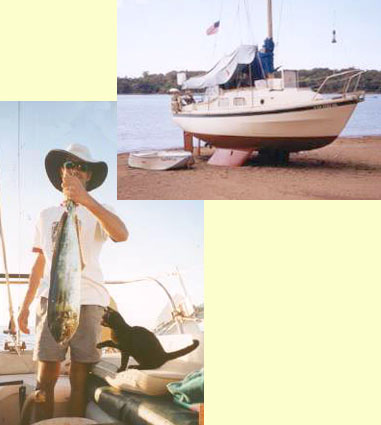 Top photo: ‘Radiance’ resting on her twin bilge keels, dinghy alongside. Lower photo: The catch of the day. 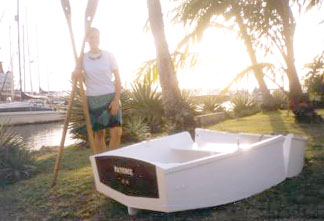 The dinghy and oars in question. Photos Courtesy ‘Radiance’ |
YOTREPS
October 9 – The Pacific Ocean and Cyberspace
Who is out making passages in the Pacific and what kind of
weather are they having? Check out YOTREPS – ‘yacht reports’ –
at http://www.bitwrangler.com/yotreps/
Racing
Voiles de St. Tropez
October 9 – St. Tropez
We sailors on the West Coast of the United States like to think
we have some big sailboats, but the truth is we don’t. Most of
the world’s big sailing yachts – we’re talking over 80 feet –
live in the Med and perhaps cruise to the Caribbean in the winter.
That the big boats hang out in the Med was evidenced by heavy
participation in this year’s Voiles de St. Tropez. Despite a pathetic
Web site, we were able to deduce that some 254 boats participated,
many of them over 100 feet in length, and many of them traditional
gaffers. To give you an idea of the kind of boats, here are some
of the more famous names:
‘Alalunga’, Swan 80; ‘Amaalta’, Pioneer 86; ‘Antonisia’, Farr
123; ‘Askherout’, Wally 80; ‘Audacious’, Frers 80; ‘Bora Bora’,
Goelette 75; ‘Braveheart of Sark’, Trully 75; ‘Genie the Lamp’,
Wally 80; ‘Gibian’, Wally 100; ‘Grand Blue II’, CNB 80; ‘K8’,
Pouvreau 75; ‘Kenora’, Wally 108; ‘Leopard’, Reichel/Pugh 90;
‘Magic Carpet’, Wally 77; ‘Mari-Cha III’, Briand 146; ‘Merit Cup’,
Farr 80; ‘Mr. Gecko,’ Wally 114; ‘Never Say Never’, C/N 98; ‘Opium’,
Baltic 88; ‘Our Blue Dream’, Unknown 121; ‘That’s Y’, Discon 98;
‘Tiketitan’, Wally 88; ‘Tuamata’, Wally 78; ‘Unfurled’, 112 Sloop;
‘Velsheda’, J Class 128; ‘Wally B’, Wally 107; and ‘Yam’, a Wally
108. We left out Roy Disney’s R/P 75 ‘Pyewacket’, which not surprisingly
to us, the French identified as a Swan 75. Oh boy! If you think
this list isn’t that long, it isn’t, because we’re saving a list
of the big classic boats for tomorrow.
The winds around St. Tropez are capricious, and this year was
no different. There were lots of postponements, and the last day
of racing was like a San Francisco Bay Midwinter. For example,
the smaller Class B boats caught many of the stalled Class A boats.
Nevertheless, most everyone had a good time.
To our knowledge, there was only one West Coast boat in the modern
fleet, Roy Disney’s Los Angeles based R/P ‘Pyewacket’. They finished
fourth, which isn’t bad considering they ran aground for one race
and were sailing with the likes of J Class ‘Velsheda’, Mike Slade’s
brand new R/P 90 ‘Leopard’, and transatlantic record holder, ‘Mari-Cha
III’.
More on the traditional boats in the Voiles de St. Tropez tomorrow.
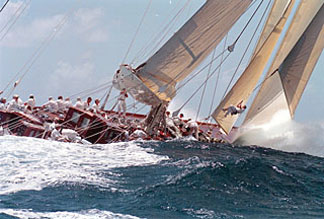 J Class ‘Velsheda’ |
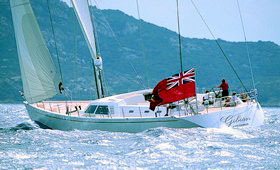 Wally 100 ‘Gibian’ Voiles de St. Tropez |
Top / Index of Stories
/ Subscriptions
/ Classifieds
/ Home