Skip to content

October 3, 2001


Security Zone

October 3 – San Francisco Bay

Randy Trudeau of the PICYA (Pacific InterClub Yachting Association)
Safety Committee offers the following information for mariners
on San Francisco Bay:

“On September 11, 2001, all Americans’
lives changed in many ways. It could be the way we travel to
the way we do everyday tasks. The American way of life has been
jolted by the horrible attacks in New York, Washington, and Pennsylvania.
Just like many things in everyday life, recreational boating
is going to have significant changes. The often-carefree way
we would conduct ourselves on the water must now be approached
with more care and thought. The United States Coast Guard (USCG)
has a tremendous job ahead. Their resources are being stretched
almost to the breaking point. The Coast Guard’s primary task
at hand is the patrol and defense of our nation’s coast and harbors,
maintaining those waters safe for shipping and free of any terrorist
threats. They must maintain the flow of commercial shipping that
is so vital to this nation’s economy. So what can we do as good
Americans and responsible boaters to help observe their guidelines
while out on the water?

“The first and most important thing
that we as recreational boaters can do is to observe the Naval
Protection Zone that was implemented in response to the attacks,
established effective from Sept. 14, 2001, to June 15, 2002.
The zones will provide for the regulation of vessel traffic in
the vicinity of U.S. naval vessels in the navigable waters of
the United States. The Naval Protection Zone has the following
requirements:

“OPERATE AT MINIMUM SPEED: All vessels
within 500 yards of a U.S. naval vessel must operate at the minimum
speed necessary to maintain a safe course and proceed as directed
by the official patrol.

“NOT ALLOWED WITHIN 100 YARDS: Recreational
and commercial vessels are not allowed within 100 yards of a
U.S. naval vessel, unless authorized by the official patrol.

“PUNISHMENT FOR VIOLATING: Mariners
who violate a Naval Vessel Protection Zone are subject to arrest,
prosecution, and if convicted, imprisonment for up to six years
and a fine of up to $250,000.

“In addition, there is heightened
security with regard to commercial vessels. The USCG asks that
recreational vessels:

“OBEY RULE 9. Be sure you stay well
clear of any large vessel whose movement is restricted by its
size. Keep at least 500 yards (1/4 mile) from any commercial
vessel. This is extremely important in crossing situations.

“NARROW CHANNELS: In narrow channels,
keep as far to the side as possible when approaching or being
approached by a commercial vessel. Do not make any abrupt course
changes or other maneuvers that may concern the ship’s pilot.

“Finally, the USCG asks that recreational
vessels stay away from sensitive areas. These include, but are
not restricted to, bridge towers, refinery docks, anchored vessels,
and military installations such as Port Chicago. If you have
any doubts about a particular spot being regarded as sensitive,
assume that it is.

“Keep a minimum of a TWO-MILE DISTANCE
away from airports and runways. Violators are subject to boarding
and arrest.

“FLY YOUR CLUB BURGEE. This will help
identify you and may reduce your exposure to being boarded.”
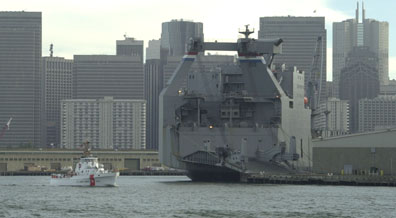

Photo Latitude/Richard


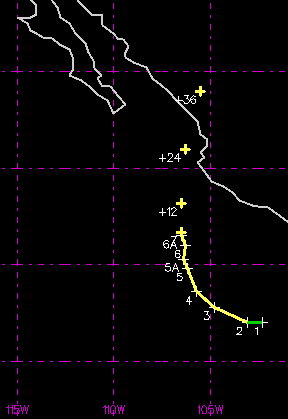
Tropical Storm Lorena and More on Juliette
Damage

October 3 –
Pacific Coast of Mexico

Already reeling from the damage to Baja
by Hurricane Juliette, mainland Mexico is now bracing to be hit
by the 50 to 60-knot winds of Tropical Storm Lorena. The tropical
storm is currently predicted to swing northeast toward Banderas
Bay, and storm and hurricane warnings are up from Punta San Telmo
north to Mazatlan.

Tropical Storm Lorena
Graphic Courtesy
Unisys
Weather

More on Juliette damage in La Paz from
Petrina Yeatts on Kiwi: “Fortunately, La Paz didn’t
suffer quite as badly from Juliette as Cabo. However, the cruisers
did have many problems such as boats sinking, boats breaking
up, boats dragging – some with moorings, some with anchors, and
one that took a whole marina piling with it! Marina Santa
Cruz lost their only slip, which broke into pontoons and caused
damage to Marina de La Paz and other boats. There were many unsung
heroes amongst the cruising fleet during and after the storm.
The ones who most deserve a mention are Dave and Olga, the owners
of the tienda known as El Faro (The Lighthouse) on the grounds
of Marina de La Paz. They stayed open for two days and two nights,
providing shelter and comfort for the cruisers. They also
gave out hurricane reports on the VHF on a regular basis,
which they accessed from their computer. The electricity was
down for 48 hours, but they borrowed two generators to keep everything
going. They made sandwiches for whoever wanted them, and
theirs was the only place where you find hot coffee, as just
about all restaurants were closed for two days. By the end of
the third day, their shelves were very depleted, but we’d always
been fed and watered.”

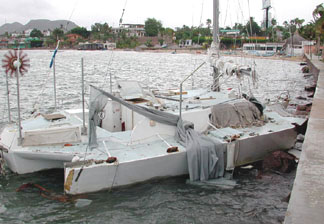
Meanwhile, up in San Carlos: “We ended
up having quite an adventure when Juliette turned NE toward Guaymas
and San Carlos. She caught us as she was downgraded to a tropical
storm, so she only hit us with winds up to 58 knots. We were
on a mooring outside of the marina but inside the bay, so the
water was relatively flat despite the wind. Then Juliette clocked
around and roared through the entrance to the bay, giving us
both wind and waves. Half of us were on our boats, but half the
boats had been left months ago. The unoccupied boats were a bit
of a problem. One trimaran chaffed through her lines and was
headed right for us, then she turned toward our friend’s boat.
Back and forth. We stood there with fenders, hoping she wouldn’t
hit us. Finally, she headed up and sailed right between us! Biagio
gave us the thumbs up from his boat, and we watched the tri drive
herself right up on the beach. In the end, three boats hit the
beach and a dive boat loaded with scuba divers heading north
‘away from the storm’ sank. All the divers were saved, although
they were in the water a long time awaiting rescue. Biagio’s
boat broke all his lines and he ripped away from his mooring,
but since he was aboard, he motored away from danger and a marina
panga came out and helped him tie on to another mooring. No sleep
and lots of excitement, but we never felt life-threatened. If
the weather cooperates, we’ll cross west to the Baja way up in
the Bay of Los Angeles and Refugio where Rick and Lynn are safely
tucked in. Our friends in the marinas in La Paz weathered the
storm with no damage, but reported the streets were muddy, rushing
rivers.” – George and Sonia of the 2000 Ha-Ha. (We believe
this is George and Sonia Kuperis of C’est Si Bon II, a
F-P Fidji cat.)

We’ll have more on Juliette’s damage tomorrow,
but are wondering if anyone in La Paz can come up with a list
of boats that were damaged, their type, and how badly damaged
they were. Folks up here would sure appreciate it.


Photo Tom Ireton


Melissa Hughes to Be Remembered

October 3 – San Francisco

Mike Whalen writes, “Sean Hughes, one of the regular crew
on my Santana 35 Spirit of Bombay, lost his wife Melissa
on September 11. She had been in the World Trade Center on business.
We would like to do something to remember Melissa this weekend
during the Santana 35 Nationals that will be held out of the
SFYC. We will be encouraging our crew and members of the other
Santanas racing this weekend to contribute to the Melissa Harrington
Hughes Endowment Fund. Sean and Melissa lived here in San Francisco,
and were married one year ago October 23. Sean will not be racing
with us this weekend, but we hope to have him back on board soon.
More information is available at www.jlsf.org/mharrington2001.html.”


YOTREPS

October 3 – The Pacific Ocean and Cyberspace

Who is out making passages in the Pacific
and what kind of weather are they having? Check out YOTREPS –
‘yacht reports’ – at www.bitwrangler.com/yotreps/


Weather Updates

October 3 – Pacific Ocean

San Francisco Bay Weather

To see what the winds are like on the Bay
and just outside the Gate right now, check out http://sfports.wr.usgs.gov/wind/.

California Coast Weather

Looking for current as well as recent wind
and sea readings from 17 buoys and stations between Pt. Arena
and the Mexican border? Here’s the place – which has further
links to weather buoys and stations all over the U.S.: www.ndbc.noaa.gov/stuff/southwest/swstmap.shtml.

Pacific Winds and Pressure

The University of Hawaii Dept. of Meteorology
page posts a daily
map
of the NE Pacific Ocean barometric pressure and winds.

Pacific Sea State

Check out the Pacific Ocean sea states
at: http://www.mpc.ncep.noaa.gov/RSSA/PacRegSSA.html.

For another view, see http://www.oceanweather.com/data/global.html.


Top
/ Index of Stories /
Subscriptions
/ Classifieds
/ Home

The De-Naming Ceremony
I once met a man in Florida who told me he’d owned 24 different yachts and renamed every single one of them.