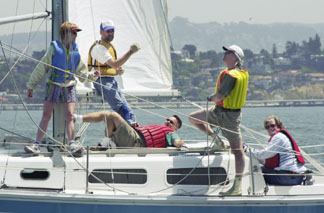
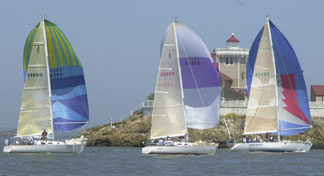
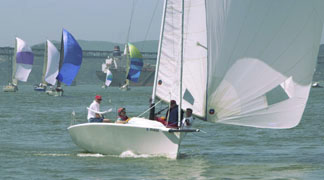
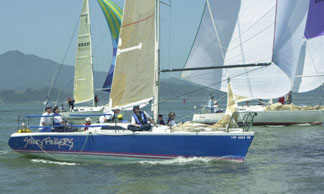
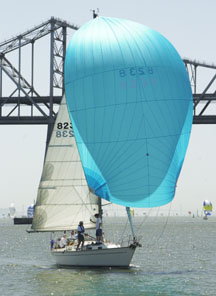
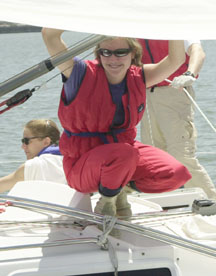
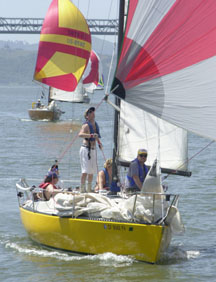
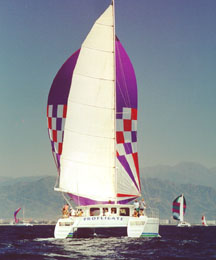
It was one of the lightest and warmest
Vallejo Races in recent memory. Our photographers were on station
near the Brother Islands, and these are but a few of the images
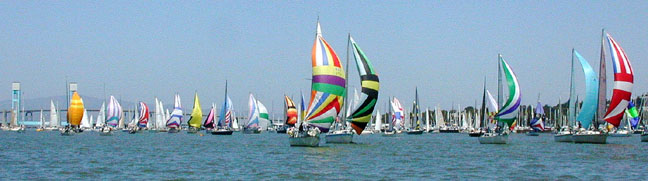
they captured. It was tough getting out of the channel on the
way home on Sunday – as can be seen from the photo by Paul Kamen
– but the boats with patience had another good sail across San
Pablo Bay to the finish at the Richmond Bridge.
Saturday’s race to Vallejo
Above Photos Latitude/Andy and JR
Sunday’s slow start against a flooding current Photo Paul Kamen
Mediterranean Odyssey
May 7 – Mediterranean
Most cruisers dream of sailing off to the South Pacific. We love
the tropics, too, but if we could put our boat anywhere right
now, it would be in the Med. As it turns out, there may be an
event with us in mind.
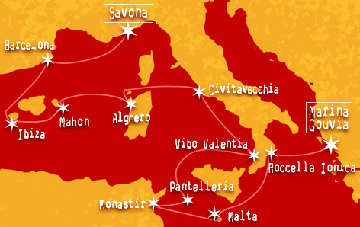
Alfredo Giacon and Ramon Jovani Sans, a couple of vets of the
Millennium Around World Odyssey, had so much fun in that event
that they decided to start the Med Odyssey, which, as you can
see from the chart, starts in Italy and takes the fleet to Spain,
Sardinia, back to Italy, Tunisia, Malta, back to Italy again,
and over to Greece. It may look like a long way, but compared
to the South Pacific, the Med is a tidy little package. As such,
the event is expected to consist of 20 days of sailing and 30
days of socializing and exploring. Alfredo and Ramon decided
to hold the event in May and June, which is when they claim the
winds are the best without getting too wild. About 45 boats have
paid the up to $3,000 U.S. fee, plus $200 for each crew. It’s
a bit of money, but it covers all the berthing, and the checking
in and out is taken care of.
The first Med Odyssey started just a few
days ago, and sure sounds like fun to us. First of all, the Med
has all that great cultural stuff. In addition, while it’s fun
cruising with a bunch of Americans and Canadians, you get a whole
different take on life when you cruise in company with Italians,
Spaniards, the French, Germans and other Europeans. If this year’s
event is a success and they do it again next year, we plan on
chartering a big cat and taking part. Anybody interested?
As we reported several days ago, the delivery crew on our 63-ft
cat Profligate found themselves in some nasty weather
off the Central California coast last week. According to a tug
captain next to them, it was blowing a steady 40 to 50 knots,
with gusts over 60 knots. According to the Cape San Martin Buoy,
the seas were 23 feet. That’s the kind of stuff we like to avoid.
We still don’t completely understand how
the crew came to find themselves in the situation they did. There
were warnings up before they left Santa Barbara, which would
have kept us in port. But there wasn’t much wind at the time,
so they decided to motor up to Conception to check it out. It
wasn’t bad there either, so they decided to press on. By the
time they were abeam of Morro Bay, gale warnings were in full
effect and had been for some time – but they still continued
on. There’s no way we would have. Gale warnings on the Central
California coast mean one thing to us: get your butt to Port
San Luis or back around Conception immediately. Profligate
motors at nearly 10 knots, so it wouldn’t have taken but a couple
of hours to be snug on the hook in calm waters.
Over the next four hours, the conditions – as forecast – went
to hell. Before long, they were slowly – by intent – motoring
up the face of huge breaking waves at 2.5 knots, and unintentionally
accelerating down the backs at four or five knots. The boat seemed
to be handling it better than the crew, who had started to get
sick. Nonetheless, their plan was to continue making slow progress
toward Santa Cruz or simply let the gale blow itself out. One
of the crew said he didn’t want to turn back unless the owner
of the boat instructed the captain to do so.
When they were finally able to reach us, it was a no brainer
to us. Turn the boat around and get ready to stream warps. After
all, a cat is most uncomfortable going upwind, and most comfortable
down wind. Once they turned the boat around, they started sailing
under windage alone at between five and 12 knots. At one point
they hit 16.2 knots. But all was under control, with the autopilot
steering, and warps weren’t needed. Before long, the crew started
to feel better. The only problems were two waves, which pooped
the very high cockpit. About 120 gallons rolled through the companionway
and down into the port hull. It didn’t do the rugs any good,
but they were just going to be replaced anyway.
Eventually, they made their way back to Santa Barbara, where
it was discovered that the spline in the Saildrive unit was trashed,
meaning the boat had to be hauled and the Saildrive replaced.
After 36 hours in a gale, followed by a few hours sleep, the
three-man crew had a lovely sail down to Oxnard and the Channel
Islands Boatyard, the only place in the area capable of lifting
such a big cat. The next day we showed up with a new Saildrive
and started the repair process. If all our dreams come true,
both Saildrives with be replaced, the props gone over, and the
bottom painted by Friday.
With the boat out of the water, we had a great chance to check
her out for damage, as this was the first real blow she’d been
in. Other than salt residue throughout the inside of the boat
and a couple of minor things, there was no damage. While it’s
good to know Profligate has been battle tested, our future
delivery instructions will be much more explicit: When possible,
sit out the bad weather, especially when headed into it, and
especially along the coast of California. We think it’s good
advice for all boats and crews.
This is Profligate in the flat waters
of Banderas Bay. Coming up the coast, the faces of the biggest
waves were about as high as the spreaders.
YOTREPS
May 7 – The Pacific Ocean and Cyberspace
Who is out making passages in the Pacific
and what kind of weather are they having? Check out YOTREPS –
‘yacht reports’ – at http://www.bitwrangler.com/yotreps/
Looking for current as well as recent wind
and sea readings from 17 buoys and stations between Pt. Arena
and the Mexican border? Here’s the place – which has further links
to weather buoys and stations all over the U.S.: www.ndbc.noaa.gov/stuff/southwest/swstmap.shtml.