

July 30, 2001
Photo of the DayJuly 30 – Australia Not long ago, Don and Kathy Radcliffe of the Santa Cruz-based |
 Photo Don Radcliffe |
The
Trouble with Brits
July 30 – Papeete, Tahiti
“My husband and I left San Diego in April for French Polynesia,”
write some Ha-Ha vets who wish to remain anonymous. “The
trip took nearly 25 days. We arrived in the Marquesas and then
went on to Papeete, Tahiti. This was one beautiful place! We have
always thought mariners were really special people; sadly, however,
we’ve found that this is not true. After being out here for three
months, we have discovered that even though most American cruisers
are really nice and helpful, a lot of the British boaters are
rude and seem to really dislike Americans. This really surprised
us. We should add that the French and Tahitians here in the islands
have been ever so helpful and friendly.
“Another thing cruisers should be prepared
for is intimidation by large British boats. If one of these big
boats wants your place in an anchorage, he usually parks right
on top of you. When you try to call him on channel 16, he will
not answer. If you go over to his boat in your dinghy to talk
the situation over, the Brit always says he knows what he is doing
and he is watching things. This really makes one feel safe if
you are the one going to be smashed by one of these boats! Twice
in one week in the same anchorage on the west side of Papeete,
we have had a big British boat park right on top of us. Each time
there were numerous other places to anchor. After the first one
parked too close and would not re-anchor, we moved our boat. The
next day another large British boat came in and parked on top
us. Again there were numerous other places to anchor, nobody would
answer on channel 16, and the Brit boat would not re-anchor. So
again we moved. We have other American cruisers here complaining
about other European boats doing the same thing.
The other thing we have seen is when the
people line up at Immigration to get checked-in or out, the Europeans
– especially the Brits – cut in line. If you object, they call
you Ugly Americans. We have always thought that the British were
our friends, and it was the French that were rude. But we’ve hardly
had any trouble with the French. Since we have a couple of good
friends who are British ex-pats, we request that you not use our
name or boat name. But we just thought that maybe the American
cruisers should be prepared for the hostility and superior attitude
that is out here from our would-be British friends. We were really
shocked by their rudeness and attitude toward us Americans.”
S. & J.
There are a couple of possible explanations. The first is that
some of the more affluent Brits, where class and privilege still
reign supreme, are in denial about losing the Empire and having
needed help in World War II. (Just reminding them is enough to
start World War III.) Another possible explanation is that you
folks, having come from Mexico, and they, no doubt having come
from the Caribbean, have totally different concepts of what it
means to anchor “right on top of someone”. In Mexico,
where there are so many anchorages, and there is so much space
in most of them, nobody has to anchor close to anyone. But if
somebody’s spent time in English Harbor, Marigot, Gustavia, the
BVIs, or many other crowded places in the Caribbean, they’re accustomed
to 50 and 60-footers being anchored right next to one another
– meaning 25 feet on each side as well as the front and back.
Check out the photo from Gustavia, St. Barts. West Coast cruisers
just aren’t accustomed to that kind of thing. Or the fact that
boats bumping in an anchorage is not considered the end of the
world. It’s a big world, and there are different ways of looking
at it.
RS
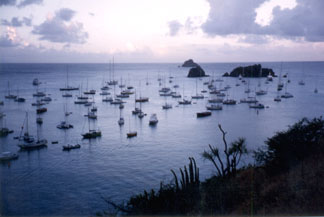
Gustavia, St. Barts
Photo Latitude/Richard
Record Run & Race Postponed
July 30 – Australia
Aussie Sean Langman and his turbo-charged Open 60 Grundig Xena
have been waiting for months until there were strong enough winds
to go for a 24-hour monohull record. Initially. It looked like
the Sydney to Gold Coast Race last weekend was going to have just
what he’d been waiting for: lots of wind. Unfortunately, for him
and the fleet, there was two much wind, as steady winds of 50
to 60 knots and 30-foot seas have been battering the Gold Coast
all weekend. As a result, the 369-mile race has been postponed
three times. If winds and seas subside, the race may go off today.
Adventure ShoalsJuly 30 – New York Team Adventure, Cam Lewis’ 110-foot maxi cat, finished
|
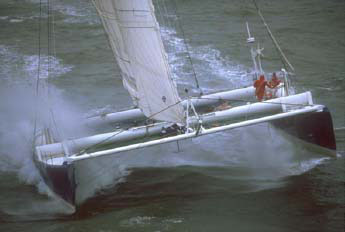 Photo Courtesy Team Adventure |
MacArthur Wins Again In AtlanticJuly 30 – Baltimore, MD Ellen MacArthur and co-skipper Nick Maloney and crew brought What is the EDS Atlantic Challenge? Their Having just finished in Baltimore, Kingfisher is getting |
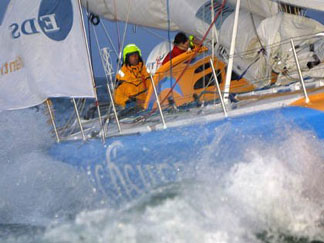 Photo Courtesy Jacques Vapillon  Photo Courtesy Kingfisher Challenges |
YOTREPS
July 30 – The Pacific Ocean and Cyberspace
Who is out making passages in the Pacific
and what kind of weather are they having? Check out YOTREPS –
‘yacht reports’ – at http://www.bitwrangler.com/yotreps/
Weather
Updates
July 30 – Pacific Ocean
San Francisco Bay Weather
To see what the winds are like on the Bay
and just outside the Gate right now, check out http://sfports.wr.usgs.gov/wind/.
California Coast Weather
Looking for current as well as recent wind
and sea readings from 17 buoys and stations between Pt. Arena
and the Mexican border? Here’s the place – which has further links
to weather buoys and stations all over the U.S.: www.ndbc.noaa.gov/stuff/southwest/swstmap.shtml.
Pacific Winds and Pressure
We dropped in on our favorite University
of Hawaii Dept. of Meteorology page and found that it has resumed
daily postings of the NE Pacific Ocean barometric pressure and
winds map. We used to run this satellite map everyday, but discontinued
using it when it stopped updating sometime in late December. You
can find it at http://lumahai.soest.hawaii.edu/cgi-bin/satview.cgi?sat=g10®ion=hus&channel=uI4&anim=no&size=large.
Pacific Sea State
Check out the Pacific Ocean sea states at:
http://www.mpc.ncep.noaa.gov/RSSA/PacRegSSA.html.
For another view, see http://www.oceanweather.com/data/global.html.
Top

/ Index of Stories /

Subscriptions

/ Classifieds

/ Home