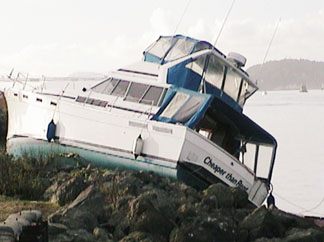
Today’s Photo of the Day is a little out
of date – it took place in late November of last year – but the
lesson remains the same: pay attention when you’re navigating.
The 38-ft Bayliner went up on the rocks on the Alameda side of
the Oakland Estuary about a half mile in. Parker Diving Service
– which took the photo – did the salvage with a water borne crane.
Photo Parker Diving Service
Not An Ordinary Circumnavigation
February 6 – San Francisco
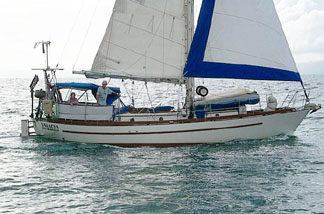
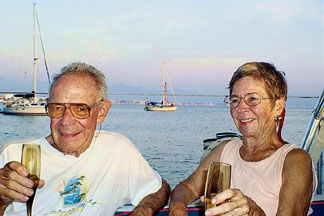
Congratulations to Bob and Jeannie Rowe
of the San Francisco-based Brewer 35 Salacia on completing
their circumnavigation, reports Lourae Kenoffel of Pizzaz.
Consider some interesting numbers.
20 – the number of years the Rowes spent
completing the circle.
44 – The number of days it took them to
sail from Mexico to the Marquesas – during which time Bob did
a valve job on the engine.
But the most impressive numbers are 81
and 74 – Bob and Jeannie’s ages! We’ll have more on this dynamic
couple in the next Latitude.
Photos Lourae Kenoffel
Deep Down In The Southern Ocean
February 6 – Southern Ocean
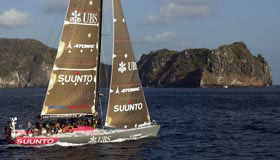
The PR folks from the Volvo Around The
World Race have had lots of great stuff to pass out. For example:
“Paul Cayard and the rest of the crew
on Amer Sports One must have reached the highest levels
of stress possible when just after a severe broach, they were
faced with two massive icebergs. “The iceberg and growler
count was growing by 10 per hour,” wrote Cayard. “We
were sailing with one reef and the smallest spinnaker we have,
so we felt fairly prudent about that. However, while watching
the radar and seeing nothing, we sailed just 100 feet away from
a growler that was 10 feet out of water. It was an ominous realization.
As there were only three of us capable of driving in these conditions,
we decided to rotate every two hours. The first term went well
with 36 knots being the top-speed and black darkness for just
the last half hour. When I came up it was black dark and blowing
30-35 knots. Within 10 minutes of taking the helm, a squall hit
us with 40 knots. Very intense in the pitch black, with huge,
sloppy waves as you get down here. Then 15 minutes later I got
a blast of 45 knots for three minutes. This was absolutely crazy.
Hanging on until it passed, I told Grant [Dalton] that I could
not do my full two hours of that intensity without serious chance
of wiping out. I should have said that no one could, but I did
not want to speak for the others. That was a mistake and not
using my experience. So as the next helmsman prepared to come
up, I got two more squalls of 45+. Southern Ocean 45+. With the
temperature down here, it’s the equivalent of 50+ everywhere
else. I managed to hang on to this beast, which was hurtling
through the pitch black of night, doing 30+ knots at one moment,
running into large objects at random (waves that I could not
see), as we caromed off these waves they would alter my course
up to 15 degrees in a situation where degrees of course change
can throw the whole boat out of balance. On top of all this,
the growlers were still out there – we just didn’t happen to
hit any. What if we did at 30 knots of boat speed?
“All three of
us Amer Sports One drivers have strong cases of tendonitis
in our hands now. Three fingers of my left hand are tingling
numb constantly. I have lost 50% of my grip strength in that
hand. Yet on we went. We just wanted to get to daylight, when
all would be much easier. We needed about another hour and a
half. An hour and a half after I’d taken the wheel, I was so
happy to give it up. I should have said, ‘Let’s slow this bus
down, we are in great shape, our house is neat and dry, no damage,
etc.’, but I failed to say it. And nobody else spoke up.
“Thirty minutes in our next driver,
we went on our side. The gyration was so violent, that downstairs
where I was sitting recovering, the engine box-cover, which doubles
as the companionway stairs, simply left its mount and landed
on me. We got up on deck and found the kite was shredded. No
sooner had we gotten the kite down and Roger [Nilson] yells up,
two icebergs ahead, four miles. It was a blessing to have the
kite down but the width of the two bergs forced us to sail between
them.This is not recommended in any book. Needless to say we
had a few tense moments there, but we got through it unscathed.
We polled out a blast reacher and just chilled out for a few
hours and took the 20-mile hit on the sked.”
Another entry, News Corp, did hit a growler while sailing
at 21 knots on Tuesday morning. The hull and crew came away unscathed,
but they had to change course to tend to problems to the rig
and sails.
Positions on February 6 at 0400 GMT: 1. illbruck, 3701
miles to finish; 2. Team Tyco, 55 miles behind leader;
3. Amer Sports One, 56 mbl; 4. Assa Abloy, 104
mbl; 5. djuice, 127 mbl; 6. Team SEB, 190 mbl;
7. News Corp, 191 mbl; 8. Amer Sports Too, 390
mbl.
For more, see www.volvooceanrace.com.
Photos Courtesy Volvo Ocean
Race
New Meaning Of Mega Yacht
February 6 – Vosper Thornycroft
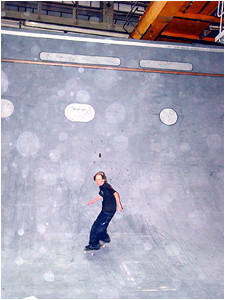
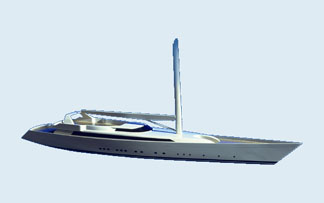
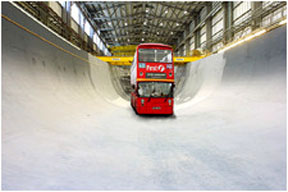
Imagine, if you will, a privately owned
sailboat whose hull is great for skateboarding. Whose hull can
easily swallow a double-decker London bus. That’s what’s coming
in the summer of 2003. But it won’t be coming to San Francisco
Bay . . . on account of the mast being 80 feet too tall to fit
under the Golden Gate Bridge. If you read Latitude, you
already know the story behind this boat.
Photos courtesy Mirabella Yachts website
YOTREPS
February 6 – The Pacific Ocean and Cyberspace
Who is out making passages in the Pacific
and what kind of weather are they having? Check out YOTREPS –
‘yacht reports’ – at http://www.bitwrangler.com/yotreps/
Looking for current as well as recent wind
and sea readings from 17 buoys and stations between Pt. Arena
and the Mexican border? Here’s the place – which has further
links to weather buoys and stations all over the U.S.: www.ndbc.noaa.gov/stuff/southwest/swstmap.shtml.
Pacific Winds and Pressure
The University of Hawaii Dept. of Meteorology
page posts a daily
map of the NE Pacific Ocean barometric pressure and winds.


 “All three of