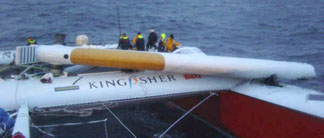
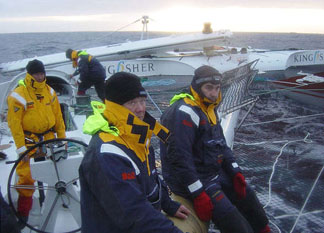
Today’s Photos of the Day are of Ellen
MacArthur’s Kingfisher2, just dismasted in the deep south
Indian Ocean during her attempt at the Jules Verne record. It
came at a most unfortunate time, for having battled light winds
in the early half of the record attempt, they had finally pulled
a full day ahead of Orange’s (now Kingfisher2)
record. Furthermore, Kingfisher2 was making great time
on Geronimo, the trimaran currently way ahead of the Jules
Verne pace, but becalmed in the South Atlantic. “We’re all
gutted,” said MacArthur.
Why the mast failed is a mystery. They
were sailing with a full main and a spinnaker, running rather
deep in about 30 knots of wind and flat seas. Those are almost
ideal conditions. The mast apparently broke up high first, then
snapped again further down. Nobody was hurt, and all but the
bottom stub was cut away to prevent damage to the hulls. MacArthur
and crew now face a two week sail under jury rig to Perth, Australia.
Photos Courtesy Offshore Challenges
Mast problems are not new to Orange/Kingfisher2.
During Bruno Peyron’s first attempt at the Jules Verne with Orange,
the top of the mast broke a half hour after the start. After
the repair and record, but before she was sold to MacArthur,
the mast broke. The new mast was made from M46J carbon fiber.
Fossett and PlayStation Crush Other
Transatlantic Record
February 24 – San Salvador, Bahamas
About the same time Ellen MacArthur was
having the ultimate breakdown in the deep Indian Ocean, Steve
Fossett and his crew of 12 aboard the maxi-cat PlayStation
were setting another new major sailing speed record. Having crossed
from Spain to the Bahamas in 9 days and 13 hours, they crushed
the old east to west record by over a day, averaging 16.9 knots
over the 3,384-mile course. In reality, PlayStation sailed
4,704 miles at an average speed of 20.5 knots, as they had to
detour to find good winds. Fossett and PlayStation already
own the west to east transatlantic record. What’s next? They
are going to sail in the Heineken Regatta in St. Maarten on March
5 “just for fun.”
America’s Cup Inaction Continues
February 24 – Auckland, NZ
Is it just us or have all the postponements
and laydays in the America’s Cup caused the excitement to dissipate?
With Alinghi up 3-0 over New Zealand, and even more fluky winds
predicted this week for the best of nine series, interest seems
to be rapidly fading. Imagine the poor folks who spent a lot
of money to fly down to Auckland and get on a spectator boat,
but have had to fly home halfway through the event. Although
what racing there has been has been terrific, the event has passed
its ‘complete by’ date.
Capricorn Cat
Gets Stuck on Reef in the Marshall Islands
February 24 – Marshall Islands
If good things really do happen to good
people, perhaps that explains why Capricorn Cat got off
the reef in the Marshall Islands.
Blair Grinols of the Vallejo-based 46-ft Capricorn Cat has been one of the most active and well-liked
sailors on the West Coast over the last eight or nine years.
He built his own 46-ft cat, and with wife Joan has cruised relentlessly
between California and Mexico as well as to French Polynesia
and Hawaii. He’s earned the respect and admiration of fellow
cruisers, both for lending a helping hand and for making his
boat available for charity sails.
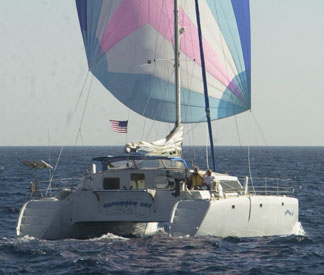
Capricorn Cat sailing in Mexico Photo Latitude/Richard
Although he’s approaching age 70, Grinols
has more energy than two 35-year-olds, so, rather than do another
Ha-Ha last fall, they sailed to Hawaii, and continued on to the
Marshall Islands. Blair was having a ball until February 20 when
his beloved boat went on a reef. Here’s how he describes it:
“For the longest, darkest, and most
traumatic half-hour of my life, myself, friends Rich and Sherrel
Richmond from Oregon, and Tabal village men fought a winning
battle to extricate Capricorn Cat from certain destruction
on a large coral reef just off the beach of Tabal, Aur. It brings
tears to my eyes just trying to write about it.
“At 2 a.m. Rich woke me up because
the wind had clocked 180 degrees and we were hanging on our anchor
just a few yards from a coral-strewn lee shore. The wind had
come up to about 20 knots and the rain was coming down in sheets.
We immediately tried to drive the boat offshore, but the anchor
chain was wrapped around other coral heads. By the time I was
able to get a knife to cut the rode, the starboard rudder was
digging into the coral. After the rope was cut and before I could
get to the throttles, one propeller struck coral, which killed
the engine. The Cat immediately swung around and the starboard
hull ground onto the reef. Between the wind, waves, and the grinding
of the hull against the coral, the noise was deafening.
“I jumped into the dinghy and threw
Sherrel a line to the front of the port bow while Rich put his
shoes on to jump onto the coral. By tying two ropes between the
rear corners of the dinghy and the cat’s bow, and adjusting their
lengths correctly, I was able to pull into the wind and waves.
In the melee, a rope caught the fuel line to my 15 hp Johnson.
It took me a second to figure out why the engine died. I was
able to push the connection into place and hold it with one arm
while steering with the other. Two of the village men heard all
the commotion and came running into the coral, where Rich was
struggling to push the bow toward the sea. After about 15 minutes
of running the little engine full throttle, the Cat moved
a little. Sherrel came running over to the port side and said
Rich reported that he had taken a few steps into deeper water.
“Unfortunately, the starboard rudder
had dug down into the coral and was really hung up. Rich and
the villagers in the water went to the stern and lifted and heaved
with the waves – and after another 15 minutes or so, the Cat
began her extrication from the reef. After running the outboard
full throttle for so long, I was worried about running out of
gas. Finally Capricorn Cat came steaming past me. She
was floating! Rich had gotten to the throttles and was driving
her out into deep water. The dinghy swamped completely from being
pulled backwards, but it was the best bath I ever had.
“The two villagers had climbed aboard
with Rich, and we spent the rest of the night running the boat
around offshore, trying to miss the other coral heads. The village
men knew where they were. At dawn, they showed us a better place
to anchor. But it wasn’t over yet. We had hardly anchored, showered
the village men with praise and gifts, and taken them to shore
– when the wind clocked about 100 degrees, once again putting
us perilously close to shore. Before we could get the new anchor
and rode in, we lost them overboard – and were just able able
to drive out into the lagoon.
“We drove into the wind for a couple
of hours, and when it appeared we were in for a long storm, we
set sail to Majuro. We have just one anchor left and no chain,
so we didn’t want to spend a night in coral-strewn waters on
that kind of an anchor kit. It cleared up just enough for us
to see our way through the atoll pass. We will lick our wounds
on a mooring in Majuro for a few days, survey the damage, and
then go back and try to retrieve our anchors and rodes when the
weather stabilizes back to the northeast trades. So far, it appears
the Cat came through the ordeal surprisingly well.”
Just hours before this posting, we got
another update from Grinols: “I dove on the boat this morning
to survey the damage. There is about a foot of material gone
off the bottom of both rudders. That loss of draft probably helped
a bunch in getting her off the reef. The bottoms of both daggerboards
look kind of like upside down mushrooms. There is one 5-inch
diameter gouge in the bottom of the starboard hull exposing the
core and that has to be repaired soonest. I am talking to a fellow
here who has a large crane that can lift the Cat with
no problem. We may have to take the mast down in order to lift
her. This could happen as early as next week. I will remove the
daggerboards and get started on repairing them tomorrow. The
rudders will probably wait till we are hauled. On Tuesday a couple
of friends I met here, Ron on the 46-ft Beneteau Kaimana,
and another guy, are going to take me back up to Aur to retrieve
my anchor and chain sets. It is just 70 miles so we can drive
up there and dive before it gets dark.”
We couldn’t be happier for Blair, who has
been our good friend for years, and was instrumental in both
last year’s Zihua Festival and the Spinnaker Cup for Charity
in Puerto Vallarta. That he got his boat off despite no longer
being a kid does not surprise us. He was smart, decisive, and
refused to give up. You’re an inspiration, Blair – but don’t
do it again!
YOTREPS
February 24 – The Pacific Ocean and Cyberspace
Who is out making passages in the Pacific
and what kind of weather are they having? The YOTREPS daily yacht
tracking page has moved to www.bitwrangler.com/psn.
Looking for current as well as recent wind
and sea readings from 17 buoys and stations between Pt. Arena
and the Mexican border? Here’s the place – which has further
links to weather buoys and stations all over the U.S.: www.ndbc.noaa.gov/Maps/Southwest.shtml.
Pacific Winds and Pressure
The University of Hawaii Dept. of Meteorology
page posts a daily
map of the NE Pacific Ocean barometric pressure and winds.