
Skip to content

December 11, 2000


Photo of the Day

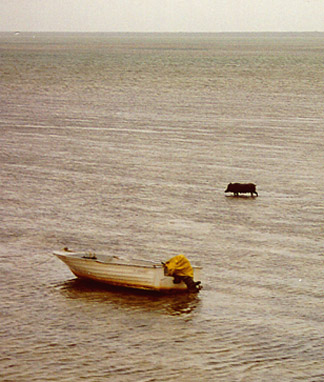
Pig At Sea?

December 11 – New Zealand

Ask Simon and Lori Elphick of the Half Moon-based Nor’West 33
‘Native Dancer’. The couple are currently summering over in New
Zealand, but while passing through Tonga last year, took this
photo of a pig rooting around the reef off Tongatapu, Tonga.
“He spent a lot of time out there with his snout submerged,”
they report.

Photo courtesy ‘Native Dancer’

News Flash! Mayday and rescue for
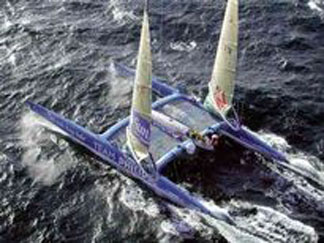
Pete Goss and the crew of Team Phillips!

December 11 – Falmouth, England

Brit Pete Goss’s gallant effort to get the radical and much
troubled Adrian Thompson designed, wave piercing, wishbone- rigged,
maxi catamaran to Monaco for the start of The Race came to an
end on Sunday morning. After rocketing around the winter seas
of the North Atlantic for nearly a week in everything up to 65
knot winds and at up to 35 knots of boat speed, the central pod
was damaged to the extent that the boat could only sail to the
northeast. Here’s the story from The Race website:

“Since leaving Dartmouth on December 4, the ‘Team Phillips’
crew had been supremely confident in the wave piercing cat’s
performance under all conditions. Until the sea made its presence
felt. Before heading for Monaco for the prologue event to The
Race, ‘Team Philips’ had to wait for a letup in weather conditions
in the Gulf of Gascony. For the last three weeks, a series of
rough weather systems has been ravaging this hazardous route
so well known to sailors. While waiting for favorable conditions,
Pete Goss decided to carry out further sea trials on the boat,
also with a view to notching up some miles towards her qualification.
The boat slipped her berth in Dartmouth on the morning of December
4, but on reaching the Channel, the skipper turned right instead
of heading out into the Atlantic, in order to use the wind to
sail around an area of low pressure centered on the British Isles.
Four days later, the boat had reached a position roughly equidistant
from Cork, Reykjavik and Greenland, and was continuing to sail
around the low. During the night of December 7, she even attained
speeds as high as 35 knots.

“But on December 8, ‘Team Philips’ had to brace herself
to head into the low and face very strong, gusting winds. On
the morning of December 9, the sea was worsening, with a 16 to
23 foot swell. The giant cat was sailing with three reefs in
her two mainsails in order to reduce the effect of the gusting
winds. In spite of these tough conditions, the crew were confident
and satisfied with her performance. And yet on the afternoon
of December 9, the team announced that the central pod, from
which the helm is controlled, had been damaged by waves. After
sailing in gusting winds for a certain time, it became clear
that the boat would only be able to sail in a northeasterly direction
– which would take her further away from shipping lanes and therefore
from potential rescuers. Pete Goss was in contact with the Falmouth
Coast Guard, and sent out a Mayday signal which was soon picked
up by the German container vessel ‘Hoechst Express’.”

Although the crew was forced to abandon ‘Team Phillips’, they
are safe and sound and say the incident was “more frightening
than harmful”. They will arrive in Nova Scotia in three
days. As for ‘Team Phillips’, she is being tracked for eventual
recovery.

While the ‘Team Phillips’ cat has been plagued by one major problem
after another, the determination and courage of Goss and his
crew should be an inspiration to everyone. Bruno Peyron, organizer
of The Race, rightly saluted Goss and crew, as well as the boat’s
innovative design. In the long run, failure often leads to the
greatest successes. 


Photo courtesy ‘Team Phillips’


Cruising

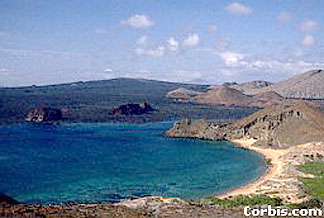
Environment taken hostage in the Galapagos Islands.

December 11 – Galapagos Islands

In the 1940s, there was virtually nobody at the Galapagos Islands,
which is where Charles Darwin formulated his theory of evolution
and which today remains one of the most intact ecosystems in
the world. Now there are nearly 20,000 full time residents and
nearly 60,000 visitors who contribute $90 million a year to the
Ecuadorian economy.

The Galapagos is also a great place to fish. In fact, exports
of fish caught at the Galapagos account for 23% of the country’s
foreign earnings. And lobster fishermen can make as much as $170
a day – in a country where the minimum wage is $3 a day.

The reason everyone hasn’t flocked to the islands to fish is
quotas on both population, fishing and fishing boats. But this
month fishermen were angered because they reached the lobster
quota quicker than any previous year – so they rampaged across
the islands of Santa Cruz, San Cristobal and Isabela. Offices,
field stations and years of scientific data were totally trashed,
park rangers and the few police fled for their lives, tourists
were threatened, and several of the rare Galapagos tortoises
were taken hostage. The latter is no laughing matter, as during
a dispute in ’96 several of the tortoises – which can live to
more than 100 years – had their throats slit.

Ecuador’s military has restored control, but the battle lines
are still drawn: the environmental and tourism industries versus
the fishing industry and fishermen.

Photo courtesy Corbis.com

The Loss of Two Friends

December 11 – The World of Cruising

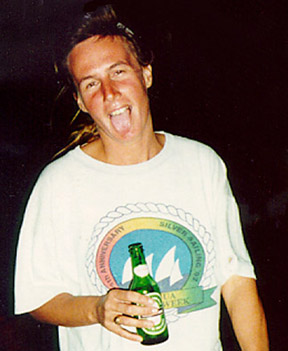
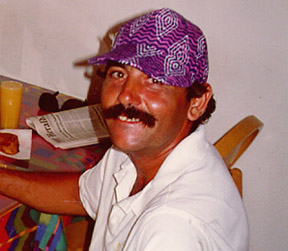
It was way back in ’86 while we were buying ‘Big O’ in St. Barts
that we first met the smiling face in the accompanying photograph,
Basque sailor Antonio ‘dos Muertos’. He became our first captain,
and would run the boat on a number of occasions between then
and when we sold her three years ago. The woman in the other
photo is Emmanuella, an Italian-Swiss woman who was a sensational
cook on ‘Big O’ and other boats, and often Antonio’s girlfriend.

Antonio was as hard-working and flamboyant a character as you
could find in the Caribbean – an area well-represented by flamboyant
charters. Multilingual and quick to give a helping hand to everyone,
he soon knew just about everybody wherever he was. He was also
supremely confident. After his brother-in-law bought a Van de
Stadt 45 in Florida, Antonio worked on the boat on the hard for
six months. He and Emmanuella then loaded her up with food, lowered
her into the water, and took off for Spain without any sea trials.
“I did the work,” Antonia said, “what’s there
to check?” The two of them made it to Spain, despite sailing
right through the first hurricane of the season.

Although we had numerous battles with Antonio, he was always
a great friend. Back in the early ’90s, he was single-handedly
restoring a 75-foot stainless steel schooner for a guy in Panama,
while we’d put ‘Big O’ on the hard in Venezuela for nine months.
With an attempted coup in Venezuela – by the current president
of that country, no less – and boatyard prices rising by the
month, we decided we needed to move ‘Big O’ to safer and more
sane Trinidad. We called our former English captain, a very proper
and slow moving fellow, who informed us that it would take no
less than three weeks – and about $20,000 – to get the boat back
into sailing condition and over to Trinidad. ‘What a crock,’
we said to ourselves, ‘if we could only find Antonio’. As luck
would have it, Antonio just returned to the Virgin Islands, having
been fired by the schooner’s owner for refusing to scuttle the
boat for insurance purposes. (The new captain did scuttle her
several months later.) When we got Antonio on the phone, he said,
“The two of us can get the boat to Trinidad in three days
for $1,000, no problem.” That was pure Antonio. He took
the first post-coup attempt plane from Puerto Rico to Barcelona,
Venezuela, and we took the first plane there from San Francisco.
We met him at the boatyard in mid-morning and had ‘Big O’ back
in the water with the sails bent on by afternoon. Having sat
for so long, the Perkins wasn’t hitting on all cylinders. No
problem for Antonio. After the work day was over, he bought a
case of beer for a couple of the engine guys from the yard and
started telling them jokes in Spanish. An hour later, they’d
sorted out the engine problem and had it purring like a kitty.
Two days later we were in Chagaramus, Trinidad, ready to haul
the boat at Don Stollmeyer’s place.

Although Antonio’s parents were affluent and ran the most famous
restaurant in all of Spain, he cared nothing for that – or people
he found to be snobs. A couple of years later, for example, Antonio
had joined ‘Big O’ again for Antigua Sailing Week. There was
a big raft-up at Jolly Harbor sort of like after the Vallejo
Race. As we entered the harbor, officials directed us to tie
up to an immaculate 45-footer named ‘Gitana IV’ from the Monte
Carlo YC. None of their crew showed any inclination to accept
our lines, so Antonio – who was small in stature – strutted up
to the bow and hollered something that started in Italian, drifted
into French, and concluded in Spanish. Immediately, the crew
of ‘Gitana’ sprung into action, calling for lines and beginning
to arrange fenders. “What the hell did you say to them?’
we asked. “I told them, “said Antonio, “that either
they take our lines or I would be right over to smash their faces.”
Not used to that kind of brash behavior, we went below to see
who we might have offended. According to the race program, it
was none other than the Baron de Rothschild.

Antonio lived and loved each moment like there was no tomorrow.
And that might have been the problem. Only recently we learned
that Emmanuella, who was working on a motoryacht in the Med two
summers ago, got a lung infection and died several weeks later.
Apparently her immune system had been ravaged by AIDS. And earlier
this year, Antonio died, apparently of AIDS-related causes.

Antonio and Emmanuella were wonderful people, and although we
only saw them occasionally during the last five years, we grieve
knowing they are no longer with us. But with it being winter
time and therefore Caribbean time, we want to use their deaths
as a caution to everyone. It’s rarely publicized, but the Caribbean
has the second highest incidence of AIDS in the world after Africa.
In some places the percentage of HIV- positive people, and babies
born with AIDS, is absolutely staggering. So if you go there
and find yourself about to share any bodily fluids, get protection.

Emmanuella

Antonio

Photos by Richard

Viva Tropical Mexico!

December 11 – Mexico

What’s everybody doing who sailed to Mexico early this winter?
We’re not sure about everybody, but a bunch of folks are enjoying
what we call ‘the Jungle Coast’ of mainland Mexico. It’s the
30 or so miles from Chacala to Punta Mita, which is at the northwest
tip of Banderas Bay. There are not many people around this part
of the coast, but there are countless sand beaches, a ferocious
jungle, unbelievable amounts of fish, and delightfully warm air
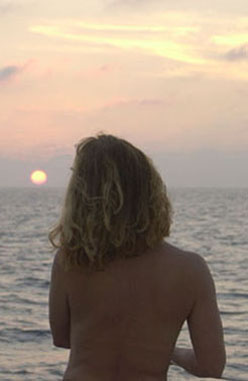
and water temperatures. So warm that it can be well past sundown
before you realize that you still don’t have any clothes on.


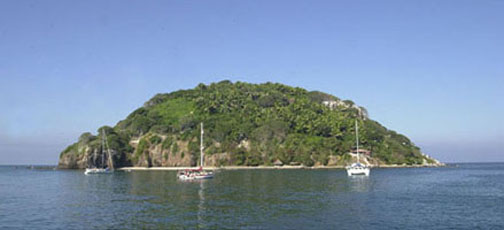
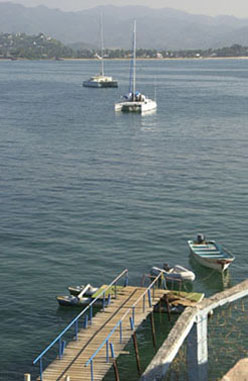
Photos clockwise from upper left:

Isla Coral; Two
cats lying between Isla Coral and Rincon de Guayabitos among
the plentiful whales, fish and birds;
Warm
at tropical Mexico – even after sundown.

Photos by Richard

YOTREPS

December 11 – The Pacific Ocean and Cyberspace

Who is out making passages in the Pacific and what kind of
weather are they having? Check out YOTREPS – ‘yacht reports’ –
at http://www.bitwrangler.com/yotreps/


Racing

December 11 – On the Race Circuit

Vendée Globe

For the second time, a skipper in the Vendée Globe singlehanded
around the world race has set a new 24-hour solo monohull speed
record. First it was Yves Parlier of ‘Aquitaine Innovations’,
now it’s Dominique Wavre, the Swiss skipper of ‘Union Bancaire
Privée, who just covered 432 miles, an average of 18 knots.
“The noise was unreal, both infernal and incredible at the
same time. It doesn’t stop!” said the Swiss skipper. He said
he hadn’t slept in 24 hours and was under a lot of stress.

As of December 10, the standings were: 1. PRB (Desjoyeaux) 2.
SILL Matines La Potagère (Jourdain) (+17 miles) 3. Aquitaine
Innovations (Parlier) (+95m) 4. Active Wear (Thiercelin) (+229m)
5. Kingfisher (MacArthur) (+281M).

Crystal Cup

Doug Baker’s Andrew 68 ‘Magnitude’ won the first ever running
of the Crystal Cup, which is trying to put Nassau back on the
sailing map. We’ll have details in tomorrow’s ‘Lectronic, as well
as the full story in the January Latitude, as our racing editor
was crew aboard the winning boat.


Weather Updates

December 11 – Pacific Oceans

Tropical Weather

The Atlantic/Caribbean region hurricane season is over.

San Francisco Bay Weather

To see what the winds are like on the Bay and just outside
the Gate right now, check out http://sfports.wr.usgs.gov/wind/.

California Coast Weather

Looking for current as well as recent wind and sea readings
from 17 buoys and stations between Pt. Arena and the Mexican border?
Here’s the place – which has further links to weather buoys and
stations all over the U.S.: www.ndbc.noaa.gov/stuff/southwest/swstmap.shtml.

Pacific Ocean Weather

You can view the University of Hawaii Department of Meteorology
satellite picture by clicking
here
.

Pacific Sea State

Seas are normal in the Pacific. But you might check at: http://www.mpc.ncep.noaa.gov/RSSA/PacRegSSA.html.

For another view, see http://www.oceanweather.com/data/global.html.


Top / Index of Stories
/ Subscriptions
/ Classifieds
/ Home

The De-Naming Ceremony
I once met a man in Florida who told me he’d owned 24 different yachts and renamed every single one of them.