

August 16, 2000
Photos of the Day
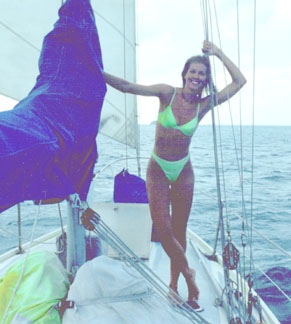
Lonesome Roy’s Girls
August 16 – Around the World
In the August Changes,
we reported on the adventures of ‘Lonesome Roy’ Wessbecher of
Santa Clara. As you might recall, Roy purchased a Columbia 34
MK II for $20,000, then sailed around the world for nearly five
years on a total monthly budget of less than $500. Another interesting
feature of his trip is that he had 18 crew – 17 of them women.
In fact, here’s a little gallery of some of the girls. Tune in
to the September ‘Latitude’
when not-so-lonesome Roy explains how he found them and the best
way to sail with them.
 |
 |
 |
 |
 Photos Courtesy Roy Wessbecher |
|
Weather UpdatesAugust 16 – Pacific Ocean San Francisco Bay WeatherTo see what the winds are like on the Bay right now, check California Coast WeatherLooking for current as well as recent wind and sea readings Pacific Ocean WeatherCheck out the weather map at right. |
 University of Hawaii Meteorology Graphic graphic. |

Pacific Sea State
Seas are relatively normal in the North Pacific except for
the last several hundred miles coming into San Francisco from
Hawaii.
Have a look at http://www.mpc.ncep.noaa.gov/RSSA/PacRegSSA.html.
For another view, see http://www.oceanweather.com/data/global.html.
Tropical Disturbances
Alberto, the first Atlantic hurricane of the season, has been
a 12-day beauty. While down to 40 knots of sustained wind from
hurricane force, she’s done a complete 360-degree turn in the
middle of the Atlantic. Check out her chart.
Meanwhile, in the Eastern Pacific, Hurricane Hector and Tropical
Storm Ileana both continue to blow well off the coast while heading
for the open Pacific. The Mexican hurricane season has been as
busy as the Atlantic’s has been quiet, but all the hurricanes
have started and continued well offshore.
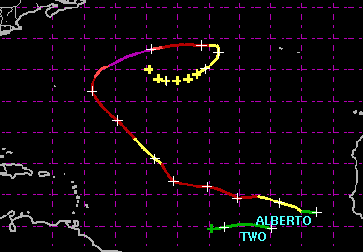 Hurricane Alberto |
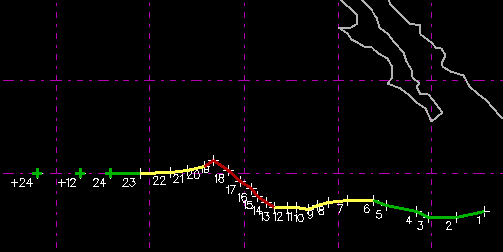 Hurricane Hector |
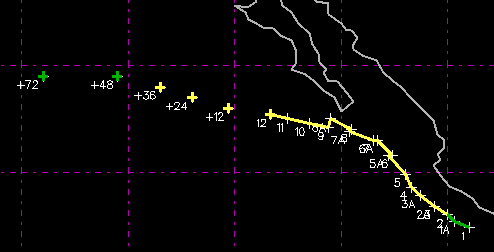 Tropical Storm Ileana |
Unisys Weather Graphics
See http://weather.unisys.com/hurricane/atlantic/2000/index.html
and http://weather.unisys.com/hurricane/e_pacific/2000/index.html
for more.
Cruising
Record Passage to Bora Bora
August 16 – San Blas Islands
It could be a record – although a somewhat dubious one. Canadians
Ken (last name unknown) and Karmella Beemer departed San Diego
on May 8 for the South Pacific aboard their 29-foot custom aluminum
sloop ‘Karmella’, and didn’t arrive at Bora Bora until August
12. That means they were at sea for an astounding 96 days! Normally
a passage like that might take a month or even five weeks. The
reasons for the particularly long passage aren’t clear, although
it’s known they didn’t lose their rig or rudder. Weather seems
to have been a factor, as they reported having one good day of
sailing out of San Diego, followed by 95 bad ones with wind on
the nose. This, however, would be most unusual. The small boat
was heavily loaded, which didn’t help the speed, but at least
they didn’t run out of food. Apparently squalls augmented their
water supply. It was also reported that they overstood Bora Bora
– which means they must have sailed by both the Marquesas and
Tuamotus – and had to be towed to land by a French Navy vessel.
We’ll try to get more on this story.
YOTREPS
August 16 – The Pacific Ocean and Cyberspace
Who is out making passages in the Pacific and what kind of
weather are they having? Check out YOTREPS – ‘yacht reports’ –
at http://www.bitwrangler.com/yotreps/
Racing
Pacific Cup Fallout
August 16 – Pacific Ocean
| While the details are unclear, there has been a serious accident aboard one of the many West Marine Pacific Cup yachts being delivered back to the mainland. Lani Spund’s Santa Cruz-based Santa Cruz 52 ‘Kokopelli 2’ was dismasted, apparently over the weekend. One of the crew was knocked unconscious and suffered a punctured lung. The crewmember’s name is not known. ‘Kokopelli’s crew was apparently able to contact a Portland-bound ship, which took the injured crewman until they were within helicopter range of shore. The injured crewman was then picked up by the Coast Guard and taken to a Portland hospital. His condition is unknown. It’s likely that the dismasting destroyed ‘Kokopelli’s SSB antenna, ‘Kokopelli 2’ is the second Pacific Cup boat to have been ‘hit |
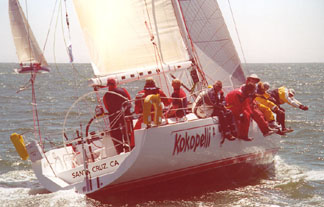 ‘Kokopelli 2’ Starting the Pacific Cup Latitude Photo |
´´´ News Flash from
the U.S. Coast Guard ´´´
August 16, 1:00 PM PDT – Alameda
On August 10, the Coast Guard received a 406 MHz SARSAT alert
located 1,000 miles west of San Francisco for an EPIRB belonging
to a 52-ft Santa Cruz sailboat. Due to the distance offshore,
this case was coordinated by the Coast Guard Rescue Coordination
Center located in Alameda, CA. The Coast Guard launched a C-130
long-range search plane from Air Station Sacramento which located
the dismasted sailing vessel with five people on board, one of
whom had been injured by the falling mast. The Coast Guard also
used the Automated Mutual-Assistance Vessel Rescue (AMVER) system
to locate a nearby commercial petroleum tanker and asked the tanker
to assist. On August 11, the injured person was transferred to
the tanker and the tanker was able to transfer fuel to the dismasted
sailing vessel before continuing its transit to Portland, OR.
At the request of the Coast Guard, four para-rescue jumpers from
the 939th Air Force Reserve Squadron were deployed to the tanker
to stabilize and evaluate the patient for possible medical evacuation.
On August 12, the injured man was hoisted by air-refuelable helicopter
600 miles south west of Portland, OR, and delivered to Emanuel
Hospital in Portland. The dismasted sailboat is scheduled to rendezvous
with a fishing vessel on August 17 to take on additional fuel
required to make land-fall. A quick note: AMVER is a completely
voluntary vessel tracking system where merchant vessels report
their location and intended tracklines to the Coast Guard to assist
mariners in distress. When called, they often divert to render
assistance to vessels hundreds of miles away at significant cost
to the parent company. The AMVER system and the generosity of
the participating companies is responsible for saving scores of
lives each year by directly assisting mariners in some of the
most remote locations of the ocean.
Top / Index of Stories
/ Subscriptions
/ Classifieds
/ Home