
Skip to content

March 8, 2004


Billionaire Beats Gold Medalist at Heineken

March 8 – St. Martin


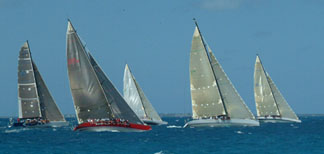
In order: Morning Glory, Pyewacket, Equation, the R/P
78 Titan, and the Volvo 60 Venom

The big story at the just-concluded Heineken
Regatta in St. Martin, indeed, the big story in the world of
yacht racing, was the debut of the two MaxZ86s, Roy Disney’s
Pyewacket and Hasso Plattner’s Morning Glory. These
boats did not fail to impress – even those who were initially
skeptical.


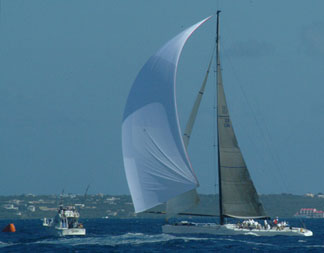
Pyewacket at the leeward mark

Dee Smith of Novato, the project manager
and tactician on Morning Glory, and Stan Honey, the Peninsula-based
navigator on Pyewacket, struggled to come up with superlatives
for the boats. Both reported they are much better at beating,
reaching, and running than similar boats without the canting
keels and forward canard rudders. The one fly in the ointment
is that canting the keels requires use of the engine. In fact,
every time the keel is moved – which is virtually all the time
– the engine revs up. It’s quite noisy. Nonetheless, these boats
showed stunning speeds and pointing ability. “It’s made
yacht racing exciting for me again,” said Smith, who has
been doing it all for close to 30 years.


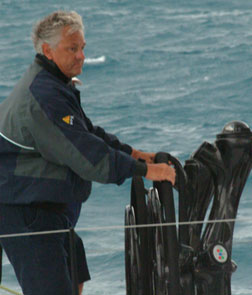
Hasso Plattner, a lifelong sailor, including aboard dinghies,
at the helm of Morning Glory

Morning Glory
took top honors, with Roger Sturgeon’s San Francisco-based TransPac
52 Rosebud, a winner at the Big Boat Series and Key West,
second. Pyewacket was third. With owner Plattner, founder
of SAP software, driving Morning Glory and besting Robbie
Haines, Olympic medalist and helmsman, some people came up with
the line ‘billionaire beats gold medalist’. But Plattner, a long
time competitive sailor, is no slouch at sailing. Further, Smith
was quick
not to read much into the victory over Pyewacket. “We
were just a little bit smoother,” he said. But he carefully
noted that neither boat is anywhere near up to their potential.
“We have no idea what that is at this point.”


Dee Smith, project manager and tactician for the victorious Morning
Glory,
hams it up to please the photographers.

In the wild world of billionaires, we were
told that Plattner had flown off the island before some of the
other boats in the class had crossed the finish line. If that’s
not mind-blowing enough, Smith says they aren’t yet sure if Plattner’s
Morning Glory is faster than his new 147-ft ultra sleek
cruising boat.

Conditions at the Heineken were challenging
for the 250+ boats. In all of the four races there were periods
when the wind was in excess of 30 knots, and it was rarely below
20. In the Anguilla Channel, the waves were big, steep, and close
together. The conditions were hardest on the multihull classes,
where three of the 19 entries dropped their rigs, and there was
considerable other damage. But
all in all, what a tremendous event with incredible local support.
A surprising number of West Coast sailors and several West Coast
boats were there. We’ll have more on them in later ‘Lectronics
and the April 1 issue of Latitude
38
.
If anyone is looking for a great sailing time next
spring, it will be the 25th anniversary of the Heineken. No doubt
the sponsor will be bringing in at least 10 miles of beer.


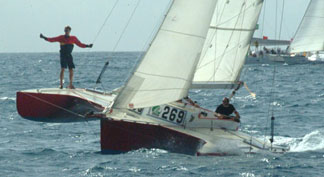
Some of the ‘biggest bang for the buck sailing’ was enjoyed by
owners and crews of ’70s vintage trimarans such as Tryst.
They were wet and wild.
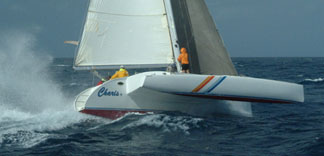

The little tri Charis was another big bang for the buck
boat, hitting in excess of 20 knots here.

At least five masts came down, including that of the lovely 70-ft
Hoek designed Kim. Three of the multihulls lost their
rigs. The most spectacular dismasting happened on the first leg
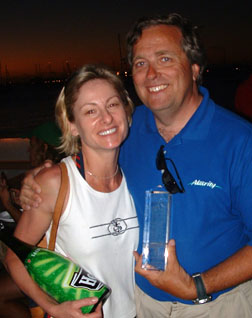
of the first race, when Rex and Celeste Conn’s 50-ft extreme
tri dropped her new carbon fiber wing mast . . . almost directly
on top of the Volvo 60 Venom. Tim Wright caught the action
with the mast halfway down and the tri still doing 20 knots.
At the awards ceremony, the couple, seen here, were awarded the
‘Crash and Burn Trophy’. Divers have located the wreckage, and
it’s to be raised today.
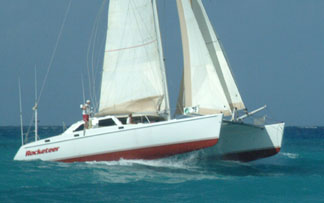

The multihull division of the Heinie proved to us, once and for
all, as we have maintained, that cats can’t point. If you’ll
remember, a few months ago, Chris White, designer of the Atlantic
55, claimed one of those boats sailed over the top of a J/160,
proving her weatherly ability. Well, the humble Profligate
rolled the
Atlantic 55 Rocketeer, seen here, on the first leg of
the first race, and never had any trouble pointing as high or
higher than her. And Profligate tacks in about 110 degrees,
which is at least 20 degrees worse than a J/160. We’ll have a
lot more on this subject in the April edition of Latitude
38
.


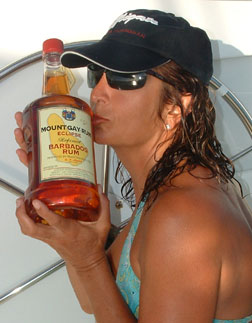
Doña de Mallorca proudly holds the bottle of rum presented
to us by John Haste of the San Diego-based Perry 52 cat Little
Wing,
thanks to our ‘victory’ over them in the Heinie. Little Wing, which was sailed by a bunch
of veterans from cruising in Mexico was slowed by a three-year
old Dacron main that’s lost her shape, a dicey head on a jib,
and other problems. However, she did finish the around-the-island
race, and in the process hit an all-time best of 22.5 knots.
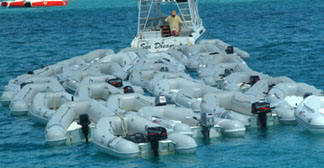

More than 150 of the Heineken entries were bareboats. Either
this guy had stolen all their dinghies while they were out racing,
or more likely, he was towing them back and forth between Marigot
and Pelican Bay for them.
Photos Vincent C. Rubino and Latitude/Richard


New Record in Manzanillo Race

March 8 – Manzanillo, Mexico

Last Tuesday was a ‘good news/bad news’
kind of day for Roy Disney, who successfully ousted Michael Eisner
as chairman of Disney Corporation about the same time he lost
his San Diego to Manzanillo course record. The new record holder,
Dick and Mary Compton’s water-ballasted Andrews 77 Alchemy,
finished San Diego YC’s revived race in 3 days, 23 hours,
52 minutes and 33 seconds. That obliterated the previous 5 day,
16 minute record, set in 1994 by Disney with his SC 70 Pyewacket.
Staffed by an all-star crew which included Mark Rudiger, Gordon
Maguire, Larry Leonard, and Mark Sims, Alchemy averaged
a speedy 11.68 knots over the 1,100-mile course. “We could
have towed a water-skier all the way down the Baja coast,”
claimed Sims.

Three other big boats also broke Pyewacket’s
decade-old milestone: the straight-out-of-the-box Magnitude
80,
which finished just five hours after Alchemy despite
numerous teething problems, Medicine Man, and Victoria.
The overall winner on corrected time was Bob Lane’s Andrews 61
Medicine Man, which nipped Dennis Conner’s R/P 50 Stars
& Stripes
by 18 minutes. Paddy Wagon, Richard
Mainland’s Ross 40, took PHRF-B, while Max and Shirley Lynn’s
Beneteau 40.7 Tranquility topped the Performance Cruising
class. One boat, the new J/145 Stark Raving Mad, retired
after a day with rudder problems.

Other than a little slow going at the end,
there was nothing not to like about this race. San Diego YC and
the revamped Las Hadas Resort (think Bo Derek in ’10’) pulled
out all the stops to make the event a big success. The awards
ceremony, in particular, was memorable – under a rising full
moon, a professional ballet troupe mesmerized the crowd with
a colorful Vegas-level after-dinner show. After such a hospitable
reception, it will be hard to take the race somewhere else in
two years – but we’ve heard that PV, Cabo and Mazatlan are all
also being considered.


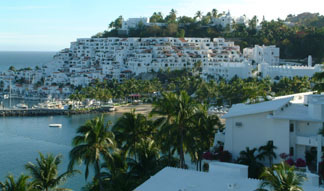
It was fun to be at Las Hadas again after a 10-year hiatus.
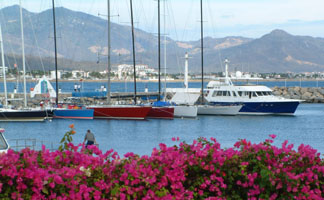

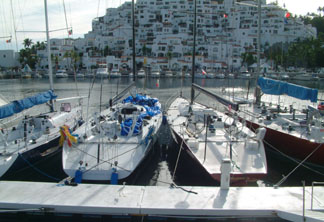
Red, white and blue at the Las Hadas docks

Big sticks, from left: Victoria, Magnitude 80, Alchemy
and Sorcery
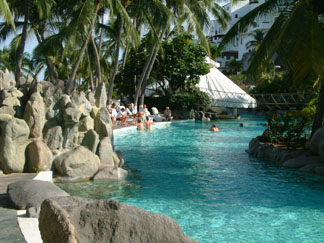

Poolside at Las Hadas


Ripping down the Baja coast on the J/160 Indigo
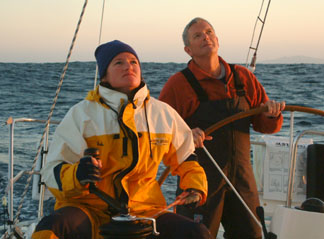

Bermuda Olympic sailor Paula Lewin and Tim Lynch enjoy an early
morning watch together.
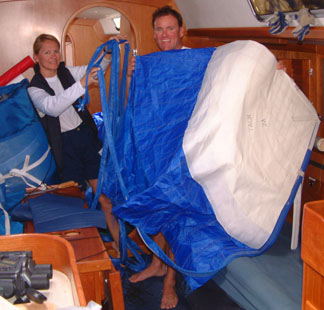

Sadly, our 2A (the vital running kite) died on the operating
table less than 48 hours into the race.
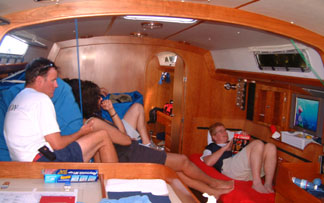

The afternoon showing of Finding Nemo
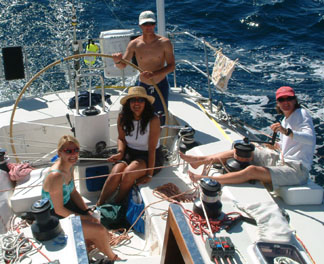

Erik Shampain steers while the ‘Indigo Girls’ trim.

Photos Latitude/Rob


Most of the 22-boat fleet is already in
Puerto Vallarta now, either provisioning for the trip north or,
in the case of six boats (Magnitude 80, Medicine Man, Victoria,
Velos, Stars & Stripes,
and Wasabi), getting ready
to duke it out in MEXORC, which begins next Sunday. See www.sdyc.org for Manzanillo Race results,
pictures and race manager Jeff Johnson’s daily reports. Also
see the April issue of Latitude
38
for more.


Cheyenne
Glides to 623-Mile Run

March 8 – Southern Pacific Ocean

Around the world in less than 60 days?
Steve Fossett and crew are now halfway around the world and on
such a pace. Entering the Pacific, Steve Fossett’s Cheyenne
scored her biggest day’s run to date.

On Saturday the world’s biggest catamaran
crossed the international date line in record time – half way
around the world in 29 days – having racked up their fifth
consecutive 500+ mile day.

Currently Cheyenne is 348 nm SE
of the Bounty Islands (NZ); 768 nm SE of Wellington, NZ. Predicted
excellent conditions continued through the end of Day 30 as Cheyenne
posted the best day yet on her Round the World record attempt
– 623 miles over the past 24 hours (25.92 kts average speed)
to stretch her lead over the 2002 RTW record track of Orange
to 2,042 miles.


South Africa to Field Interracial America’s
Cup Challenge

March 8 – Cape Town, South Africa

South Africa will enter the America’s Cup
Challenge in 2007 for the first time ever. World-class Cape Town
yachtsman Geoff Meek will skipper the South African entry, Shosolosa,
which will be built in the city by top British designer, Jason
Ker. The city’s Royal Cape Yacht Club has been nominated as the
South African Challenge club.

The training vessel for the crew, IACC
Luna Rossa, built for the Italian Prada Challenge, arrived
in the Cape Town harbor today. It will be the first America’s
Cup yacht seen in South Africa, and marks the official start
of the South African Challenge.

Sailing crew signed up so far are Ian Ainslie,
David Rae, Golden Mgedeza, Ashton Sampson, Marcello Burricks,
Marc Lagesse and Guido Verhovert. The full crew will be selected
during trials held throughout the year. Mafika Mkwanazi, former
CEO of Transnet, has been appointed president of the SA America’s
Cup Challenge.

The announcement was made this weekend
by Salvatore Sarno, chairman of
Mediterranean Shipping Company South Africa, who is also managing
director
of the South African America’s Cup Challenge campaign. This will
be the first time in the event’s history that a black crew will
take part. Thinking long-term, Sarno started to train young black
crew members several years ago. “We will have six or seven
highly trained, wonderfully skilled black crew on board,”
he said.

See www.capetimes.co.za/index.php?fSectionId=271&fArticleId=367722
and http://tinyurl.com/3bwdn.


On Rising from a Dive

March 8 – Kitchener, ON, Canada

Kent Hunter-Duvar, of the T26 Luff Affair,
writes on the subject of rising from a dive safely: “Stuck
here in the frozen North, I look forward to each new edition
[of ‘Lectronic Latitude]. Just reading the latest (March
5
) and as a fairly experienced scuba diver, the last story
“Rise No Faster than Your Bubbles” causes me great
concern. While in their particular situation (OOA) an emergency
ascent was indicated, the recommendation to rise no faster than
your bubbles is false and very likely to cause serious injury.
Current guidelines and training recommend an ascent rate of 30
feet/minute or less (so about 80 seconds from 40 feet) with an
absolute maximum ascent rate of 60 feet/minute. Anything faster
drastically increases your risk of DCI (the bends). This applies
to hooka as well as scuba diving as in both cases you are breathing
air under pressure equivalent to the surrounding water pressure.
It does not apply to freediving (breath hold diving) as the lack
of compressed breathing gas makes it entirely different and the
time period of the dive is much shorter.

“It is my opinion that anyone using
hooka should complete a basic (open water level) scuba course
in order to know the risks and proper techniques, including such
issues as ascent (and descent) rates and dive tables. For example
the U.S. Navy dive tables indicate a max of 60 minutes at 60
feet for no decompression diving, anything beyond that and decompression
stops are required (or at least highly recommended) on ascent.
And all training agencies recommend a minimum 3 minutes ‘safety
stop’ at 15 feet on EVERY dive. If you’re interested in more
info, I’d recommend a visit to Divers Alert Network at www.diversalertnetwork.org. Membership is
very low cost and provides for free emergency transportation
and access to advice from specialists in dive medicine in case
of a dive injury, including locating the nearest hyperbaric chamber
if recompression therapy is required, as well as access to non-emergency
medical help and advice.”


Piracy in the Gulf of Aden

March 8 – Gulf of Aden

Katie and Don Radcliffe of Santa Cruz,
sailing in the Red Sea, report that two attempts at piracy have
been made on their yacht, Klondike, in the Gulf of Aden.
They will be in Massawa, Eritrea, shortly and will try to send
us details and photos.

They comment on communications in the Red
Sea: “Both Sailmail and Winlink (Ham) present challenges
in connecting with distance transmitters here in the Red Sea.
Winlink with transmitters in Italy and Qatar has been more user
friendly. Winlink allows 30 minutes/day per station versus the
10 that Sailmail gives totally. You’ve got more time to make
several attempts at connection to Winlink. Transmitters for Sailmail
are located in Belgium, Mozambique and Brunei. Late evening connections
to Brunei have given the best results on Sailmail.”


YOTREPS

March 8 – The Pacific Ocean and Cyberspace

Who is out making passages in the Pacific
and what kind of weather are they having? The YOTREPS daily yacht
tracking page has moved to www.bitwrangler.com/psn.


Weather Links

March 8 – Pacific Ocean

San Francisco Bay Weather

Check out this guide to San Francisco Bay
Navigational Aids: http://sfports.wr.usgs.gov/sfports.html.

To see what the winds are like on the Bay
and just outside the Gate right now, check out http://sfports.wr.usgs.gov/wind.

The National Weather Service site for San
Francisco Bay is at www.wrh.noaa.gov/Monterey.

California Coast Weather

Looking for current as well as recent wind
and sea readings from 17 buoys and stations between Pt. Arena
and the Mexican border? Here’s the place – which has further
links to weather buoys and stations all over the U.S.: www.ndbc.noaa.gov/Maps/Southwest.shtml.

Pacific Winds and Pressure

The University of Hawaii Dept. of Meteorology
page posts a daily map of the NE Pacific Ocean barometric
pressure and winds.

Pacific Sea State

The site for the Pacific Ocean sea states
has moved to http://www.mpc.ncep.noaa.gov/shtml/PacRegSSA.shtml.

For views of sea states anywhere in the world, see http://www.oceanweather.com/data.


Top
/ Index of Stories /
Previous 'Lectronic Edition

Subscriptions
/ Classifieds
/ Home

©2004 Latitude
38 Publishing Co., Inc.

The De-Naming Ceremony
I once met a man in Florida who told me he’d owned 24 different yachts and renamed every single one of them.