
Skip to content

February 7, 2003


Photos of the Day: Revillagigedos

February 7 – Revillagigedo Islands, Mexico

Tired of the relatively murky waters of
the Pacific Coast of Mexico? You might want to try the Revillagigedo
Islands, where Pete Boyce of the Sabre 42 Edelweiss III reports
he could clearly see his anchor in 65 feet of water. Visiting
comes at a steep price, however.

The Revillagigedos are a chain of volcanic
islands roughly 250 miles southwest of Cabo San Lucas, which
puts them out in the middle of nowhere. Formerly a popular spot
for long range fishing charters out of San Diego, the islands
are now a protected preserve. It’s a good thing, too, because
they are home to lots of whales, huge rays, sharks, and countless
other forms of sea life.

You can’t go to the islands without a permit,
and in the past getting a permit has been an uncertain endeavor.
But Boyce reports that he got one in just 90 days – hey, it’s
Mexico – from John M. Riffe of La Paz. Here’s the catch: The
permit cost $600 for about 10 days, so it’s not for economy cruisers.

Boyce sailed to Isla Socorro from Puerto
Vallarta with Stef and Marilyn Tyhordarson, who cruised the Tacoma-based
Tayana 37 Circe in Mexico for years, and Sue Strembitsky
of Calgary, Canada. It took the foursome 2.5 days, mostly under
sail. It was predominantly close and broad reaching in winds
under 17 knots and gentle three to six foot seas. One hundred
miles from the islands, they hooked a 50-lb yellowfin tuna.

Fishing is not allowed at the islands,
neither is going ashore. And the Navy, which maintains a base
on the islands, checks in with the boats each day. They are very
friendly. Boyce reports the snorkeling was excellent, as they
saw many tropical fish, white tip sharks, dusky sharks, a whale
with two calves, and lots of other interesting stuff. The water
was pleasant, in the high 70s. The anchorage is always a little
rolly, however.

Also at the islands were Steve and Barbara
Cambell of the Leadville, Colorado-based Valiant 40 Blue Chablis.
Apparently they sail out to the Revillagigedos every year.

If you’re looking for tiendas, restaurants,
hiking, and white sand beaches, the Revillagigedos are precisely
the wrong place. But if you want to get away to great diving
that few experience, you might consider digging deep into the
cruising kitty and applying for a permit. Boyce says he hopes
to return.

Their return sail to Puerto Vallarta was
a beat followed by a close reach in winds up to 20 knots. It
took three days, about 30% of it motoring.


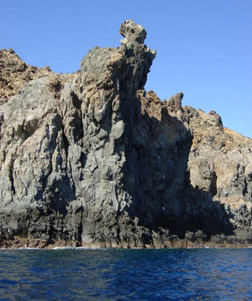
The islands are volcanic.

Photos Pete Boyce except as
noted


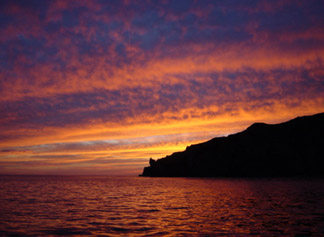
The colors at the isolated islands are vivid.
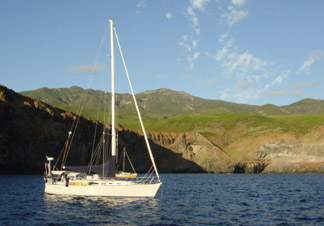

Edelweiss III at Isla Socorro.
There’s only one anchorage in most conditions.
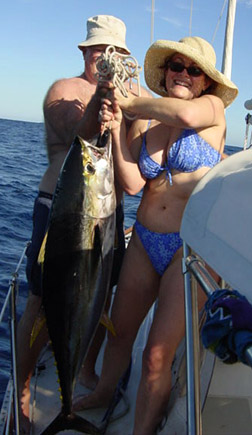

Stef and Marilyn pull in a 50-pounder
on their way to the islands.
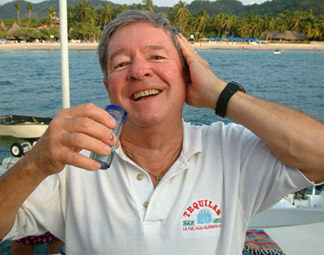

Pete, in Zihua, recalling his trip to the Revillagigedos.
Photo Latitude/Richard


Equator Crossing Ritual aboard Kingfisher2

February 7 – South Atlantic Ocean

Kingfisher2’s latest
position report came in from 1 56′ S 26 48′ W (approx. 121 nm
south of the Equator). In her Jules Verne around-the-world record
attempt, she is nine minutes behind the record and 24 hours and
21 minutes behind Geronimo, which is still battling harsh
conditions south of Australia.

After being gripped by the Doldrums, the
southeast Trades are bringing some relief this afternoon as Kingfisher2
sails at 16-18 knots in a building breeze. “The SE trades
will hopefully increase more over the next 24 hours and hold
for two to three days,” said skipper Ellen MacArthur. “We’re
more west than we’d probably like but on the wind and just aiming
to get south as far as we can in this breeze.”

Following the crossing of the Equator this
morning, Equator ‘first timers’ Andrew Preece and Kevin McMeel
initially thought they may have escaped the King Neptune initiation
ritual. But they were not too surprised when they were hauled
on deck to make an offering to Neptune. Peerce reports, “We
crossed at 0121 and 59 seconds on our eighth day at sea. It was
something of an anticlimax after a long and frustrating day trying
to work the fitful breezes; at one stage we were headed right
back where we came from. But then how can crossing a notional
point ever be truly sensational. The only difference is that
now subconsciously the countdown to the South has begun. As I
arrived on deck Youngster, the most recent person to have undergone
the King Neptune ritual when he was initiated on the northbound
leg of the recent Volvo Race, appeared from the starboard hull
with a silver freeze dried food bag as a crown, some netting
as a beard and a toilet plunger as an instrument of torture.
Kevin and I were lashed to the martingale strops by Ellen as
Hendo circled menacingly with a bucket of brown lumpy liquid.
It wasn’t being beaten with the plunger that was difficult. It
wasn’t having the brown slime rubbed in my hair that was hard
or even having it poured down the inside of the back of my shorts.
But having to drink a mouthful had me retching much to the amusement
of the assembled crew; I could even see Guilllermo, on the wheel
a hundred feet away, heaving with laughter.

“It feels great to have survived after
four salt water washdowns and it is great to have passed one
of sailing’s great milestones and I hope that it brings us great
fortune for the future; sailors are highly superstitious and
asking Neptune for permission to pass across the Equator has
humorous overtones but a very serious underlying purpose, just
as many of them will not whistle on a boat, carry anything green,
leave on a Friday or mention that small cuddly animal that breeds
frequently and has long furry ears.

“I asked Ellen about her first Equator
crossing when she brought Kingfisher back from New Zealand
as a new boat. ‘First I dressed up as Neptune and quizzed myself
to the camera,’ said Ellen. ‘Then I doused myself in a combination
of old food and diesel. I tried to make myself as hard on myself
as possible,’ she laughed. Superstition is a serious business,
especially when you are dealing with a force as mighty as the
ocean and its elements; you need all the help you can get.”
See www.kingfisherchallenges.com.


USA Tops ISAF World Team Racing Championship

February 7 – Auckland, NZ

Team USA 2 will take home the gold from
the 2003 ISAF World Team Racing Championship, held in 420s in
Auckland Jan. 31 through Feb. 7. GBR 2 won the silver, and defending
champions NZL 1 get the bronze. Sixteen three-boat teams from
nine countries participated. For complete results, see http://www.nzteamracing.com.


YOTREPS

February 7 – The Pacific Ocean and Cyberspace

Who is out making passages in the Pacific
and what kind of weather are they having? The YOTREPS daily yacht
tracking page has moved to www.bitwrangler.com/psn.


Weather Updates

February 7Pacific
Ocean

San Francisco Bay Weather

To see what the winds are like on the Bay
and just outside the Gate right now, check out http://sfports.wr.usgs.gov/wind.

The National Weather Service site for San
Francisco Bay is at www.wrh.noaa.gov/Monterey.

California Coast Weather

Looking for current as well as recent wind
and sea readings from 17 buoys and stations between Pt. Arena
and the Mexican border? Here’s the place – which has further
links to weather buoys and stations all over the U.S.: www.ndbc.noaa.gov/Maps/Southwest.shtml.

Pacific Winds and Pressure

The University of Hawaii Dept. of Meteorology
page posts a daily
map
of the NE Pacific Ocean barometric pressure and winds.

Pacific Sea State

Check out the Pacific Ocean sea states
at: http://www.mpc.ncep.noaa.gov/RSSA/PacRegSSA.html.


For views of sea states anywhere in the world,
see http://www.oceanweather.com/data.


Top
/ Index of Stories /
Subscriptions
/ Classifieds
/ Home

©2003 Latitude
38 Publishing Co., Inc.

The De-Naming Ceremony
I once met a man in Florida who told me he’d owned 24 different yachts and renamed every single one of them.