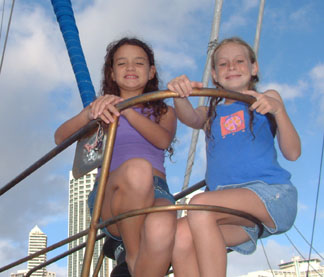
Today’s Photo of the Day is of Michela
and Kaianne, a couple of smiling girls who were playing on the
bowsprit of the Island Trader 41 Hattie Mai Aloha at the
Waikiki YC in July. We asked them and their dad if we could take
their picture. They all agreed, so here they are.
Photo Latitude/Richard
Cruiser Steve Kingsley Dies in Baja Traffic
Accident
August 26 – San Quintin, Baja California
“Steve Kingsley of the Formosa 41 Valkyrie (Class of ’00), died Friday in an auto accident
near San Quintin, Baja,” reports Lucie van Breen. “Sue
Robertson, Kingsley’s wife, was not in the car with him. Kingsley
had apparently planned on hitchhiking to a wedding. Sue wanted
to go with him, but he advised against it. Kingsley was reportedly
riding in a trailer being pulled by a vehicle with a family –
including kids – inside. During a passing incident, the trailer
was sideswiped, lost a wheel, and flipped over. Kingsley was
thrown out of the trailer and killed. We don’t know anything
about the other passengers or the reason why Kingsley was near
San Quintin, since Valkyrie is believed to be near Bahia
de Los Angeles. Up until that time, Steve and Sue had been happily
cruising in the Sea of Cortez, enjoying being away from the hustle
and bustle, and loving the sea life and friendships they were
making.
“Paul Kamen reminded me this morning
that Kingsley really lived many lives,” continues van Breen.
He and Sue had crewed on the Bird boat, Falcon, which
sank in Raccoon Straits during a race about 10 years ago. As
the boat was rapidly sinking, Kingsley’s PFD became caught in
the rigging and he was pulled down – until he was able to free
himself and return to the surface. His chosen profession, professional
diver, no doubt helped him survive the accident.”
Upstart Brits Steal the Stars
August 26 – Marina del Rey
Rich Roberts reports from Marina del Rey:
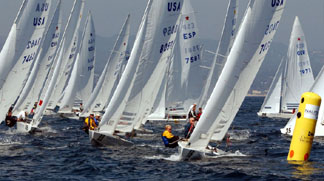
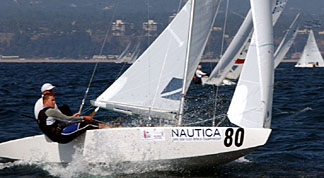
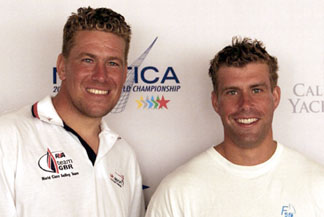
Iain Percy and Steve Mitchell, mere rookies
among many of the world’s best sailors, won the final race of
the 81st Nautica 2002 Star Class World Championship Friday to
give Britain its first title in the venerable class. “That’s
the way to take the pressure off, isn’t it?” Mitchell said
as they sailed into the California YC dock with the Union Jack
flying from their mast. “He put that in the cool box this
morning and didn’t tell me,” Percy said. “I would have
thought it was bad luck.”
The way they sailed, luck didn’t matter.
Neither Percy, 26, the 2000 Olympic Finn class gold medalist
from Winchester, nor Mitchell, 32, of London, had sailed a Star
until 10 months ago, although they had already worked their way
up to the No. 17 ranking in the class. With finishes of 4-1-3-2
in the 103-boat fleet in the previous four races, they entered
the sixth and final race with a four-point lead over 1990 champions
Torben Grael and Marcelo Ferreira of Brazil, and nine points
over France’s Xavier Rohart and Yannick Adde. Although Grael
finished fourth and Rohart 10th, neither ever threatened seriously
Percy and Mitchell, who led at every mark. Boosted by breezes
as strong as 14 knots, which they prefer, they finished 41 seconds
ahead of 1998 winner Colin Beashel of Australia, who had David
Giles as crew. Three-time winner Bill Buchan, 67, of Seattle,
with Mark Brink, was third – by far the best performance of the
week by one of the class’s enduring icons. Counting Grael, Beashel
and Buchan, Percy/Mitchell put away 11 former champions. Paul
Cayard, the ’88 champion sailing with Hal Haenel – also a world
and Olympic champion as crew – placed fifth Friday to score fourth
overall.
The top 10 (worst score discarded):
1. Iain Percy/Steven Mitchell, UK, (19)-4-1-3-2-1, 11 points.
2. Torben Grael/Marcelo Ferreira, Brazil, 3-1-5-(9)-5-4, 18.
3. Xavier Rohart/Yannick Adde, France, 6-8-2-(33)-3-10, 29.
4. Paul Cayard/Hal Haenel, San Francisco, 7-9-4-8-(40)-5, 33.
5. Rick Merriman/Bill Bennett, San Diego, (53)-7-8-4-15-12, 46.
6. Peter Bromby/Martin Siese, Bermuda, (33)-2-32-5-1-9, 49.
7. Colin Beashel/David Giles, Australia, (41)-19-11-2-18-2, 52.
8. Mark Mansfield/Killean Collins, Ireland, 2-13-17-25-7-(104),
65.
9. Mark Reynolds/Magnus Liljedahl, San Diego, (78)-5-29-1-10-22,
67.
10. Howie Shiebler/Rick Peters, San Francisco, (70)-21-30-6-4-6,
67.
Jobson Missing the Right Recommendation?
August 26 – Long Island Sound, NY
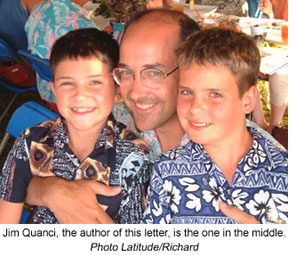
“I am upset by Gary Jobson’s article
in the September 2002 Sailing World about the tragic death
of Jamie Boeckel,” writes Jim Quanci, “because Jobson
doesn’t recommend the one action that would have most likely
prevented this horrible accident – and the one action that most
amateur sailors crossing oceans use – wearing a safety harness.
“I have participated in numerous ocean
races up and down the West Coast, including a number of TransPacs
and West Marine Pacific Cups. On every offshore race, the rule
at night is one must have a harness on and must be clipped in
at all times. Jacklines run from bow to stern allowing all maneuvers
at night to be completed without being disconnected from the
boat. I have been involved in numerous safety at sea seminars
where time and again people are told to use harnesses – especially
at night. In the West Marine Pacific Cup, skippers have been
required to tell their crew in writing the boat’s requirements
for the use of flotation and harnesses – impressing on the skippers
and crew how important flotation and harnesses are.
“I also believe there is a growing
danger among the more professional crews – that they believe
because of their experience and talent – these safety requirements
don’t apply to them. In this year’s West Marine Pacific Cup,
there was a man overboard from one of the professionally crewed
boats – and as with Blue Yankee – the man overboard had
no flotation and no harness on. In this case, thank God, they
recovered the person. On the amateur boats, no one would think
of performing maneuvers at night without being harnessed in.
“Anyone who
has been out to sea knows that if someone goes overboard at night,
with flotation on or not, the odds of not being able to find
them are too high. This is doubly true on a big fast boat with
a spinnaker up, where it can take many yards and many minutes
to stop and return to where the crew went overboard. Jobson’s
article does the sailing community a real disservice as it doesn’t
strongly recommend – doesn’t recommend at all – the one most
effective remedy one can take. Do not get disconnected from the
boat – use a harness. The use of a harness is only mentioned
in passing- and virtually written off because the crew felt it
wasn’t necessary. Since when do skippers pass on responsibility
for the safety of their crew to the crew? Was the obvious need
for crew to be harnessed in at all times during the night not
mentioned due to potential liability – or feelings of guilt?
Surely Jobson and Isler know everyone on the boat should have
been wearing a harness – and owe it to the sailing community
to say so.
“I get a sick feeling in my stomach
saying all this, as I am sure the crew of Blue Yankee
already feel terrible and guilty about what happened, and this
letter is rubbing salt in the wound. But we need to learn from
this tragedy and let the sailing community know how to prevent
it from happening again.”
From One U.S. Island to Another
August 26 – Honolulu, HI
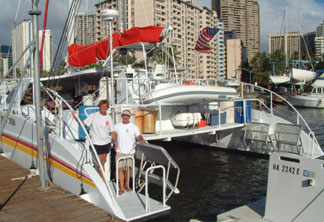
If you want to carry paying passengers
on a boat in the United States, the boat has to be built in the
United States. Captain Andy – he’s standing on the transom steps
with Keith, the deckhand – has long been doing catamaran charters
on the Na Pali Coast of Kauai. His first cat was built by Golden
Coast Yachts of St. Croix, one of the U.S. Virgin Islands, which
is why it’s legal. After 10 years or so of good service, he went
to Gold Coast for this second charter cat for the Na Pali Coast.
He and Keith had just sailed the 55-footer to Hawaii by way of
Panama and Cabo San Lucas. They hadn’t found much wind, so it’s
good that the new cat motors well. Real well. Thanks to huge
engines and four-bladed props, it does 25 knots to weather.
Photo Latitude/Richard
YOTREPS
August 26 – The Pacific Ocean and Cyberspace
Who is out making passages in the Pacific
and what kind of weather are they having? Check out YOTREPS –
‘yacht reports’ – at http://www.bitwrangler.com/yotreps/
Looking for current as well as recent wind
and sea readings from 17 buoys and stations between Pt. Arena
and the Mexican border? Here’s the place – which has further
links to weather buoys and stations all over the U.S.: www.ndbc.noaa.gov/Maps/Southwest.shtml.
Pacific Winds and Pressure
The University of Hawaii Dept. of Meteorology
page posts a daily
map of the NE Pacific Ocean barometric pressure and winds.


 “Anyone who