
Skip to content

February 19, 2001


Photo of the Day

February 19 – Tenacatita Bay, Mexico

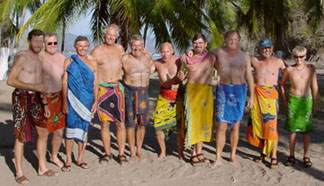
Think cruising doesn’t change a man? Before
they took off cruising to Mexico, most of these guys were probably
your typical hard-charging, stressed-out, career freaks, worried
about all kinds of artificial stuff. There was no way any of
them in their former lives would have agreed to participate in
a ‘pareo fashion show’, as they’re seen doing here at Tenacatita
Bay. It’s just a guess, but we suspect their blood pressure has
dropped an average of 20 points and that they’re laughing a whole
lot more. Jan Twardowski of the Deerfoot 65 Raven took
the photo.


Photo Jan Twardowski


Puerto
Vallarta Race Update

February 19 – Pacific Ocean

The rich are getting richer. All the smaller and slower boats
that were in the early starts of the Del Rey to Puerto Vallarta
Race suffered through several days of zephyrs, sometimes covering
less than 100 miles in 24 hours. But when the sleds finally started,
they had at least enough wind to turn in 200-mile days. Nothing
for them, but they’re rapidly overtaking the smaller boats. For
details, check out today’s report about 1:30 p.m. at www.dryc.org.


The Race Update

February 19 – Atlantic and Southern Oceans

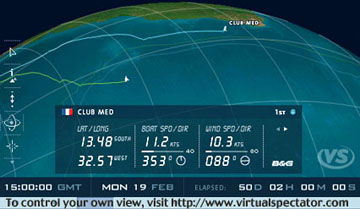
With Club Med, soon to cross back into the North Atlantic
and having a nearly 1,000-mile lead on Innovation Explorer,
the only question seems to be whether Club Med will finish
the course in less than 60 days. Skipper Grant Dalton is cautioning
against any such expectation. Meanwhile, the other three boats
are basically 6,500 miles behind in New Zealand. Warta Polpharma
is in third place, having overtaken Team Adventure, which
pulled into Wellington for repairs and the loss of another crewman
to injury. They’ve continued on with nine. As she departed, Team
Adventure
crossed paths with Team Legato, which was
putting into Wellington so three crew could seek medical attention.
It’s expected they’ll be down to seven crew.

With a comfortable lead, Grant Dalton touched
on several interesting topics: “The Trades blow at between
15-18 knots at night and 11-12 knots during the day. We are sailing
with the full main and the Solent and moving correctly towards
the north. Perhaps if I had this race to do again, we would have
developed another reaching sail for the Trades that would be
a bit more efficient right now, something like the sail that
Team Adventure used on the way south through here a month
ago. But taking another sail means having to carry that extra
weight when it isn’t used, and, importantly, putting it down
below inside one of the hulls in the South.

“You can never have enough food on
board. We are always hungry. At the beginning of The Race we
were throwing some of the food we prepared away everyday as people
weren’t that hungry. But as The Race has progressed we are just
more and more hungry. Every grain of rice that falls on the floor
is meticulously picked up and eaten, every scrap is devoured.
One of the biggest dilemmas for each of the crew is to decide
whether or not to eat his three extra daily snacks, issued for
the time between meals, right at the beginning of the day, or
to try and make them last out all day. Not an easy one to solve.”

Blue Club Med
Green Innovation Explorer
Orange Team Adventure
Yellow Warta Polpharma
Magenta Team Legato
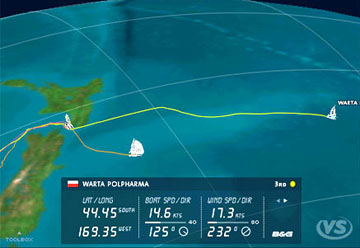

Graphics Courtesy Club
Med
http://www.catamaran.clubmed.fr/

Ranking of 19 Feb 2001 15:00:00 GMT:

1. Club Med / dtf 4084.3 miles
2. Innovation Explorer / dtl 926.7 miles
3. Warta Polpharma / dtl 6615.9 miles
4. Team Adventure / dtl 7007.3 miles
5. Team Legato / dtl 7232.9 miles


Port Captain fees in Mexico

February 19 – Mexico City

On January 1, Mexico’s Secretary of Communication and Transportation
instructed Mexican port captains to, for the first time, charge
fees each time a boat checked in and out of a port. These fees
were not only very expensive, about $20 each way, but required
an extra visit to a bank to pay the fee. It was not good. Another
reason it wasn’t good was because it was confusing. If a boat
left a marina to anchor out for a night, did it have to check
out and then back in again? Some port captains thought yes, some
thought no.

Terri Grossman, president of the Mexican Marina Owner’s Association,
and several others flew to Mexico City to tell Communications
and Transportation that this new law wasn’t in anyone’s best
interest. Not for the Mexican government, not for the port captains,
and not for owners of private boats or the Mexican marine industry.

Apparently the government listened, because on February 13, the
Director General of Port Captains sent out a temporary modification
of the law that is expected to be a prototype of a permanent
change in the law. According to Mary Shroyer of Marina de La
Paz, the main impact of the modification is that when a boat
leaves a port, but stays within the port captain’s jurisdiction,
they only have to check out over the VHF radio and there is no
fee. For example, if a boat that was in La Paz wanted to leave
for a month of cruising between Muertos and Agua Verde – a fine
and large cruising area – it would only have to inform the port
captain over the radio. But if the boat was going to leave the
port captain’s jurisdiction, perhaps going down to Cabo, up to
Puerto Escondido, or over to Mazatlan, the boat would have to
check out and pay the fee.

Everything was relatively clear this morning, until we got the
following email from Heidi Grossman in San Carlos. Heidi is Terri
Grossman’s daughter:


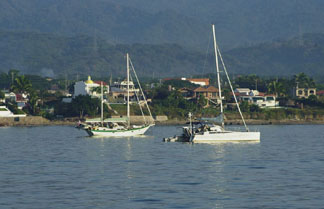
Should these boats anchored off La Cruz have
to pay $20 to check out, and then another $20 10 miles later
to check into Nuevo Vallarta?
Photo Richard/Latitude

“The law actually states three types
of despachos.
1. Interno. The internal despacho is the one that
causes some confusion. The law says that this despacho
is required when leaving the Captain’s port or zone. This usually
means that just exiting the port would require you to have a
despacho. Some Captains have not really been too strict
about requiring this despacho, but others have. The Captain
of the Port here has already started requiring a monthly despacho
for all rental boats that go out fishing/diving in the immediate
San Carlos area. The next step will be to also require these
monthly despachos for private owners that fish or dive
in the area.

“2. Cabotaje. This despacho
applies when you are leaving the port for an overnight stay elsewhere
or to another port. This has always required a despacho, and
if I am able to become an honorary delegate, I would be able
to issue these without having to pay the new port captains fees.
Until then clients will have to go through the new steps to get
the despacho.

“3. Altura. This despacho
is issued when traveling from a Mexican port to a foreign port.
This type of despacho may only be issued by the port captain’s
office and they will charge you the new fees. Another big change
in the temporary modification is that day charter boats – particularly
the hundreds of sports fishing boats in Cabo – no longer have
to check in and out every day. They’ll now be allowed to do it
once a month.”

We’re now totally confused, because Mary and Heidi seem to have
a different take on Interno despachos. Mary understands
they can be done over the radio without a fee; Heidi says not
all port captains are seeing it that way, but in any event she’s
trying to become an honorary delegate so she can do it for cruisers
for free. Confusion about Mexican law is nothing new, and we’ll
try to stay on top of it.


YOTREPS

February 19 – The Pacific Ocean and Cyberspace

Who is out making passages in the Pacific
and what kind of weather are they having? Check out YOTREPS –
‘yacht reports’ – at www.bitwrangler.com/yotreps/


Weather Updates

February 19 – Pacific Ocean

San Francisco Bay Weather

To see what the winds are like on the Bay
and just outside the Gate right now, check out http://sfports.wr.usgs.gov/wind/.

California Coast Weather

Looking for current as well as recent wind
and sea readings from 17 buoys and stations between Pt. Arena
and the Mexican border? Here’s the place – which has further links
to weather buoys and stations all over the U.S.: www.ndbc.noaa.gov/stuff/southwest/swstmap.shtml.

Pacific Sea State

Seas are normal in the Pacific. But you
might check out the Pacific Ocean sea states at: http://www.mpc.ncep.noaa.gov/RSSA/PacRegSSA.html.

For another view, see http://www.oceanweather.com/data/global.html.


Top / Index of
Stories
/ Subscriptions
/ Classifieds
/ Home

The De-Naming Ceremony
I once met a man in Florida who told me he’d owned 24 different yachts and renamed every single one of them.